Table of Contents
Introduction: Understanding Marketing Models in Modern Business
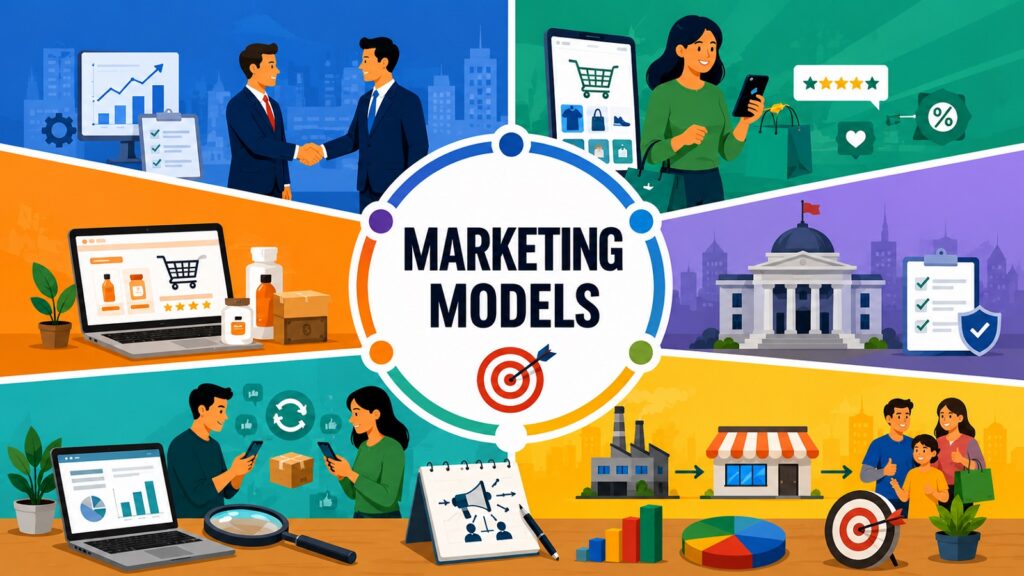
Every business has a structure. That structure shapes how it talks to its buyers. It shapes what the brand says, where it says it, and how often. Marketing models help a company match its style of talking to that structure. They are not just theory. They come from the nature of the business itself.
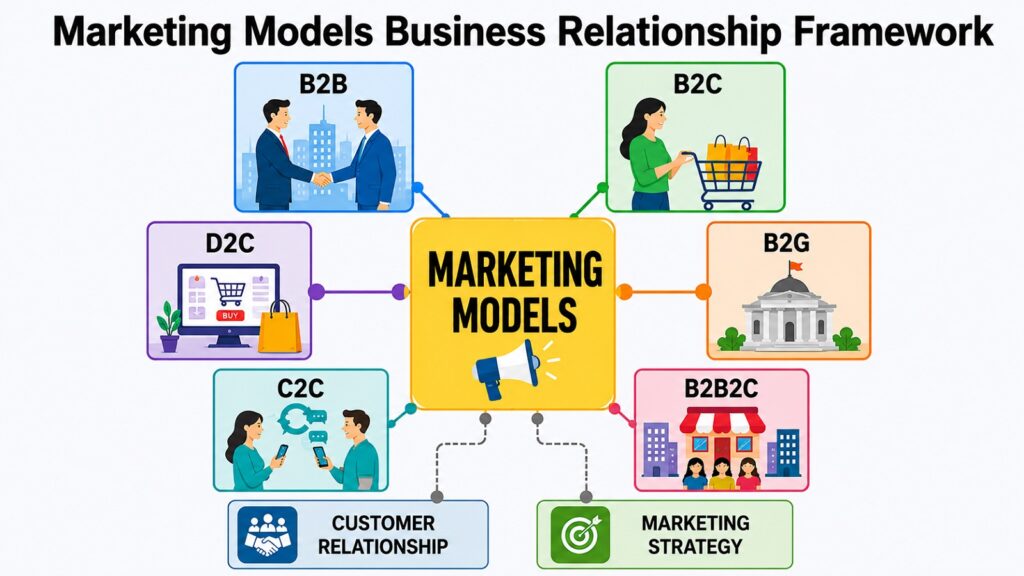
It helps to draw a clear line early. Terms like B2B, B2C, D2C, B2G, C2C, and B2B2C are business models. They describe the path of trade — who sells to whom. Marketing models describe how a business reaches and keeps its buyers within that path. The marketing model follows from the business model, but the two are not the same thing.
This article looks at the marketing work tied to these six business models. It covers how each one finds buyers, what it says to them, which channels it uses, and what kind of value it puts across. The goal is to show what makes marketing different across these six settings and why those gaps matter for the firms that work within them.
Picking the right approach is one of the most important choices a business can make. It shapes how new buyers find the firm. It shapes how the brand looks next to its rivals. It also shapes whether ties with buyers grow stronger over time. A bad fit between structure and approach wastes money and blurs the message. A good fit builds steady, real growth.
Consider a small technology company that provides tools to major banks. Its marketing strategy must cultivate trust over an extended period. It cannot depend on eye-catching advertisements. Instead, it requires case studies, expert content, and direct engagement with the appropriate stakeholders. Now, envision a brand that sells face wash online. Its marketing approach is vibrant, rapid, and personalized. While the fundamental concept of marketing remains the same, the execution is vastly different. This disparity is what marketing models aim to clarify.
The six approaches in this article are B2B, B2C, D2C, B2G, C2C, and B2B2C. Each section covers the core plan, what buyers expect, and which fields rely on that approach most. By the end, the picture of each model should be clear and useful for any business owner, marketer, or student trying to think through where their own work fits.
Marketing Models Overview: Six Approaches and Their Primary Marketing Focus
| Marketing Models | Primary Focus of Marketing Models |
| B2B Marketing | Relationship building, solution selling, account growth |
| B2C Marketing | Brand awareness, emotion, and buyer convenience |
| D2C Marketing | Direct customer ownership, personal touch, loyalty programs |
| B2G Marketing | Credibility, compliance, and long-term contract work |
| C2C Marketing | Platform trust, network growth, and peer community |
| B2B2C Marketing | Channel partners, co-branding, and shared buyer experience |
| Common Thread | Aligning the message and channel to the buyer relationship type |
1. B2B Marketing Models: Building Value Through Business Relationships
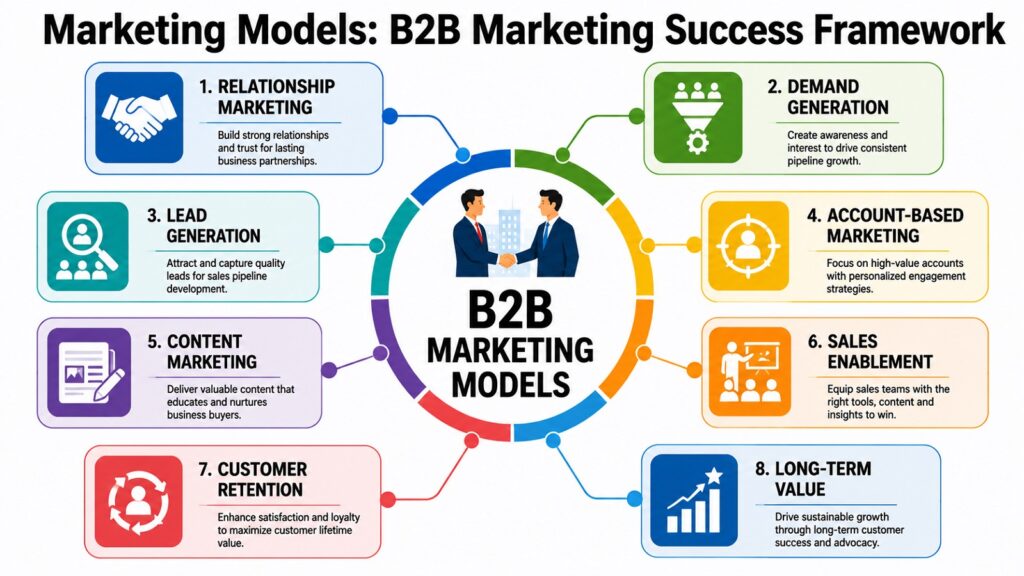
B2B marketing models cater to companies that sell to other businesses. The buyer is not an individual; rather, it is a collective group—often comprising finance, IT, and senior personnel, each with distinct requirements. This reality profoundly influences the way marketing strategies must be developed.
Relationships sit at the core of B2B marketing. A software firm selling tools to large companies does not win deals with a single ad. It builds trust slowly, through useful content and steady presence in the places its buyers look for help. Sales cycles run long — often six months to two years — and marketing must hold buyer attention at every step.
Demand work and lead work drive the engine. Demand work sparks interest among buyers who are not yet looking. Lead work gathers signals from those who are. Both need steady effort across content, email, online ads, and live events. When these two types of work run well together, the pipeline stays full.
Account-based marketing works well for firms chasing a small number of high-value targets. It skips broad messages. Instead, it puts focused effort into named accounts, shaping content and outreach to fit each firm’s exact needs. A company selling to twenty large banks does not need to reach a million people. It needs to reach the right people at those twenty firms.
Content and expert ideas build trust over time. A consulting firm earns its place by sharing research, case studies, and fresh views. A shipping firm wins trust by helping buyers see their supply chain gaps before any sales talk begins. Give value first. Ask for the sale later. That pattern holds across every B2B field.
Sales support links marketing with the sales team. It means giving reps the right tools, data, and content to hold real talks with buyers. In software, making, and expert services, close ties between sales and marketing are not a bonus. They are the engine. Without them, good leads go cold and good content goes unseen.
The key shift B2B marketing has made in the last decade is toward buyer education. Buyers now do much of their own research before ever speaking to a sales rep. Marketing that answers buyer questions early — through blogs, guides, webinars, and tools — wins by being helpful long before a deal is on the table.
Marketing Models in B2B: Key Characteristics and Marketing Practices
| Key Characteristics of B2B Marketing Models | B2B Marketing Practice |
| Primary audience | Buying teams, procurement staff, and senior decision-makers |
| Core marketing goal | Build trust, show expertise, and support long sales cycles |
| Key channels | Content, email, LinkedIn, trade shows, and webinars |
| Lead generation | Account-based marketing, inbound content, sales support |
| Messaging focus | ROI, risk control, real skill, and long-term value |
| Customer bond type | Long-term accounts with high value over time |
| Typical sales cycle | Months to years, with many stakeholder steps |
| Content role | Educates buyers before and during the sales process |
2. B2C Marketing Models: Winning Customers Through Consumer-Centric Marketing
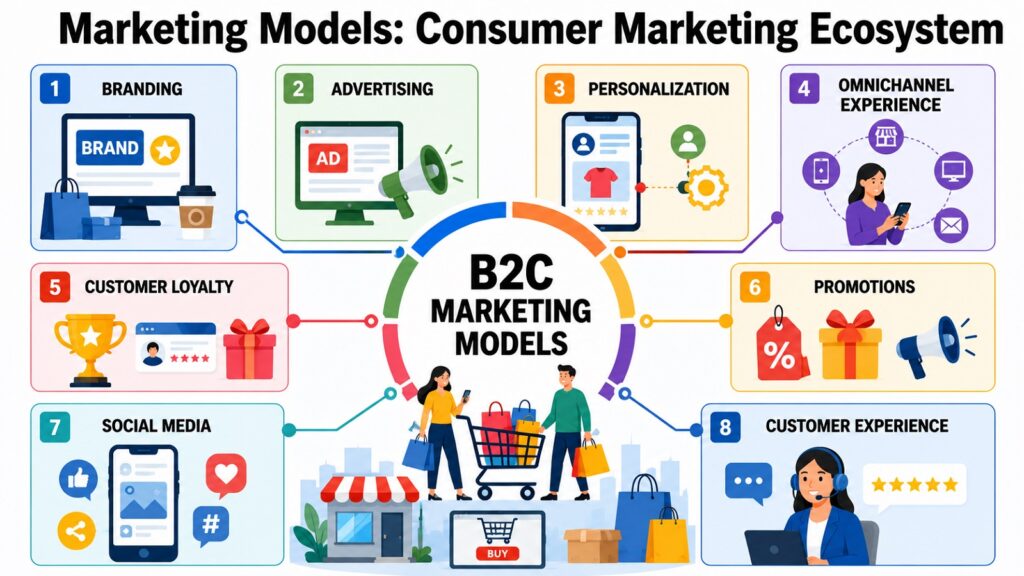
B2C marketing models reach people buying for themselves. The scale here is vast. One brand may reach millions of buyers across many channels in a single day. That scale calls for marketing that is clear, fast, and easy to track.
Brand and feeling form the base of strong B2C marketing. A clothing brand does not just show its goods. It shares a feeling, a way of life, an idea of who the buyer could be. People often choose brands based on how they feel, not just on price or features. The best consumer brands know this well. They invest in those bonds over many years and many campaigns.
Buying cycles are short in B2C markets. A person picking a new pair of shoes may go from first sight to checkout in a few hours. That speed means digital channels matter most — search ads, social posts, and emails that reach the buyer at the exact moment they are ready to act. Every extra step in the buying path is a chance to lose the sale.
Reaching buyers on all fronts is now a must. People want the same feel whether they shop on an app, walk into a store, or call support. Retailers and travel brands have put in real work to link these touch points so the brand feels the same wherever the buyer shows up. A gap in that experience can break the trust a brand has spent years building.
Personal touches drive results. Online shops use past purchases and browsing habits to suggest new items. Streaming services learn what a viewer likes. Travel brands offer deals based on past trips. These small moments of recognition lift sales rates and make buyers feel understood rather than just sold to.
Promotions and loyalty plans keep the engine running. A grocery chain with a loyalty card gathers useful data while drawing shoppers back. A film studio pushes hard around a big launch to fill seats fast. Short-term offers and long-term brand work must run side by side to keep B2C growth on track. Neither alone is enough.
Social proof has also become a key tool in B2C. Reviews, ratings, and user posts now shape buying choices more than most paid ads do. Brands that make it easy for happy buyers to share their stories — through review systems, social tags, and referral plans — gain a real edge over those that rely only on their own voice.
Marketing Models in B2C: Consumer Engagement Strategies and Key Practices
| Key Characteristics of B2C Marketing Models | B2C Marketing Practice |
| Primary audience | People making personal buying choices |
| Core marketing goal | Drive awareness, preference, purchase, and return visits |
| Key channels | Social media, search, TV, display ads, and email |
| Lead generation | Mass ads, offers, and social proof campaigns |
| Messaging focus | Feeling, ease, lifestyle, price, and brand identity |
| Customer bond type | High volume, short cycle, and repeat buying |
| Typical sales cycle | Hours to days, shaped by feeling and brand trust |
| Key success metric | Brand recall, conversion rate, and repeat purchase rate |
3. D2C Marketing Models: Creating Direct Customer Connections
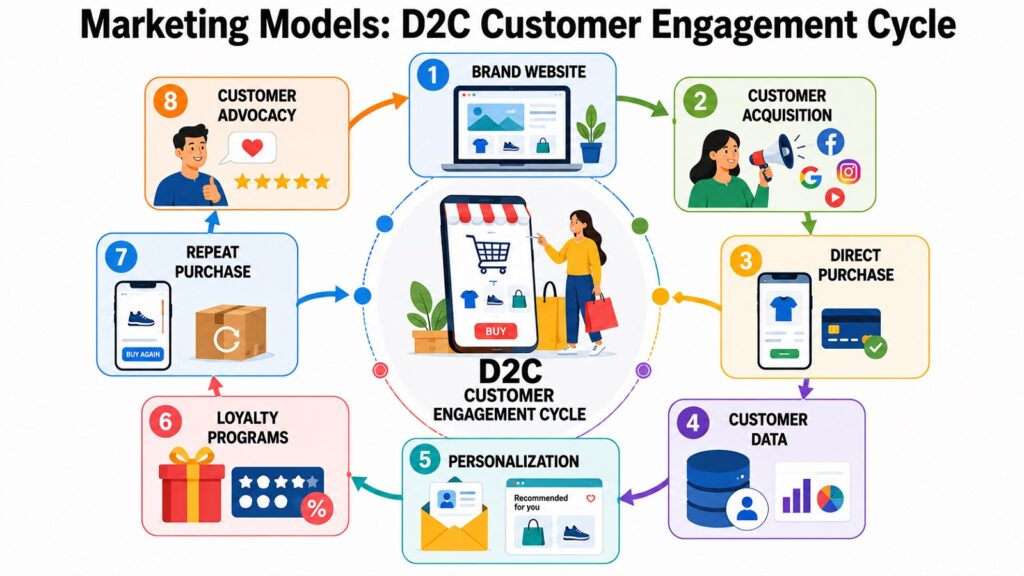
D2C marketing models let brands reach buyers without going through stores or third-party sellers. Rather than using supermarkets or retail chains to carry and push their goods, D2C brands build their own channels — mostly digital — and own every part of the buyer journey from first click to repeat order.
The biggest edge in D2C is owning the buyer data. When a brand sells through a retailer, it rarely knows who buys, how often, or what else that buyer picks. When it sells direct, it knows all of this. That data feeds sharper targeting, more useful products, and smarter use of the ad budget.
Personal messages are central to D2C. A skincare brand on its own site can group buyers by skin type, order history, and email open rates. It can then send each group content that fits their exact needs. That kind of fit is very hard to reach through any retail go-between. The data that makes it possible simply does not flow back to the brand when a retailer sits in the middle.
Subscription plans and loyalty programs are common growth tools in D2C. A coffee brand shipping direct can offer a monthly plan that locks in steady income while deepening the tie with each buyer. A clothing brand can give members early access to new items, building a habit of buying direct rather than from a store. Over time, these plans raise buyer lifetime value in a real way.
Working with social voices and selling through social apps have become key ways to find new buyers. A wellness brand that works with trusted voices online can reach fresh groups without big ad spend. It also borrows the trust those voices have built with their fans. Many social apps now let users buy right from a post, cutting steps from finding to buying.
Brands like Warby Parker, Casper, and Allbirds grew early by going direct. By owning their channels, they told a clean brand story, got direct buyer feedback, and changed course fast. D2C takes more work than selling through stores, but the control it gives over the buyer bond is usually worth that extra effort.
Marketing Models in D2C: Direct Engagement Practices and Retention Strategies
| Key Characteristics of D2C Marketing Models | D2C Marketing Practice |
| Primary audience | End buyers buying direct from the brand |
| Core marketing goal | Own the buyer bond and grow long-term value |
| Key channels | Brand site, email, social media, and partner voices |
| Lead generation | Paid social, search, content, and referral plans |
| Messaging focus | Brand story, product quality, personal fit, and community |
| Customer bond type | Direct, data-rich, and loyalty-driven |
| Typical sales cycle | Short, extended by subscription and repeat orders |
| Key advantage | Full ownership of buyer data and the customer experience |
4. B2G Marketing Models: Marketing Solutions for Government Organizations
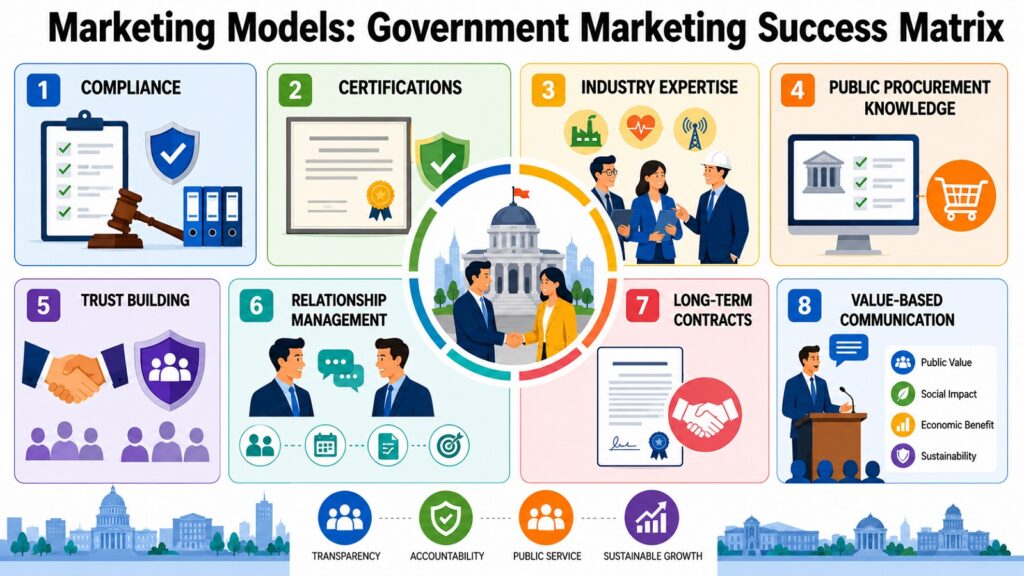
B2G marketing models cater to companies that provide goods and services to government entities and public-sector organizations. This environment is distinct from consumer markets or traditional B2B sectors. Government purchasers operate under stringent regulations, budgetary constraints, and oversight that influence every aspect of their procurement process. Consequently, marketing in this domain must prioritize demonstrating trustworthiness, expertise, and adherence to regulations above all other considerations.
Trust and proven skill are the main tools in B2G marketing. A tech firm going after a government software deal must show not just that its product works, but that the firm behind it has the right track record, the right papers, and the right systems to deliver on a contract. Case studies, past client lists, and audit trails all support that case well before any bid is filed.
Expert ideas and thought leadership matter in B2G. Defense firms, road builders, and health tech firms publish white papers, attend government meetings, and take part in policy talks. These steps do not bring fast returns. But they place the firm in the mind of public buyers as a group that knows the field and can handle public funds with care.
Long sales cycles are the norm. A firm going after a city water system contract may spend years in talks, answering data requests, and sitting through reviews. Marketing must keep the firm in view and seen as the right choice over that whole time, without looking pushy. The B2G buyer is not rushed. Marketing that respects that tends to hold more weight.
Proof of rule-following is more front and center in B2G marketing than in most other models. IT firms, building groups, and consultants must show they meet set standards — security papers, quality systems, green-building rules. Making these facts clear in marketing content removes a key worry for government buyers who are held to account for every vendor they choose.
Marketing Models in B2G: Strategic Characteristics of Government-Focused Marketing
| Key Characteristics of B2G Marketing Models | B2G Marketing Practice |
| Primary audience | Government buyers, agency heads, and public-sector teams |
| Core marketing goal | Build trust, show rule-following, and win long-term contracts |
| Key channels | White papers, conferences, government sites, direct talks |
| Lead generation | Relationship work, request responses, and tender bids |
| Messaging focus | Skill, certifications, past work, and risk control |
| Customer bond type | Long contracts with high scrutiny and public accountability |
| Typical sales cycle | Multi-year, with deep checks and rule reviews |
| Key differentiator | Proven compliance record and documented past performance |
5. C2C Marketing Models: Enabling Consumer-to-Consumer Marketplaces
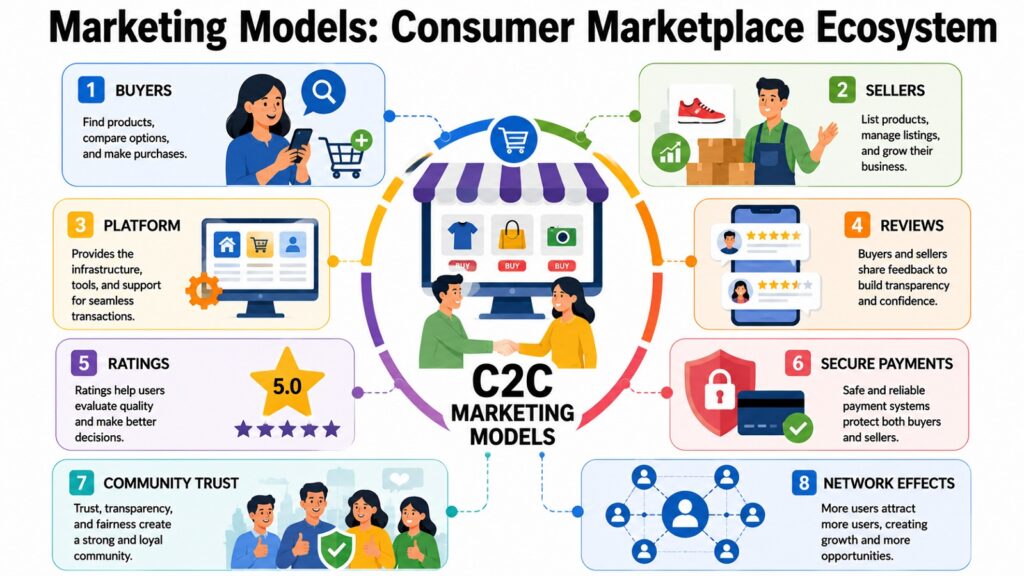
C2C marketing models connect individual buyers and sellers. The platform facilitating these transactions does not act as the seller. Instead, it creates the environment, provides safety features, and conveys the message that unites strangers. The marketing challenge is distinct from others: the platform must attract two groups simultaneously and ensure the satisfaction of both.
Trust is the base of C2C platform marketing. A space where one person sells to another only works if both feel safe doing it. Ratings, reviews, user badges, and check systems are not just features. They are marketing signals. They tell new users the platform can be counted on. Sites like eBay, Airbnb, and Etsy have spent years making these signals easy to see and hard to fake.
User-made content does double duty. It gives real proof that draws new users in. It also fills the platform with listings, reviews, and talk that make it feel alive. A platform with active users creates much of its own marketing through normal use. The users build the platform’s voice for it, post by post and review by review.
Referral plans and network effects keep the cost of growth low. When a happy buyer brings in a friend, or a good seller tells others about the platform, the user base grows without big ad spend. Network effects add a second benefit: the more people join, the more useful the platform gets for everyone on it. Growth feeds more growth in a loop.
Platform brand building becomes more vital as these markets grow up. Early platforms fought on features. Now they compete on name, feel, and what they stand for. Marketing means owning a clear idea — value, craft, trust, or planet care — and drawing in users who share it. Competing only on price or volume is a race that most platforms will eventually lose.
Marketing Models in C2C: Platform Marketing Practices and Community Engagement
| Key Characteristics of C2C Marketing Models | C2C Marketing Practice |
| Primary audience | Buyers and sellers as two linked but distinct user groups |
| Core marketing goal | Build trust, grow the user base, and lift trade volume |
| Key channels | Platform interface, email, social media, and referral tools |
| Lead generation | Network effects, referrals, and user-made content |
| Messaging focus | Safety, ease of use, peer trust, and community health |
| Customer bond type | Community-based, driven by peer standing and platform feel |
| Typical sales cycle | Short peer trades enabled by platform tools |
| Key growth driver | Network effects that raise platform value as the user base grows |
6. B2B2C Marketing Models: Combining Business Partnerships with Consumer Reach
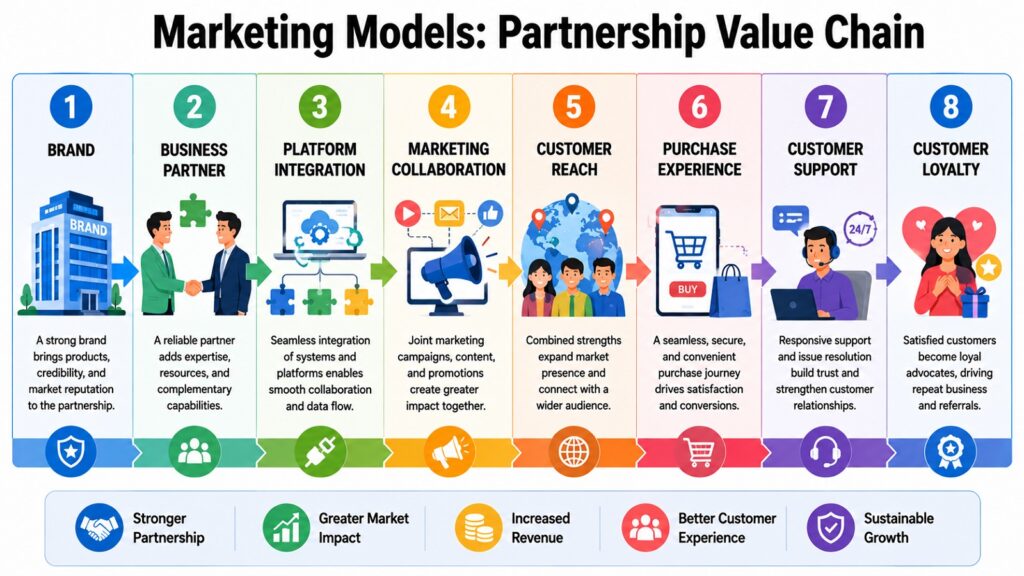
B2B2C marketing models link one firm to end buyers through the channel of another firm. The first firm builds a product or service. The second firm owns the channel, the app, or the shelf that gets the product in front of buyers. Both sides gain from the deal, but the marketing needed to run this well is more complex than standard B2B or B2C work.
Partner marketing sits at the heart of B2B2C work. A food app that lists local restaurants does more than move meals. It markets those restaurants to people who may never have found them on their own. The restaurant gets more reach. The app gets more variety. The buyer gets more ease. Good marketing must serve all three at once, or the model starts to break down.
Channel work and shared branding are key B2B2C tools. A financial firm selling insurance through a bank must stay clear in the buyer’s mind even when the bank holds the main bond. Shared campaigns, clear brand rules, and agreed messages help keep the brand in view without confusing the buyer. Both sides must agree on where each brand begins and ends.
Digital platforms have spread B2B2C models across far more fields than before. Apple’s App Store and Google Play are B2B2C setups where app makers reach buyers through a store they do not own. Travel sites pull in hotels and flights for buyers to look at and book. In every case, the marketing job is to stay distinct in a shared space packed with rivals.
Buyer experience is hard to manage in B2B2C setups. When something goes wrong, the buyer may not know if the fault lies with the product, the delivery partner, or the platform. B2B2C marketing must set clear service rules, write them into partner deals, and make recovery steps fast and easy to find across all touch points. When this is done well, the buyer trusts the brand even when things go wrong.
Food delivery, travel, finance, and software firms have all shown that B2B2C models can grow at speed. The cost of keeping a brand strong across partner networks is real. But access to the partner’s existing buyer base can lift growth in ways that going it alone rarely matches. The key is building the right partner deals from the start and investing in joint marketing from day one.
Marketing Models in B2B2C: Partnership Marketing Characteristics and Strategic Practices
| Key Characteristics of B2B2C Marketing Models | B2B2C Marketing Practice |
| Primary audience | End buyers reached through a business partner’s channel |
| Core marketing goal | Keep the brand clear and the buyer experience consistent |
| Key channels | Partner platforms, co-branded campaigns, and digital ecosystems |
| Lead generation | Channel marketing, platform listing, and shared ad efforts |
| Messaging focus | Shared value, steady experience, and brand trust |
| Customer bond type | Mediated by a partner but shaped by the brand’s own name |
| Typical sales cycle | Short for digital, longer for financial services |
| Key challenge | Keeping brand identity clear within a shared partner channel |
Conclusion: Bringing Marketing Models Together for Sustainable Business Growth
Marketing models do not stand alone. They are shaped by the kind of business a company runs. A firm selling raw steel to factories faces a very different marketing job than one selling coffee pods direct to homes. Treating both jobs the same leads to wasted spend, weak messages, and lost ground to rivals who think more carefully.
The six models in this article — B2B, B2C, D2C, B2G, C2C, and B2B2C — each begin as business models. They describe which way trade flows. What this article has aimed to show is that each one also carries its own marketing logic — its own way of talking to buyers, its own channels, and its own sense of what value looks like to the people it serves.
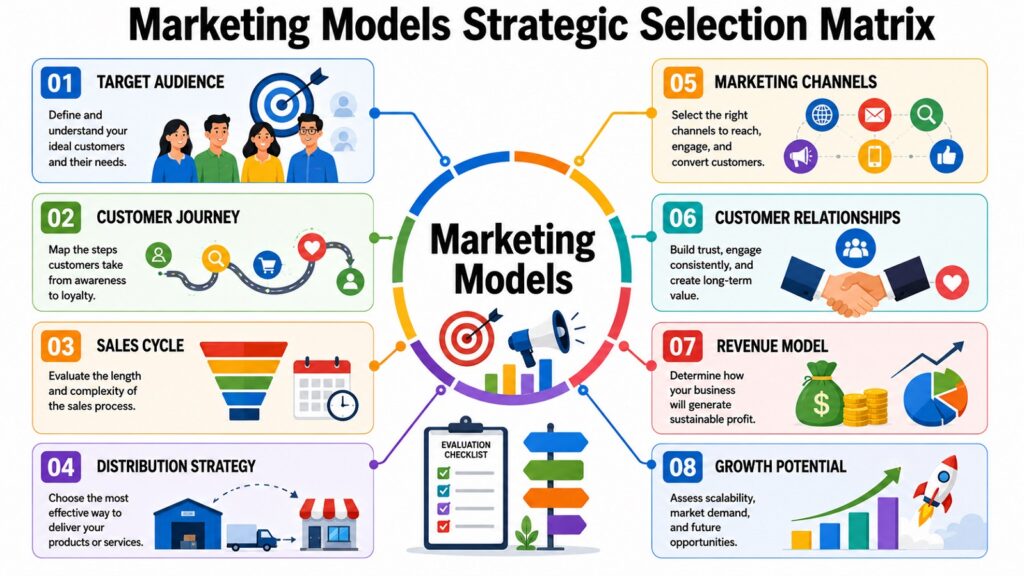
Choosing the right model takes honest thought. What does the business want to reach? Who is the buyer, and how do they decide what to buy? What does the market look like? Which channels are open? What will drive growth over the long haul? These questions do not have one fixed answer, but they point toward the model that fits best for each case.
Many businesses run more than one model at the same time. A software firm might sell to big companies through B2B, offer a consumer app through B2C, and put its tools in partner stores through B2B2C. Keeping the marketing clear and steady across all three is one of the harder jobs in modern business, but it is very much possible with the right setup and the right team.
The best way to think about marketing models is as thinking tools, not fixed rules. They show the logic of how to reach buyers in different settings. They help businesses make clear choices about what to spend, what to say, and where to show up. Firms that use them this way — as guides rather than boxes to check — tend to build sharper, more flexible marketing that creates real value over time.
Marketing Models Summary: Strategic Strengths and Primary Focus of Each Approach
| Marketing Models | Primary Strategic Strength of Marketing Models |
| B2B Marketing | Builds long-term value through trust, skill, and account relationships |
| B2C Marketing | Drives volume through brand strength, feeling, and broad reach |
| D2C Marketing | Maximizes buyer ownership, data control, and direct brand bonds |
| B2G Marketing | Wins contracts through credibility, rule-following, and steady presence |
| C2C Marketing | Scales through network effects, peer trust, and community strength |
| B2B2C Marketing | Expands reach through partner channels and shared brand work |
| Common Thread | Matching marketing to the structure of the buyer relationship |
| Shared risk | Misaligned marketing wastes budget and weakens brand position |