Table of Contents
Introduction: Music Streaming and the Transformation of Digital Entertainment
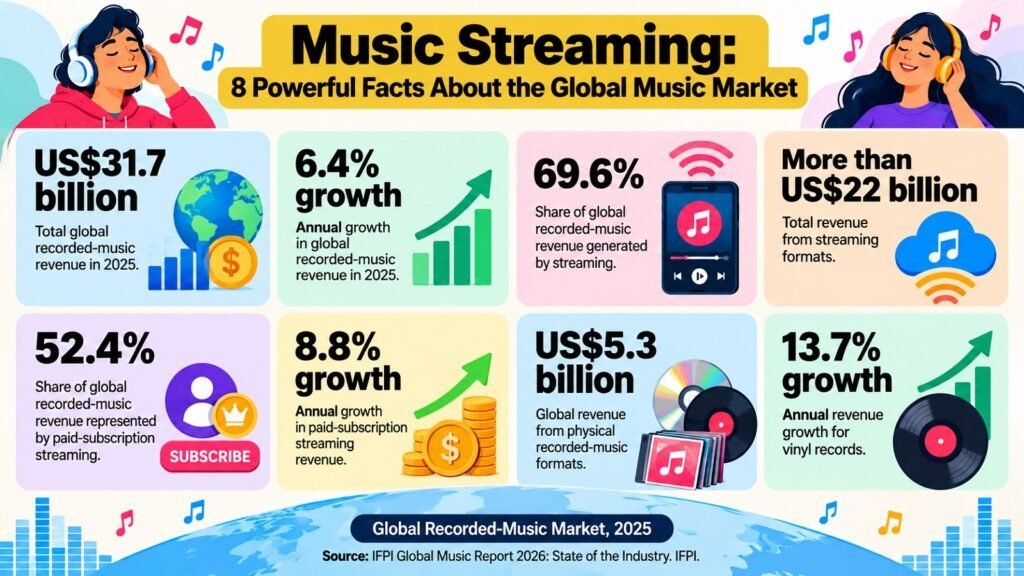
Music Streaming, the network delivery of recorded music for on-demand playback without permanent transfer of a file to the listener, has become one of the most consequential aspects of Digital Entertainment. Ubiquitous connectivity, smartphones, cloud infrastructure, and platform business models have converted music from a purchased object into a continuously available service, while rising expectations of immediacy and personalization have changed how listeners find and judge recordings. According to the International Federation of the Phonographic Industry (IFPI, 2026), streaming generated more than 22 billion US dollars, or 69.6 percent of global recorded-music revenue, in 2025.
The term needs careful boundaries, because Music Streaming differs from physical ownership, which transfers a durable artifact; from digital downloads, which transfer a file; and from broader audio streaming, which also covers podcasts, audiobooks, and radio simulcasts governed by different conventions. This article concentrates on recorded music and treats those neighbors only as points of contrast. Keeping these categories apart prevents conclusions about one from being quietly extended to the others.
Treating Music Streaming merely as technology would miss most of what matters. It operates at once as an economic system of licensing and revenue allocation, a legal system of copyright and territorial rights, a cultural system of curation and taste formation, and a behavioral system of habits and expectations. The sections below draw on multisided-market theory, recommender-systems research, psychoacoustics, intellectual-property analysis, and media studies. Each separates established knowledge, current industry conditions, analytical interpretation, and informed speculation, and each proposes a framework that graduate and doctoral researchers can adapt. Durable concepts take precedence over platform features, which change faster than the scholarship describing them. The table below previews the eight aspects.
Table 1: Overview of the Eight Aspects of Music Streaming
| Aspect of Music Streaming | Central Focus |
| 1. Consumption evolution | Shift from ownership to licensed access |
| 2. Platforms and catalogs | Intermediation, licensing, metadata, and availability |
| 3. Music discovery | Search, curation, and recommender systems |
| 4. Technology and playback quality | Codecs, delivery networks, and perceived audio quality |
| 5. Business models and royalties | Revenue sources, rights, and payment flows |
| 6. Artist distribution | Release strategies and independent distribution |
| 7. Listener behavior | Listening habits, autonomy, and research methods |
| 8. Future developments | Artificial intelligence, regulation, and uncertainty |
1. Music Streaming and the Evolution of Digital Music Consumption
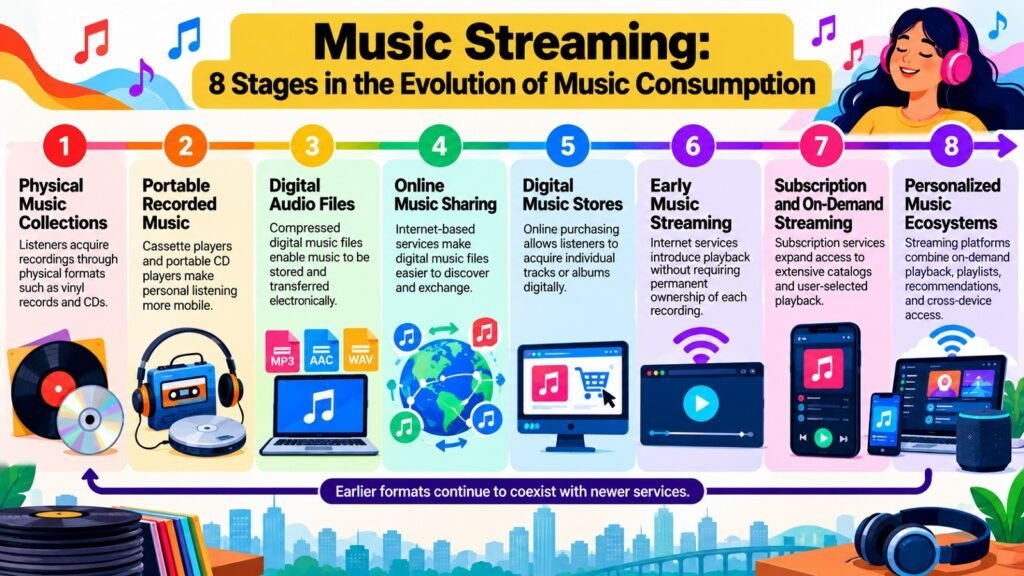
Music consumption has moved through distinct access regimes rather than along a single line of progress. Vinyl records, cassettes, and compact discs sold recordings as owned objects, while broadcast radio offered free but scheduled exposure controlled by programmers. Digital downloads, popularized by the iTunes Store from 2003, preserved ownership of a file yet removed the physical carrier. Subscription and advertising-supported Music Streaming then replaced possession with conditional access to a very large catalog, altering portability, convenience, and the listener’s relationship with recorded music. Each transition also reorganized who held power, since labels, retailers, broadcasters, and later platform operators in turn controlled the point of contact between recording and listener.
Ownership, temporary access, and licensed use carry different consequences. A purchased record can be resold, lent, and kept indefinitely, whereas a streaming library persists only while a subscription, a platform’s licences, and regional rights remain in force. Consumers gain breadth and lose durability; rights holders gain recurring revenue and lose the one-off sale. Technology-acceptance research (Davis, 1989) and diffusion theory (Rogers, 2003) explain adoption through perceived usefulness and ease of use, while media economics adds the near-zero marginal cost of serving an existing catalog. IFPI (2026) reports 837 million paid subscription accounts worldwide in 2025, yet adoption varies with income, infrastructure, and regional markets, which cautions against reading the trend as inevitable.
The Digital Music Consumption Transition Framework compares models along five dimensions: accessibility, cost structure, user control, portability, and ownership. Rating each model exposes trade-offs, such as streaming maximizing accessibility while minimizing ownership. Its limits are real, since listeners weight dimensions differently and ratings remain interpretive. Applied to radio, downloads, and subscription streaming, for example, it shows that each model improved one dimension at the expense of another, which is more informative than a ranking of progress.
Table 2: Music Streaming Compared with Earlier Music Consumption Models
| Comparison Dimension | Historical or Practical Significance |
| Physical formats | Durable ownership, limited portability and catalog size |
| Broadcast radio | Free exposure, but programmer-controlled schedules |
| Digital downloads | File ownership without a physical carrier |
| Subscription streaming | Licensed catalog access for a recurring fee |
| Advertising-supported streaming | Free access funded by advertising, with listening constraints |
| Catalog availability | Moved from shelf space to licensed digital libraries |
| Portability | Moved from carried media to connected devices |
| Ownership | Replaced by conditional access tied to licences |
2. Music Streaming Platforms and Digital Music Catalogs
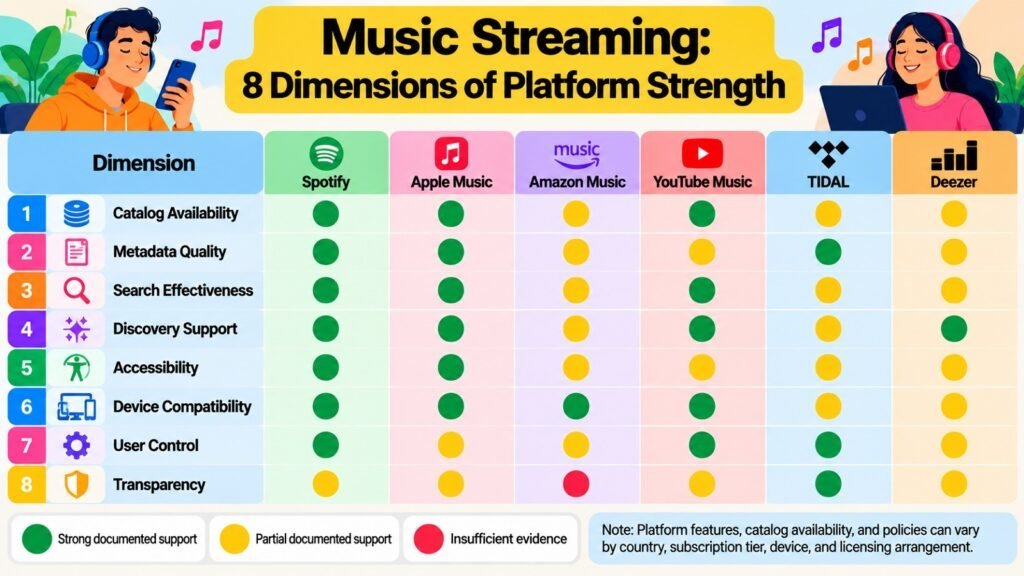
Platforms act as intermediaries linking listeners, catalogs, rights holders, distributors, and commercial partners. Their usefulness depends on catalog acquisition through licensing, the quality of metadata identifying recordings and contributors, search functionality, regional availability, playlist organization, and interface design. Platform policies on content eligibility and fraud further govern what listeners can reach. Because these elements interact, a weakness in one, such as incomplete credits, can undermine the others, including search quality and the accurate routing of royalties.
Competition among platforms is well described by multisided-market theory (Rochet and Tirole, 2003), in which a platform must attract several groups whose participation is interdependent. Direct network effects are arguably modest in music, since listeners gain little from one another’s presence, but accumulated playlists, personalization, and social features create switching costs. Services differentiate through catalog, pricing, editorial identity, and quality tiers, so they do not compete under identical conditions.
Territorial licensing means catalogs differ by country, and a large catalog does not secure effective discovery, because abundance moves the problem from access to selection. Exclusive arrangements, regional launches, and delistings can alter a catalog within a single year, which is why comparisons across platforms are valid only for a stated date and country.
The Music Streaming Platform Evaluation Framework compares services on catalog breadth, metadata accuracy, accessibility, search effectiveness, interoperability, transparency, and user control. Researchers can operationalize each criterion through audits, for instance by testing availability and credit accuracy for a fixed sample of recordings across territories. Evidence should distinguish independently verified findings from platform self-reporting, such as the market analysis of the UK Competition and Markets Authority (2022), and results require dating because licences and features change. Transparency and user control deserve particular attention, since they are rarely visible in marketing material yet strongly influence how far listeners can understand and direct a service.
Table 3: Music Streaming Platform and Catalog Characteristics
| Platform or Catalog Characteristic | Implication for Listeners, Researchers, or Industry |
| Catalog licensing | Determines which recordings exist on each service |
| Territorial rights | Produces country-level differences in availability |
| Metadata quality | Affects search, credits, and royalty attribution |
| Search functionality | Shapes how effectively known items are located |
| Playlist organization | Structures listening and exposure for artists |
| Accessibility features | Determine usability for listeners with disabilities |
| Interoperability | Governs device support and library portability |
| Platform policies | Control content eligibility and fraud enforcement |
3. Music Streaming and Intelligent Music Discovery
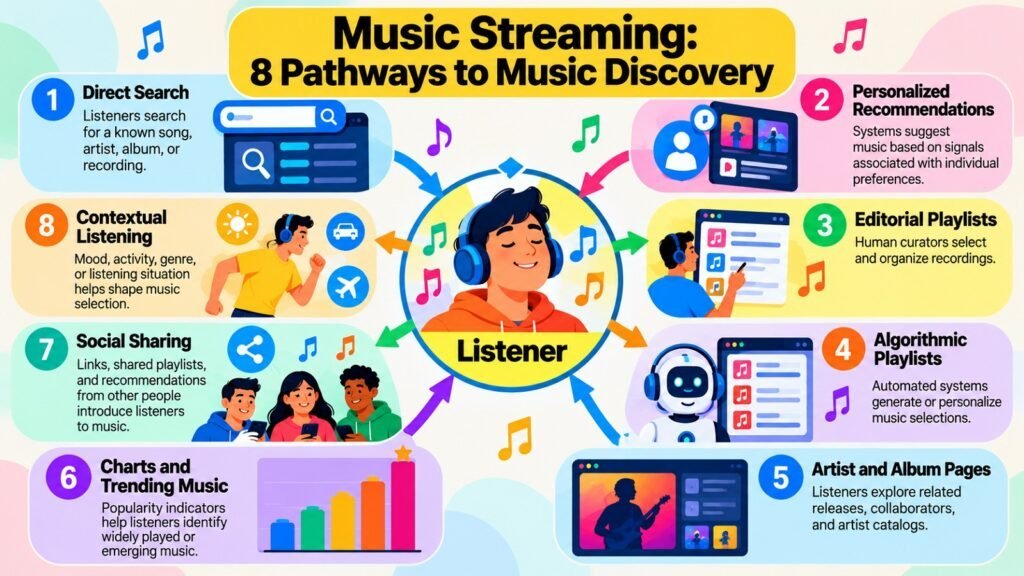
Listeners find music through search, charts, editorial playlists, algorithmic recommendations, social sharing, listening history, and contextual suggestions. Beneath these lie information-retrieval techniques and recommender systems. Collaborative filtering infers preferences from similar users, content-based methods compare audio or metadata features, and hybrid approaches combine both to offset weaknesses such as the cold-start problem for new users and new tracks (Schedl et al., 2018). Charts and social sharing contribute a collective dimension, whereas listening history and context supply individual signals, so the same recording may surface through very different routes for different people.
Evaluation is complicated by tensions between personalization and exploration, convenience and control, relevance and diversity, and popular items and lesser-known artists. Evidence is mixed, as Datta, Knox, and Bronnenberg (2018) found that adopting streaming broadened listening, while Anderson et al. (2020) reported that diverse consumption on Spotify correlated with later engagement, although correlation does not show that recommendations caused it. Claims that algorithms homogenize culture remain hypotheses until tested longitudinally, and diversity itself is hard to measure because genre categories are contested. Because platforms rarely publish their ranking logic, independent researchers often depend on partial data, donated listening histories, or simulated users, each of which limits how far findings extend.
The Music Discovery Evaluation Matrix assesses relevance, diversity, novelty, serendipity, transparency, and user control (Kaminskas and Bridge, 2016). Relevance can be measured offline through ranking accuracy, diversity through dissimilarity within recommendation lists, novelty through item popularity, and serendipity or satisfaction through surveys and field experiments. No single metric suffices, since offline accuracy can diverge from real listener satisfaction (McNee et al., 2006), and long-term discovery outcomes require longitudinal data. Combining several measures in a profile, rather than a composite score, preserves the trade-offs among dimensions and lets different stakeholders weight them according to their own objectives.
Table 4: Music Streaming Discovery Mechanisms and Evaluation Considerations
| Mechanism or Evaluation Criterias of Music Streaming | Significance for Discovery Research |
| Collaborative filtering | Infers taste from similar users’ behavior |
| Content-based filtering | Matches audio or metadata features, aiding new releases |
| Hybrid recommendation | Combines methods to offset cold-start weaknesses |
| Editorial curation | Human selection that shapes artist exposure |
| Offline accuracy metrics | Convenient but weak predictors of satisfaction |
| Diversity and novelty | Capture breadth but rely on contested definitions |
| Serendipity | Requires user studies, as it blends surprise and value |
| Transparency and control | Affect trust and autonomy in personalization |
4. Music Streaming Technology and Playback Quality
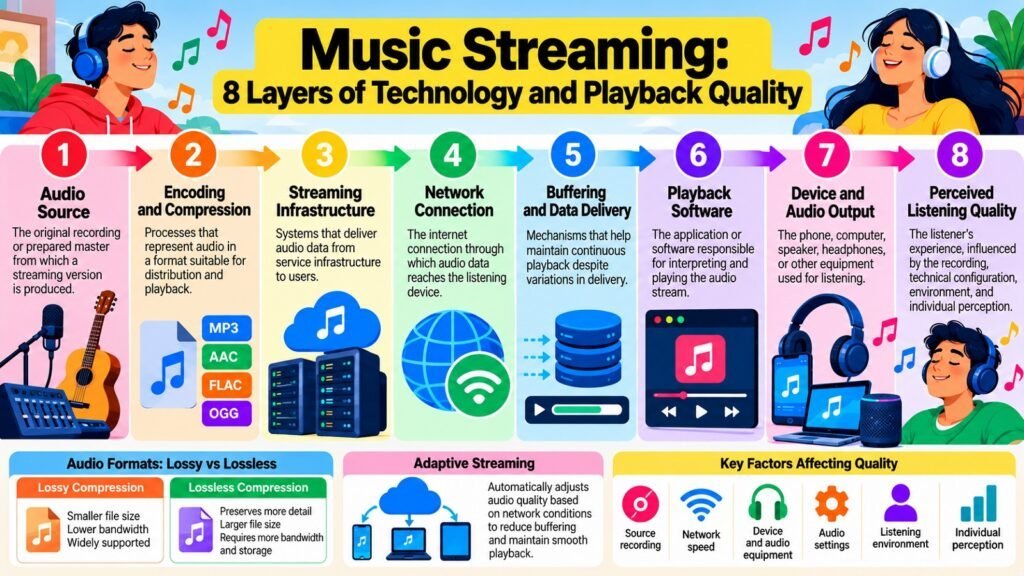
Reliable playback rests on a chain of technologies. Audio is encoded with codecs such as MP3, AAC, Ogg Vorbis, Opus, or FLAC; delivered through content delivery networks that place copies near listeners; and adapted to network conditions by protocols such as HTTP Live Streaming and MPEG-DASH, with buffering absorbing brief interruptions. Device compatibility and playback software determine which formats are actually reachable. These factors govern delivery reliability and differ from the perceptual factors shaping how quality is experienced. Latency matters less for pre-recorded music than for live or interactive audio, which is one reason aggressive buffering is a practical strategy in this context.
Lossy codecs discard information judged perceptually less significant, exploiting auditory masking to shrink files, whereas lossless codecs such as FLAC permit exact reconstruction of the original signal. Whether listeners hear the difference depends on source material, bitrate, equipment, environment, and individual hearing, and controlled studies of compressed music, such as Pras et al. (2009), show sensitivity varying by genre and listener experience.
Higher quality also raises file size, data consumption, and energy use, while lower bitrates reduce buffering risk on constrained networks, so no configuration is best everywhere. Marketing labels are not evidence of audible superiority. Differences also shrink further when playback occurs through small speakers or in noisy settings, which suggests that claims about fidelity should always specify the listening conditions under which they were tested.
The Playback Quality Assessment Framework compares experiences on audio fidelity, reliability, data consumption, accessibility, device support, and user control. Controlled listening tests following ITU-R Recommendation BS.1534 establish audible differences, objective measurements document technical properties, and field studies capture real conditions; the three methods complement rather than replace one another. Reporting measurement conditions, including device, codec settings, network state, and participant characteristics, is essential if results are to be compared or reproduced.
Table 5: Music Streaming Playback Quality Factors
| Technical or Perceptual Factors of Music Streaming Playback | Practical or Research Significance |
| Audio codec | Sets the compression method and reconstruction fidelity |
| Bitrate | Trades file size and data use against detail |
| Lossless versus lossy coding | Differs in reconstruction, not always in audibility |
| Adaptive bitrate delivery | Adjusts quality to fluctuating network capacity |
| Content delivery network | Reduces latency by serving copies near listeners |
| Buffering | Protects continuity at the cost of startup delay |
| Playback equipment | Limits whether quality differences are audible |
| Listener hearing and context | Moderate perceived quality across individuals |
5. Music Streaming Business Models, Licensing, and Royalties
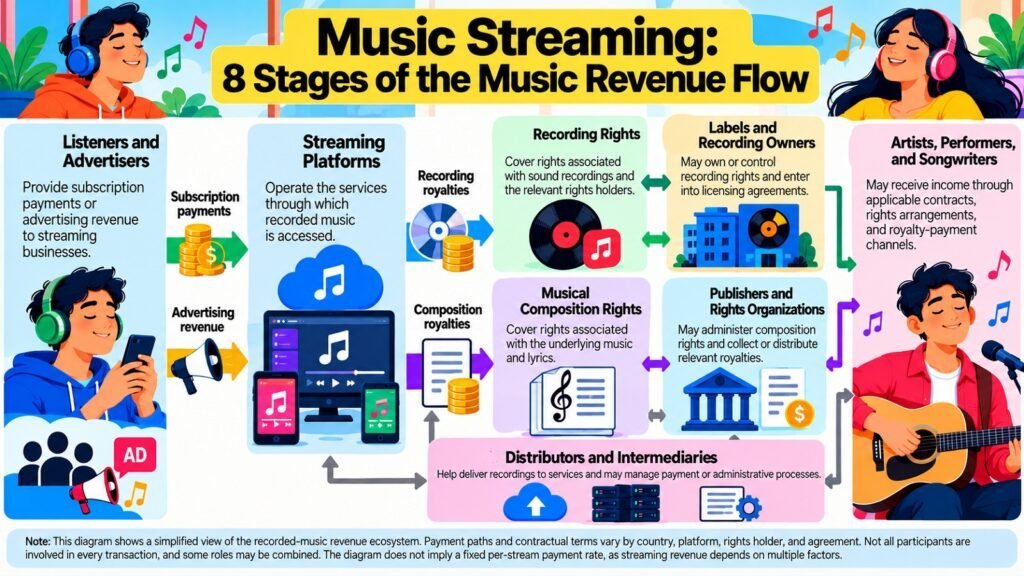
Revenue in Music Streaming comes from subscriptions, advertising-supported access, family and student plans, and bundles with other products. Money paid by listeners and advertisers reaches creators through layered rights. A recording involves a sound-recording copyright, usually controlled by a label or distributor, and a musical-work copyright, controlled by songwriters and publishers, each with distinct licences and collecting organizations. Platform revenue, the amount allocated to rights holders, and the income finally reaching an artist are three different quantities, separated by contractual splits, recoupment, and intermediary fees, a distinction that matters for any analysis of fairness. Bundled offers complicate attribution further, because revenue from a combined subscription must be apportioned between the music component and other services.
No universal per-stream rate exists, because allocation depends on contracts, subscription and advertising revenue, territory, usage, rights ownership, and the payment model. Many services divide revenue pro rata by share of total streams, whereas user-centric proposals assign each subscriber’s payment to the artists that person actually played; each redistributes income differently, so claims about fairness require evidence rather than assertion. IFPI (2026) supplies verified global totals, and bodies such as the US Copyright Royalty Board set statutory rates for certain uses, but most company contracts remain confidential. Collecting organizations and distributors add further layers, which explains why two artists with identical stream counts can receive different payments.
The Music Streaming Revenue Flow Analysis Framework traces money from listeners and advertisers through platforms, distributors, labels, publishers, collecting organizations, and rights holders. It surfaces distributional questions at each node, yet public data rarely suffice to compute an individual artist’s income. Verified financial data, estimates, contractual assumptions, and advocacy claims must therefore be labelled separately. Mapping each node also clarifies where transparency is weakest, which is typically where private contracts, advances, and unrecouped balances obscure the final split.
Table 6: Music Streaming Business and Royalty Components
| Business or Royalty Components of Music Streaming | Economic or Legal Role |
| Subscription revenue | Recurring listener payments; the largest share of recorded-music income |
| Advertising-supported tier | Funds free access through advertising revenue |
| Sound-recording copyright | Controlled by labels or distributors; licensed to platforms |
| Musical-work copyright | Held by songwriters and publishers; licensed separately |
| Distributors and labels | Intermediaries passing revenue onward under contract |
| Collecting organizations | Administer licences and distribute royalties to members |
| Pro-rata allocation | Divides the revenue pool by share of total streams |
| User-centric allocation | Directs each subscriber’s payment to artists played |
6. Music Streaming and Artist Distribution Strategies
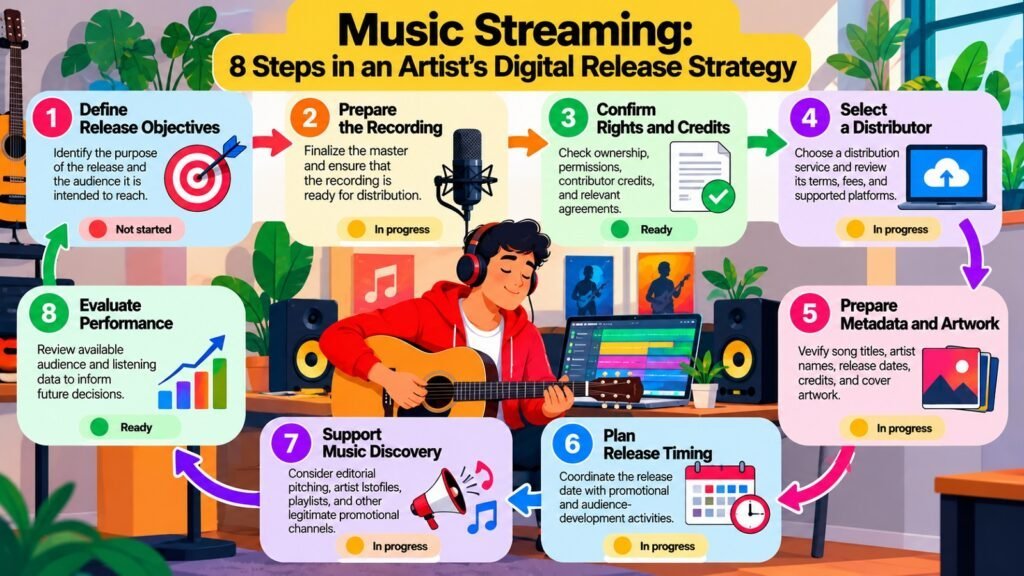
Music Streaming has altered how artists, labels, independent musicians, and rights organizations release recorded music. Digital distributors deliver recordings and metadata to many platforms, enabling independent release without the physical logistics of a traditional label. Release timing, the balance of singles and albums, catalog management, playlist pitching, audience development, international reach, and direct-to-fan channels now form part of ordinary release practice. Distribution agreements vary in fees, exclusivity, and rights administration, and these terms determine how much control an artist retains over catalog, metadata, and revenue. Owned channels such as mailing lists complement platform exposure by keeping audience contact outside platform control.
Independent distribution lowers some barriers while raising others. Platform access is easier, but discoverability, promotion, competition for attention, revenue uncertainty, and dependence on platform policies become harder. Streaming therefore guarantees neither commercial success nor equal benefit, and outcomes vary with genre, existing audience size, release frequency, geographic market, and promotional resources.
Bonini and Gandini (2019) describe how editorial and algorithmic playlist curators mediate artist visibility, and the literature review by Hesmondhalgh et al. (2019) for the UK Intellectual Property Office examined how recommendation systems affect production. Documented outcomes must be separated from anecdote, and correlations between release tactics and success should not be read as causes. Marketing budgets and prior audiences also compound advantages, since early listening signals can lead to further exposure, so initial inequalities may persist rather than correct themselves.
The Artist Music Release Planning Framework evaluates release objectives, audience fit, distribution arrangements, metadata readiness, promotional resources, performance indicators, and long-term catalog value. Artists can test strategies against it before release, and researchers can compare strategies across contexts, although changing algorithms, audience behavior, and commercial conditions limit how long any conclusion remains valid. Performance indicators should extend beyond stream counts to include listener retention, saves, and audience location, interpreted cautiously because platforms define and disclose such measures differently.
Table 7: Music Streaming Artist Distribution Considerations
| Distribution Consideration | Strategic or Practical Implication |
| Digital distributors | Deliver recordings and metadata to multiple platforms |
| Metadata readiness | Incorrect credits can misdirect royalties |
| Release timing | Interacts with editorial schedules and audience availability |
| Singles versus albums | Influences release frequency and catalog structure |
| Playlist pitching | Offers editorial exposure without guaranteed placement |
| International reach | Requires territorial rights and local audience development |
| Direct-to-fan channels | Reduce platform dependence through owned audience contact |
| Performance indicators | Guide evaluation but can mislead without context |
7. Music Streaming and Changing Listener Behavior
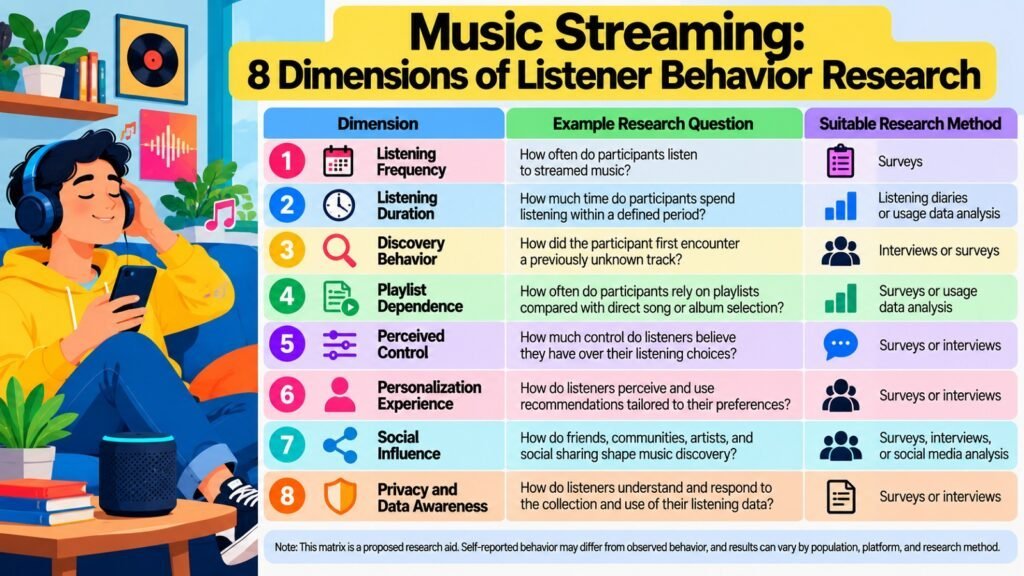
On-demand access has changed listening routines. Listeners build playlists, repeat favorite recordings, play music in the background of other activities, share tracks socially, and keep collections that exist as licensed libraries rather than owned objects. Hagen (2015) showed through interviews how personal playlists organize everyday listening. Subscription access may weaken perceived ownership while raising convenience and expectations of immediate availability, though much of the evidence is qualitative or context-specific and should not be generalized to all populations. Background listening deserves separate treatment from attentive listening, since the same catalog supports both and their implications for engagement, satisfaction, and artist recognition differ.
Age, culture, income, accessibility needs, musical preferences, and digital literacy mediate these patterns, so findings from one group rarely transfer. Consumer-behavior research, media psychology, human-computer interaction, and cultural studies each illuminate how interface design and listening practice interact. Privacy and data collection bear directly on the topic because personalization depends on behavioral data, raising questions of consent, attention, and autonomy that remain unresolved. Accessibility needs are particularly instructive, because interface choices that suit some listeners, such as complex gestures or dense visual layouts, can exclude others entirely.
Music Streaming Listener Behavior Research Framework organizes inquiry around listening frequency, discovery patterns, playlist dependence, perceived control, satisfaction, and cultural or social influences. Surveys scale well but suffer self-report bias; interviews and listening diaries yield depth from small, self-selected samples; observation captures context; and platform usage data are large yet constrained by privacy and rarely reveal motivation. Causal claims require designs that go beyond correlation, such as experiments or natural experiments. Mixed-methods designs that pair usage data with interviews often offset these weaknesses, because logged behavior shows what people do while accounts of motivation show why. Ethical review is also essential whenever behavioral data are involved.
Table 8: Music Streaming Listener Behaviors and Research Variables
| Listener Behavior or Factor | Research Significance |
| Playlist use | Organizes everyday listening and mediates discovery |
| Repeat listening | Indicates habit and attachment to familiar recordings |
| Background listening | Separates low-attention use from focused engagement |
| Social sharing | Links listening to identity and peer influence |
| Perceived ownership | Tests how access-based models alter attachment |
| Demographic and cultural factors | Limit generalization across populations |
| Digital literacy and accessibility | Shape the ability to use platform features |
| Data collection and privacy | Condition consent, personalization, and autonomy |
8. The Future of Music Streaming and the Music Industry
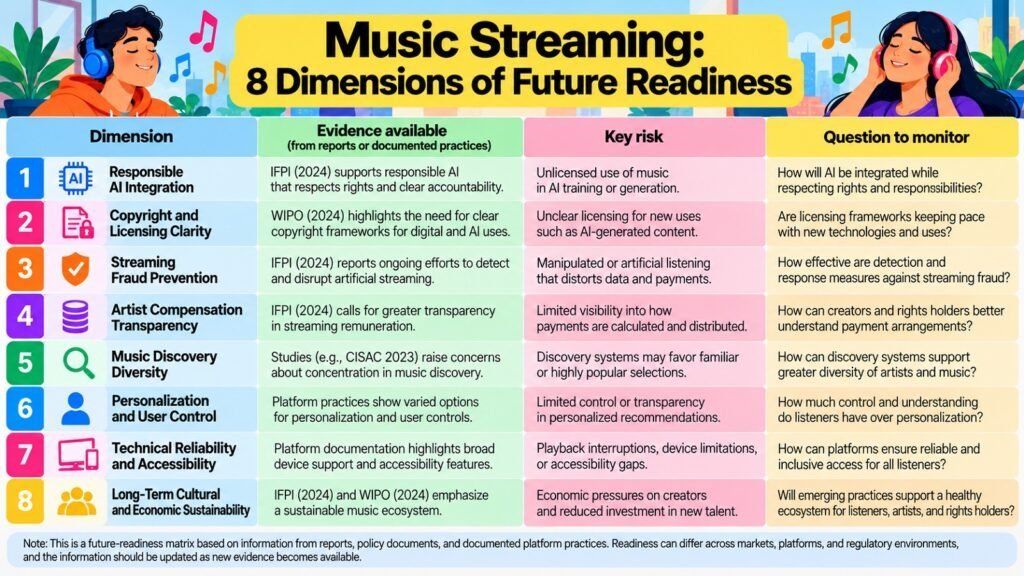
Plausible developments include stronger recommendation systems, generative artificial intelligence, deeper personalization, immersive audio, new distribution tools, evolving licensing arrangements, and shifting platform competition. These differ in maturity, and some already exist: Deezer (2026) reported that fully AI-generated tracks reached roughly 90,000 daily uploads, over half of its new deliveries at the June 2026 peak, and that it tags such content and excludes it from recommendations.
Others remain experiments or unresolved debates, notably copyright and attribution for training data and outputs, creator compensation, and litigation involving generative music developers. Long-term forecasts occupy the weakest evidentiary tier. Immersive audio and deeper personalization are already feasible technically, but their audible or economic value depends on equipment, listener preference, and licensing terms rather than capability alone.
Tensions follow: automation against human curation, personalization against exploration, commercial optimization against cultural diversity, and wider access against sustainable artist income. Regulation matters as well; the European Union Artificial Intelligence Act (Regulation 2024/1689) introduces transparency obligations for certain AI-generated content, though its effect on music remains to be seen. Speculative predictions should never be presented as inevitable. Human curation may therefore survive less as a competitor to automation than as a signal of trust, provenance, and editorial accountability, although that proposition is an interpretation rather than an established finding.
The Music Streaming Future Readiness Framework assesses developments by technological feasibility, economic sustainability, legal clarity, creator impact, listener value, transparency, and cultural consequences. Scenario analysis (Schoemaker, 1995) explores alternative futures built from explicit assumptions, and trend monitoring tracks observable indicators, but both rest on assumptions that regulatory, economic, or technological shocks can overturn, so findings should be dated and revisited. Applying the same criteria to each candidate development allows comparison across very different technologies and prevents enthusiasm for novelty from substituting for assessment.
Table 9: Music Streaming Emerging Developments and Open Questions
| Development or Challenges of Music Streaming | Potential Implication |
| AI-generated music | Raises volume, labeling, and fraud concerns |
| Copyright and attribution | Unresolved for training data and synthetic outputs |
| Transparency labeling | Informs listeners, though adoption varies by platform |
| Streaming fraud | Diverts royalties; highlighted by IFPI (2026) |
| Advanced personalization | May improve relevance yet narrow exposure |
| Immersive audio | Expands formats; audible benefit depends on equipment |
| Evolving licensing | Could change royalty allocation and catalog availability |
| Data governance | Shapes privacy, consent, and personalization limits |
Conclusion: Music Streaming and the Future of Digital Music
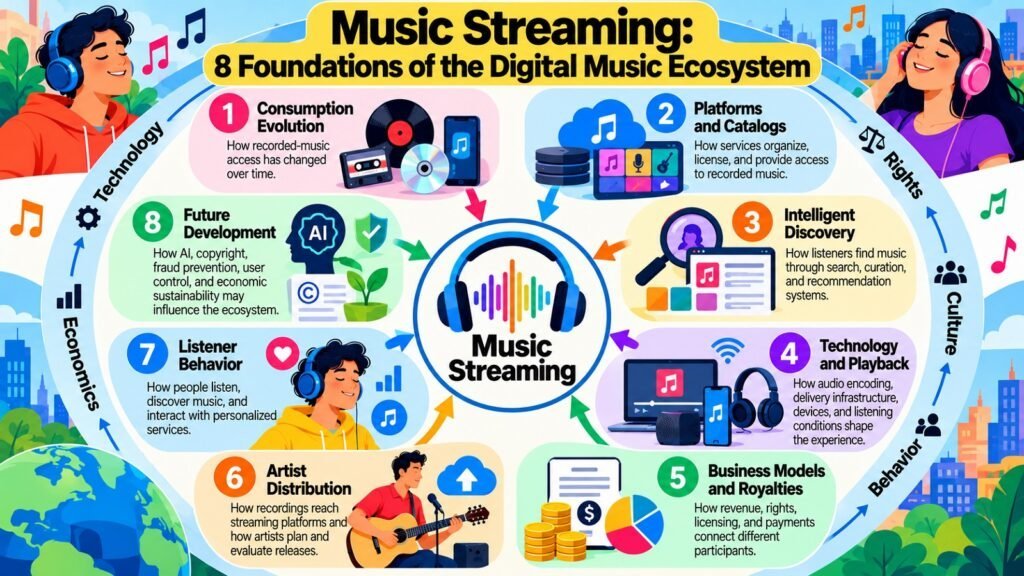
Music Streaming functions as an interconnected technological, economic, legal, cultural, and behavioral system, and the eight aspects examined here cannot be understood in isolation. Platform design determines which catalogs are reachable, discovery systems determine which recordings are heard, playback technology conditions experience, licensing arrangements determine who is paid, distribution strategies determine who can participate, and listener behavior feeds back into every element through the data it generates. Recognizing these feedback loops explains why interventions in one domain, such as changing a recommendation policy, can reshape economic and cultural outcomes elsewhere.
Several tensions recur: convenience against control, personalization against diversity, access against ownership, and artist reach against income sustainability. Robust conclusions are few and modest: the scale of streaming revenue, the absence of a universal per-stream rate, and the gap between offline accuracy and listener satisfaction are well supported, whereas claims about cultural homogenization, optimal audio configurations, and fair remuneration remain contested.
For graduate and doctoral researchers, productive directions include comparative platform audits, longitudinal listening studies, royalty transparency, recommendation diversity, creator outcomes, and the effects of generative AI. Combining theory, empirical evidence, technical evaluation, and practical frameworks guards against the narrowness of any single approach. Music Streaming remains central to understanding the future of recorded music and Digital Entertainment because it concentrates, within one infrastructure, the technical, commercial, and cultural questions every digital cultural industry must answer. Findings should be dated and framed with geographic scope, since conditions differ across markets and change quickly.
Table 10: Synthesis of Music Streaming Findings
| Music Streaming Aspects Examined | Central Contribution to Understanding |
| 1. Consumption evolution | Access replaced ownership, with uneven adoption |
| 2. Platforms and catalogs | Intermediation and licensing shape availability |
| 3. Music discovery | Recommendations mediate exposure; metrics remain imperfect |
| 4. Technology and quality | Delivery reliability and perception are separate questions |
| 5. Business and royalties | Revenue splits, not a universal rate, define income |
| 6. Artist distribution | Lower barriers coexist with discoverability challenges |
| 7. Listener behavior | Habits and perceived ownership vary across populations |
| 8. Future developments | AI and regulation create uncertain, evolving conditions |