Table of Contents
Introduction: Remote Work – Understanding Its Role in Modern Society
Remote Work has moved from a niche accommodation of the 1970s, when Jack Nilles coined the term telecommuting to describe substituting information flows for physical journeys, to a structural feature of contemporary employment. Broadband connectivity, cloud computing, mobile devices, and collaboration platforms have loosened the long-standing coupling between a job and a building, while organizations have gradually revised the supervisory and coordination routines that once presupposed shared premises.
Precision matters here. In this article, Remote Work denotes paid work performed away from the employer’s premises and coordinated through digital technologies. It is broader than working exclusively from home, since it includes shared workspaces, client sites, and travel, and it differs from hybrid arrangements, which divide time between locations, and from traditional office-based employment, in which presence is the default (Eurofound & ILO, 2017).
Its significance extends well beyond office logistics. Employees negotiate boundaries and autonomy, employers redesign management and security, governments confront questions of infrastructure and labour regulation, and researchers treat Remote Work as a socio-technical phenomenon in which technical systems, organizational arrangements, lived experience, and economic consequences shape one another. This article therefore treats Remote Work as an important aspect of Technology and Society, relying on peer-reviewed studies, established theory, institutional reports, and documented examples.
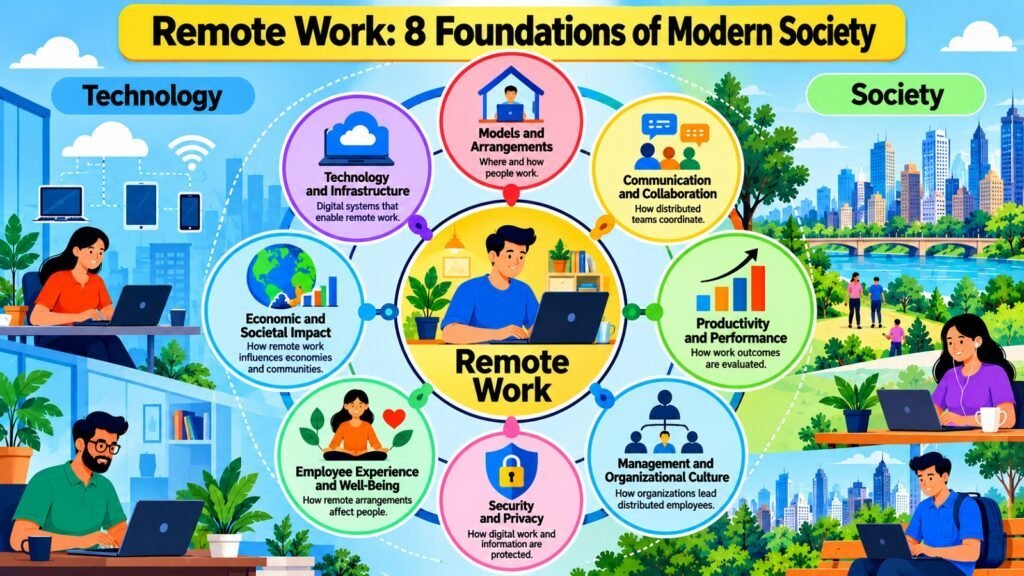
Eight aspects structure the analysis: models, infrastructure, communication, productivity, management, security, well-being, and societal impact. Together they move from definition through mechanism to consequence, and understanding Remote Work requires examining its technological foundations and societal implications together.
Eight Core Aspects of Remote Work at a Glance
| Aspect of Remote Work | Central Focus |
| Models and Arrangements | Definitions and suitability of fully remote, hybrid, and distributed configurations |
| Technology and Infrastructure | Connectivity, cloud platforms, devices, and technical readiness |
| Communication and Collaboration | Synchronous and asynchronous coordination across locations and time zones |
| Productivity and Performance | Evidence on output, quality, and meaningful measurement |
| Management and Organizational Culture | Trust, accountability, onboarding, and fair evaluation |
| Security and Privacy | Information protection, access control, and proportionate monitoring |
| Employee Experience and Well-Being | Autonomy, boundaries, isolation, and health |
| Economic and Societal Impact | Labour markets, geography, inclusion, and environmental effects |
1. Remote Work Models and Arrangements
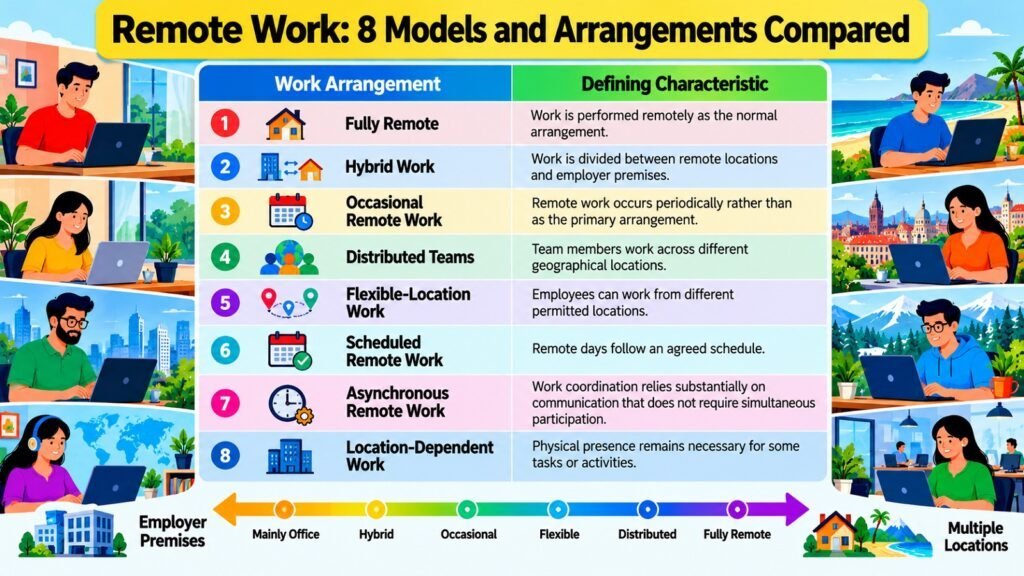
Remote Work is organized through several distinct arrangements, and conflating them produces misleading comparisons across studies. Fully remote work removes any expectation of regular attendance at an employer-controlled site, whereas hybrid work divides time between home or other locations and a workplace, typically on a fixed or negotiated schedule.
Occasional remote work is an exception granted for particular days or tasks. Distributed teams describe a structural property, namely members dispersed across locations, and flexible-location arrangements give employees discretion over where they work within stated limits. Each dimension is separable from employment status, since a contractor and a salaried employee may work identically, and from scheduling flexibility, because choosing where one works differs from choosing when.
Suitability depends on occupational requirements, task interdependence, employee preferences, organizational resources, and operational constraints. Work design theory, especially the job characteristics model of Hackman and Oldham (1976), helps explain why: tasks with observable outputs and low interdependence tolerate dispersal, while tasks requiring tight, iterative coordination incur costs that remote settings amplify. Dingel and Neiman (2020) estimated that roughly 37 percent of US jobs could plausibly be performed at home, yet this share varies sharply by occupation and country, and physical presence remains essential in surgery, manufacturing, and field maintenance.
Research findings regarding outcomes demonstrate conditional effects. Meta-analytic investigations have documented modest advantages of remote work arrangements concerning employee autonomy and occupational satisfaction, with interpersonal relationship disadvantages manifesting predominantly at elevated frequency levels (Gajendran & Harrison, 2007), whereas a randomized controlled trial examining hybrid work implementation at Trip.com demonstrated reduced employee turnover without statistically significant negative effects on performance evaluations or career advancement opportunities (Bloom et al., 2024). These findings collectively indicate that neither arrangement demonstrates universal superiority across all organizational contexts.
For practical screening, decision-makers can ask whether outputs are observable, whether dependencies require real-time exchange, whether the role demands physical assets, and whether the employee has an adequate working environment. Hybrid designs deserve particular scrutiny, because the benefits attributed to flexibility may depend on which days employees attend and whether teams coordinate those days.
Principal Remote Work Arrangements Compared
| Remote Work Arrangement | Defining Characteristics |
| Fully remote | No expected attendance at an employer-controlled site |
| Hybrid | Scheduled division of time between workplace and elsewhere |
| Occasional remote | Ad hoc location flexibility for specific days or tasks |
| Distributed team | Members dispersed across locations or time zones |
| Flexible location | Employee chooses workplace within defined limits |
| Home-based work | Primary work location is the worker’s residence |
| Remote-first | Practices designed around dispersion, with no headquarters default |
| Office-based | Presence at the employer’s site is the default |
2. Remote Work Technology and Infrastructure
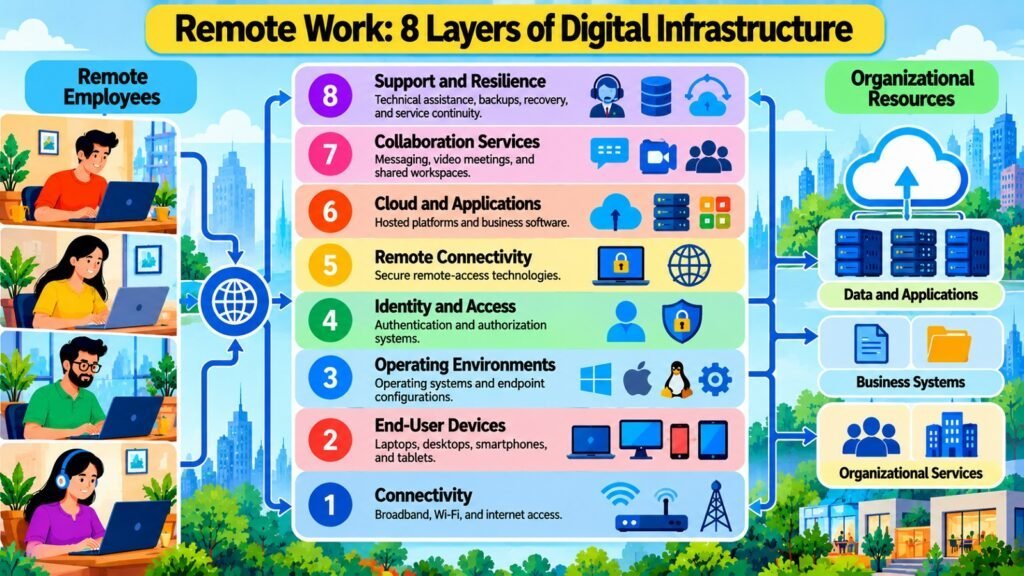
Remote Work depends on a layered stack in which each component presupposes the reliability of those beneath it. Broadband and Wi-Fi provide the transport layer, computing devices provide the endpoint, and cloud platforms and software-as-a-service applications host the data and workflows that once resided on corporate servers. Remote-access technologies, including virtual private networks and virtual desktops, extend controlled access to internal resources, while collaborative systems support shared editing, messaging, and conferencing. Because these layers are interdependent, weakness in any one, whether a congested home network or an incompatible file format, degrades the whole, and design priorities therefore include reliability, interoperability, accessibility, scalability, technical support, and resilience.
Socio-technical systems theory, traced to the coal-mining studies of Trist and Bamforth (1951), holds that technical and social subsystems must be jointly optimized. Technology cannot compensate for poorly specified workflows, thin digital skills, absent support channels, or tasks unsuited to remote execution. Inadequate connectivity, unreliable electricity, and unaffordable devices impose costs that fall unevenly, and the International Telecommunication Union (2024) reports that about one-third of the world’s population remains offline, which constrains who can participate in Remote Work at all. Dependence on employer-provided equipment, moreover, shifts costs and responsibilities in ways that policy must clarify.
Established infrastructure should be distinguished from emerging capabilities. Cloud collaboration and identity management are mature, whereas artificial intelligence assistants and workflow automation remain uneven in reliability and raise unresolved questions about oversight. Infrastructure choices also shape accessibility, since platforms lacking captioning or screen-reader compatibility exclude some workers regardless of other support.
Organizations can assess readiness by auditing connectivity, device provision, support capacity, and interoperability, identifying which gaps most threaten continuity, and testing failure scenarios before they occur. The practical implication is that infrastructure investment should follow task requirements; a team exchanging large design files, for instance, depends on upload bandwidth and latency far more than a team working primarily in text-based applications.
Core Infrastructure Components Supporting Remote Work
| Infrastructure Component | Function in Remote Work |
| Broadband connectivity | Carries data between homes, networks, and cloud services |
| Wi-Fi networks | Provide local wireless access within the worker’s premises |
| Computing devices | Serve as endpoints for applications, data, and authentication |
| Cloud platforms | Host storage and computing resources accessible from any location |
| Software-as-a-service | Delivers business applications through browsers without local installation |
| Virtual private networks | Encrypt traffic between remote devices and organizational networks |
| Virtual desktops | Run centrally hosted desktop environments streamed to endpoints |
| Collaboration systems | Support messaging, conferencing, and shared document editing |
3. Remote Work Communication and Collaboration
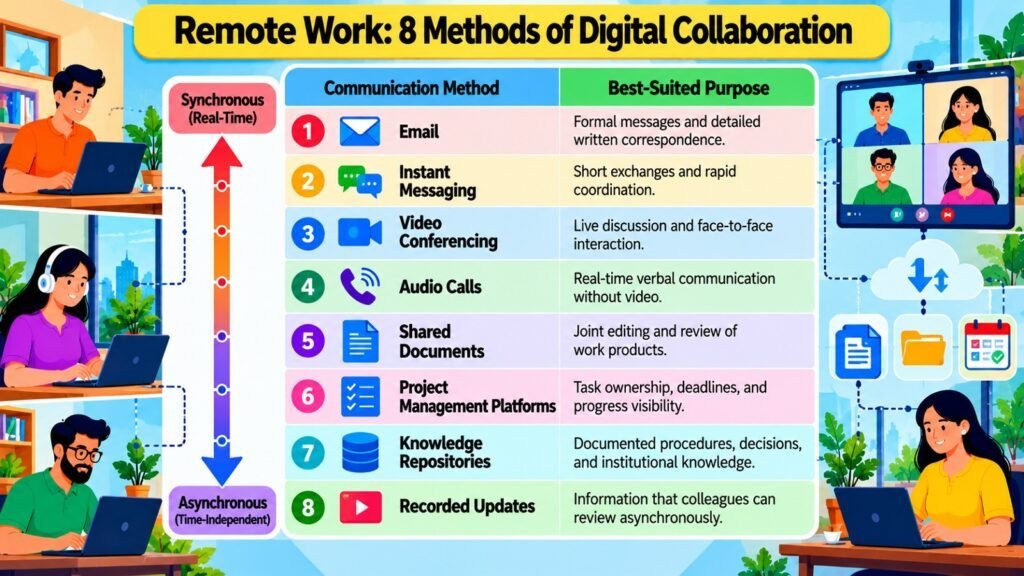
Remote Work alters communication by removing the ambient cues on which colocated teams rely for coordination. Synchronous channels, including meetings and calls, enable rapid clarification and relational signaling, whereas asynchronous channels, such as messages, shared documents, and recorded updates, permit contributions across time zones and preserve a searchable record. Media richness theory (Daft & Lengel, 1986) suggests that ambiguous or emotionally charged exchanges benefit from richer media, and media synchronicity theory (Dennis et al., 2008) refines this by emphasizing the fit between media capabilities and task needs. The choice is therefore analytical rather than a matter of preference.
Distributed work also introduces mutual knowledge problems. Cramton (2001) showed that dispersed members often misattribute colleagues’ silence or delay because they lack context about local circumstances, while Hinds and Bailey (2003) linked distribution to conflict arising from poor shared understanding. Time zones, languages, and cultural norms about directness and hierarchy compound these effects. Evidence from a global technology firm indicated that firm-wide remote adoption made collaboration networks more static and siloed and reduced bridging ties across teams (Yang et al., 2022). Misunderstandings of this kind are costly precisely because they remain invisible until a deadline slips.
Overload is a parallel hazard. Videoconference fatigue has been attributed to sustained gaze, self-view, and reduced mobility (Bailenson, 2021), although its empirical foundation is still developing. Messaging platforms can create expectations of constant responsiveness, and the loss of informal encounters reduces incidental knowledge exchange, particularly in complex, interdependent work. Practical guidance follows from these mechanisms: choose channels by task ambiguity and urgency, state response-time norms explicitly, record decisions in a durable shared location, and make asynchronous handovers self-contained. No channel is a universal remedy, and for tightly coupled problem solving, scheduled synchronous sessions often remain preferable.
Communication Methods Used in Remote Work
| Communication Method | Appropriate Use or Limitation |
| Video conferencing | Suits complex discussion; prolonged use may contribute to fatigue |
| Audio calls | Allow quick clarification with fewer visual demands |
| Instant messaging | Supports rapid queries; may fragment attention and imply constant availability |
| Suits formal, traceable exchange; weak for rapid iteration | |
| Shared documents | Enable joint editing and durable records; require version discipline |
| Recorded video updates | Allow asynchronous explanation; viewers cannot ask real-time questions |
| Digital whiteboards | Support collaborative visual ideation; depend on facilitation |
| Project trackers | Make task status visible; do not convey rationale or nuance |
4. Remote Work Productivity and Performance
Productivity, work quality, efficiency, individual performance, and organizational results are related but not interchangeable. Productivity ratios output to input, quality concerns the conformity and value of that output, and performance may reflect behaviors that never appear in output counts. Treating them as a single construct explains much of the apparent disagreement in the literature. Each construct also operates at a different level, so a team may improve individually while an organization declines on collective outcomes.
The strongest evidence comes from field experiments. Bloom and colleagues (2015) found that call-centre employees randomly assigned to work from home at a Chinese travel firm performed about 13 percent better, largely through fewer breaks and sick days and a quieter environment, and Choudhury, Foroughi, and Larson (2021) reported modest output gains among patent examiners working from anywhere. Yet Gibbs, Mengel, and Siemroth (2023) observed declines in output per hour among IT professionals whose working hours lengthened, and these settings differ in task structure, selection, and measurement.
Interpretation requires caution. Self-reported productivity tends to exceed measured output, short-term experiments say little about innovation or mentoring over time, and pandemic-era data reflect unusual conditions such as school closures. Concentration, commuting time, digital interruptions, home conditions, managerial expectations, and task complexity all mediate outcomes, and individual efficiency gains may coexist with coordination costs for the team.
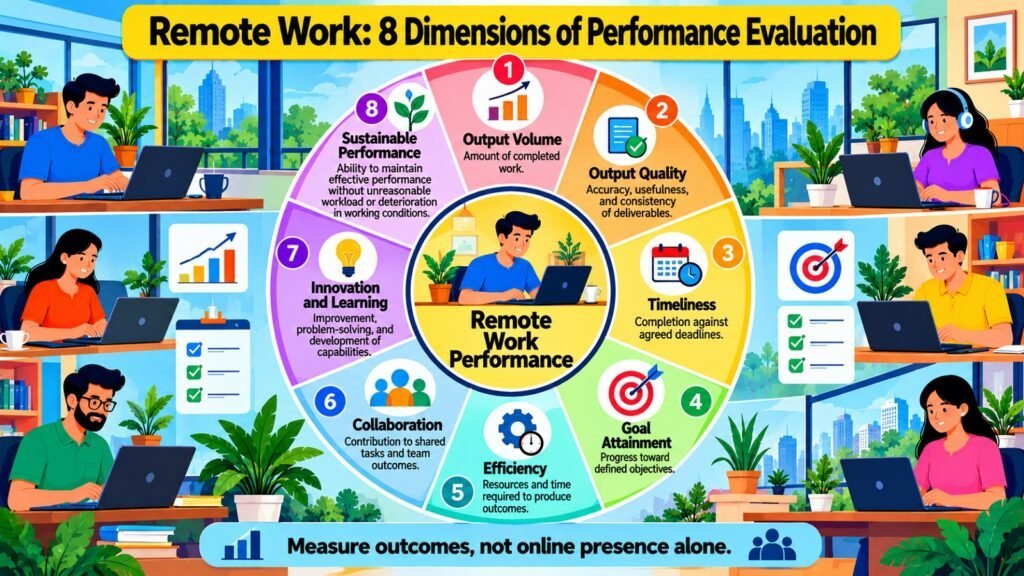
Hours online and visible activity are weak indicators because they reward presence rather than results. Better practice uses goal attainment, output quality, timeliness, error rates, and collaboration contributions, applied proportionately rather than through intrusive surveillance, with interventions evaluated against comparison groups where feasible. Open questions include effects on creativity, career progression, and long-run team capability. Heterogeneity matters as well: effects differ for novices, for routine versus creative tasks, and for workers with demanding home circumstances.
Performance Indicators for Evaluating Remote Work
| Performance Indicator | What It Measures or May Miss |
| Goal attainment | Progress toward agreed objectives; may ignore how targets were set |
| Output volume | Units completed; overlooks quality and complexity |
| Output quality | Conformity to standards; requires reliable assessment criteria |
| Timeliness | Delivery against deadlines; may reward rushing |
| Error or rework rates | Accuracy of results; sensitive to task difficulty |
| Collaboration contribution | Support given to colleagues; hard to quantify without distortion |
| Hours online | A proxy for presence only; says little about results |
| Self-reported productivity | Perceived effectiveness; subject to bias and social desirability |
5. Remote Work Management and Organizational Culture
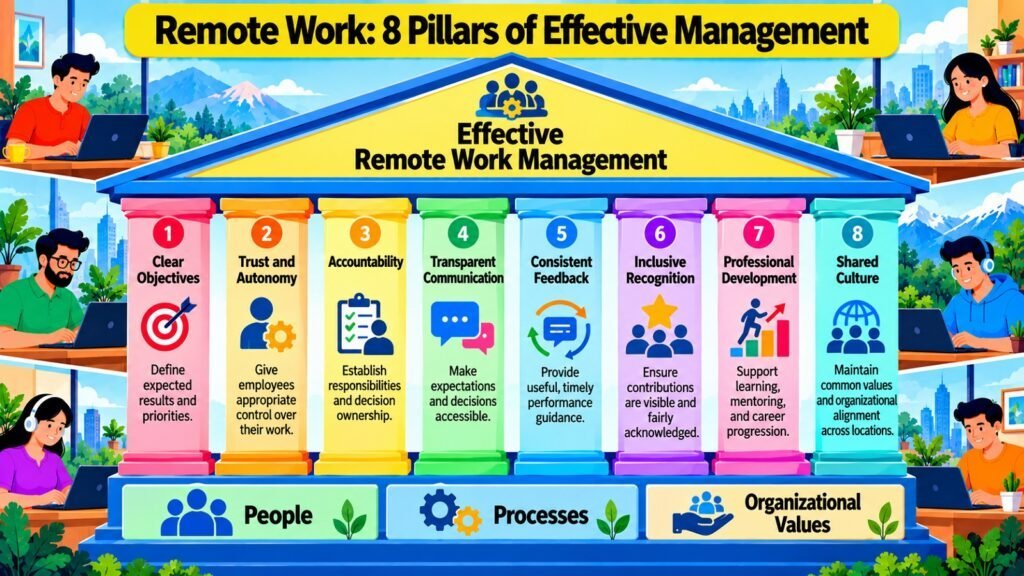
Remote Work shifts management from observing activity to specifying and evaluating outcomes. Without physical supervision, leaders rely more heavily on clear objectives, documented expectations, regular feedback, and trust, and the autonomy granted to employees is, under social exchange theory (Blau, 1964), reciprocated when workers perceive support and fairness. Socio-technical reasoning adds that management systems must be redesigned for distributed work rather than reproduced digitally through monitoring tools that merely replicate office surveillance. Trust here is less a sentiment than a managerial infrastructure, built through predictable communication and demonstrated follow-through.
Coordination becomes more deliberate. Managers must assign responsibilities explicitly, structure onboarding that substitutes for informal observation, resolve conflicts that surface late, recognize contributions that are less visible, and sustain career development. Proximity bias, the tendency to favor those physically present, threatens fairness in hybrid settings. Emanuel, Harrington, and Pallais (2023) reported that co-located software engineers received more feedback than remote peers, particularly early in their careers, which suggests that informal learning is not easily replicated at a distance. Fragmented team identities add a further risk, because members who rarely meet may identify with subgroups rather than the organization, a pattern that deliberate team rituals only partly address.
Culture is then a product of repeated practices rather than the shared space. Evidence supports transparent expectations, consistent feedback, inclusive decision-making, and criteria applied equally to remote and onsite staff, but it is less decisive about particular rituals, which depend on size, sector, and workforce composition. This section concerns management systems only; channel selection belongs to Section 3, performance indicators to Section 4, and well-being to Section 7. Practical steps include documenting decision rights, auditing promotion and opportunity data by work location, and training managers in outcome-based evaluation. Where policy and leadership behavior diverge, employees tend to follow what leaders do, which makes consistency more influential than formal statements.
Management Practices in Remote Work Settings
| Management Practice | Organizational Purpose |
| Outcome-based objectives | Align effort with results instead of presence |
| Documented expectations | Clarify roles, availability, and decision rights |
| Regular one-to-one feedback | Sustain development and early problem detection |
| Structured onboarding | Build knowledge and relationships without informal observation |
| Transparent performance criteria | Support fair evaluation across work locations |
| Inclusive meeting norms | Equalize participation between remote and onsite staff |
| Recognition practices | Make contributions visible beyond physical presence |
| Career development planning | Reduce unequal access to opportunity |
6. Remote Work Security and Privacy
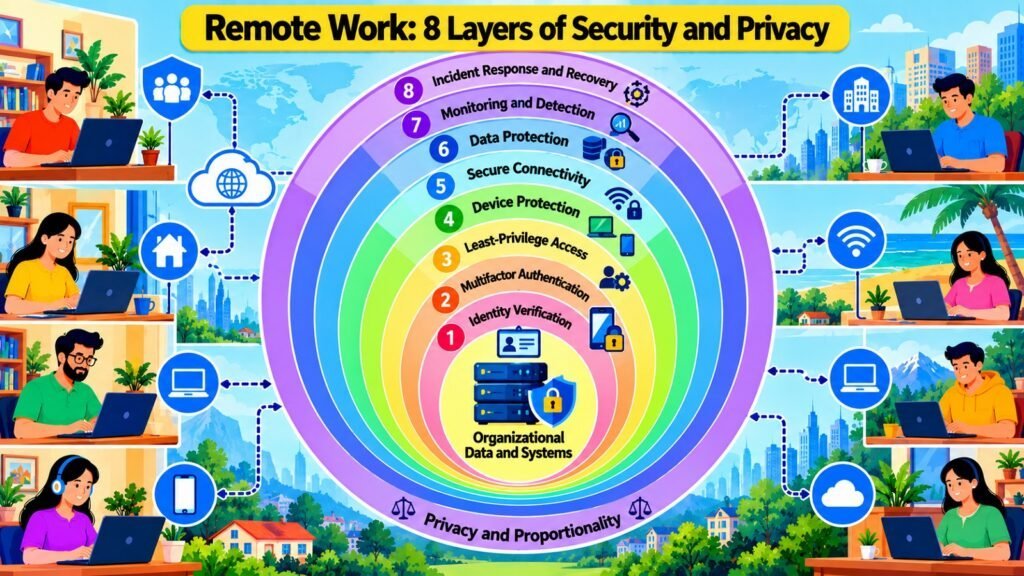
Remote Work extends the attack surface beyond centrally managed environments. Compromised credentials, phishing, insecure home networks, lost devices, unauthorized access, personal-device use, unsafe file sharing, and accidental exposure of sensitive information all become harder to govern when employees operate outside organizational perimeters. The NIST telework guidance (SP 800-46 Rev. 2) and CISA publications converge on protective principles that include multifactor authentication, least privilege, device encryption, endpoint protection, secure remote access, patch management, backups, and prompt incident reporting. Personal-device use is especially contentious, since it lowers equipment costs while limiting organizational visibility and control.
Zero trust, as articulated in NIST SP 800-207, abandons the assumption that network location implies trustworthiness. Access decisions instead rest on verified identity, authorization to specific resources, device posture, and continuing risk assessment. It is an architectural approach rather than a product, and no single technology guarantees security; multifactor authentication, for example, remains vulnerable to certain phishing and fatigue attacks. Responsibility is shared among organizations that set policy and provision controls, employees who follow practices, and providers that secure their services.
Privacy requires equal attention. Monitoring that exceeds a legitimate purpose erodes trust and autonomy, so transparency, data minimization, and proportionality are essential; the European Union’s General Data Protection Regulation, for instance, makes data minimization a principle of processing, whereas obligations differ across jurisdictions, industries, and data categories. Controls should therefore be selected according to data sensitivity and circumstances, layered so that one failure does not become a breach, and reviewed continuously. A checklist, however complete it appears, is not a security strategy. Incident reporting also depends on a culture in which employees can disclose mistakes without fear of punishment, which links security outcomes to management practice.
Security Risks and Controls in Remote Work
| Security Risks or Controls in Remote Work | Purpose or Limitation |
| Phishing (risk) | Deceives users into disclosing credentials or running malicious content |
| Compromised credentials (risk) | Allow unauthorized access, particularly without secondary verification |
| Insecure home networks (risk) | Expose traffic and devices to interception or compromise |
| Multifactor authentication (control) | Strengthens identity assurance; certain phishing methods can bypass it |
| Least privilege (control) | Limits access to what a role requires, reducing breach impact |
| Device encryption (control) | Protects stored data if a device is lost; does not stop network attacks |
| Patch management (control) | Closes known vulnerabilities; depends on timely deployment |
| Backup procedures (control) | Enable recovery after loss or ransomware; require tested restoration |
7. Remote Work Employee Experience and Well-Being
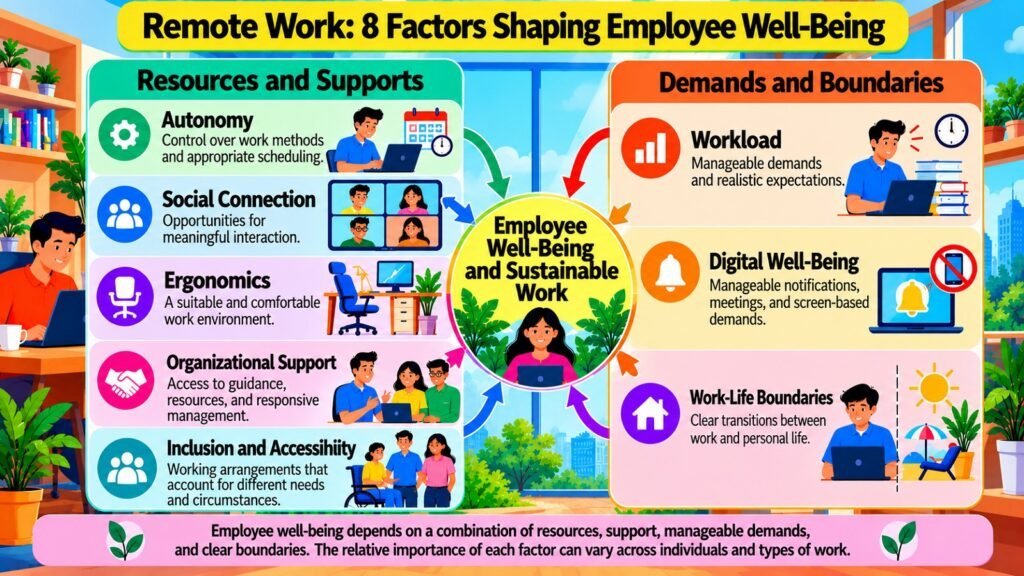
Remote Work reshapes the conditions under which employees experience autonomy, connection, and strain. The Job Demands–Resources model (Bakker & Demerouti, 2007) provides a valuable framework for analysis, as remote work environments can simultaneously enhance resources, including scheduling autonomy, while introducing demands such as social isolation, screen-related exhaustion, and inadequate work environments. Boundary theory (Ashforth et al., 2000) illuminates how flexibility benefits individuals who favor work-life integration but creates challenges for those whose professional and domestic responsibilities or household structures already overlap, thereby complicating temporal separation.
Self-Determination Theory (Ryan & Deci, 2000) establishes connections between psychological well-being and three fundamental psychological needs—autonomy, competence, and relatedness—with relatedness demonstrating particular vulnerability in remote work contexts. These frameworks are complementary rather than competing, which allows researchers to trace how the same arrangement produces divergent experiences.
Benefits include reduced commuting and greater control over arrangements; challenges include excessive availability, competing caregiving duties, and reduced informal learning. A comprehensive examination of remote work arrangements revealed heterogeneous consequences for psychological and physiological well-being, with outcomes determined primarily by employment circumstances rather than geographical setting exclusively (Oakman et al., 2020). Outcomes also vary with job design, disability, housing, social support, and especially the degree of employee choice, which is why voluntary and mandated remote work should not be conflated. Much of the evidence relies on self-reports gathered during the pandemic, so unusual circumstances limit generalization.
Practical approaches follow the ILO and WHO technical brief on healthy and safe telework (2022): ergonomic workspaces, reasonable workloads, boundaries around working hours, accessible practices, and organizational support. Some jurisdictions, including France and Portugal, have legislated rights to disconnect. Well-being should be distinguished from productivity and culture, though the three interact, since exhausted staff perform unevenly and weak cultures amplify isolation. Healthier arrangements therefore demand coordinated attention to employee needs, work design, and employer responsibilities. Effective support is therefore specific, such as equipment allowances and workload review, rather than generic wellness messaging.
Well-Being Factors in Remote Work
| Well-Being Factors in Remote Work | Potential Effect or Consideration |
| Schedule flexibility | May support autonomy; may also extend working hours |
| Reduced commuting | Frees time and reduces strain for some workers |
| Social isolation | Can weaken relatedness, depending on support and preference |
| Digital fatigue | Linked to sustained screen-based interaction and constant messaging |
| Workspace ergonomics | Inadequate setups can contribute to physical discomfort |
| Work-life boundaries | Outcomes depend on boundary preferences and household demands |
| Caregiving responsibilities | May be eased by flexibility or intensified by competing demands |
| Accessibility needs | Remote options may reduce barriers if tools are accessible |
8. Remote Work and Its Economic and Societal Impact
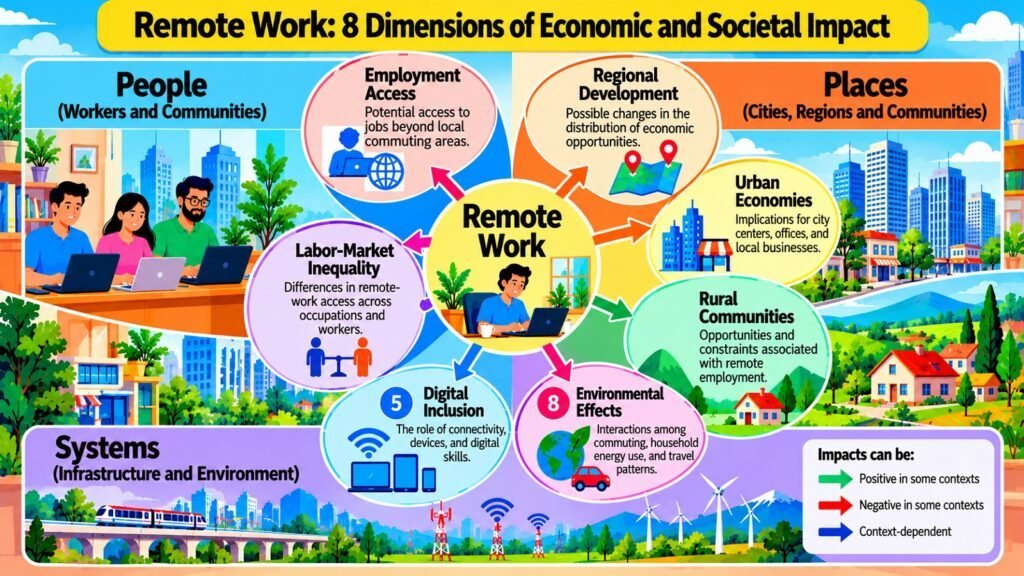
Viewed as a transformation in Technology and Society, Remote Work reconfigures labour markets, economic geography, and the distribution of opportunity. Location-independent employment can widen access to jobs for people who face commuting barriers, caregiving constraints, or disabilities, and it lets organizations recruit across regions. Barrero, Bloom, and Davis (2023) document how work from home has persisted well above pre-pandemic levels in many countries, with implications for commuting, migration, housing, and urban activity. Labour-market theory predicts that reduced locational constraints may intensify competition for some roles while enlarging the opportunity pool for others, so net effects remain an empirical question.
Spatial consequences are uneven. Ramani and Bloom (2021) found a donut effect in US metropolitan areas, with demand shifting from city centers toward outer suburbs, which affects commercial property, transit demand, and local businesses that depend on daytime worker populations. Digital inequality theory (van Dijk, 2005) explains why benefits cluster among workers who possess connectivity, skills, and suitable space, while occupations requiring physical presence are excluded, reinforcing divisions by income and occupation. OECD, ILO, and Eurofound analyses likewise emphasize that exposure varies across countries and sectors, so findings from one setting rarely generalize. Tax, regulatory, and housing policy mediate these shifts, which is why regional outcomes diverge.
Environmental effects need careful treatment. A systematic review by Hook and colleagues (2020) concluded that teleworking can reduce travel-related emissions but that rebound effects, including additional non-commute trips, household energy use, and relocation to more distant homes, can offset savings. The balanced conclusion is that Remote Work may support inclusive and sustainable outcomes when connectivity is broadly available, regional policy anticipates changing demand, and costs are shared fairly, whereas assumptions of automatic benefit obscure real trade-offs. National statistical agencies supply the comparable data on commuting and work location needed to test such claims.
Economic and Societal Dimensions of Remote Work
| Economic or Societal Dimensions of Remote Work | Impact Mechanism or Consideration |
| Labour market access | Location independence may widen opportunities for some workers |
| Talent distribution | Employers can recruit beyond commuting range |
| Regional development | Residents may remain in or move to lower-cost regions |
| Urban centers | Reduced daytime presence affects local retail and services |
| Commercial property | Altered office demand influences leasing and land use |
| Transport demand | Commuting patterns change; non-commute travel may increase |
| Digital inequality | Connectivity and skills determine who can participate |
| Environmental outcomes | Net emissions depend on rebound effects and energy use |
Conclusion: Remote Work – Building a More Connected and Inclusive Society
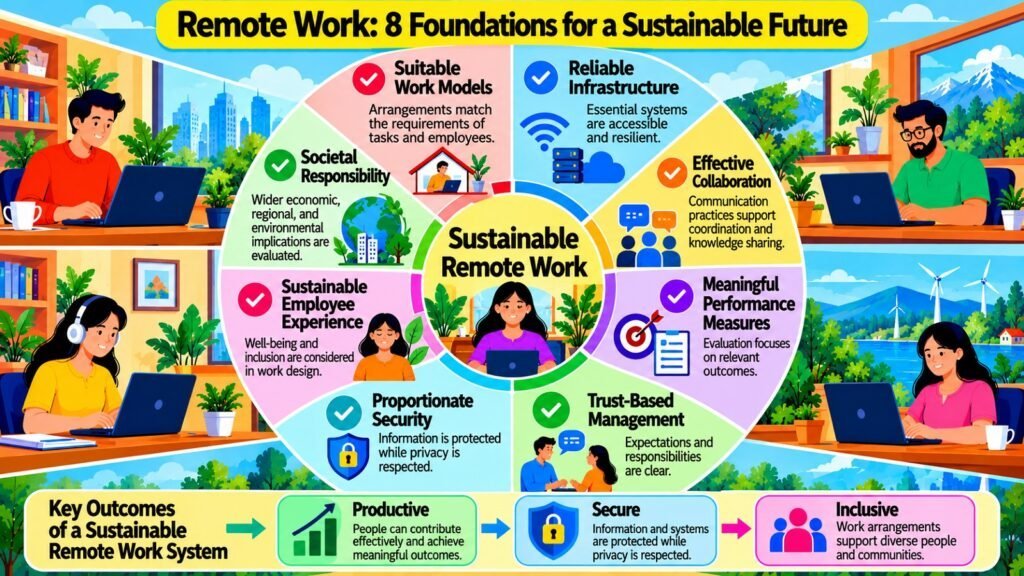
The eight foundations examined here show that Remote Work is not merely a question of where employees sit but a systemic arrangement linking technological capability, organizational practice, individual experience, and social consequence. Arrangements determine feasibility, infrastructure determines access, communication determines coordination, and productivity evidence, management systems, security design, and well-being research each qualify the others. That interdependence is why Remote Work is an important aspect of Technology and Society.
Outcomes depend on occupational requirements, technological readiness, management quality, employee circumstances, organizational policy, and wider social conditions, so no model deserves endorsement in the abstract. The most durable insights are theoretical and methodological: socio-technical thinking warns against technology-led solutions, exchange and demands-resources perspectives explain why trust and support matter, and careful measurement distinguishes outputs from proxies. Reliable research, inclusive access, and proportionate security practices should guide decisions rather than anecdote or managerial intuition.
Enduring questions remain. Researchers and policymakers still need longer-term evidence on career progression, innovation, and team capability, a clearer account of how Remote Work interacts with inequality across regions and occupations, and better assessments of environmental net effects as technologies and employment arrangements evolve. Answering them will require comparable measures and studies that follow workers over time. The practical task is plain: Remote Work must be designed to be productive, secure, inclusive, and sustainable together, because gains in one dimension purchased at the expense of the others will not endure.
Key Takeaways from the Eight Foundations of Remote Work
| Foundational Aspects of Remote Work | Key Takeaway |
| Models and arrangements | Suitability depends on tasks, roles, and context |
| Technology and infrastructure | Technical readiness is necessary but insufficient |
| Communication and collaboration | Channel choice should match task and time-zone realities |
| Productivity and performance | Evidence is conditional and measurement must be meaningful |
| Management and organizational culture | Outcome-based, fair practices replace presence-based supervision |
| Security and privacy | Layered controls and proportionate monitoring are needed |
| Employee experience and well-being | Choice, design, and support shape health outcomes |
| Economic and societal impact | Benefits and costs are unevenly distributed |