Table of Contents
Introduction — Neuromorphic Computing: The Foundation of Brain-Inspired Computing
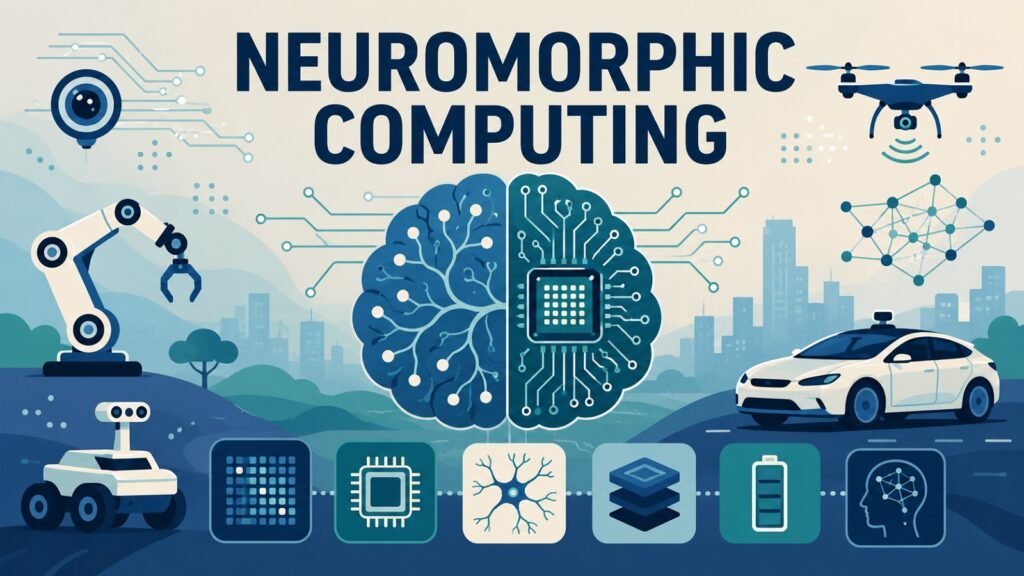
Despite decades of progress, conventional computing architectures still follow the mid-twentieth-century separation of processor and memory. This design is flexible, but moving data between those two units consumes energy and adds latency. As workloads shift toward real-time perception, edge intelligence, and energy-constrained environments, interest in fundamentally different approaches has grown. Neuromorphic Computing has emerged from this context as an important Future Computing Technology, one that draws from the organizational principles of biological nervous systems to address problems where conventional architectures are poorly matched.
The term neuromorphic, coined by Carver Mead in the late 1980s, describes hardware and software that translate biological principles into engineering. Biological neurons communicate through discrete electrical pulses called spikes. They operate in parallel, adapt their connections in response to experience, and process information with energy economy that current silicon systems cannot match. Neuromorphic systems attempt to transfer these principles into practical architectures. The goal is not to replicate the brain in silicon but to rethink how machines sense, represent, compute, communicate, and learn from information.
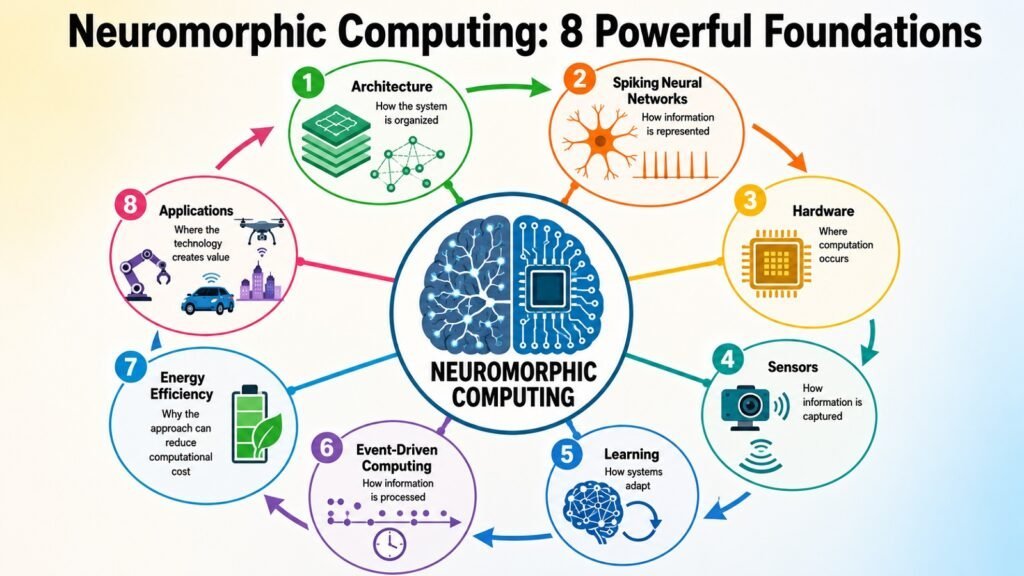
This article maps the field through eight foundations: architecture, spiking neural networks, hardware, sensors, learning, event-driven processing, energy efficiency, and applications. Each builds on the previous, and together they reveal not only what Neuromorphic Computing is but why it matters within the broader evolution of computing.
Table: Neuromorphic Computing — Eight Foundations at a Glance
| Neuromorphic Computing Foundations | Contribution to Understanding Neuromorphic Computing |
| Architecture | Explains how brain-inspired circuit organization differs from von Neumann designs |
| Spiking Neural Networks | Describes the spike-based computational model central to neuromorphic processing |
| Hardware | Covers the physical chips, circuits, and materials that implement neuromorphic systems |
| Sensors | Shows how event-driven perception extends the paradigm from processor to data source |
| Learning | Examines how neuromorphic systems adapt and change connections over time |
| Event-Driven Processing | Clarifies the asynchronous, sparse information pathway that defines operation |
| Energy Efficiency | Provides a framework for evaluating power and efficiency claims critically |
| Applications | Identifies the workloads and contexts where neuromorphic approaches are well suited |
1. Neuromorphic Computing Architecture: Designing Brain-Inspired Systems
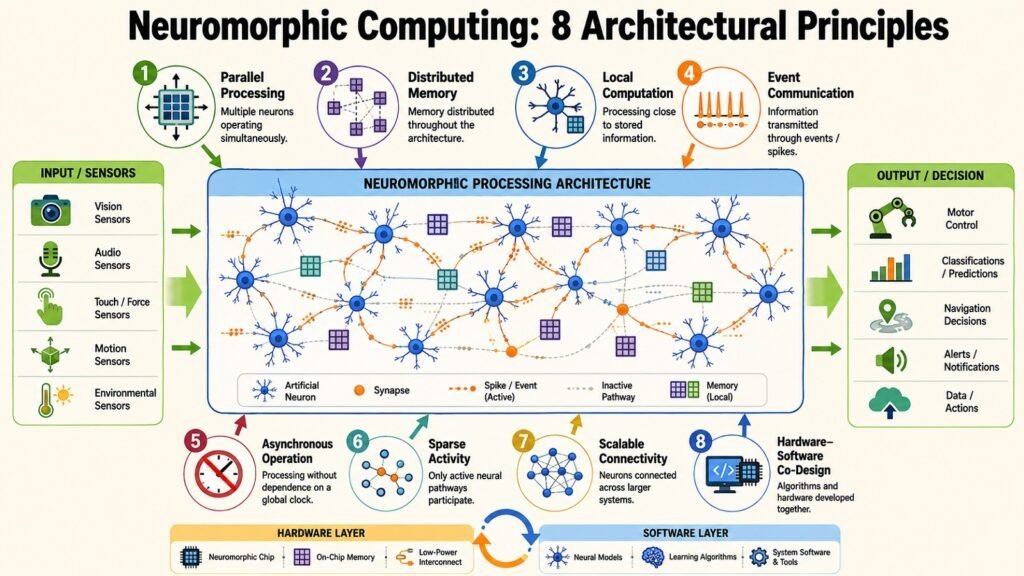
Architecture is the organizing framework for Neuromorphic Computing, and every other element depends on how the underlying system is structured. Conventional processors follow the von Neumann model, fetching instructions and data from memory banks that are physically separate from the processing unit. This separation is practical, but moving data consumes energy and adds latency. As workloads grow more data-intensive, that cost compounds. Neuromorphic architectures attempt to reduce it by integrating memory and computation far more tightly than von Neumann designs permit.
In a neuromorphic system, artificial neurons and synapses are implemented directly in hardware. A synapse stores a weight and performs a computation at the same physical location, eliminating repeated round trips to external memory. Neurons receive inputs from many synapses in parallel, accumulate them, and emit a spike when a threshold is crossed. This distributed organization allows many neurons to process different parts of a problem simultaneously without a central scheduler or a shared bus.
Implementations span digital, analog, and mixed-signal approaches. Digital designs use standard transistor logic, offering noise immunity and programmability. Analog designs exploit transistors operating in subthreshold regimes, where current-voltage relationships approximate biological membrane dynamics. Mixed-signal architectures combine both strategies. Intel’s Loihi research chip uses a fully digital, asynchronous architecture organized around cores that each contain a population of spiking neurons, with spike routing between cores managed by an on-chip network rather than a software scheduler. This demonstrates how parallelism and event-driven communication can be embedded in the chip fabric itself.
Information in a neuromorphic system flows as sparse events rather than dense data blocks. Memory is a property of synaptic connections, not a separate bank, and computation is distributed across locally connected elements. The actual benefit depends on workload structure, hardware technology, and algorithm design.
Table: Neuromorphic Computing — Key Architectural Characteristics
| Architectural Characteristic | Description |
| Co-located memory and compute | Synaptic weights stored at the computation site reduce data-movement overhead |
| Distributed processing | Many neurons operate concurrently without a central scheduler or shared bus |
| Asynchronous communication | Spikes propagate on demand rather than driven by a global clock |
| Event-driven activation | Neurons fire only when threshold is crossed, limiting unnecessary computation |
| Local connectivity | Each neuron connects to a subset of others, keeping communication manageable |
| Sparse activity patterns | Only a fraction of neurons are active at any moment |
| Digital, analog, mixed modes | Architectures range from programmable digital to energy-efficient analog circuits |
| Scalability challenges | Efficiently connecting billions of neurons remains an open engineering problem |
2. Neuromorphic Computing and Spiking Neural Networks: Computing with Spikes
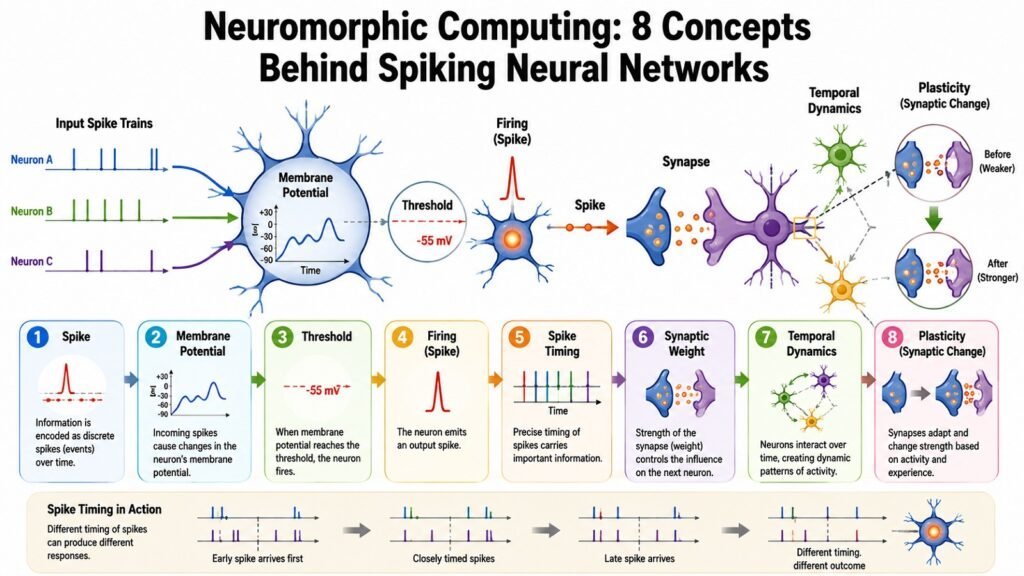
Spiking Neural Network (SSN) is the primary computational model associated with Neuromorphic Computing, though it does not define the entire field. Where conventional artificial neural networks pass continuous-valued activations between layers at every forward pass, SNNs transmit discrete spikes across time. Each artificial neuron integrates incoming spikes, accumulates a membrane potential, and emits a spike when that potential crosses a threshold. It then resets, mimicking the refractory behavior observed in biological neurons.
This distinction carries practical consequences. A conventional deep learning model performs dense matrix multiplications at every layer regardless of input content. An SNN neuron is silent when its accumulated input falls short of threshold and fires only when something meaningful arrives. For sparse or event-driven inputs, total operations can be substantially fewer than in an equivalent conventional network, though accuracy tends to be lower when SNNs are trained directly rather than converted from pretrained conventional models.
Timing carries information in SNNs in ways it does not in conventional networks. The precise moment a spike occurs, its relation to other spikes, and activity patterns over time can all encode meaning. This temporal dimension makes SNNs relevant to auditory processing, gesture recognition, and other tasks where input dynamics matter alongside content.
Training SNNs presents genuine difficulties. Standard backpropagation does not apply because spikes are non-differentiable. Surrogate gradient methods approximate the spike function’s derivative to enable gradient-based training, while conversion approaches translate pretrained conventional weights into SNN form with some accuracy loss. Both have limitations: surrogate gradients are sensitive to hyperparameter choices, and conversions often require high spike rates that erode the sparsity benefit. Accuracy parity with conventional deep learning on standard benchmarks has not been consistently achieved, and SNN training remains one of the field’s most active research challenges.
Table: Neuromorphic Computing — SNN Characteristics vs. Conventional Networks
| Spiking Neural Network (SNN) Characteristic | Explanation or Contrast with Conventional Networks |
| Spike-based signaling | Information encoded as discrete events rather than continuous activations |
| Membrane potential dynamics | Neurons integrate inputs over time and fire when an internal threshold is reached |
| Temporal information | Spike timing and patterns carry meaning absent from static activation values |
| Sparse computation | Inactive neurons perform no operations, reducing total compute for sparse inputs |
| Non-differentiable firing | Standard backpropagation does not apply; surrogate gradient methods are required |
| ANN-to-SNN conversion | Pretrained conventional network weights converted to SNN form with accuracy trade-offs |
| Refractory period | Neurons enter a brief recovery state after firing, limiting maximum spike rate |
| Synaptic delay modeling | Propagation delays between neurons can represent temporal structure in data |
3. Neuromorphic Computing Hardware: Building Intelligent Machines
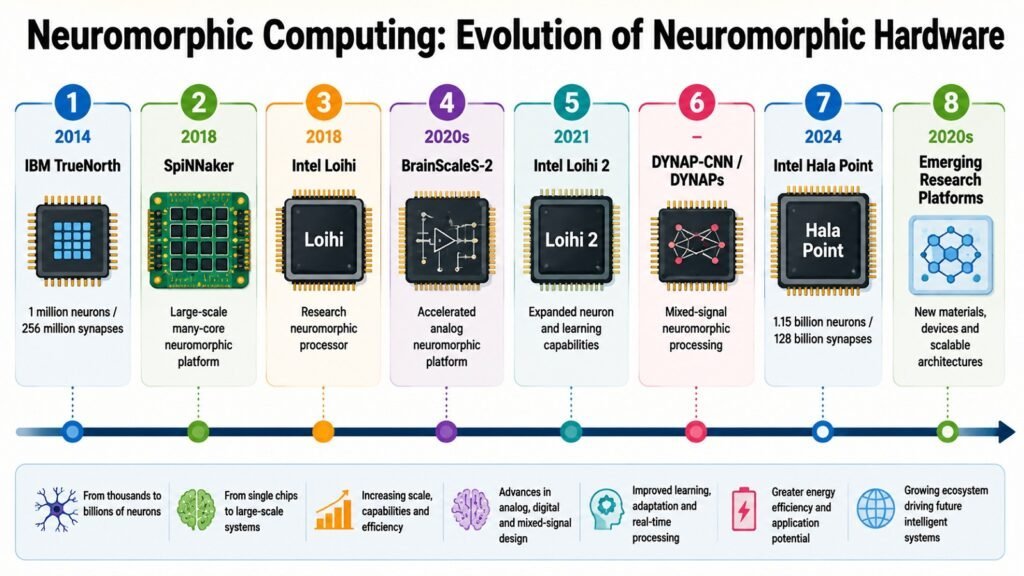
Translating neuromorphic principles into physical hardware requires solving problems quite different from those in conventional processor design. A CPU or GPU optimizes for high-throughput arithmetic on dense data. Neuromorphic hardware must support massively parallel, event-driven, asynchronous computation with local memory, low idle power, and communication pathways suited to sparse spike traffic. The diversity of current platforms reflects the fact that no single design philosophy has prevailed.
IBM’s TrueNorth chip, introduced in 2014, demonstrated that large-scale digital neuromorphic design was feasible at very low power. It integrated one million programmable neurons and 256 million synapses while consuming approximately 70 milliwatts during pattern recognition inference, well below the power of GPU alternatives on comparable tasks. Intel’s Loihi, developed from 2017 onward, added on-chip learning by implementing spike-timing-dependent plasticity in hardware, allowing weights to adjust during operation without off-chip computation. Both platforms are research tools rather than commercial products, but they have enabled hundreds of published studies.
Memristive devices represent a separate direction. A memristor is a two-terminal element whose resistance depends on its history of current flow, giving it non-volatile memory behavior. Arrays of memristors can implement compact artificial synapses with analog resistance values encoding weights directly in device state. Research groups have demonstrated small memristive crossbar arrays performing matrix-vector multiplication in the analog domain at low energy per operation. Device variability, write endurance, and limited precision remain active challenges.
BrainScaleS, from Heidelberg University, uses mixed-signal circuits operating up to ten thousand times biological speed, making it useful for studying plasticity at accelerated time scales. Hardware-software co-design matters as much as the chip itself: without programming frameworks, compiler support, and benchmark workloads, even capable hardware cannot be applied at scale, and this ecosystem gap is a widely recognized limitation of current neuromorphic platforms.
Table: Neuromorphic Computing — Hardware Approaches and Technologies
| Hardware Approach or Platform | Description |
| Intel Loihi | Digital research chip with on-chip STDP learning and asynchronous spike routing |
| IBM TrueNorth | One-million-neuron digital chip designed for low-power inference |
| BrainScaleS | Mixed-signal platform operating up to 10,000x faster than biological time |
| Memristive crossbars | Analog synaptic arrays using resistance to encode synaptic weights |
| SpiNNaker | Manchester University platform using ARM cores for spiking neural simulation |
| CMOS subthreshold circuits | Transistors biased below threshold to approximate analog neural dynamics |
| Photonic neuromorphic chips | Emerging optical approach for fast, low-energy spike processing |
| Neuromorphic FPGA prototypes | Reconfigurable hardware for evaluating SNN architectures before fabrication |
4. Neuromorphic Computing Sensors: Bringing Intelligence to Perception
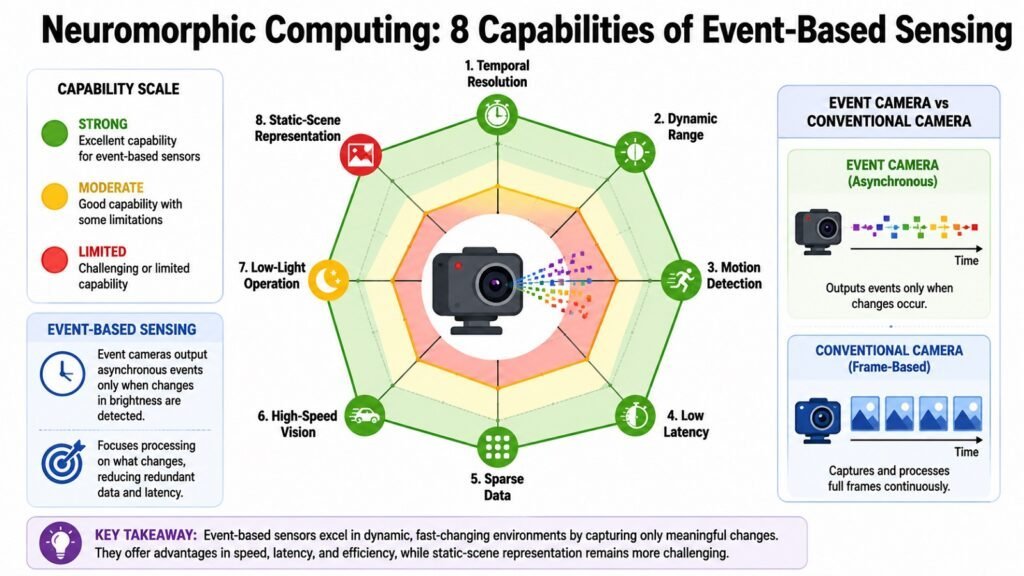
A neuromorphic system that begins intelligence at the point of sensing avoids the cost of delivering raw data to a processor for interpretation. Traditional cameras capture full frames at a fixed rate, generating data continuously regardless of whether anything has changed. An event-based vision sensor generates output only when individual pixels detect a light intensity change above a threshold, producing a sparse stream of timestamped events rather than dense frames.
The Dynamic Vision Sensor, developed at ETH Zurich and the University of Zurich, is among the most studied event-based cameras in research. It detects motion with latencies in the microsecond range, operates with low power during periods of low scene activity, and supports high effective dynamic range because each pixel responds independently to local contrast. These properties suit it well to fast-moving robotics and high-speed tracking. Research has demonstrated DVS-based systems achieving latency advantages over frame-based alternatives in controlled settings, with performance depending on lighting and scene complexity.
Neuromorphic auditory sensors translate acoustic signals into spike trains that mimic the biological cochlea. The silicon cochlea, associated with Carver Mead’s group, uses analog filters to decompose sound by frequency, with each channel producing spikes when its band is active. This supports keyword detection and speech processing at power levels well below what a conventional digital signal processing pipeline requires.
Neuromorphic tactile sensors are under development for robotic manipulation, where detecting contact and slip events rapidly is critical. Research at the Italian Institute of Technology has demonstrated event-based tactile arrays capable of capturing contact dynamics relevant to grasping tasks. Across all sensing modalities, the principle is consistent: when sensing itself is event-driven and spike-coded, the data pathway from environment to decision becomes more coherent and avoids the bandwidth and latency costs of raw frame or waveform transmission.
Table: Neuromorphic Computing — Sensing Technologies and Characteristics
| Sensing Technology | Description |
| Dynamic Vision Sensor (DVS) | Event-based camera with per-pixel asynchronous output and microsecond latency |
| Silicon cochlea | Analog auditory sensor converting sound into frequency-channeled spike trains |
| Event-based tactile sensing | Pressure arrays generating spikes in response to contact and slip events |
| High dynamic range | Per-pixel local contrast response avoids the saturation limits of frame cameras |
| Sparse data output | Events generated only on change, reducing data volume during stable scenes |
| Temporal resolution | Timestamps on individual events preserve timing information lost in frame sampling |
| Olfactory neuromorphic sensors | Research systems mimicking chemical receptor arrays with spike-coded outputs |
| End-to-end spike coding | Sensor output formatted as spikes feeds directly into downstream SNN processing |
5. Neuromorphic Computing Learning: Enabling Adaptive Intelligence
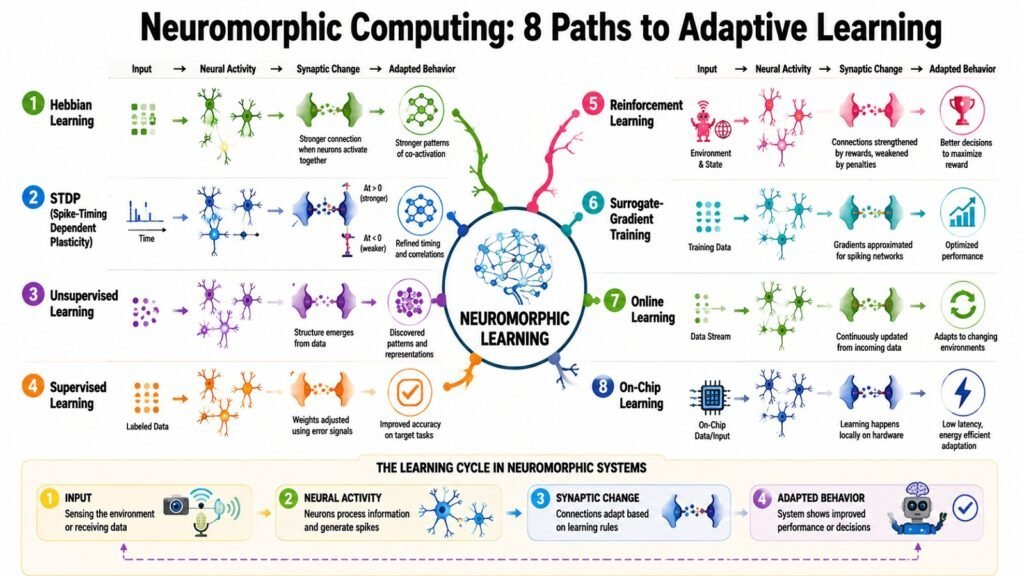
Learning is the most biologically motivated aspect of Neuromorphic Computing. The brain does not arrive with fixed synaptic weights; it changes in response to experience through synaptic plasticity, the strengthening or weakening of connections based on activity. Neuromorphic researchers replicate this in hardware to produce systems that adapt after deployment without retraining in a data center.
Spike-timing-dependent plasticity is the most studied biological learning rule in this field. In STDP, the direction and magnitude of a synaptic weight change depend on the relative timing of pre- and post-synaptic spikes. A pre-synaptic neuron that fires shortly before its target strengthens the synapse; reversed order weakens it. This rule supports unsupervised pattern detection because repeated co-activation naturally strengthens connections between neurons that tend to fire together. Hardware STDP has been demonstrated on Intel Loihi and IBM TrueNorth, though achieving competitive accuracy on complex tasks remains an active challenge.
Online learning, updating weights during operation, distinguishes neuromorphic from conventional inference deployments. A standard deep learning model is trained offline and deployed with fixed weights, while an online neuromorphic system could adapt to environmental shifts without retraining. Research has demonstrated online SNN learning for gesture recognition and odor detection, but scaling this to high-dimensional problems while preserving accuracy remains unsolved.
Supervised SNN learning is complicated by the non-differentiable nature of spikes. Surrogate gradient techniques approximate the spike derivative and have made gradient-based training more tractable, but an accuracy gap with conventional networks on standard benchmarks persists. Reinforcement learning has been explored with reward signals modulating plasticity in ways that parallel biological neuromodulation. In practice, the most viable current strategy for many applications is hybrid: conventional offline training initializes weights, and limited on-chip adaptation refines them during deployment. This combines the accuracy of established training pipelines with some degree of adaptivity at the edge.
Table: Neuromorphic Computing — Learning Mechanisms and Characteristics
| Learning Mechanism | Description |
| STDP | Weight change determined by relative timing of pre- and post-synaptic spikes |
| Unsupervised learning via STDP | Repeated co-activation strengthens connections without labeled training data |
| Online learning | Synaptic weights updated during operation without offline retraining |
| Surrogate gradient training | Approximated spike derivative enables gradient-based supervised SNN training |
| ANN-to-SNN weight transfer | Weights trained conventionally converted for use on SNN hardware |
| Reinforcement learning | Reward signals modulate plasticity in ways inspired by biological neuromodulators |
| Local learning rules | Weight updates use only local synaptic activity, avoiding global error signals |
| Hybrid training approach | Offline conventional training followed by on-chip fine-tuning during deployment |
6. Neuromorphic Computing and Event-Driven Processing: Computing When It Matters
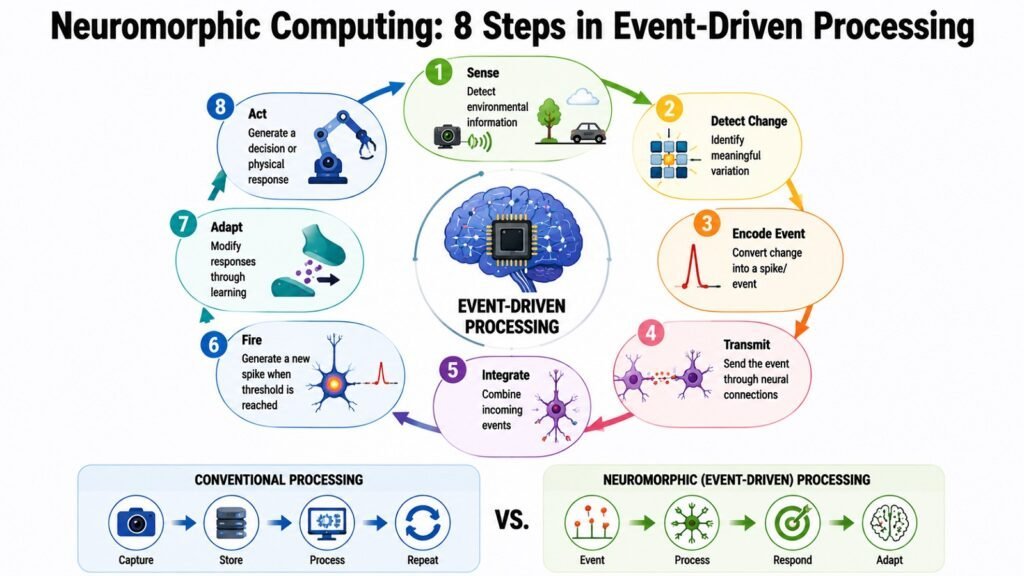
Event-driven processing is one of the defining operational characteristics of Neuromorphic Computing. Conventional processors operate synchronously, executing instructions at every clock cycle regardless of whether the computation produces a meaningful result. A GPU classifying images processes every pixel of every frame whether or not anything in the scene has changed. Event-driven processing replaces this continuous cycle with activity triggered only by meaningful changes.
In a neuromorphic system, events are spikes. A neuron fires when its accumulated input exceeds a threshold, and the spike propagates through the network, triggering computation only where it lands. During stable periods, large portions of the network remain silent. This sparse, asynchronous activity pattern is how event-driven processing reduces total operations for suitable workloads. The qualifier matters: dense or continuous inputs can produce more operations in an SNN than in an equivalent conventional network, because encoding that information as spikes introduces overhead that partially or fully offsets the sparsity benefit.
Connecting event-driven processing to sensors reveals the full potential of this approach. When a DVS camera detects motion, it emits a burst of events. Those events propagate through a neuromorphic processor, activating only the relevant neurons. A response can be generated within microseconds of the stimulus. This low-latency pipeline from perception to decision is one of the strongest arguments for neuromorphic systems in robotics, autonomous vehicles, industrial monitoring, and security, where reaction time is critical and frame-based processing introduces unacceptable delay.
Research evidence is consistently workload-specific. Studies of gesture recognition using DVS sensors and SNN processors have demonstrated latency reductions compared with frame-based pipelines. Studies of dense visual object recognition have found that the sparsity benefit diminishes when scene activity is high. Event-driven processing is a design tool that fits certain problem structures well, not a universal performance multiplier.
Table: Neuromorphic Computing — Event-Driven Processing Characteristics
| Characteristic | Description |
| Asynchronous operation | Computation triggered by events rather than a fixed clock cycle |
| Sparse activation | Only neurons receiving sufficient input activate; most of the network stays idle |
| Low-latency response | Events propagate and trigger processing within microseconds of the stimulus |
| Temporal event encoding | Spike timing carries information about when changes occurred |
| Reduced data movement | Sparse spike traffic requires less bandwidth than dense activation matrices |
| Workload dependency | Sparsity benefit diminishes when input activity is dense or continuous |
| Event-sensor compatibility | Pairs naturally with DVS cameras and other event-generating sensors |
| Parallel propagation | Multiple events propagate through different paths simultaneously without synchronization |
7. Neuromorphic Computing Energy Efficiency: Powering Efficient Intelligence
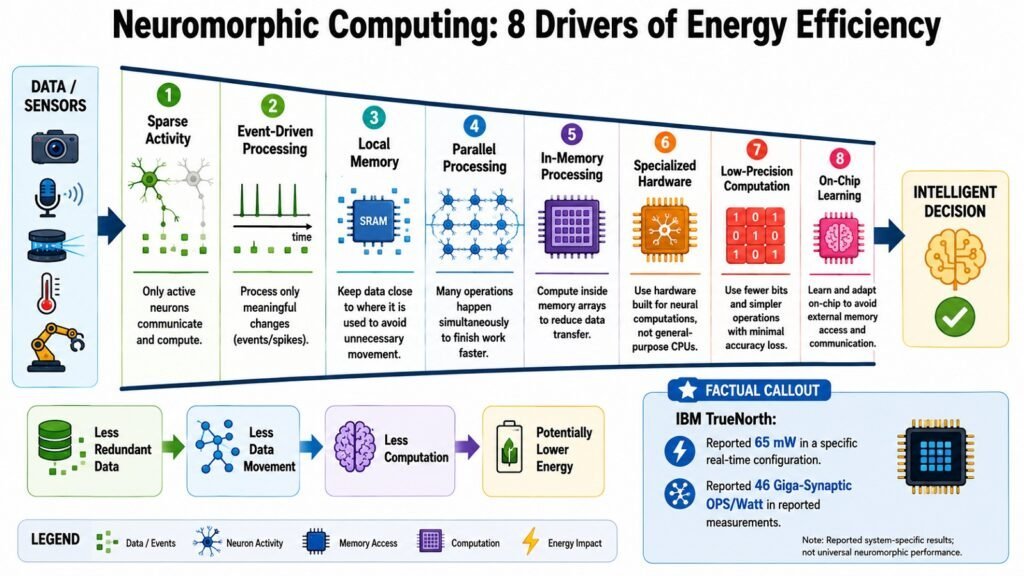
Energy efficiency is one of the primary motivations for Neuromorphic Computing and one of the areas where misleading claims are most common. The human brain consumes roughly 20 watts to support perception, reasoning, and motor control at a level no artificial system has matched. This observation inspires neuromorphic engineers, but it does not mean any neuromorphic chip will automatically outperform a GPU on any given task. Understanding what actually drives efficiency is essential for evaluating the field critically.
Several architectural mechanisms contribute to lower energy consumption. Sparse, event-driven computation reduces total operations when input is sparse. Memory-compute integration cuts the cost of data movement, which accounts for a large share of power in memory-bound workloads. Asynchronous operation eliminates clock distribution energy. Subthreshold analog circuits operate at voltages below standard digital logic. These mechanisms can combine to produce meaningful efficiency advantages, but only when workload and input characteristics match the architecture’s strengths.
Published comparisons support specific claims. IBM’s TrueNorth demonstrated approximately 70 milliwatts during pattern recognition inference, far below GPU alternatives on similar benchmarks. Intel’s Loihi achieved energy-per-inference advantages on sparse tasks such as keyword spotting compared with embedded processors. These results are benchmark-specific and do not generalize directly. When SNNs require high spike rates to maintain accuracy on dense tasks, the energy advantage can shrink significantly.
Readers evaluating efficiency claims should identify which metric is being reported. Energy per inference, energy per synaptic operation, and average power are not interchangeable, and the comparison baseline, technology node, and input spike rate all affect results. Neuromorphic hardware may offer genuine efficiency gains for sparse, event-driven edge workloads, but those gains must be measured against appropriate baselines rather than assumed.
Table: Neuromorphic Computing — Energy Efficiency Factors and Metrics
| Factor or Metric | Description |
| Energy per inference | Total energy consumed to classify or respond to one input instance |
| Energy per synaptic op | Energy cost of a single spike-triggered weight accumulation |
| Spike activity rate | Higher spike rates increase total energy; sparsity is required for efficiency gains |
| Memory access energy | Data movement between memory and compute is a major share of system power |
| Clock elimination | Asynchronous designs avoid energy cost of distributing a global clock |
| Subthreshold operation | Below-threshold analog circuits consume less power per operation than digital gates |
| Technology node dependence | Efficiency comparisons must account for differences in semiconductor process generation |
| Workload sparsity | Energy advantages most pronounced for sparse inputs; diminish on dense tasks |
8. Neuromorphic Computing Applications: From Intelligent Sensors to Autonomous Systems
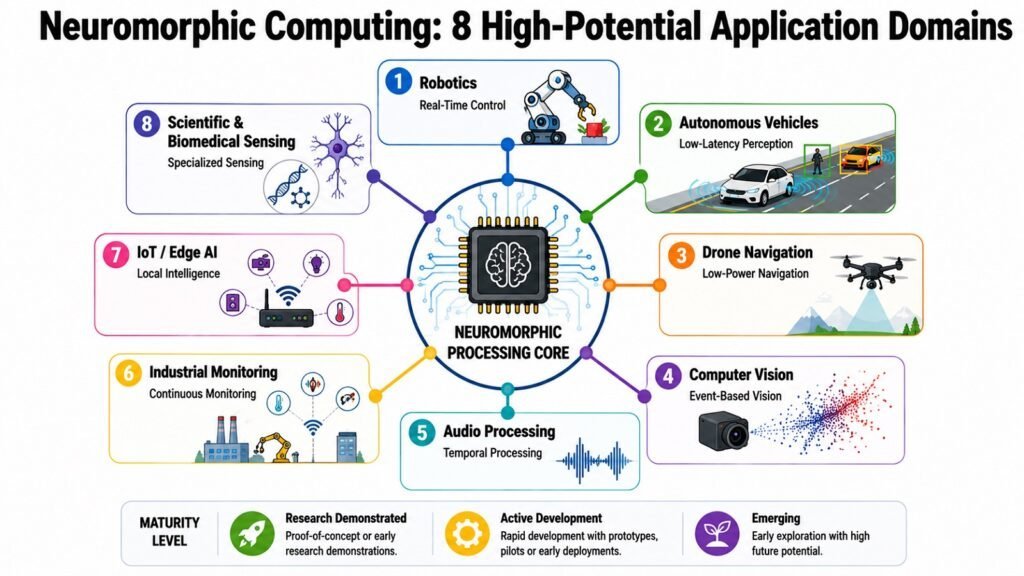
The practical relevance of Neuromorphic Computing is clearest when examined through specific problem types. The most compelling application areas share certain characteristics: real-time processing of sparse or temporally structured data, tight power constraints, rapid response requirements, or a need for post-deployment adaptation. Where these conditions are present, neuromorphic research has produced credible evidence of advantage. Where they are absent, conventional processors or AI accelerators generally remain more competitive.
Robotics is among the most active domains. Robots operating in dynamic environments must respond quickly to visual, tactile, and proprioceptive inputs. Research at ETH Zurich, Heidelberg University, and the University of Edinburgh has demonstrated neuromorphic control loops for obstacle avoidance, drone stabilization, and manipulation using DVS cameras and SNN processors, achieving response times in the millisecond range. The coherence between event-based sensing and event-driven computation is well matched to the temporal demands of physical interaction.
Edge AI and IoT applications represent another strong fit. Battery-powered edge devices with limited connectivity benefit from always-on processing at milliwatt power levels. A keyword-spotting module using a neuromorphic auditory sensor and a small SNN can detect a trigger word continuously at power levels a GPU cannot sustain. Intel has demonstrated Loihi-based keyword detection at energy per detection below comparable embedded DSP solutions, with accuracy depending on vocabulary size and noise conditions.
Neuromorphic approaches have also been investigated for medical signal monitoring, autonomous vehicle perception, industrial anomaly detection, and brain-computer interfaces. In each case, the key question is whether the problem involves the computational characteristics that neuromorphic systems handle well. A wearable EEG monitor detecting rare epileptic events under continuous low-power operation is a strong candidate. An autonomous vehicle processing dense high-resolution video at state-of-the-art accuracy is currently better served by GPU-class hardware. Matching technology to problem structure is where Neuromorphic Computing delivers real value.
Table: Neuromorphic Computing — Application Areas and Problem Characteristics
| Application Area | Characteristic That Makes Neuromorphic Computing Relevant |
| Mobile robotics | Millisecond response to dynamic scenes under power and weight constraints |
| Keyword spotting | Always-on detection in sparse audio streams at battery-level power budgets |
| Autonomous drone stabilization | High-speed visual and inertial event processing with minimal latency |
| Industrial anomaly detection | Rare, sparse events in continuous monitoring streams |
| Brain-computer interfaces | Real-time decoding of neural spike trains with biologically compatible processing |
| Wearable health monitoring | Continuous low-power signal processing for physiological event detection |
| Smart surveillance | Motion-triggered processing that avoids continuous analysis of static scenes |
| Scientific neural simulation | Hardware-accelerated modeling of biological neural circuit dynamics |
Conclusion — Neuromorphic Computing: The Future of Intelligent Computing
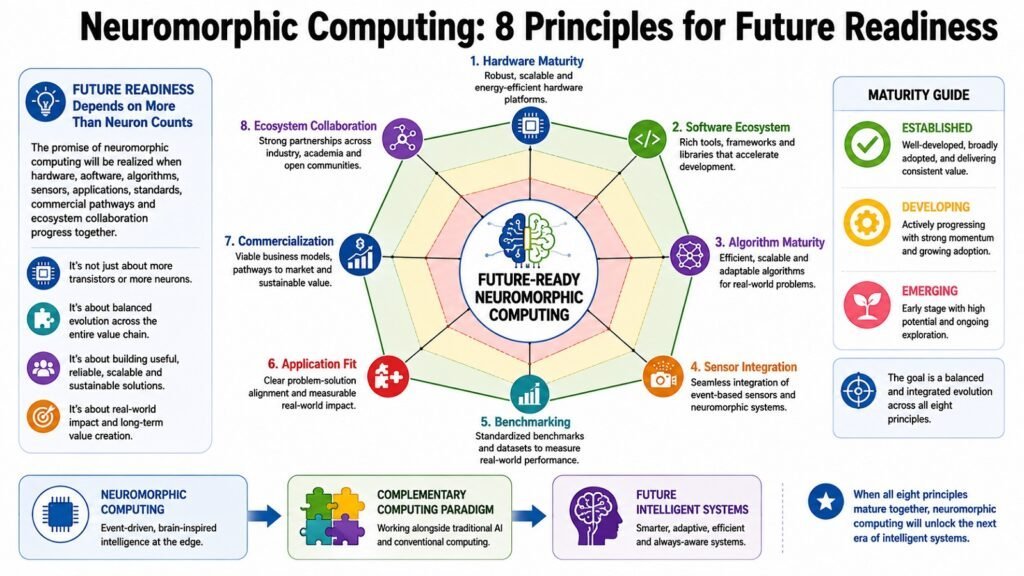
The eight foundations explored in this article reveal Neuromorphic Computing as an integrated approach to rethinking how machines process the world. Architecture integrates memory and computation, enabling distributed asynchronous operation. Spiking neural networks bring a temporal model encoding information in spike patterns unavailable to conventional networks. Hardware platforms from IBM, Intel, and academic groups translate these concepts into physical systems, while neuromorphic sensors extend the paradigm to perception itself.
Learning mechanisms allow neuromorphic systems to adapt in deployment, with STDP and online learning offering biologically motivated pathways beyond fixed-weight inference. Event-driven processing gives the field its operational signature: responding to meaningful change rather than continuously processing every data point. Energy efficiency follows from these choices, but only for workloads with the right structure. Applications anchor the framework — robotics, edge AI, and real-time systems under power and latency constraints are where current research shows the clearest advantage.
Significant challenges remain. Software ecosystems are immature compared with GPU-based toolchains, training SNNs accurately at scale is unsolved, hardware platforms are primarily research tools, and standardized benchmarks are still emerging. The technology is best understood as a complementary paradigm, most effective alongside conventional processors in heterogeneous systems.
What justifies continued investment is mounting research evidence for specific advantages and the growing relevance of the problems these systems address. As AI moves to the edge and autonomous systems demand faster and more adaptive intelligence, the strengths of Neuromorphic Computing become more valuable. Whether hardware maturity, software tooling, and training methods advance fast enough to translate that promise into broad deployment will determine the ultimate role this technology plays in intelligent computing.
Table: Neuromorphic Computing — Eight Key Takeaways
| Takeaway | Conclusion |
| Architectural integration | Co-locating memory and compute reduces data-movement costs for sparse workloads |
| SNNs differ fundamentally | Spike-based computation encodes timing and sparsity not available in conventional ANNs |
| Hardware diversity | No single platform dominates; digital, analog, and mixed-signal designs involve trade-offs |
| Sensor-processor coherence | Event-based sensors and neuromorphic processors form a coherent low-latency pipeline |
| Learning remains challenging | On-chip plasticity is demonstrated but accuracy at scale is an open research problem |
| Event-driven benefit is conditional | Sparsity gains require sparse input; dense workloads reduce or eliminate the advantage |
| Energy claims need context | Efficiency advantages are real for specific workloads but must be verified against baselines |
| Complementary paradigm | Neuromorphic Computing is most effective alongside conventional processors |