Table of Contents
Introduction: Organizational Structure – A Critical Component of Business Ecosystem
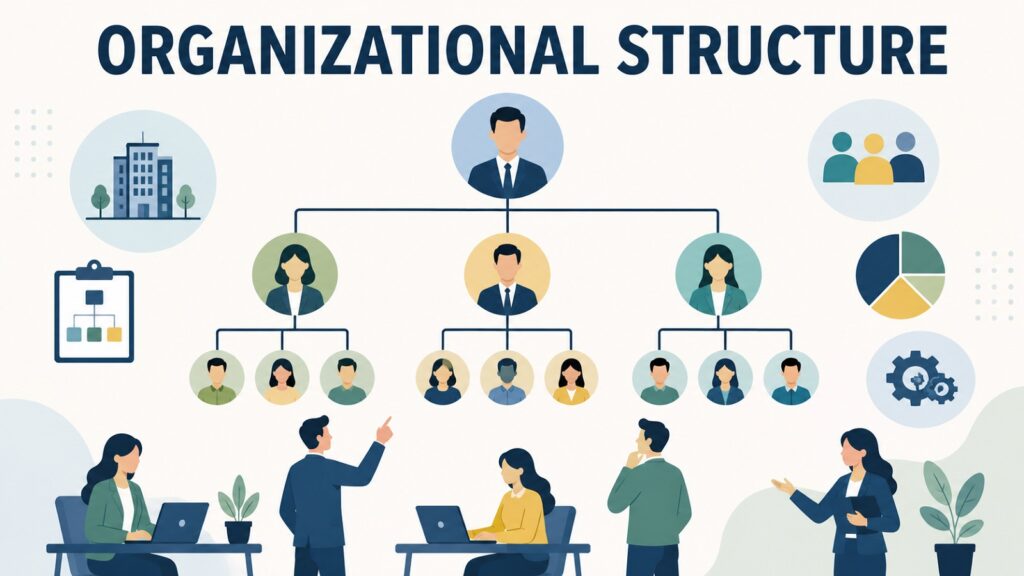
Every business has a shape. You may not have drawn it on paper, but it exists in how decisions move, how authority flows, and how work gets done from one level to the next. That shape is called Organizational Structure. It is not just a chart hanging on a wall. It is the operating system that keeps a business functioning, even when no one is paying attention to it.
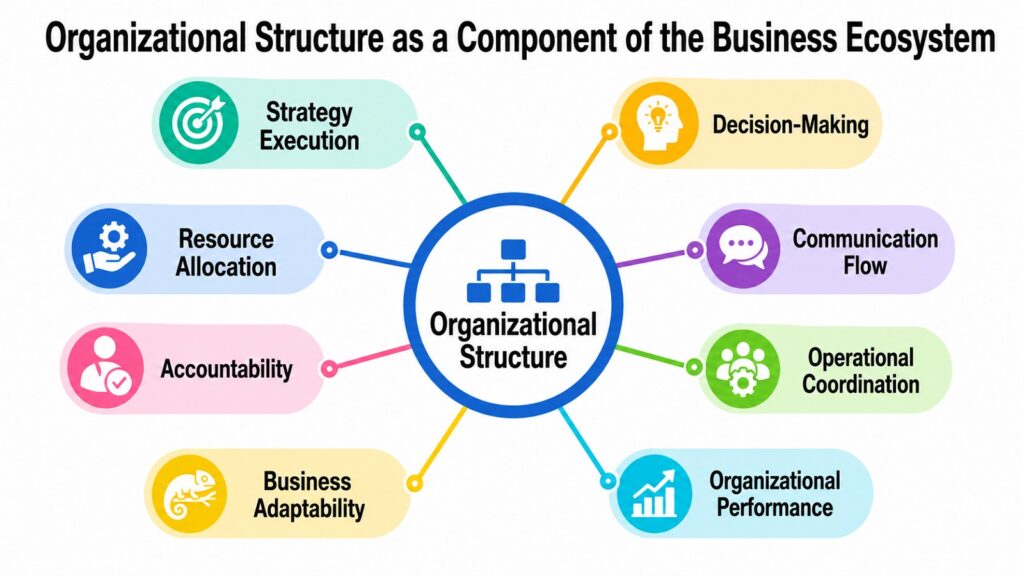
Organizational Structure is one of the most important aspects of the business ecosystem. It determines who holds authority, who bears responsibility, and how information travels across an organization. When a company grows from five people to five hundred, structure is what keeps coordination possible. Without it, decisions stack up, teams pull in different directions, and accountability becomes impossible to trace.
Most organizations initially do not consciously design their structure. Instead, it tends to develop from habits, personalities, and necessities. However, even an unplanned structure constitutes a form of structure and influences outcomes. The distinction between a deliberately crafted Organizational Structure and an accidental one manifests in terms of efficiency, speed, employee clarity, and strategic alignment.
Structure also shapes how businesses adapt. When markets shift or new opportunities appear, a well-designed Organizational Structure allows the business to respond without losing coordination. A poorly designed one creates friction at every decision point and slows down execution precisely when speed matters most.
This article explores eight business pillars that together explain how Organizational Structure works in practice. Each pillar covers a different dimension, from design principles to communication systems to performance measurement. Together, they offer a complete picture of why Organizational Structure is one of the most important decisions any business makes.
Table 1: Organizational Structure Influence Across Eight Business Areas
| Business Area | Structural Influence |
| Decision-making | Determines authority levels and approval routes |
| Accountability | Establishes clear ownership of outcomes |
| Communication | Defines formal information channels |
| Coordination | Aligns cross-functional work |
| Resource allocation | Shapes how budgets and people are assigned |
| Specialization | Groups skills for focused execution |
| Adaptability | Enables or limits responses to change |
| Performance | Connects structure to measurable business results |
1. Organizational Structure Fundamentals: Understanding the Foundation of Business Design
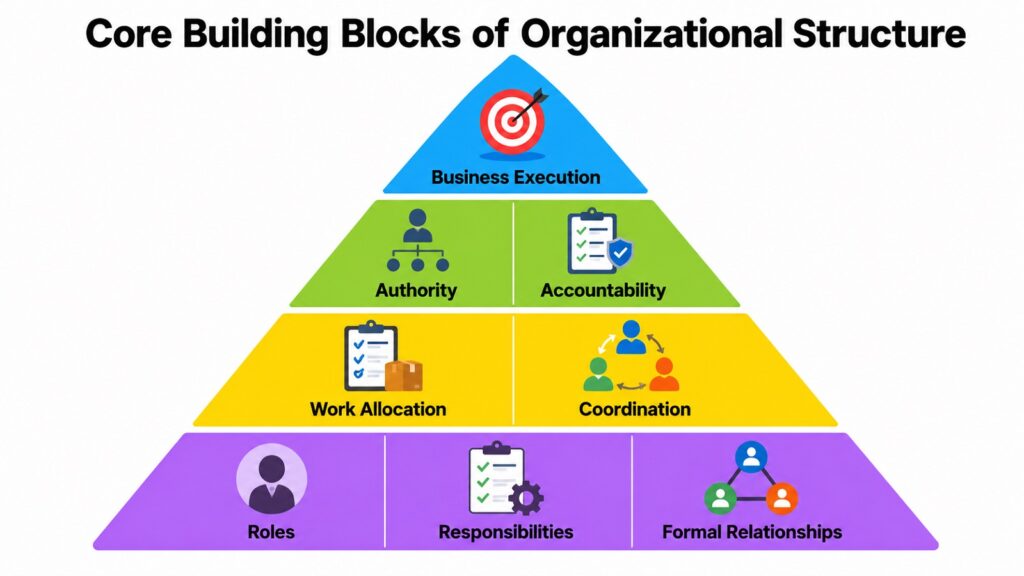
Organizational Structure is the formal arrangement that defines how authority, responsibility, and work are distributed across a business. It answers three basic questions: who reports to whom, who decides what, and who does what. These questions seem simple, but how a business answers them determines almost everything about how it operates.
At its most fundamental level, Organizational Structure exists to enable coordinated effort. A business is a collection of people working toward shared goals, and without structure, effort scatters. Structure creates the channels through which work flows, decisions travel, and results accumulate. It is the framework that turns individual effort into organizational output.
Structure organizes authority by clarifying where decision-making power sits. It distributes responsibility by assigning ownership of tasks, teams, and outcomes. It shapes work distribution by grouping activities to promote efficiency and focus. None of these functions happens automatically. They require deliberate structural choices.
The consequences of a clear Organizational Structure are practical. Employees know who to go to for decisions. Managers know what they own and what they can delegate. Leaders can focus on strategy because execution is handled through reliable reporting channels. Work happens without constant clarification because the structure makes expectations clear.
When Organizational Structure is unclear or misaligned, the consequences are just as visible. Decisions get delayed because no one knows who has authority. Conflicts emerge over overlapping responsibilities. Information gets lost between teams that lack coordination mechanisms. People work hard, but results stay inconsistent because the structural framework cannot carry the load.
Think of Organizational Structure as a business operating system rather than a static arrangement. Just as an operating system manages how hardware and software interact, Organizational Structure manages how people, authority, and work interact. When the operating system is well-designed, the business runs smoothly. When it is outdated or misaligned, friction appears everywhere, and performance suffers.
Table 2: Organizational Structure Fundamentals and Their Business Role
| Structural Element | Business Role |
| Authority distribution | Assigns decision-making rights across levels |
| Responsibility assignment | Clarifies ownership of tasks and outcomes |
| Reporting relationships | Creates accountability chains |
| Work grouping | Organizes related activities for efficiency |
| Span of control | Determines managerial oversight capacity |
| Formalization | Standardizes processes and expectations |
| Centralization level | Controls where decisions are made |
| Coordination mechanisms | Links interdependent teams and functions |
2. Organizational Structure and Organizational Design Principles
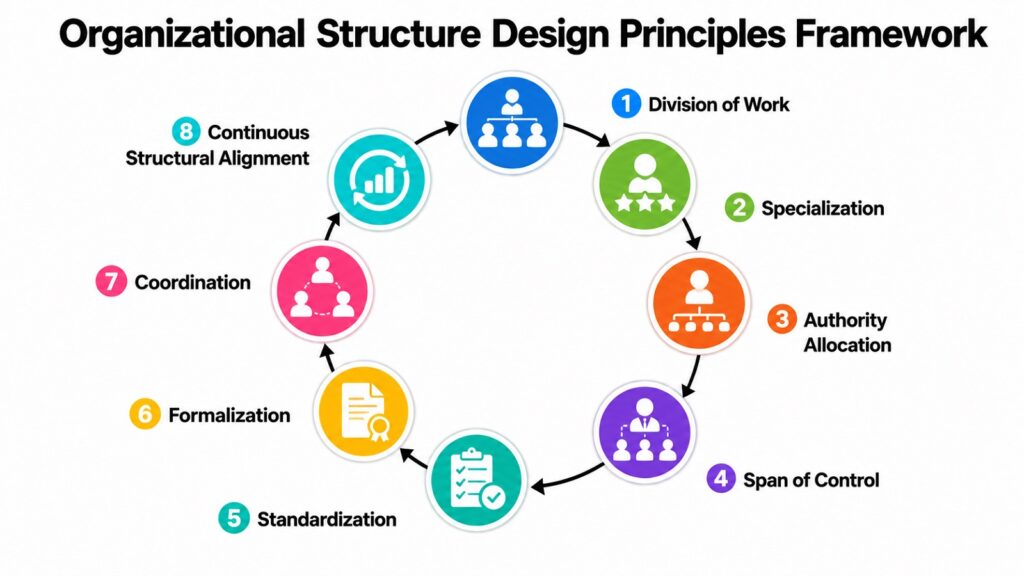
Organizational Structure does not appear on its own. It emerges from deliberate choices about how authority should be distributed, how work should be grouped, and how decisions should flow. These choices are guided by design principles that shape the entire structure. Understanding these principles helps explain why different businesses arrive at different structural arrangements.
Specialization stands as one of the most fundamental design principles. It entails assigning individuals to specific roles based on their skills and expertise. Specialization enhances the quality of execution as individuals cultivate deep capabilities in their respective areas. Nevertheless, if taken to an extreme, it can lead to the creation of silos, in which teams narrow their focus and lose sight of the broader organizational objectives.
Formalization refers to the degree to which rules, procedures, and expectations are written down and standardized. High formalization creates consistency and predictability, which matters enormously in large organizations where individual judgment cannot be relied on at every level. Low formalization allows flexibility and creativity, which suits smaller or innovation-focused businesses. Every business must find its point on this spectrum.
Authority distribution, often called centralization versus decentralization, determines where decisions are made. Centralized structures keep authority at the top, which supports control and consistency. Decentralized structures push authority downward, which supports speed and local responsiveness. Neither is inherently better. The right choice depends on the business environment, the nature of decisions being made, and the capability of people across the organization.
Span of control refers to the number of people a manager directly oversees. Narrow spans mean fewer direct reports per manager, allowing closer oversight but createing taller hierarchies. Wide spans mean more direct reports, which flattens the hierarchy but demands capable, self-sufficient employees. Structural design always involves this kind of trade-off, where improving one dimension creates costs in another.
Standardization involves creating repeatable processes that reduce variation and improve reliability. It supports efficiency in high-volume operations but can slow adaptation in dynamic environments. Strong design principles work together as a system. A business that chooses high specialization and high formalization is making a coherent structural choice. A business that combines high specialization with almost no formalization may find itself with capable specialists who can not coordinate effectively.
Table 3: Organizational Structure Design Principles and Their Business Effects
| Design Principle | Business Effect |
| Specialization | Deepens skill and execution quality |
| Formalization | Creates consistency and process reliability |
| Centralization | Strengthens control and uniform decision-making |
| Decentralization | Accelerates decisions and local responsiveness |
| Span of control | Shapes management layers and oversight depth |
| Standardization | Reduces variation across operations |
| Coordination design | Aligns interdependent teams structurally |
| Authority clarity | Prevents overlap and decision paralysis |
3. Types of Organizational Structures: Choosing the Right Model
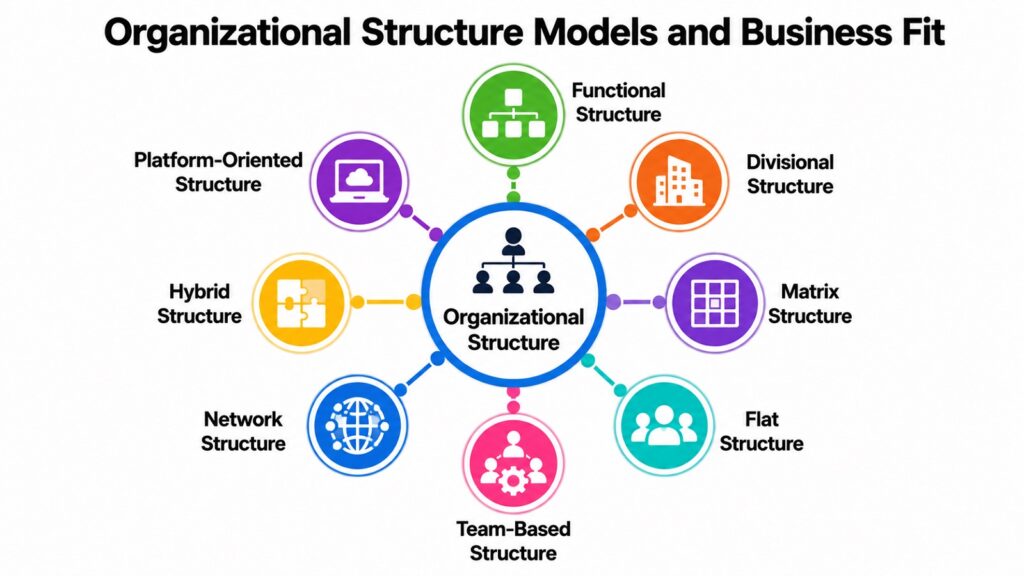
Organizational Structure models are not categories to memorize. They are strategic choices that reflect how a business coordinates its work, distributes authority, and responds to its environment. Different structure types solve different coordination problems, and the best choice always depends on the specific conditions a business operates in.
The functional structure groups people by their area of expertise, such as finance, operations, marketing, or engineering. It promotes deep specialization and efficient use of expertise. It works well when a business has stable operations and benefits from concentrated functional knowledge. The challenge is that cross-functional coordination can become slow and difficult when every project must pass through separate departmental channels.
The divisional structure organizes the business around products, markets, or geographic regions. Each division operates with a degree of autonomy and often has its own functional capabilities. This structure improves focus and accountability within each division but can create resource duplication and inconsistency across the organization.
The matrix structure overlays functional and project-based reporting lines, giving employees dual accountability to both a functional manager and a project or product manager. It enables flexible resource allocation and supports cross-functional collaboration, but managing dual reporting lines requires strong communication and clear authority boundaries. Conflict over priorities is a known challenge.
Flat structures reduce management layers and give employees broader responsibilities. They work well in small companies and creative industries where speed, collaboration, and innovation matter more than hierarchical control. As businesses grow, flat structures can create coordination challenges because the absence of management layers eventually limits oversight capacity.
Network structures rely on a central coordinating entity that contracts or partners with external organizations for specific functions. Technology companies and creative agencies often use this model to stay lean while accessing specialized capability. Control is lower, but flexibility is high.
Holacratic structures distribute authority to self-managing teams called circles, eliminating traditional management hierarchy. This model is used by a small number of progressive organizations that prioritize autonomy and rapid adaptation. It requires high organizational maturity and a strong shared culture to function well.
No Organizational Structure is universally superior. A pharmaceutical company with strict regulatory requirements needs a different structural logic than a software startup chasing rapid growth. The structure should always follow business requirements, not the other way around.
Table 4: Organizational Structure Types and Their Strongest Business Application
| Structure Type | Strongest Application |
| Functional | Stable operations with deep specialization needs |
| Divisional | Multi-product or multi-market businesses |
| Matrix | Project-driven organizations needing flexible teams |
| Flat | Small or creative businesses valuing speed |
| Network | Asset-light models using external partners |
| Holacratic | Self-managing teams with distributed authority |
| Hybrid | Large businesses combining multiple structural logics |
| Geographic | Multinational businesses serving regional markets |
4. Organizational Structure, Hierarchy, and Reporting Systems
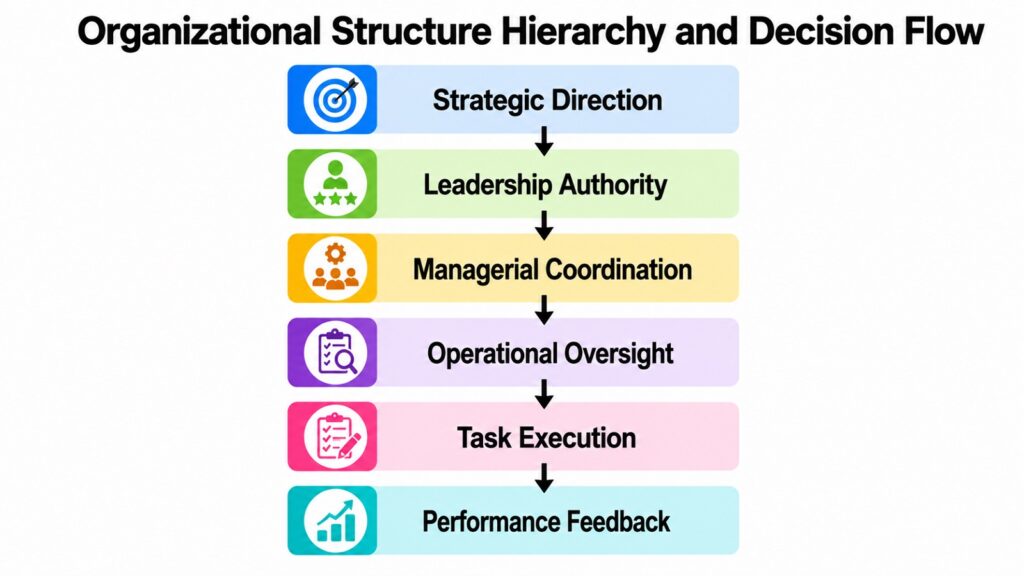
Authority does not execute itself. It becomes action through reporting relationships that connect leaders to teams, decisions to outcomes, and accountability to specific people. Organizational Structure creates these connections through hierarchy and reporting systems, which are two of its most visible and consequential features.
Hierarchy establishes the various levels of authority within an organization. It indicates to all members where decisions are made, who holds ultimate authority on particular issues, and the escalation process when problems exceed an individual’s capacity. In the absence of a well-defined hierarchy, authority becomes unclear, making it difficult to enforce accountability. Every effective organization requires some hierarchy, regardless of the number of layers.
Reporting systems translate hierarchy into practice. When a manager knows who reports to them and what outcomes they are accountable for, execution becomes possible. Reporting relationships create lines of visibility. Leaders can monitor performance, identify problems, and direct resources through the reporting system rather than relying solely on informal communication.
Tall hierarchies have many management layers. They support close oversight and detailed control, which suits large organizations with complex operations and regulatory requirements. But tall hierarchies slow decision-making because approvals must travel through multiple levels. Information also tends to distort as it moves up and down through many layers.
Flat hierarchies have few management layers. Decisions move faster, and communication is more direct, which is valuable in dynamic environments. But wide spans of control place heavy demands on managers and require employees who can operate with greater independence. As businesses scale, purely flat structures eventually require additional layers to maintain coordination.
The most effective Organizational Structure designs use hierarchy as a tool rather than a default. They build reporting systems that give managers visibility without creating excessive approval chains, and they distribute authority at the level where the best decisions can actually be made.
Table 5: Organizational Structure Hierarchy Concepts and Their Business Implications
| Hierarchy Concept | Business Implication |
| Chain of command | Establishes clear escalation and authority lines |
| Tall hierarchy | Supports control but slows decision speed |
| Flat hierarchy | Accelerates decisions but widens management load |
| Span of control | Determines oversight capacity per manager |
| Reporting lines | Creates accountability and visibility pathways |
| Dual reporting | Increases flexibility but requires clear priorities |
| Escalation paths | Routes unresolved decisions to appropriate authority |
| Accountability assignment | Ties outcomes to identifiable owners |
5. Organizational Structure Through Departmentalization and Business Units
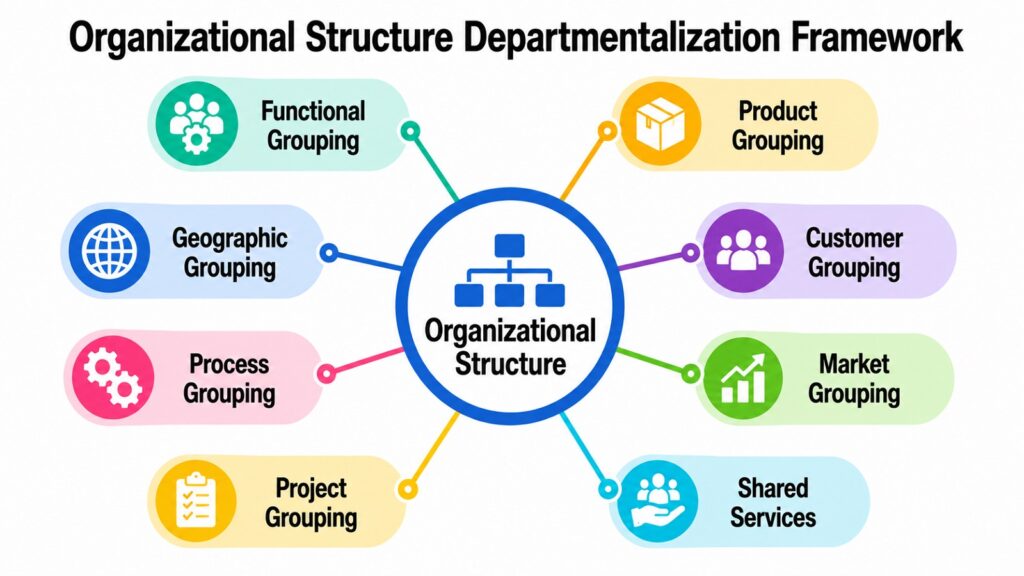
Organizational Structure groups people, activities, and capabilities into units that can focus, coordinate, and deliver results. This grouping process is called departmentalization, and it is one of the most consequential structural decisions a business makes. How you group work shapes how people think about their responsibilities, how resources get allocated, and how the business serves its markets.
Functional departmentalization groups people by their discipline, such as finance, human resources, operations, or marketing. This approach creates deep expertise within each function and makes efficient use of specialized knowledge. It works well when functions are clearly defined, and the interdependencies between them is manageable. The limitation is that functional boundaries can create barriers to cross functional work.
Product departmentalization organizes the business around distinct product lines or services. Each product unit takes full responsibility for its own development, delivery, and performance. This creates strong product ownership and clear accountability, but can lead to resource duplication when each product unit builds its own support functions.
Customer departmentalization structures the business around specific customer segments or client types. This allows the business to tailor its operations to the distinct needs of different customers, significantly improving service quality and customer relationships. It is especially valuable in businesses where customer requirements vary widely.
Geographic departmentalization creates units based on location, which is essential for multinational businesses where local markets, regulations, and cultural expectations differ substantially. Each geographic unit can adapt to its environment while the parent organization maintains strategic oversight.
The choice of departmentalization approach shapes organizational behavior in ways that go far beyond the organizational chart. When work is grouped in a particular way, people naturally develop loyalty to their unit, communicate more within it, and compete with other units for resources. Structural boundaries create social boundaries, and these in turn shape priorities and behaviors.
Table 6: Organizational Structure Departmentalization Approaches and Business Implications
| Departmentalization Type | Business Implication |
| Functional | Deepens expertise; may create cross-unit friction |
| Product-based | Strengthens ownership; risks resource duplication |
| Customer-based | Improves service focus; requires segment clarity |
| Geographic | Enables local adaptation; needs central coordination |
| Process-based | Optimizes workflow; less flexible to change |
| Market-based | Aligns to competitive segments; needs clear boundaries |
| Strategic business units | Creates semi-autonomous performance accountability |
| Project teams | Supports temporary focus; requires reintegration planning |
6. Organizational Structure: Communication and Coordination Systems
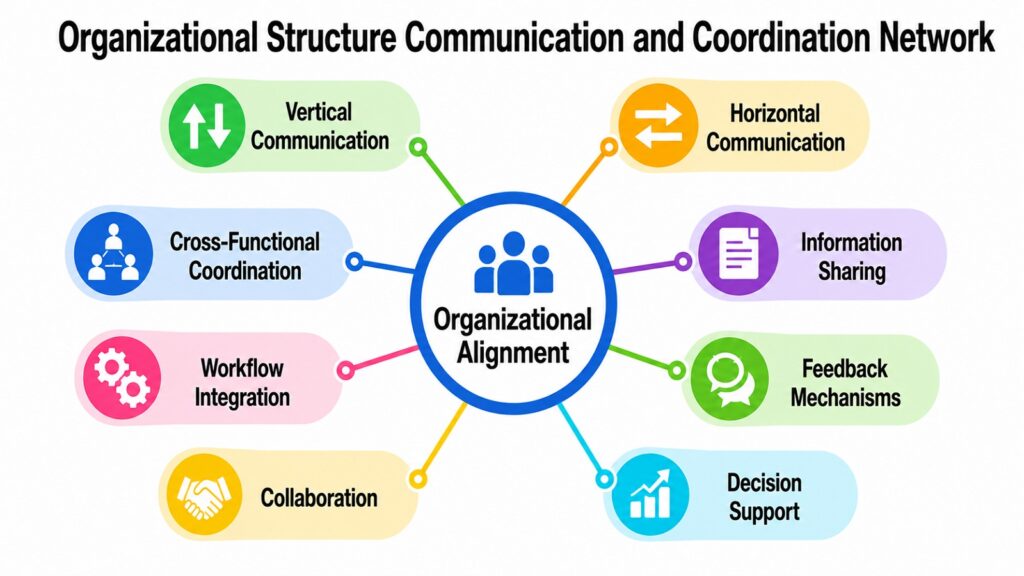
Organizational Structure creates the pathways through which information travels. Communication in a business is not just a behavioral issue. It is a structural one. The way a business is designed determines whether information reaches the people who need it, whether decisions get made with the right context, and whether teams can coordinate effectively across boundaries.
Formal communication channels follow the lines of the organizational structure. Information moves up through reporting relationships, down through management directives, and horizontally through coordination mechanisms. These channels exist because informal communication alone cannot scale reliably in larger organizations. Structure ensures that information has defined routes even when informal networks are not sufficient.
Coordination systems are mechanisms built into Organizational Structure to align the work of interdependent teams. These include regular meetings, shared planning processes, liaison roles, cross-functional committees, and integrated information systems. They are not optional add-ons. They are structural features that allow separate units to work together toward shared outcomes.
When coordination is poor, the symptoms are recognizable. Teams duplicate work because they do not know what others are doing. Decisions get made in isolation and create downstream problems. Customer commitments are missed because one team does not know the other team’s constraint. These problems often appear to be communication failures, but they are actually structural failures.
The flow of information is influenced by structural design in a significant manner. Elevated hierarchies with numerous layers tend to filter and postpone information as it ascends and descends. Conversely, flat hierarchies facilitate a quicker flow but may inundate decision-makers with excessive volume. Decentralized structures direct information to the locations where decisions are made, enhancing local responsiveness; however, they necessitate a robust shared context to ensure alignment.
Strong Organizational Structure design builds communication and coordination capability into the structure itself, rather than relying on people to overcome structural gaps through extra effort. When coordination is built in, execution becomes reliable. When it depends on individual initiative to bridge structural gaps, execution becomes fragile.
Table 7: Organizational Structure Coordination Mechanisms and Their Operational Outcomes
| Coordination Mechanism | Operational Outcome |
| Formal reporting lines | Establishes consistent upward information flow |
| Cross-functional teams | Bridges unit boundaries for shared objectives |
| Liaison roles | Manages ongoing interdependencies between units |
| Integrated planning | Aligns unit priorities toward common goals |
| Shared information systems | Creates visibility across structural boundaries |
| Standing committees | Provides recurring cross-unit decision forums |
| Escalation protocols | Routes unresolved issues to appropriate authority |
| Direct communication norms | Reduces delay in time-sensitive coordination |
7. Organizational Structure, Scalability, and Change Management
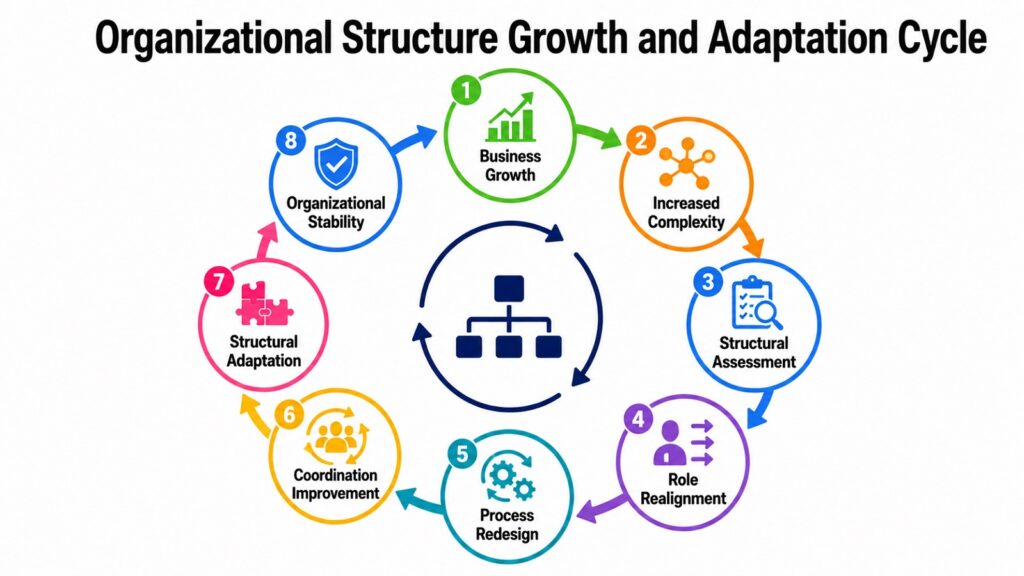
Growth reveals structure. When a business is small, informal coordination and direct communication can compensate for structural gaps. When it grows, those gaps become visible in slower decisions-making, confusion over accountibility, and coordination failures. Organizational Structure must evolve alongside the business, or it becomes a barrier rather than a support.
The most common structural challenge in growing businesses is that the structure designed for one stage of growth does not serve the next. A startup might function well with a flat structure and informal authority, but as it adds people, markets, and complexity, the absence of formal structure creates chaos. Designing a structure for where the business is going, rather than where it currently is, is one of the most important strategic capabilities a leadership team can develop.
Structural change is not just an organizational exercise. It is a change management challenge. People have built relationships, habits, and informal power through existing structural arrangements. When structures change, reporting relationships shift, authority moves, and roles change. Managing this transition requires clear communication, deliberate planning, and honest acknowledgment of what will be different.
Structural redesign often happens in response to specific growth triggers. Entering a new market might require a geographic structure that did not previously exist. Launching a new product line might require a product division with its own leadership. Acquiring another company requires integrating two different Organizational Structures, which is one of the most complex coordination challenges in business.
The most resilient organizations treat Organizational Structure as a dynamic capability rather than a fixed blueprint. They monitor structural effectiveness continuously, identify misalignment early, and make adjustments before dysfunction becomes entrenched. They also recognize that structural change should be driven by business needs rather than management preference or organizational politics.
Effective scalability requires not just building larger versions of existing structures but rethinking how authority, coordination, and communication should work at the new scale. What worked at fifty people will not automatically work at five hundred. Structure must be purposefully redesigned to support each new stage of organizational complexity.
Table 8: Organizational Structure Growth Situations and Structural Responses
| Growth Situation | Structural Response |
| Rapid headcount increase | Formalize reporting lines and roles |
| Market expansion | Add geographic or regional structure |
| New product line | Create dedicated product division or unit |
| Mergers and acquisitions | Integrate or rationalize overlapping structures |
| Increased specialization | Deepen functional or expertise-based grouping |
| Coordination breakdown | Add liaison roles or integration mechanisms |
| Decision bottlenecks | Decentralize authority to appropriate levels |
| Strategy shift | Redesign structure to align with new priorities |
8. Organizational Structure, Organizational Performance, and Effectiveness
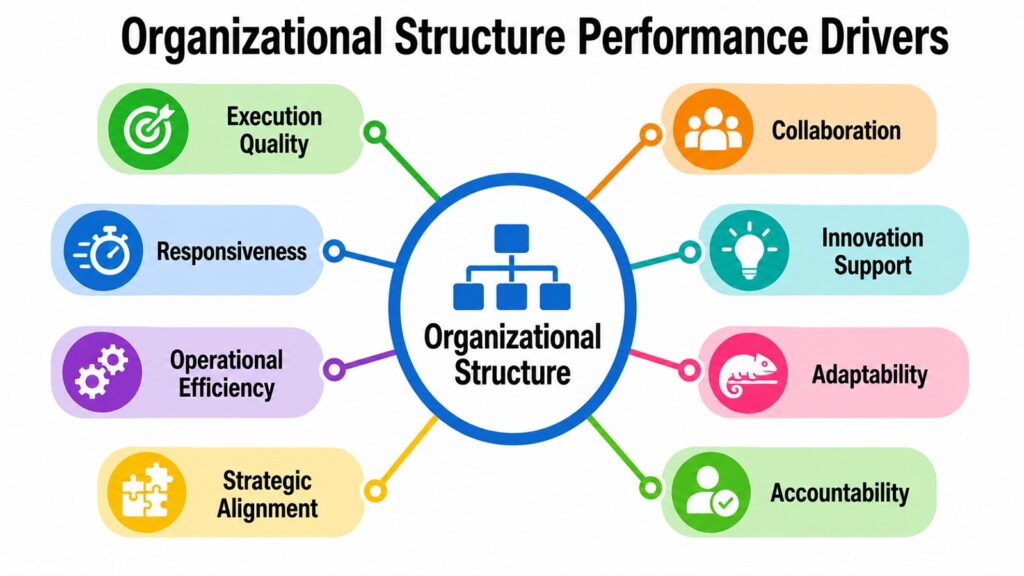
Organizational Structure affects measurable business outcomes in ways that are often attributed to other causes. When execution is slow, the cause might be an approval chain that is too long. When innovation stalls, the cause might be a structure that keeps functional groups too isolated. When customer service is poor, the cause might be a structure that separates the people responsible for customer outcomes from the people who make the relevant decisions.
Performance evaluation should examine structural capability, not just financial results. Financial outcomes are lagging indicators. They tell you what already happened. Structural indicators tell you something about why it happened and whether it is likely to continue. A business with strong financial results but a misaligned structure may be drawing on accumulated advantages while structural problems quietly accumulate.
Execution quality is one of the most direct performance indicators of Organizational Structure. When structure is clear, execution is faster, more consistent, and more accountable. When the structure is unclear or misaligned, execution becomes inconsistent and dependent on individual effort to compensate for structural gaps. Tracking execution quality, including decision speed, project delivery rates, and process reliability, tells you a great deal about structural health.
Responsiveness measures how quickly an organization can react to external changes. A well-designed Organizational Structure allows the business to redirect resources, make decisions, and adjust operations without lengthy approval chains or coordination delays. Poor structural design creates rigidity that shows up as slow response to market shifts, competitive moves, or customer needs.
Innovation capacity is shaped significantly by structure. Organizations that group diverse capabilities and give teams latitude to experiment tend to generate more innovation than those that keep functional groups strictly separated with limited cross-boundary interaction. Structural choices around authority, grouping, and coordination directly effect the conditions on which innovation either flourishes or stagnates.
Strategic alignment measures whether the Organizational Structure is configured to execute the business strategy. A business pursuing rapid geographic expansion needs a structure that supports local decision-making. A business pursuing product leadership needs a structure that supports deep technical specialization. When structure and strategy are misaligned, execution suffers regardless of how capable the people are.
The most effective organizations treat Organizational Structure as an evolving business asset. They evaluate it periodically against their strategic priorities, identify where it is working well and where it creates friction, and make deliberate adjustments. Structure is never finished. It is always being calibrated to the demands of the business environment.
Table 9: Organizational Structure Performance Indicators and Their Interpretation
| Performance Indicator | Structural Interpretation |
| Decision speed | Reflects clarity of authority and approval chains |
| Execution consistency | Indicates process formalization and accountability |
| Cross-unit collaboration | Measures coordination mechanism effectiveness |
| Employee role clarity | Reflects structural definition and communication |
| Innovation rate | Signals openness of structural boundaries |
| Strategic responsiveness | Shows alignment between structure and priorities |
| Talent retention | Reflects clarity of growth paths and accountability |
| Customer satisfaction | Indicates structural alignment with service delivery |
Conclusion: How Organizational Structure Creates Sustainable Business Advantage
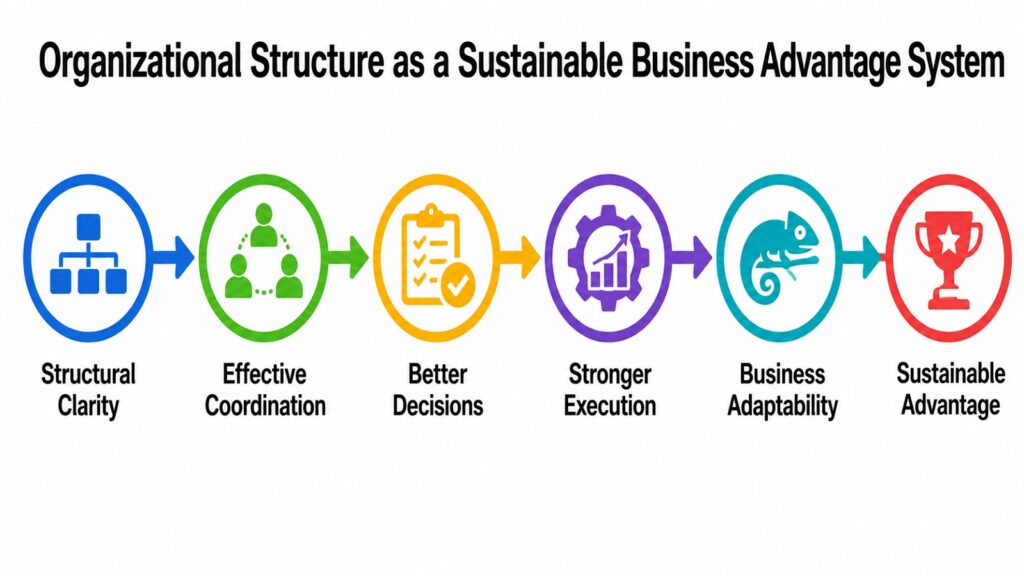
Every pillar explored in this article connects to one central truth: Organizational Structure is not a background feature of a business. It is an active force that shapes how decisions get made, how work gets done, how people coordinate, and how organizations grow and adapt over time.
The eight pillars covered here, from foundational design to performance measurement, reveal that Organizational Structure operates at every level of business reality. It is present in the reporting relationships that create accountability, in the departmental boundaries that shape focus, in the coordination mechanisms that connect execution, and in the structural redesigns that allow businesses to scale without losing coherence.
Treating Organizational Structure as a fixed blueprint is a mistake that many businesses make. Structure should be treated as a living business capability, one that requires continuous attention, honest evaluation, and deliberate adjustment. The businesses that do this well maintain execution quality and strategic alignment even as they grow and as their environments change.
The deepest insight this article can offer is simple but easy to overlook: the quality of your Organizational Structure is the quality of your business execution. Come back to these pillars when you need to evaluate why things are working or why they are not. The answers are usually structural.
Table 10: Organizational Structure, Business Pillars, and Core Summary
| Business Pillar | Core Summary |
| Fundamentals | Structure defines how authority and work are distributed |
| Design principles | Deliberate choices shape execution and flexibility |
| Structure types | Models solve different coordination problems |
| Hierarchy and reporting | Authority becomes action through clear accountability |
| Departmentalization | Grouping shapes focus, resources, and behavior |
| Communication systems | Structure creates reliable information pathways |
| Scalability and change | Structure must evolve to support growth stages |
| Performance and effectiveness | Structure determines execution and strategic alignment |