Table of Contents
Introduction: Google Competitive Advantage and the Rise of a Global Leader
Credit: iken3
The story of Google is not simply a story of a company that got lucky. It is a story of how a small research project at Stanford turned into one of the most durable competitive positions in the history of business. Today, when researchers, investors, and management scholars talk about digital dominance, the Google Competitive Advantage almost always enters the conversation. Very few organizations have managed to build an edge so wide, so deep, and so difficult to copy.
Go back to the mid-1990s, and the internet looked like a chaotic library with no system. Yahoo, AltaVista, Lycos, Excite, and many others were all trying to make sense of it. They were crawling pages, indexing content, and returning results that were often cluttered and unreliable. Users moved from one engine to another, hoping to find something useful. There was no clear winner, and competition was fierce.
Into this crowded space, two graduate students named Larry Page and Sergey Brin introduced something different. Their approach treated the web as a network of relationships rather than a pile of documents. A page that other pages pointed to was likely more important than one that nobody referenced. That logic, simple as it sounds, changed everything. Google returned results that actually helped people find what they were looking for.
That early technical insight created trust. And trust, once established, is very hard to take away. People came back. They searched more. They told others. The company grew not because it advertised heavily in its early years but because its product genuinely worked better than what came before. The Google Competitive Advantage was not built on marketing. It was built on utility.
The central question this article tries to answer is this: how did Google build a global edge that competitors have struggled to replicate? The analysis here draws on business strategy, competitive advantage frameworks, market dynamics, and organizational capabilities. This is not a company profile. It is a case study that looks at evidence, applies theory, and extracts lessons that are relevant beyond Google itself. The article examines search technology, data systems, digital ecosystems, network effects, innovation, and the challenges that Google now faces. Each section connects practice to theory and offers something useful for managers, entrepreneurs, and students thinking about how competitive advantage is created and sustained.
1. Google Competitive Advantage Through Superior Search Technology
Credit: iken3
Before Google arrived, search engines had a real problem. They ranked pages based on keyword frequency. If a page mentioned a particular word many times, it ranked higher for that word. That sounds logical until you realize it rewards repetition rather than relevance. Websites began stuffing keywords into pages to trick the algorithms. The quality of the results suffered. Users grew frustrated.
Google’s founders approached the problem differently. Their PageRank algorithm treated hyperlinks as votes. If a website linked to another page, that was treated as an endorsement. A link from a widely trusted site carried more weight than a link from an obscure one. This network-based logic gave Google a way to measure authority rather than just frequency. The results were noticeably better, and people noticed.
The Resource-Based View of competitive advantage, developed by scholars like Jay Barney, argues that sustainable advantages come from resources that are valuable, rare, difficult to imitate, and well-organized. Google’s early search technology met most of those criteria. It was clearly valuable because it solved a real user problem. It was rare because nobody else had developed it at the same scale. And it was difficult to imitate because the algorithm’s effectiveness depended on processing a vast and growing index of web pages, which required infrastructure that rivals found hard to match.
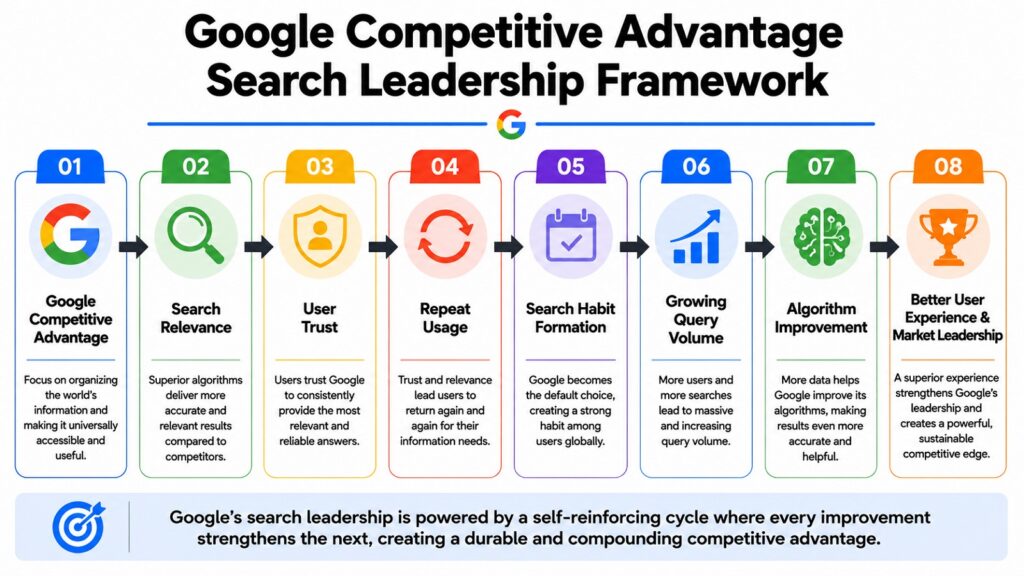
What made the advantage deepen over time was that search quality drove usage, and usage generated data, and data improved quality. This is not a simple linear progression. It is a reinforcing cycle. Every search query taught the system something. Every click on a result told Google whether that result was useful. Millions of such signals accumulating every day meant that the algorithm kept improving while competitors had smaller datasets to learn from.
The strategic lesson here goes beyond technology itself. Google did not merely build a clever algorithm. It built a capability that improved through use and created barriers that compounded over time. Organizations in other industries can take something from that. A capability that grows stronger with experience is more defensible than one that stays static. If your product gets better every time someone uses it, you have something that is genuinely hard to replicate.
Search also became the gateway through which users interacted with the digital world. Controlling that gateway meant controlling the most valuable real estate in the attention economy. Advertisers needed to be where users were looking. Google’s search position gave it access to demand at a moment of intent, which turned out to be the most commercially potent advertising slot ever created.
Table 1: Google Competitive Advantage — Search Quality Factors and Strategic Benefits
| Google Competitive Advantage – Search Quality Factor | Strategic Business Impact |
|---|---|
| PageRank algorithm | Delivered more relevant results, built early user trust |
| Query understanding | Matched intent rather than keywords, reduced bounce rates |
| Speed of results | Set user expectations for instant access, increased return visits |
| Spam resistance | Maintained result quality as web grew, protected brand trust |
| Personalization signals | Made results more contextual, increased user retention |
| Autocomplete and suggestions | Reduced search effort, improved user experience and session depth |
| SafeSearch and content filters | Expanded usability across audiences, broadened advertiser appeal |
| Continuous algorithm updates | Sustained quality leadership, raised the cost of imitation for rivals |
2. Google Competitive Advantage Through Data and Learning Effects
Credit: iken3
Data has become one of the most discussed topics in modern business. But simply collecting data does not create a competitive advantage. What matters is what an organization does with it. Google’s approach to data is worth studying closely because it illustrates the difference between having information and converting it into strategic capability.
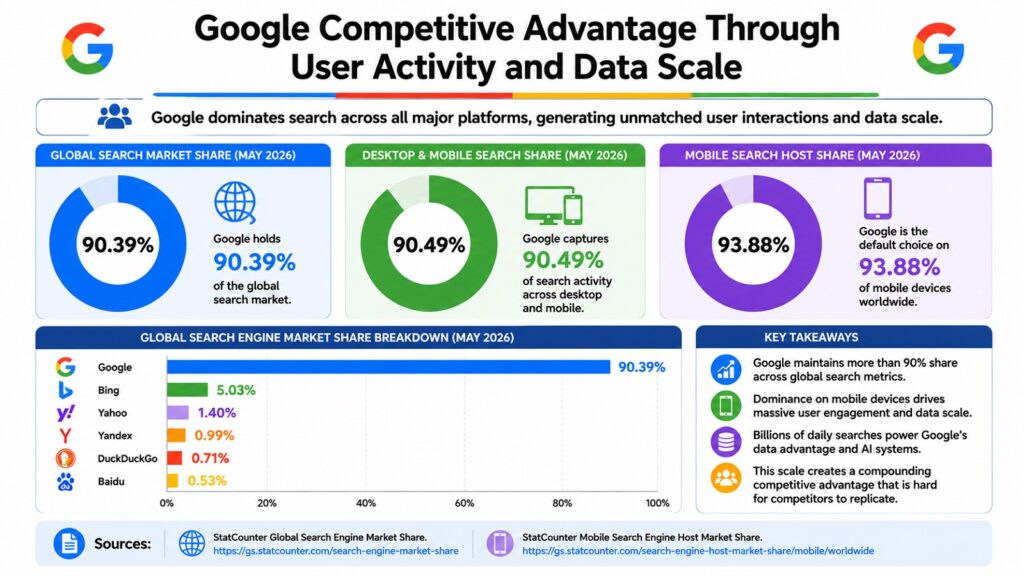
Google processes more than 8.5 billion searches every day. Each of those searches carries signals. The words someone uses, the results they click on, the time they spend on a page, the queries they refine — all of this feeds back into the system. At scale, these signals form a picture of how people think, what they want, and how they evaluate information. No survey or focus group could produce that kind of depth.
The concept of learning effects describes how organizations improve through accumulated experience. In digital platforms, the equivalent is algorithmic improvement through interaction with data. Google sits at the center of an enormous interaction loop. Better results bring more users. More users generate more data. More data enables better results. The loop has been running for more than two decades.
This also connects to data network effects. Unlike traditional network effects, where value comes from connecting users to each other, data network effects work because a larger user base generates better training signals for machine learning systems. Google’s advertising platforms, translation tools, image recognition, and voice assistant all benefit from the volume of interaction data the company accumulates daily.
The question of sustainability is worth raising honestly. Regulators in Europe and the United States have scrutinized how Google uses data. Privacy laws in several jurisdictions restrict the ways in which user information can be stored. If those restrictions tighten further, the data advantage may narrow. Still, Google has spent years building AI infrastructure and data governance systems that give it a head start, even if the rules change.
For other organizations, the lesson is not to collect more data for its own sake. The lesson is to design systems where data naturally flows back into product improvement. That requires technical architecture, organizational culture, and a willingness to invest in long-term capability rather than short-term outputs.
3. Google Competitive Advantage Through a Powerful Digital Ecosystem
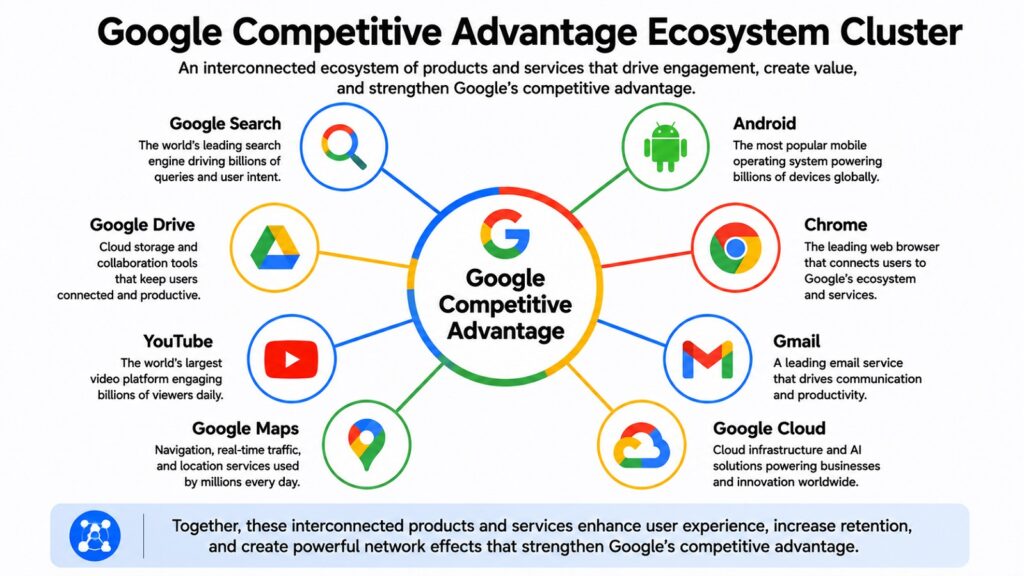
There is a temptation to look at Google and see a search company that also has some other products. That framing misses the point entirely. What Google built over time is not a collection of separate services but an interconnected system where each part reinforces the others. Understanding that system is essential to understanding the Google Competitive Advantage.
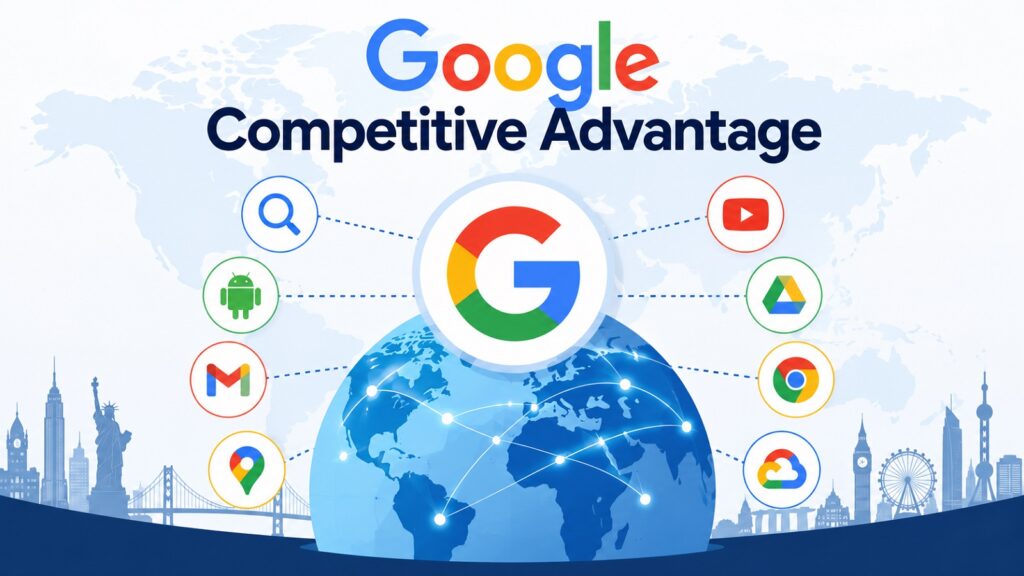
Consider how the pieces connect. Android is installed on roughly 72 percent of smartphones worldwide. That makes Google the default operating environment for most mobile users globally. Chrome is the most widely used web browser, and it integrates seamlessly with Google accounts and services. Gmail is the world’s most popular email platform. Google Maps has become the default navigation tool for hundreds of millions of people. YouTube is the second most-visited website on Earth. Google Drive and Google Docs have replaced desktop software for many users and organizations.
Each of these products strengthens the others. A user with a Gmail account is more likely to use Google Calendar, which integrates with Google Meet, which works with Google Drive. Android devices make it easy to access all of these services from a single account. The more deeply embedded a user becomes in this ecosystem, the higher the cost of switching to something else. Platform strategy theory describes this as the creation of a multi-sided platform where users, developers, advertisers, and content creators all find value in participating.
What rivals face is not simply the challenge of building a better product in one category. They face the challenge of building a better system across many interconnected categories simultaneously. That is a much harder task. Microsoft has tried with Bing and its own productivity suite. Apple has tried with its closed ecosystem. Neither has dislodged Google’s position in search or digital advertising.
The strategic lesson for businesses in other sectors is that interconnected systems are more defensible than standalone products. When your products create value through combination rather than isolation, you raise the barriers to competition in a way that is difficult to overcome with a single superior offering.
Table 2: Google Competitive Advantage — Ecosystem Components and Strategic Roles
| Google Competitive Advantage – Ecosystem Components | Strategic Role |
|---|---|
| Android | Controls the mobile entry point for the majority of global smartphone users |
| Google Search | Generates primary advertising revenue and anchors user attention |
| Chrome Browser | Directs web traffic through Google defaults, expands data collection surface |
| YouTube | Captures video advertising market and retains users through content depth |
| Gmail | Builds persistent account relationships and daily engagement habits |
| Google Maps | Dominates local search and navigation, supports location-based advertising |
| Google Drive and Docs | Increases switching costs through stored files and collaborative workflows |
| Google Play Store | Monetizes Android ecosystem and controls app distribution on Android devices |
4. Google Competitive Advantage Through Network Effects and Scale
Credit: iken3
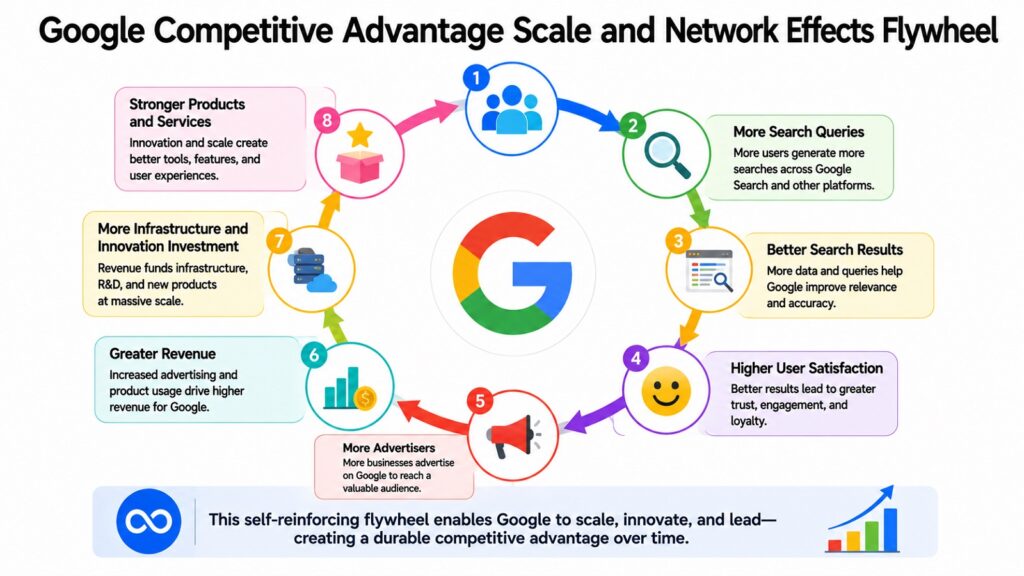
When economists and strategists talk about network effects, they mean a situation where a product or platform becomes more valuable as more people use it. Digital platforms work on this logic, though the mechanisms are sometimes different from the telephone network analogy that is often used to explain the concept.
Google benefits from several types of network effects working simultaneously. On the advertising side, more users mean more attention available to sell. More advertising revenue funds better products. Better products attract more users. This cycle has operated continuously since Google launched AdWords in 2000. More advertisers competing for the same keywords also drives up prices, increasing Google’s revenue without requiring proportional cost increases.
On the developer side, the Android ecosystem attracts developers because it has the largest user base. More developers create more applications, which makes Android more valuable to users. This two-sided network effect has made Android effectively impossible for a new mobile operating system to displace without solving the chicken-and-egg problem of needing both users and developers simultaneously.
Scale creates operational advantages that are separate from network effects. Google operates one of the largest infrastructure networks in the world, with data centers on multiple continents. The cost per unit of computing falls as volume rises, giving Google a structural cost advantage over smaller competitors. Google can also afford research teams working on problems that may not produce revenue for a decade, which gives it a longer horizon than most rivals.
Barriers to competition that arise from scale and network effects are sometimes called structural moats. Once in place, they are very hard to breach through product improvements alone. A competitor would need to simultaneously offer a better product and attract enough users to generate comparable network value.
The lesson for organizations is that building for participation early, even at a cost, can create structural advantages that become more valuable later. Accepting lower margins to grow faster makes sense when that growth generates network effects that eventually produce pricing power and defensibility.
Table 3: Google Competitive Advantage Through Network Effects and Scale Drivers
| Google Competitive Advantage – Network Effect or Scale Driver | Strategic Impact |
|---|---|
| Search Users | Generate queries that improve search relevance and usefulness |
| Advertisers | Increase advertising demand and platform value |
| Content Creators | Produce searchable content that enriches the web ecosystem |
| Android Ecosystem | Expands Google’s reach across billions of devices |
| Chrome Browser Users | Strengthens access to Google services and search |
| YouTube Community | Creates engagement loops between viewers and creators |
| Developer Community | Expands applications and integrations across platforms |
| Data Centers and Infrastructure | Supports global service delivery at massive scale |
5. Google Competitive Advantage Through Innovation and Artificial Intelligence
Credit: iken3
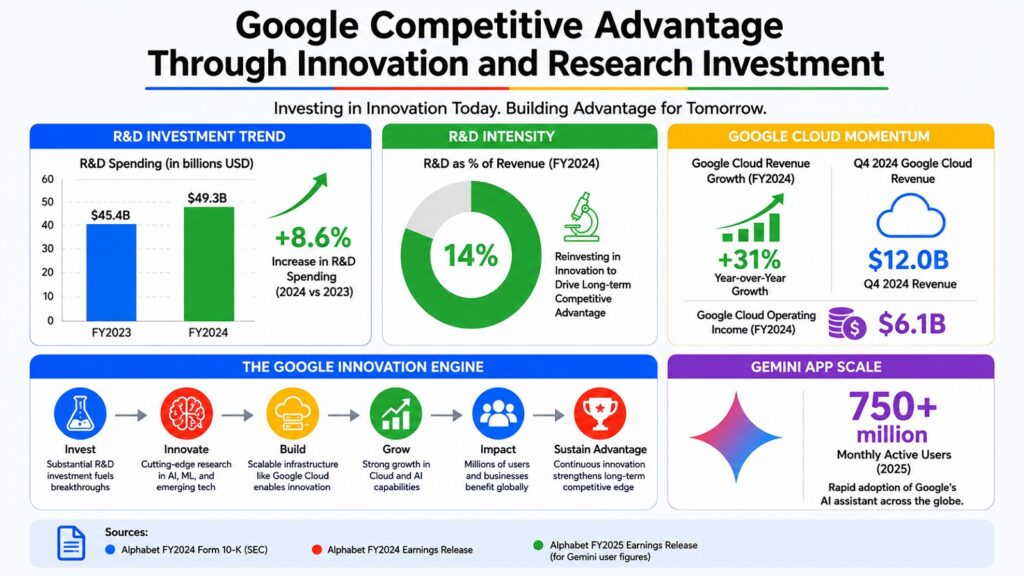
A company that builds a strong position and then stops evolving is vulnerable. Markets change. Technologies shift. New competitors emerge from unexpected directions. What distinguishes durable competitive positions from temporary ones is the ability to renew capabilities rather than simply defend existing ones. Google has shown a significant capacity for this kind of renewal, though its record is not perfect.
Google’s research division, Google DeepMind, has produced work that influenced the entire field of artificial intelligence. AlphaGo, which defeated world-champion Go players in 2016, showed what reinforcement learning could achieve. Google’s Transformer architecture, introduced in a 2017 research paper, became the technical foundation for much of the AI industry’s progress in natural language processing.
The challenge for Google is that AI has also opened new competitive fronts. OpenAI’s ChatGPT and Microsoft’s integration of AI into Bing created a genuine threat to Google’s search dominance for the first time in years. Google responded with its Gemini model, integrated into search and other products. Dynamic Capabilities Theory, developed by David Teece and others, argues that organizations sustain advantage through the ability to sense change, seize opportunities, and reconfigure capabilities. Google’s AI response demonstrated some of those abilities, though questions about execution remain.
Google Cloud now competes with Amazon Web Services and Microsoft Azure for enterprise business. This diversification reduces dependence on advertising, which represents a large share of current revenue. Waymo, Google’s autonomous vehicle subsidiary, represents a long-horizon bet on technology that could reshape transportation.
Not every Google innovation succeeds. Google Glass failed. Google+ failed. Several other products have been discontinued. But the ability to absorb those failures and continue investing reflects the kind of organizational resilience that sustains long-term advantage.
6. Google Competitive Advantage Amid Emerging Challenges
Credit: iken3
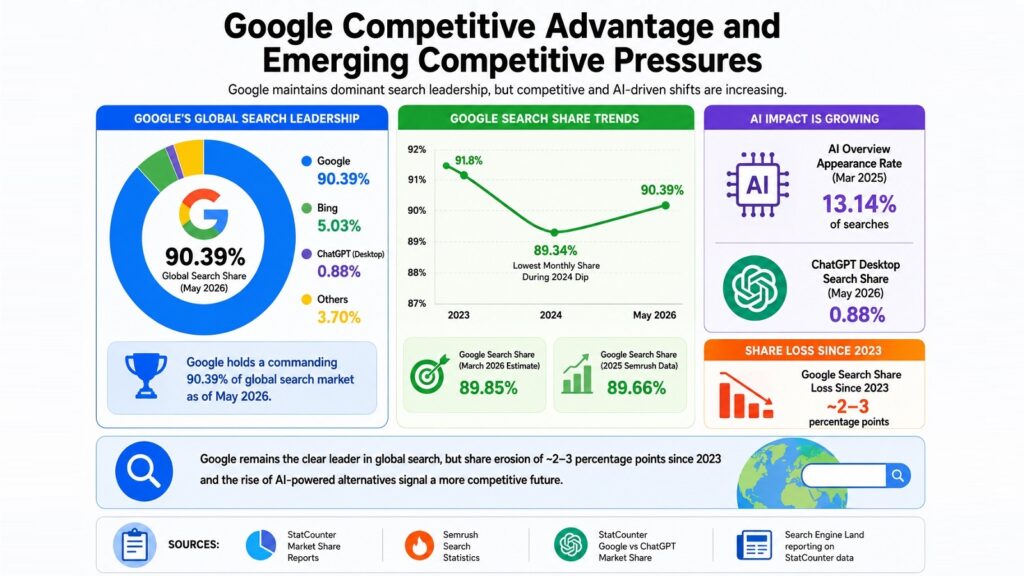
No competitive position lasts forever without being tested. The Google Competitive Advantage has been among the most durable in the digital economy, but the environment is changing in ways that deserve serious attention.
Regulatory pressure is perhaps the most immediate challenge. The United States Department of Justice has pursued antitrust actions against Google, alleging that the company used its market position to exclude competition in search and digital advertising. The European Union has levied significant fines and required operational changes. These actions reflect a broader political shift in which governments are less willing to treat digital platform dominance as a natural or benign phenomenon. If courts force structural changes, such as requiring Google to divest parts of its business or offer default search alternatives more widely, the distribution advantages reinforcing its search position could weaken.
Privacy concerns create a different kind of pressure. As users and governments push back against data collection practices, the behavioral data that powers Google’s advertising systems may become more restricted. The deprecation of third-party cookies, which Google itself announced, reflects the tension between its data business model and growing privacy expectations. Navigating that tension without damaging advertising revenue is a genuine strategic challenge.
Applying Porter’s Five Forces, the threat of substitutes has increased meaningfully. Generative AI tools now allow users to get direct answers without visiting a search results page. If users increasingly turn to AI assistants rather than search engines, the traffic sustaining Google’s advertising model could erode. Search will not disappear, but information retrieval may change in ways that affect Google’s position.
Changing user behavior, especially among younger audiences who prefer TikTok for discovery, presents another challenge. Search remains dominant, but its grip on specific demographics may be less secure than it once appeared.
Dominance creates comfort. Comfort creates vulnerability. Competitive advantages must be actively defended, adapted, and sometimes reinvented. Companies that assume their position will persist without continuous effort tend to be surprised by how quickly markets shift.
Conclusion: Google Competitive Advantage and Lessons in Sustainable Leadership
Credit: iken3
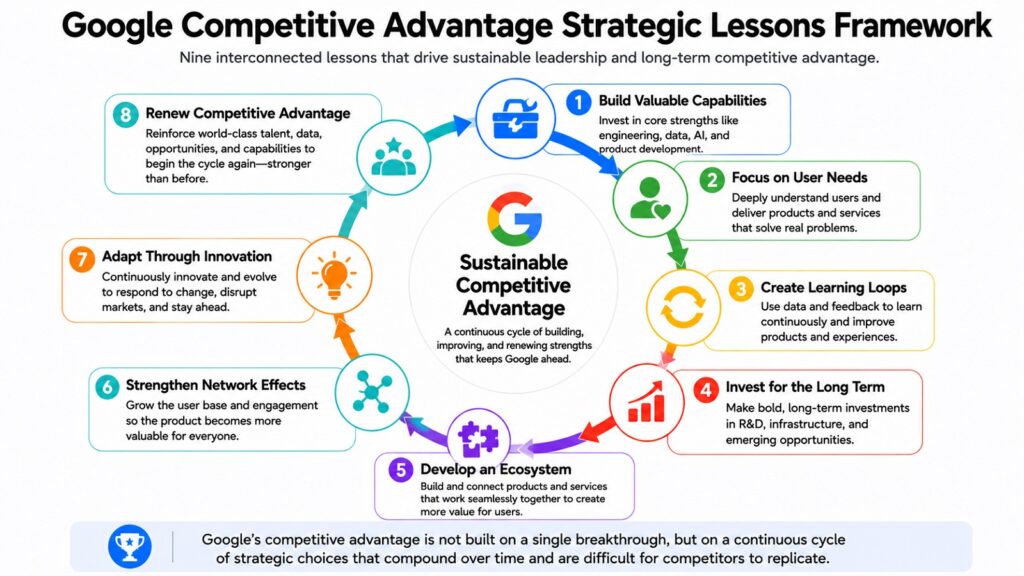
This article set out to answer a single question: how did Google build a global edge that competitors have struggled to replicate? The answer that emerges is not a single factor but a combination of capabilities that reinforced one another over time.
Google began with search technology that was genuinely better than what came before. That quality created user trust, which drove volume, which generated data, which improved the system further. Data became a strategic asset not because Google collected it but because the company built systems that converted interaction signals into better products. Those products expanded into an ecosystem where Android, Chrome, Gmail, Maps, YouTube, and other services each strengthened the whole. Network effects from advertisers, developers, and users created structural barriers that have proven difficult to breach. A culture of research and long-term investment gave the company the capacity to renew its capabilities when the environment changed.
At the same time, the challenges facing Google are real. Regulatory pressure, privacy restrictions, AI-driven substitutes, and shifting user behavior all represent genuine threats. Whether Google’s advantages prove durable over the next decade will depend on how well it adapts rather than on how strong its current position happens to be.
For managers and entrepreneurs, the case offers several transferable insights. Build capabilities that improve through use. Design systems where learning happens automatically. Think about your product portfolio as a system rather than a collection of independent offerings. Invest in network effects early, even when returns are not immediately visible. And never treat a competitive advantage as permanent, because the environment will keep changing, whether you are ready or not.
For students and researchers, Google offers a rare case where multiple theoretical frameworks — the Resource-Based View, Dynamic Capabilities Theory, platform strategy, and network effect theory — all find evidence and application within a single organization’s history. That makes it a particularly rich subject for analytical thinking about how advantage is built, defended, and eventually challenged.
The story of Google is still being written. But the principles that drove its rise are clearer than they might first appear, and they travel well beyond one company or one industry.
Table 4: Google Competitive Advantage — Strategic Lessons for Leaders
| Google Competitive Advantage – Strategic Lessons for Leaders | Practical Application |
|---|---|
| Build capabilities that improve through use | Design products where interaction generates data that feeds back into quality |
| Create system-level advantages, not just product-level ones | Develop interconnected offerings where each component strengthens the others |
| Invest in network effects before they pay off | Accept early losses to build participation that becomes structurally valuable |
| Use data as a learning asset, not just a reporting tool | Build pipelines that convert user behavior into product and model improvement |
| Sustain innovation through long-horizon research investment | Fund work that may not produce returns for years to stay ahead of disruption |
| Monitor regulatory and social environment alongside markets | Treat governance risk as a strategic variable, not an external nuisance |
| Defend advantages actively rather than assuming their permanence | Treat competitive position as something earned continuously, not inherited |
| Diversify revenue before core business comes under pressure | Build adjacent revenue streams while the main business still has strong margins |