Table of Contents
Introduction: Renewable Energy Technologies – Building the Future of Modern Energy
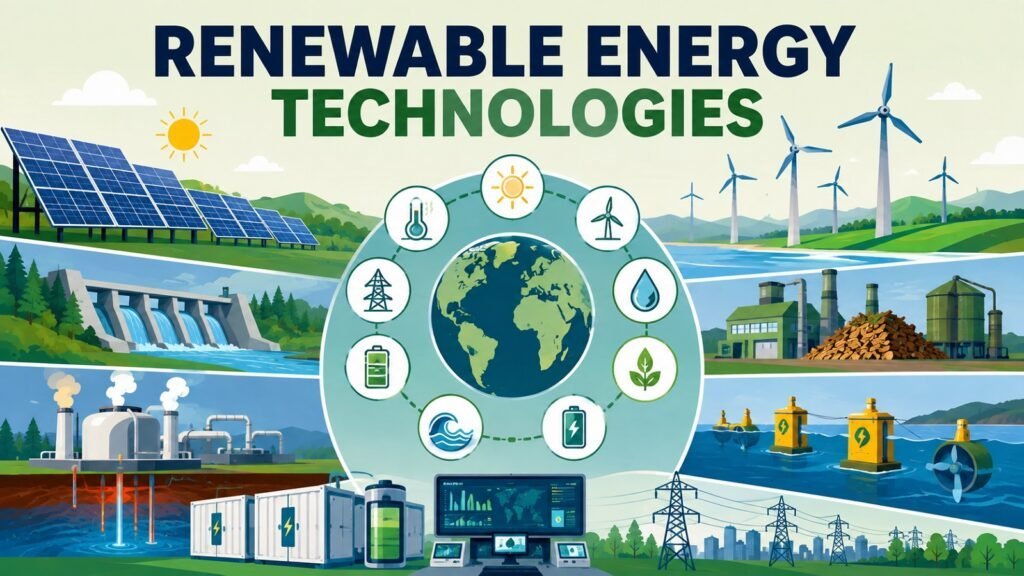
Renewable Energy Technologies are the engineering systems and methods that harness naturally replenishing energy sources to generate, store, manage, and distribute clean and reliable power. They draw on solar radiation, wind, flowing water, geothermal heat, biological matter, and ocean dynamics to produce electricity and thermal energy without consuming finite resources. Far from a set of simple devices, they form a sophisticated and deeply interdependent ecosystem.
Among all Green Technologies, Renewable Energy Technologies occupy a uniquely central position because they combine engineering innovation, digital intelligence, and sustainable resource utilization to build modern energy systems that are efficient, scalable, and economically viable. This article examines Renewable Energy Technologies from a technology and engineering perspective, focusing on how these systems are designed, how they have evolved, and why they attract sustained global investment in research and industrial development.
The strategic importance of this technology domain extends well beyond electricity generation. Renewable Energy Technologies now shape national energy security, industrial competitiveness, digital infrastructure planning, and long-term economic development. Countries and corporations that achieve leadership in this space gain durable advantages in energy cost, productivity, and export potential — which explains why research institutions, technology companies, and governments are pursuing advances across every branch of this field.
What once comprised isolated generation experiments has evolved into an integrated ecosystem spanning power generation, electrochemical storage, thermal systems, intelligent monitoring, predictive optimization, and smart grid infrastructure. Each component reinforces the others. Solar panels without storage are limited by daylight; storage without grid intelligence cannot distribute power efficiently; and smart grids without generation lack practical value. The eight technology domains examined in this article each contribute a distinct and indispensable capability to the whole.
Table 1: Renewable Energy Technologies — Eight Core Technology Domains
| Domains of Renewable Energy Technologies | Core Contribution |
| Solar Energy Systems | Photovoltaic and concentrated solar power generation |
| Wind Energy Systems | Onshore and offshore turbine-based electricity generation |
| Hydropower Systems | Conventional, run-of-river, and pumped-storage generation |
| Geothermal Energy Systems | Earth’s internal heat converted to baseload electricity |
| Bioenergy Systems | Biological feedstocks converted to electricity, heat, and fuel |
| Marine Energy Systems | Tidal, wave, and ocean thermal energy conversion |
| Energy Storage Systems | Batteries, hydrogen, and mechanical storage for grid reliability |
| Smart Grid Systems | Intelligent infrastructure for integration and optimization |
1. Renewable Energy Technologies in Solar Energy Systems
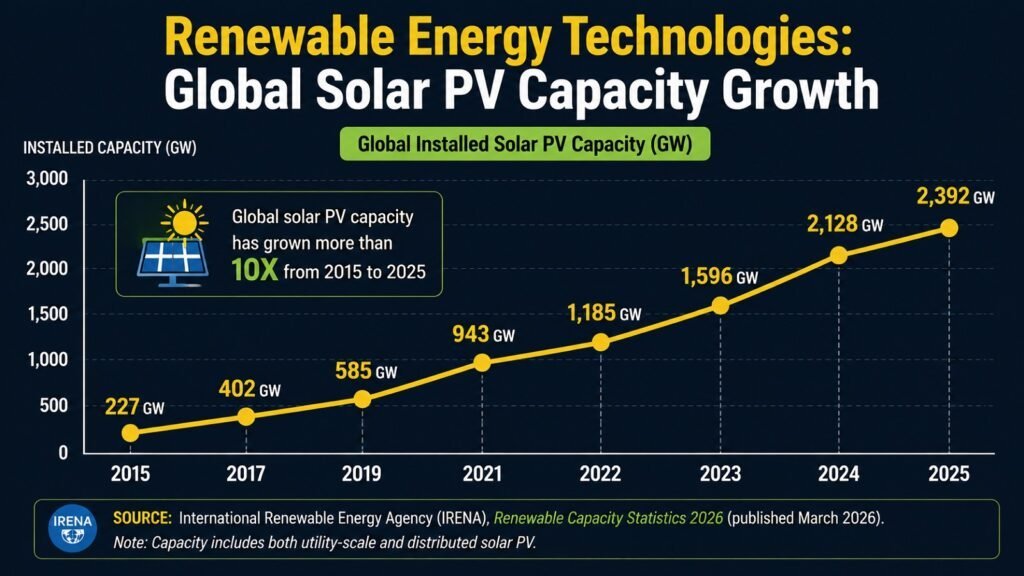
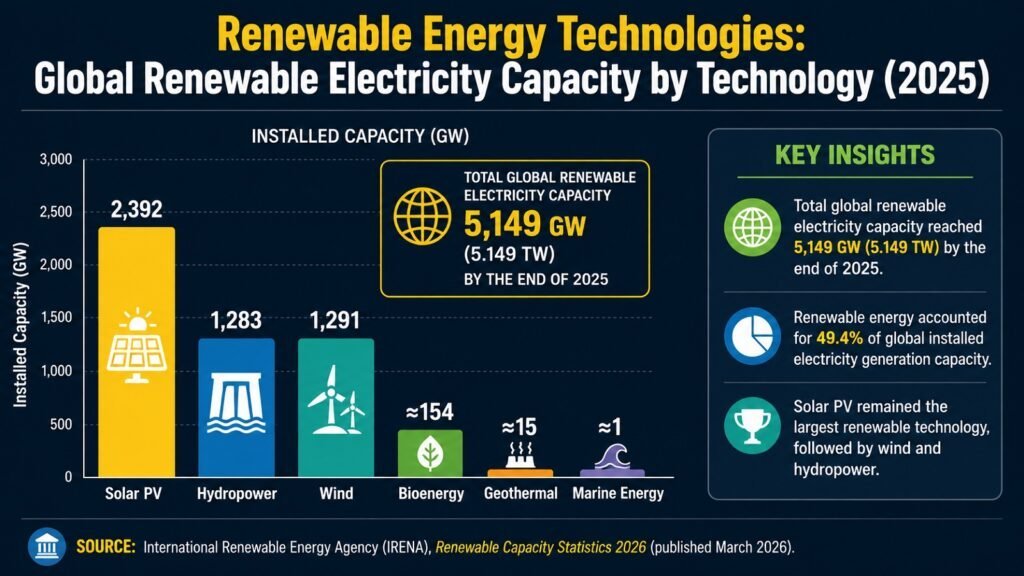
Solar energy systems represent one of the most technologically dynamic branches of Renewable Energy Technologies. Photovoltaic modules operate on the photoelectric effect, converting photons from sunlight into direct electrical current through semiconductor junctions. Silicon remains the dominant material, but the science of solar cells has expanded significantly, driving efficiency gains and cost reductions that have reshaped global electricity markets over the past two decades.
Monocrystalline silicon modules deliver higher conversion efficiencies than polycrystalline alternatives, making them the preferred choice where space is limited. Bifacial panels extend this advantage by capturing reflected light on their rear surface, typically increasing energy yield by eight to twenty percent. Solar tracking systems rotate panels to follow the sun’s path throughout the day, improving output by fifteen to forty percent compared to fixed-tilt installations, at the cost of greater mechanical complexity and higher maintenance requirements.
Concentrated solar power uses mirrors or lenses to focus sunlight onto a thermal receiver, generating heat that drives a conventional steam turbine. CSP plants can incorporate thermal storage to continue generating electricity after sunset, a significant operational advantage. Floating solar installations placed on reservoirs combine reduced land use with the cooling effect of water, which improves panel efficiency and slows degradation.
Perovskite solar cells represent a significant advancement in recent solar research. Laboratory efficiency has increased from below four percent in 2009 to more than twenty-six percent in recent years. Research has shown that tandem configurations, which stack perovskite absorbers on silicon substrates, have achieved efficiencies exceeding thirty percent. However, the main challenge that remains before commercial deployment is ensuring long-term stability in conditions of heat and humidity. Additionally, artificial intelligence and digital monitoring enhance these hardware developments: machine learning algorithms process data from inverters and sensors to identify underperforming modules, forecast failures, and optimize energy dispatch in real time, thereby lowering operational costs across various scales of solar deployment.
Table 2: Renewable Energy Technologies — Comparison of Key Solar Technologies
| Solar Technology | Key Characteristic |
| Monocrystalline Silicon PV | High efficiency; best for limited roof space |
| Polycrystalline Silicon PV | Lower cost; moderate efficiency |
| Bifacial PV Panels | Captures rear-surface reflected irradiance |
| Concentrated Solar Power (CSP) | Thermal generation with optional heat storage |
| Perovskite Solar Cells | Rapid efficiency gains; stability under study |
| Tandem Solar Cells | Perovskite on silicon; exceeds 30% lab efficiency |
| Floating Solar (Floatovoltaics) | Deployed on water bodies; reduces land use |
| Solar Tracking Systems | Dynamic panel orientation; improves yield 15–40% |
2. Renewable Energy Technologies in Wind Energy Systems
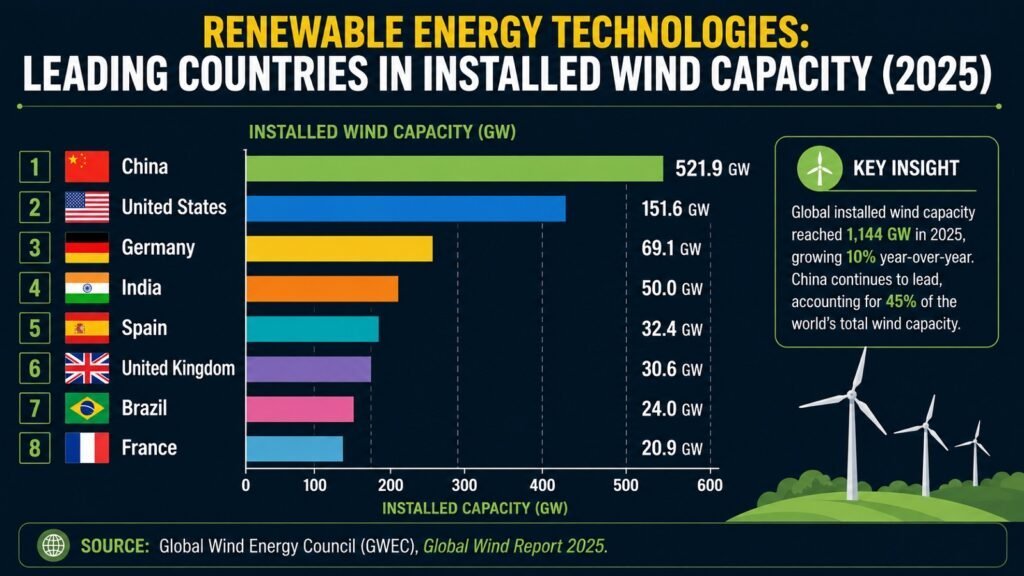
Wind energy systems extract kinetic energy from moving air and convert it into electricity through rotating blades, mechanical drivetrains, and generators. Turbine blade geometry follows aerodynamic principles derived from aircraft wing design, engineered to maximize lift while minimizing drag. Variable-pitch blade mechanisms continuously adjust the angle of each blade in response to real-time conditions, maintaining optimal rotational speed while protecting structural integrity during high-wind events.
Onshore wind remains the most cost-effective form of utility-scale renewable generation in many regions. Hub heights exceeding 150 meters and rotor diameters surpassing 170 meters are now standard on modern designs. Larger rotors sweep greater areas of the wind resource, improving capacity factors and lowering the cost of energy per megawatt-hour. Advanced composite materials, including carbon fiber reinforced polymer blends, allow manufacturers to build longer blades without proportional weight increases, enabling this scale-up without excessive mechanical stress on towers and foundations.
Offshore wind technology accesses the stronger and more consistent resources over open water. Fixed-bottom foundations suit depths up to around sixty meters, while floating platforms extend deployment into deeper locations. Floating offshore wind remains in early commercial stages but has shown solid results off Norway, Scotland, and Portugal, substantially expanding the accessible global resource. Direct-drive generators eliminate the gearbox, reducing mechanical failure points and lowering maintenance costs, though they introduce design challenges around generator size and weight.
IoT sensors distributed across nacelles, blades, and towers continuously transmit vibration, temperature, and load data to supervisory control systems. Digital twin models replicate the mechanical behavior of individual turbines in real time, enabling engineers to simulate failure modes and plan maintenance proactively. AI-based wind farm control algorithms also manage turbine wake interactions, coordinating neighboring turbines to maximize collective farm output beyond what independent optimization of each unit would achieve.
Table 3: Renewable Energy Technologies — Comparison of Major Wind Technologies
| Wind Technology | Key Characteristic |
| Onshore Wind Turbines | Most cost-effective; widely deployed globally |
| Offshore Fixed-Bottom Wind | Stronger wind resource; up to ~60m water depth |
| Floating Offshore Wind | Deep-water deployment; expanding accessible resource |
| Variable-Pitch Blade Systems | Dynamic blade angle adjustment for optimal output |
| Direct-Drive Generators | Gearbox-free; lower maintenance risk |
| Carbon Fiber Composite Blades | Extended length with controlled weight |
| Digital Twin Monitoring | Real-time turbine simulation and fault prediction |
| AI Wake Management Control | Coordinated farm-level output optimization |
3. Renewable Energy Technologies in Hydropower Systems
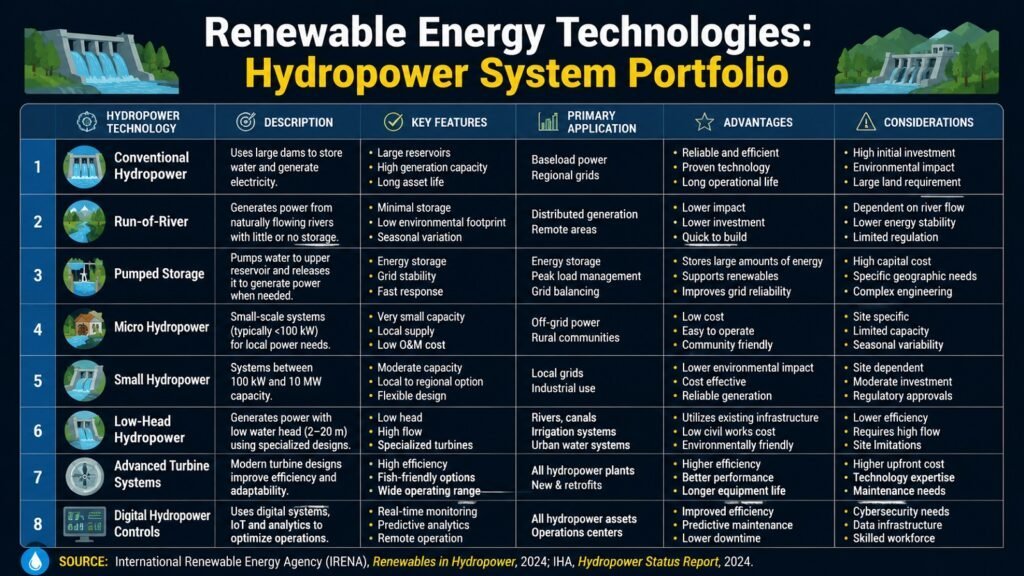
Hydropower generates electricity by converting the potential and kinetic energy of flowing or falling water into mechanical rotation and then into electrical current. Conventional plants use dams to create elevated reservoirs, releasing water through penstocks to drive Francis, Kaplan, or Pelton turbines selected by head height and flow characteristics. Hydropower has been in commercial operation for over a century, yet Renewable Energy Technologies continue to modernize it through advanced engineering, improved materials, and digital control systems.
Run-of-river systems divert a portion of a river’s natural flow through a channel to drive turbines, producing far less hydrological disruption than large dams and operating across a broader range of geographic settings. Micro-hydropower installations, typically below one megawatt, apply the same principle at community and industrial scale, delivering stable electricity in mountainous and rural areas without grid connection and with minimal civil engineering requirements. Their output fluctuates with seasonal river flow rather than being dispatchable on demand, but they contribute reliable baseload generation within suitable watersheds.
Pumped-storage hydropower functions as the most critical storage component within the Renewable Energy Technologies ecosystem. It works by pumping water uphill during surplus generation and releasing it through turbines when demand exceeds supply, and it accounts for the overwhelming majority of installed grid-scale energy storage capacity worldwide. Its ability to respond quickly to grid frequency deviations makes it indispensable for balancing variable output from solar and wind plants.
Variable-speed turbines adapt to changing head heights and flow conditions, maintaining higher efficiency across a wider operating range than fixed-speed designs. Digital control systems optimize dispatch in real time based on grid frequency, electricity prices, and reservoir levels. Many older hydroelectric facilities are undergoing modernization through upgraded generators and improved control platforms, extending operational lifespans and recovering efficiency lost over decades of service.
Table 4: Renewable Energy Technologies — Comparison of Key Hydropower Technologies
| Hydropower Technology | Key Characteristic |
| Conventional Dam Hydropower | Large-scale dispatchable generation; reservoir-based |
| Run-of-River Hydropower | Minimal storage; follows natural river flow |
| Micro-Hydropower Systems | Below 1 MW; suited to remote and rural settings |
| Pumped-Storage Hydropower | Grid-scale energy storage using elevation difference |
| Francis Turbines | Widely used; effective across medium head ranges |
| Kaplan Turbines | Adjustable blades; optimal for low-head sites |
| Variable-Speed Turbines | Efficient across varying flow and head conditions |
| Digital Plant Control Systems | Real-time dispatch optimization and monitoring |
4. Renewable Energy Technologies in Geothermal Energy Systems
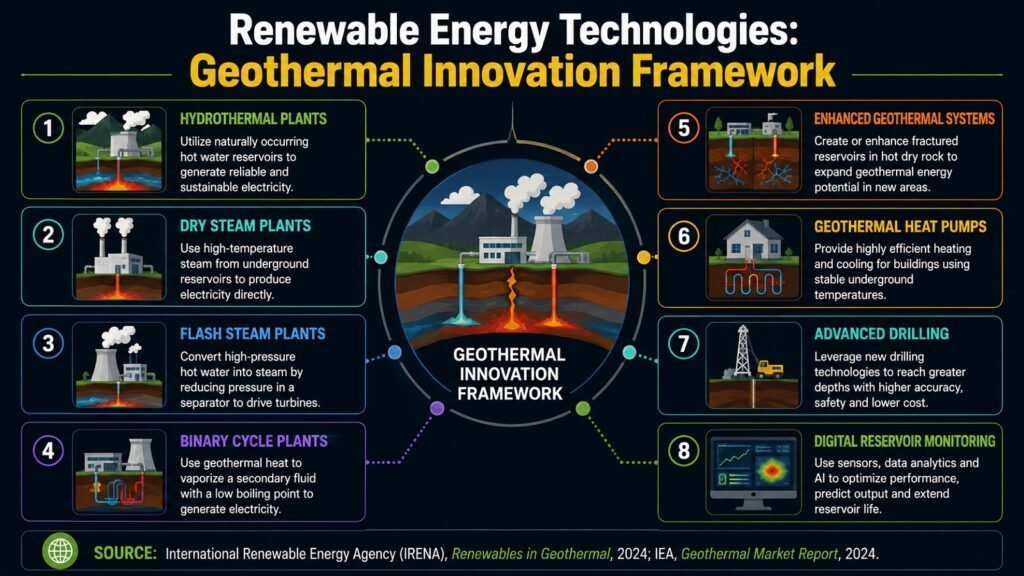
Geothermal energy systems access thermal energy stored within the Earth’s crust and mantle, converting it into electricity or direct heat. Unlike solar and wind, geothermal generation is not intermittent: it delivers consistent and controllable output, making it a valuable baseload resource. The engineering challenge lies in accessing and transferring underground heat economically at the temperatures required for useful power generation.
Hydrothermal systems exploit naturally occurring reservoirs of hot water or steam in geologically active regions. Dry steam plants pipe superheated steam directly to surface turbines. Flash steam plants draw high-pressure hot water to the surface, where rapid depressurization converts it to steam. Binary cycle power plants heat a secondary working fluid with a lower boiling point using geothermal fluids, which then vaporizes to drive a turbine without the geothermal fluid reaching the surface as steam. Binary cycle technology has extended viable geothermal generation down to around seventy degrees Celsius, substantially widening the geographic range of feasible installations.
Enhanced geothermal systems represent the frontier of geothermal Renewable Energy Technologies. EGS creates artificial reservoirs in hot dry rock by hydraulically fracturing formations that lack natural permeability, then circulating water through the created pathways to extract heat at the surface. Research programs in the United States, Europe, and Australia are actively working to reduce EGS drilling costs, which remain the dominant barrier to widespread deployment.
Geothermal heat pumps use the stable temperatures of shallow ground for building heating and cooling, transferring thermal energy at efficiencies far exceeding conventional systems. Advanced directional drilling technologies borrowed from the oil and gas sector have reduced the cost and time required to develop geothermal wells, benefiting both power generation and direct-heat applications across a growing range of commercial and industrial contexts.
Table 5: Renewable Energy Technologies — Comparison of Geothermal Technologies
| Geothermal Technology | Key Characteristic |
| Dry Steam Power Plants | Uses direct steam from underground reservoirs |
| Flash Steam Power Plants | High-pressure hot water flashed to steam at surface |
| Binary Cycle Power Plants | Lower-temp fluids; extends geographic range |
| Enhanced Geothermal Systems | Engineered reservoirs in hot dry rock formations |
| Geothermal Heat Pumps | Shallow ground thermal transfer for heating/cooling |
| Directional Drilling Technology | Precise well placement; reduces development cost |
| Hydrothermal Reservoir Systems | Natural hot water or steam at accessible depths |
| Direct-Use Geothermal Heat | Industrial and district heating from geothermal fluids |
5. Renewable Energy Technologies in Bioenergy Systems
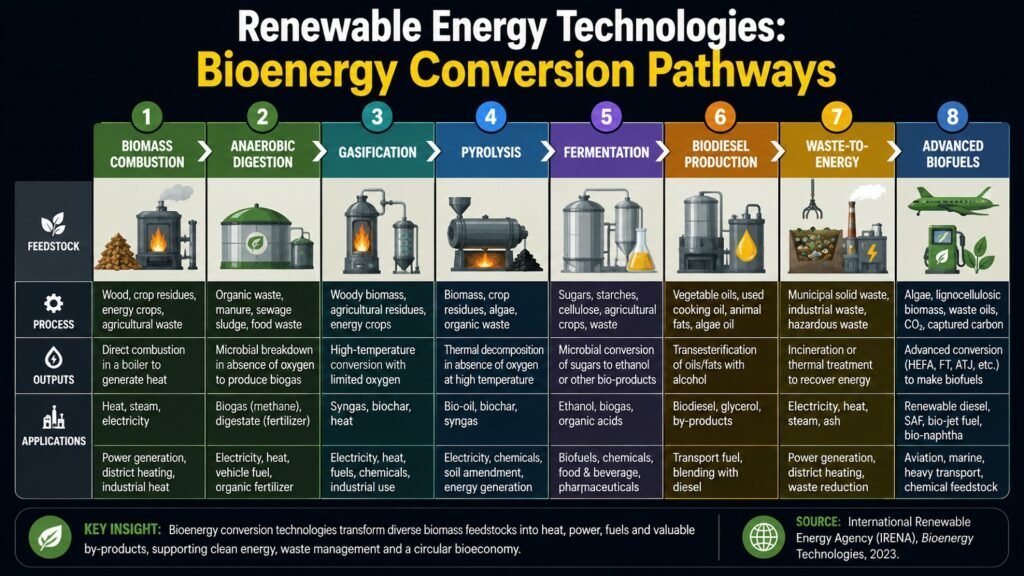
Bioenergy systems convert biological matter — agricultural residues, forestry waste, energy crops, organic municipal waste, and animal manure — into electricity, heat, and liquid transport fuels. Within Renewable Energy Technologies, bioenergy holds a distinctive position because it can provide dispatchable electricity on demand and serve sectors such as transport and industrial heat that are difficult to electrify directly. The engineering principle is releasing chemical energy from organic matter through thermochemical or biological conversion processes.
Biomass combustion burns material in dedicated boilers to produce steam that drives electricity-generating turbines, often in combined heat and power configurations that recover waste thermal energy for industrial or district heating. Co-firing biomass with coal in existing power stations reduces fossil fuel consumption without requiring entirely new generation infrastructure. Gasification converts biomass into combustible syngas at high temperatures under limited oxygen, which then fuels gas turbines or combined-cycle systems at higher efficiency than direct combustion.
Anaerobic digestion uses microorganisms to decompose organic material in the absence of oxygen, producing biogas that can generate electricity and heat or be upgraded to biomethane for pipeline injection and vehicle fuel. It is particularly suited to wet organic wastes such as sewage sludge and food processing effluent, combining waste treatment with energy recovery. Second-generation advanced biofuels produced from lignocellulosic feedstocks avoid direct competition with food supply and achieve better lifecycle performance than first-generation crop-based fuels. Third-generation algae biofuels offer high biomass yields but remain early-stage due to high cultivation and processing costs.
Feedstock management is a critical operational challenge. Advances in torrefaction, densification, and pelletization have improved the energy density and storability of biomass materials, reducing transport costs and expanding viable supply geographies for large-scale bioenergy facilities.
Table 6: Renewable Energy Technologies — Comparison of Bioenergy Technologies
| Bioenergy Technology | Key Characteristic |
| Biomass Combustion | Steam generation for electricity and heat |
| Biomass Gasification | Syngas production via high-temperature conversion |
| Anaerobic Digestion | Biogas from organic waste via microbial breakdown |
| Biomethane Upgrading | Refined biogas for pipeline injection or vehicle use |
| Co-firing with Coal | Biomass blended into existing coal plants |
| First-Generation Biofuels | Ethanol and biodiesel from food crops |
| Advanced (2nd-Gen) Biofuels | Lignocellulosic or waste-based liquid fuels |
| Algae-Based (3rd-Gen) Biofuels | High-yield; early commercial stage |
6. Renewable Energy Technologies in Marine Energy Systems
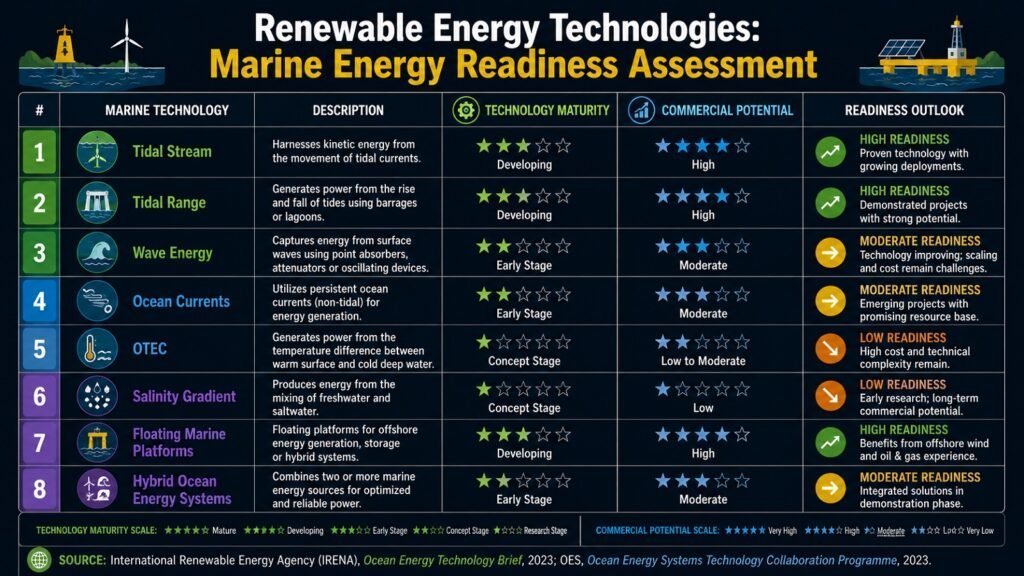
Marine energy systems harness the kinetic and thermal energy contained in tides, waves, ocean currents, and thermal gradients. These technologies represent an emerging frontier within Renewable Energy Technologies, characterized by high theoretical potential and significant engineering challenges associated with the corrosive and mechanically demanding marine environment. Advances in materials science, offshore engineering, and underwater power electronics are gradually advancing several marine technologies toward early commercial deployment.
Tidal power exploits the predictable rise and fall of sea levels driven by gravitational forces from the Moon and Sun. Tidal barrages built across tidal estuaries have operated at La Rance in France and Sihwa Lake in South Korea for several decades. Tidal stream turbines, positioned in fast-flowing tidal channels, offer a less intrusive alternative that avoids major civil engineering works. The predictable nature of tidal cycles provides a notable planning advantage over other variable renewable sources, since generation schedules can be forecast with high accuracy years in advance.
Wave energy converters capture the oscillatory motion of ocean surface waves through oscillating water columns, point absorbers, attenuators, and overtopping devices, each translating wave motion into mechanical movement to drive a generator. The irregular and multidirectional nature of ocean waves makes efficient and durable conversion considerably more difficult than tidal generation, and most projects remain at small-scale demonstration stages.
Ocean thermal energy conversion uses the temperature difference between warm surface water and cold deep water in tropical regions to drive a low-temperature thermodynamic cycle. Though continuous in theory, small temperature differences limit thermodynamic efficiency and require large heat exchangers, making OTEC systems capital-intensive. Salinity gradient power, which extracts energy from the chemical potential difference where freshwater meets saltwater, remains at an early research stage. Advanced mooring systems, corrosion-resistant coatings, and subsea power cables are critical enabling technologies across all marine energy variants.
Table 7: Renewable Energy Technologies — Comparison of Marine Energy Technologies
| Marine Energy Technology | Key Characteristic |
| Tidal Barrage Systems | Estuarine dam; proven but geographically limited |
| Tidal Stream Turbines | Underwater turbines in fast tidal channels |
| Oscillating Water Column Devices | Wave-driven air compression to generate power |
| Point Absorber Wave Converters | Buoyant device harvesting wave motion |
| Attenuator Wave Devices | Floating elongated structure aligned to waves |
| Ocean Thermal Energy Conversion | Exploits surface-to-deep temperature gradient |
| Salinity Gradient (Osmotic) Power | Energy from freshwater-seawater mixing; early stage |
| Ocean Current Energy Systems | Turbines in strong, persistent ocean currents |
7. Renewable Energy Technologies in Energy Storage Systems
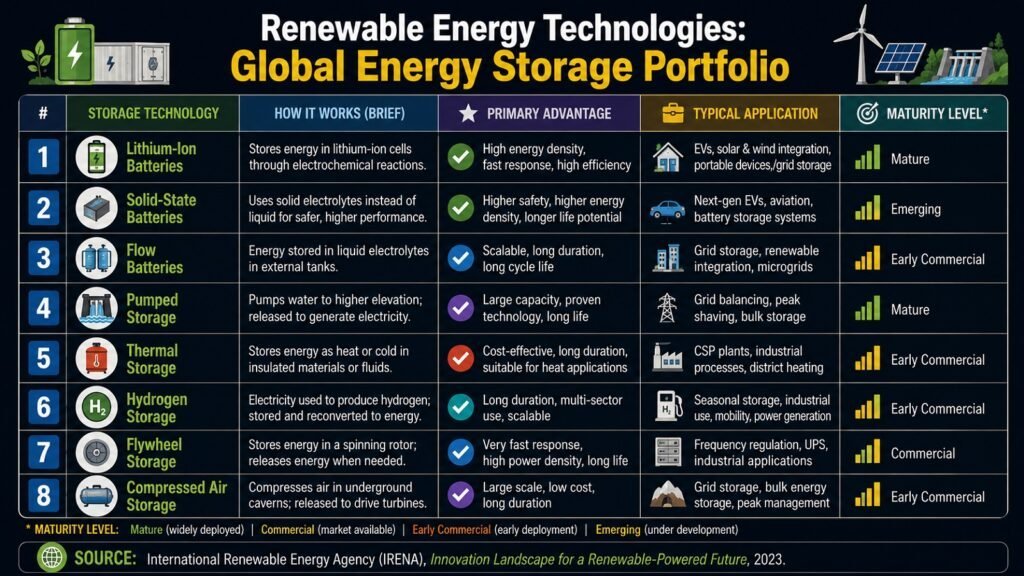
Energy storage systems address the fundamental challenge that many Renewable Energy Technologies generate electricity only when their natural resource is available, not necessarily when demand is highest. Without adequate storage, a grid dominated by solar and wind faces unavoidable mismatches between supply and demand that reduce reliability and raise operating costs. Storage bridges this gap by absorbing surplus generation and discharging it when and where it is needed.
Lithium-ion batteries are the leading technology for short-duration grid-scale storage, owing to their high energy density, excellent cycle efficiency, and significant cost reductions achieved through the scaling up of electric vehicle production.
Utility-scale installations now offer services such as frequency regulation, peak shaving, and renewable energy integration across all continents. Current research focuses on enhancing cycle life, improving thermal stability, and decreasing reliance on cobalt. Solid-state batteries utilize a solid ionic conductor in place of the liquid electrolyte, which enhances safety and may allow for higher energy densities with lithium metal anodes; however, challenges in the manufacturing of solid electrolytes pose a short-term obstacle to commercial scalability.
Flow batteries store energy in liquid electrolyte solutions held in external tanks, allowing energy capacity to be scaled independently of power capacity. This makes them well-suited to longer-duration storage — typically four to twelve hours or more — where lithium-ion systems become economically less competitive. Vanadium redox flow batteries are the most mature variant, with installations operating in China, the United States, and Europe.
Green hydrogen enables long-duration and seasonal storage by using surplus renewable electricity for electrolysis, storing the hydrogen, and reconverting it via fuel cells or turbines. Compressed air energy storage compresses air into underground caverns during surplus generation and releases it through expanders when needed. Flywheel systems provide extremely rapid response in kinetic form, best suited to frequency regulation rather than bulk storage. Pumped-storage hydropower remains the single largest contributor to total installed grid-scale storage capacity worldwide.
Table 8: Renewable Energy Technologies — Comparison of Energy Storage Technologies
| Storage Technology | Key Characteristic |
| Lithium-Ion Batteries | Short-duration; high cycle efficiency; widely deployed |
| Solid-State Batteries | Higher safety and energy density; pre-commercial |
| Vanadium Redox Flow Batteries | Scalable capacity; suited to long-duration storage |
| Pumped-Storage Hydropower | Largest installed storage capacity globally |
| Green Hydrogen (Electrolysis) | Seasonal storage via electrolysis and reconversion |
| Compressed Air Energy Storage | Underground compressed air; grid-scale potential |
| Flywheel Energy Storage | Kinetic storage; fast response for frequency control |
| Thermal Energy Storage | Heat or cold stored in material for later use |
8. Renewable Energy Technologies in Smart Grid Systems
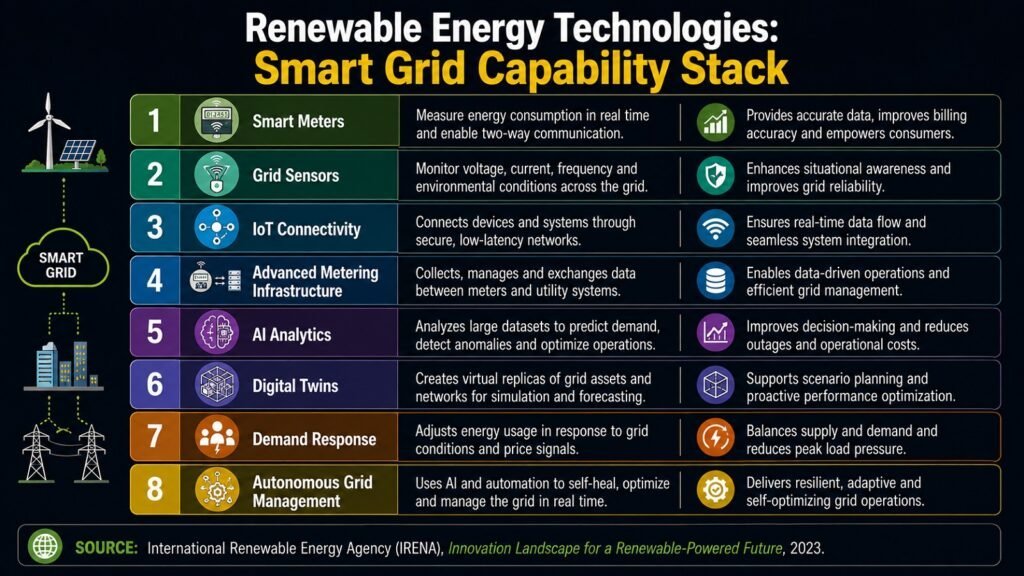
Smart grid systems deliver the advanced electrical infrastructure necessary for the large-scale integration of Renewable Energy Technologies to be feasible. A contemporary power grid must effectively coordinate electricity from numerous sources, manage thousands of distributed resources, and maintain a continuous balance between supply and demand within intricate transmission and distribution networks. Achieving this on a large scale necessitates digital sensing, communication, analytics, and control capabilities that far exceed the capabilities of traditional grid infrastructure.
Advanced metering infrastructure replaces conventional electricity meters with digital smart meters that record consumption in real time and communicate bidirectionally with utility systems. This enables demand response programs that encourage or automate reductions in electricity use during grid stress, turning flexible consumer loads into a distributed management resource. Time-of-use pricing creates economic incentives to shift discretionary loads such as electric vehicle charging away from peak demand periods, reducing the need for expensive peaking generation capacity.
Microgrids are localized networks that connect to the main grid or operate autonomously in island mode. They integrate local generation, storage, and intelligent energy management software, and can disconnect during grid disturbances to maintain power to connected loads independently — a significant resilience advantage for hospitals, data centers, and military facilities. IoT sensor networks distributed across substations and transmission lines feed continuous operational data into supervisory control systems, enabling granular real-time monitoring at a scale previously impractical.
AI algorithms analyze sensor data streams to forecast generation, predict demand, optimize power flow, and detect anomalies indicating developing faults or cyberattacks. Digital twin models of grid sections allow operators to simulate scenarios without risking real infrastructure. Cybersecurity frameworks combining network segmentation, encrypted communications, and anomaly detection systems maintain grid integrity against digital threats. Wide-bandgap semiconductors based on silicon carbide and gallium nitride are improving inverter efficiency and switching speed, reducing conversion losses across the entire Renewable Energy Technologies system.
Table 9: Renewable Energy Technologies — Comparison of Smart Grid Technologies
| Smart Grid Technology | Key Characteristic |
| Advanced Metering Infrastructure | Real-time digital metering with two-way communication |
| Demand Response Systems | Flexible load management to balance grid supply |
| Microgrids | Autonomous local networks with islanding capability |
| AI-Based Grid Optimization | Real-time analytics for dispatch and fault detection |
| Digital Twin Grid Models | Virtual grid replicas for simulation and planning |
| Wide-Bandgap Power Electronics | SiC and GaN inverters; higher efficiency and speed |
| Grid Cybersecurity Frameworks | Encryption, segmentation, and anomaly detection |
| IoT Sensor Networks | Distributed real-time monitoring across grid assets |
Conclusion: The Future of Renewable Energy Technologies
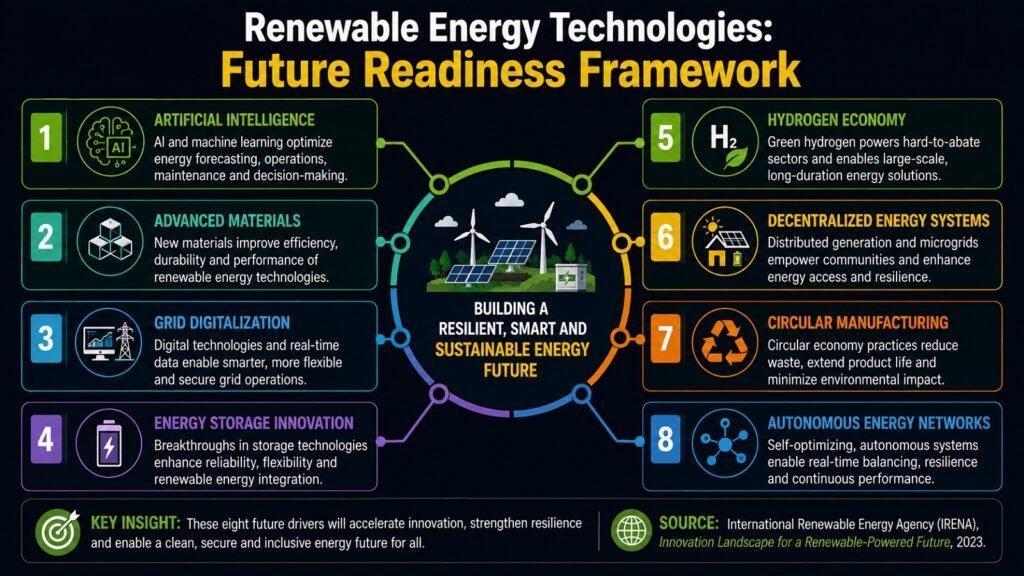
Renewable Energy Technologies have matured from a collection of individual generation methods into an integrated technological ecosystem spanning power generation, electrochemical and mechanical storage, digital monitoring, and intelligent grid management. Solar and wind provide primary generation capacity; hydropower, geothermal, and bioenergy add dispatchable and baseload generation; marine energy expands the accessible resource base; storage bridges temporal gaps; and smart grid infrastructure ties all components into a functional, scalable, and commercially viable energy system.
Among all Green Technologies, Renewable Energy Technologies hold a uniquely foundational role. They combine engineering innovation, digital intelligence, and sustainable resource utilization to advance energy security, reduce input cost dependence, strengthen industrial competitiveness, and support long-term economic development. These strategic considerations explain why investment across all eight domains has sustained remarkable momentum across diverse national and corporate contexts.
The pace of technological advancement shows no sign of moderating. Materials science advances continue improving solar cell efficiencies and battery energy densities. Floating offshore wind and marine platforms are unlocking resources that were previously inaccessible. Enhanced geothermal systems are beginning to demonstrate potential far from volcanic zones. Artificial intelligence is improving optimization, reliability, and predictive maintenance across every asset class. Digital twins and advanced grid analytics are enabling operators to manage increasing complexity with greater precision and lower costs than any previous generation of energy infrastructure.
The most important shift in perspective is to view Renewable Energy Technologies not as individual generation methods but as a rapidly evolving and deeply interconnected technological ecosystem. Competitive advantage belongs to those who understand the relationships between generation, storage, and intelligent grid management, and who can integrate these capabilities into coherent systems at scale. Renewable Energy Technologies are among the most consequential engineering domains of this era, and their continued evolution will shape modern infrastructure for decades ahead.
Table 10: Renewable Energy Technologies — Key Insights from Eight Technology Domains
| Technology Domain | Key Strategic Insight |
| Solar Energy Systems | Perovskite and AI monitoring accelerating performance gains |
| Wind Energy Systems | Floating offshore expands global wind resource access |
| Hydropower Systems | Pumped storage anchors grid-scale energy balancing |
| Geothermal Systems | EGS extends viability beyond traditional volcanic regions |
| Bioenergy Systems | Dispatchable output fills gap left by variable renewables |
| Marine Energy Systems | Predictable tidal power offers grid planning certainty |
| Energy Storage Systems | Multi-technology portfolio required across storage durations |
| Smart Grid Systems | AI and digital twins enable complex renewable integration |