Table of Contents
Introduction: Resource Optimization Cycle as the Foundation of Sustainable Technology
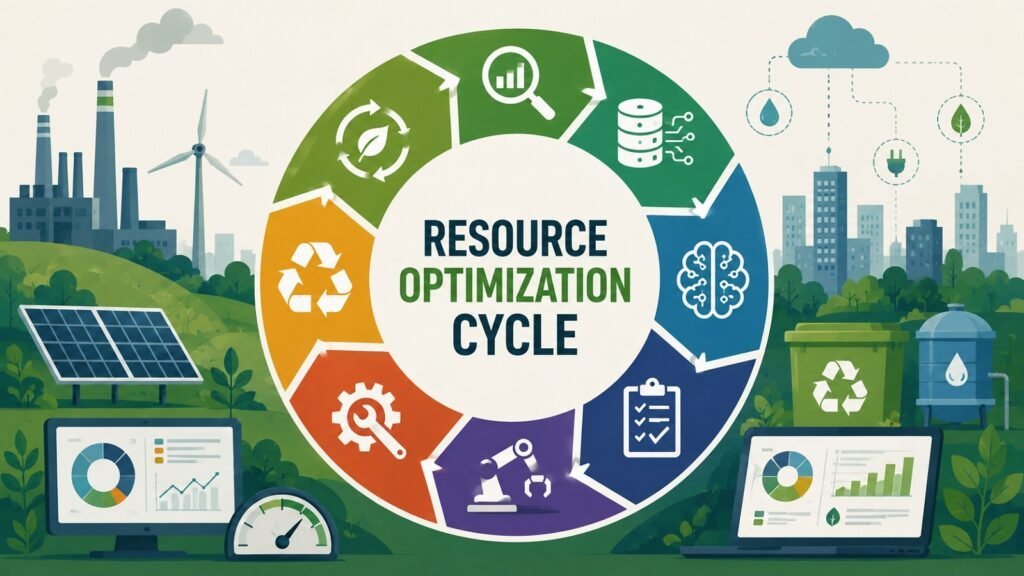
Technological advancement has progressed significantly beyond the time when the focus was merely on resource consumption for performance enhancement. Contemporary engineering systems are crafted to oversee, regulate, and perpetually enhance the utilization of energy, water, materials, computing infrastructure, and industrial assets throughout their entire lifecycle. This transition signifies a more profound comprehension that sustained performance relies not solely on the resources a system utilizes but also on the intelligence with which it manages them.
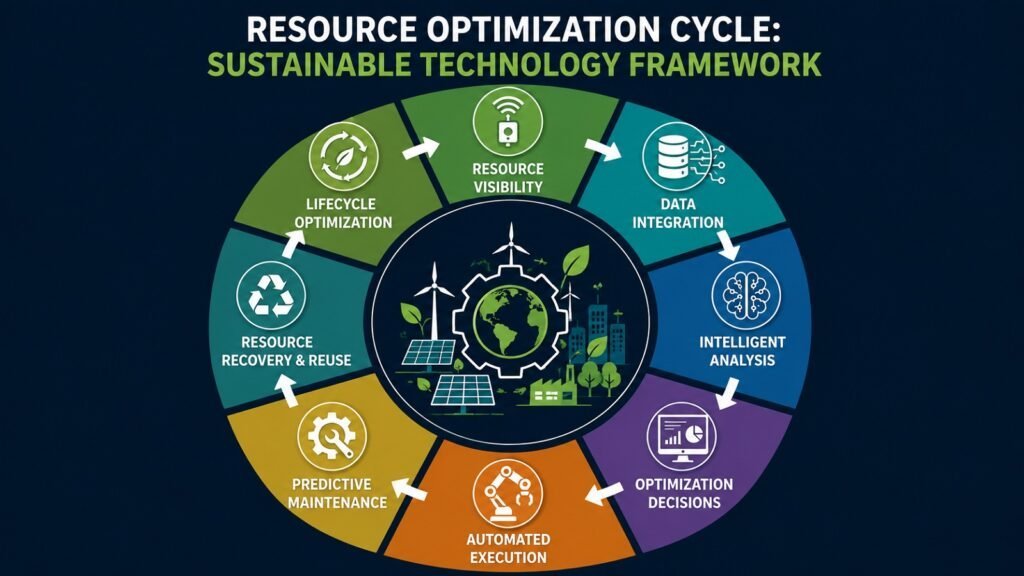
The Resource Optimization Cycle is a key component of Sustainable Technology because it provides a structured, technology-driven framework for converting raw operational data into decisions that reduce waste, extend asset life, and improve system reliability. Rather than treating efficiency as a one-time milestone, the Resource Optimization Cycle establishes a continuous feedback loop where monitoring, analysis, optimization, automation, maintenance, recovery, and lifecycle management reinforce one another at every stage.
The International Energy Agency estimates that industrial energy demand accounts for approximately 37 percent of global final energy consumption, much of which could be reduced through smarter resource management systems. The World Economic Forum has highlighted that AI-driven resource optimization could unlock trillions of dollars in productivity gains by 2030 while substantially reducing emissions. These findings explain why organizations are investing in artificial intelligence, the Internet of Things, digital twins, edge computing, cloud platforms, and predictive analytics to achieve measurable efficiency without sacrificing operational output.
What makes the Resource Optimization Cycle particularly valuable is its systemic nature. Visibility generates data. Integration creates a unified operational picture. Analysis converts that picture into optimization opportunities. Decisions are executed through automation, automated systems are protected through predictive maintenance, and recovered resources are fed back into the cycle. Lifecycle optimization ensures continuous improvement across the full system lifespan, making the eight stages collectively far more powerful than any single element operating alone.
Table: Resource Optimization Cycle — Eight Stages and Their Core Functions
| Stages of Resource Optimization Cycle | Role within the Resource Optimization Cycle |
| Resource Visibility | Continuously collects operational data from sensors, meters, and monitoring systems |
| Data Integration | Combines data from multiple sources into a unified operational view |
| Intelligent Analysis | Converts integrated data into actionable insights using AI and analytics |
| Optimization Decisions | Applies algorithms and models to determine the most efficient resource allocation |
| Automated Execution | Implements optimization decisions through automation and intelligent control systems |
| Predictive Maintenance | Monitors equipment health to prevent failures before they cause resource losses |
| Resource Recovery and Reuse | Recovers, reuses, and recycles materials to maximize existing resource value |
| Lifecycle Optimization | Improves resource efficiency across the full system lifecycle through continuous refinement |
1. Resource Optimization Cycle Through Resource Visibility
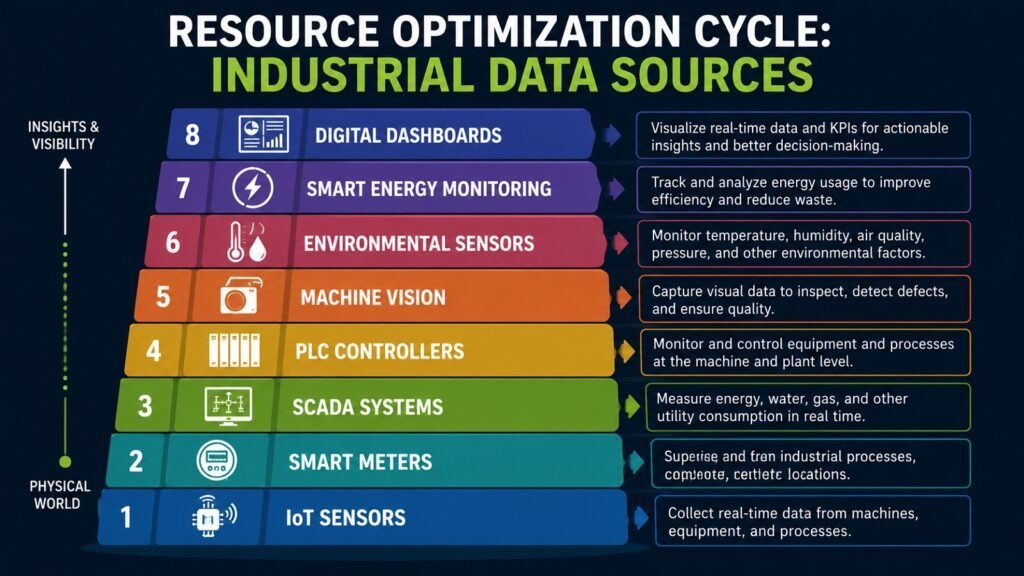
Start of every Resource Optimization Cycle depends on an organization’s capacity to monitor its systems in real time. This principle is simple yet frequently overlooked: improvement is impossible without precise measurement. In the absence of thorough resource visibility, optimization initiatives depend on approximations and conjectures instead of validated operational data, which creates considerable blind spots in the decision-making process.
Modern resource visibility depends on a network of interconnected technologies. IoT sensors and smart meters continuously capture consumption data across manufacturing facilities, commercial buildings, data centers, and utilities. SCADA systems supervise industrial processes and provide real-time control feedback across energy grids and water treatment networks. Telemetry systems transmit equipment performance data from remote assets such as wind turbines, pipelines, and transportation fleets. Digital dashboards aggregate these streams into formats that operational teams can interpret quickly.
What makes this infrastructure genuinely powerful is not any single technology but how these systems function together. When a smart meter records an energy spike, a SCADA system can simultaneously check whether the corresponding process is operating within normal parameters, while an edge computing node processes the data locally to flag anomalies before they escalate. This layered architecture converts isolated readings into contextual operational intelligence.
Siemens reported that its MindSphere industrial IoT platform enabled customers to reduce unplanned downtime by up to 30 percent through continuous asset monitoring and early anomaly detection. Implementing these systems is not without challenges. Data quality remains a persistent concern because sensors can drift, fail, or generate incomplete records. Integrating monitoring infrastructure with legacy equipment involves interoperability barriers that require custom engineering, and cybersecurity demands careful attention given that connected systems expand the attack surface of industrial networks.
Resource visibility establishes the technological foundation for every subsequent stage of the Resource Optimization Cycle. Data collected accurately at this stage determines the quality of every analysis, decision, and action that follows.
Table: Resource Optimization Cycle — Key Monitoring Technologies and Their Contribution to Resource Visibility
| Technology | Contribution to Resource Visibility |
| IoT Sensors | Continuously measure energy, water, temperature, pressure, and other resource parameters |
| Smart Meters | Capture granular, time-stamped consumption data across facilities and infrastructure |
| SCADA Systems | Supervise and control industrial processes while collecting real-time operational data |
| Telemetry Systems | Transmit equipment performance data from remote or difficult-to-access assets |
| Industrial Monitoring Platforms | Aggregate and visualize operational data from multiple sources across a facility |
| Digital Dashboards | Present real-time performance metrics to operational and management teams |
| Edge Computing Nodes | Process sensor data locally to reduce latency and support faster operational decisions |
| Connected Devices | Extend data collection to a wide range of physical assets across distributed environments |
2. Resource Optimization Cycle Through Data Integration
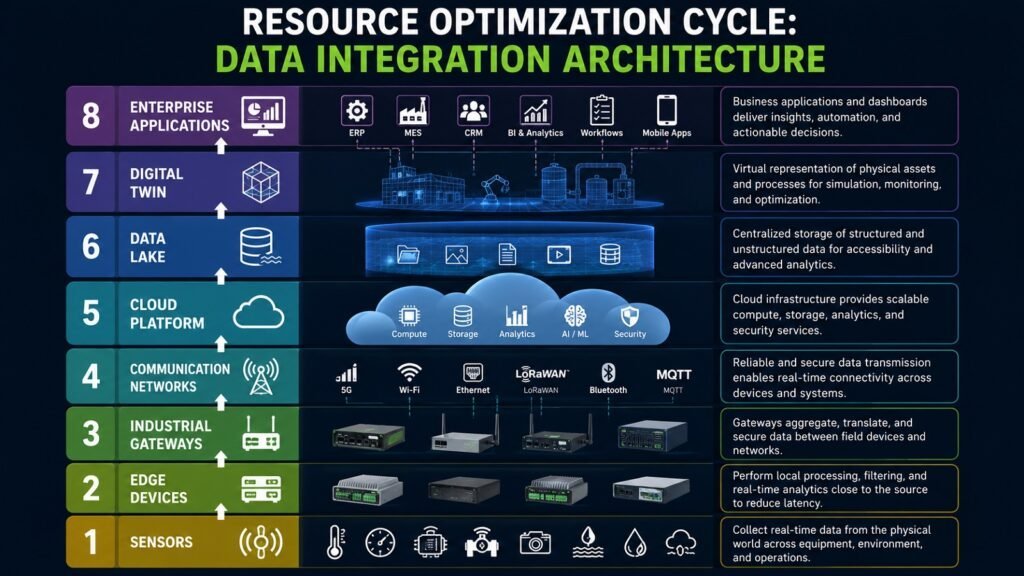
Collecting operational data is only the beginning of the Resource Optimization Cycle. Data generated by sensors, meters, control systems, and enterprise software is rarely useful in isolation. Only by combining information from multiple systems can an organization develop the unified operational view needed for intelligent optimization decisions.
Data integration brings together information from industrial IoT platforms, enterprise resource planning systems, cloud infrastructure, edge computing networks, digital twins, and operational databases. In a manufacturing context, this means linking production line sensor data with supply chain inventories, energy consumption records, and equipment maintenance histories so that every decision reflects the full operational context.
The underlying technical principles matter. Data from different systems is often stored in incompatible formats and structured according to different schemas. Cloud computing platforms provide scalable environments where disparate datasets can be normalized and analyzed together. Edge computing reduces latency by filtering and aggregating data closer to the source. Industrial communication standards such as OPC-UA and MQTT enable interoperability between equipment from different manufacturers.
McKinsey Global Institute research suggests that organizations achieving effective data integration can improve productivity by 15 to 20 percent compared with those managing siloed information systems. BP’s digital operations centers integrate data from offshore platforms, refinery systems, and logistics networks to optimize production across geographically distributed assets. Challenges include data compatibility across older systems, cybersecurity risks from connecting previously isolated networks, and the complexity of scaling integration architectures as operations expand.
Integrated data creates the information foundation that intelligent analysis systems require to identify genuine optimization opportunities rather than acting on incomplete data.
Table: Resource Optimization Cycle — Data Integration Technologies and Their Primary Functions
| Technology | Primary Function within the Resource Optimization Cycle |
| Cloud Computing Platforms | Provide scalable infrastructure for storing, processing, and analyzing operational data |
| Edge Computing | Process and filter data locally to reduce latency and bandwidth requirements |
| Industrial IoT Platforms | Aggregate sensor and device data from across manufacturing and infrastructure environments |
| OPC-UA Protocol | Enable standardized communication between industrial equipment from different manufacturers |
| Digital Twins | Mirror physical systems in software to integrate real-time operational and simulation data |
| Enterprise Resource Planning Systems | Combine operational, financial, and supply chain data into a unified business view |
| MQTT Protocol | Provide lightweight messaging for IoT device communication across distributed networks |
| Data Lakes | Store large volumes of structured and unstructured operational data for centralized analysis |
3. Resource Optimization Cycle Through Intelligent Analysis
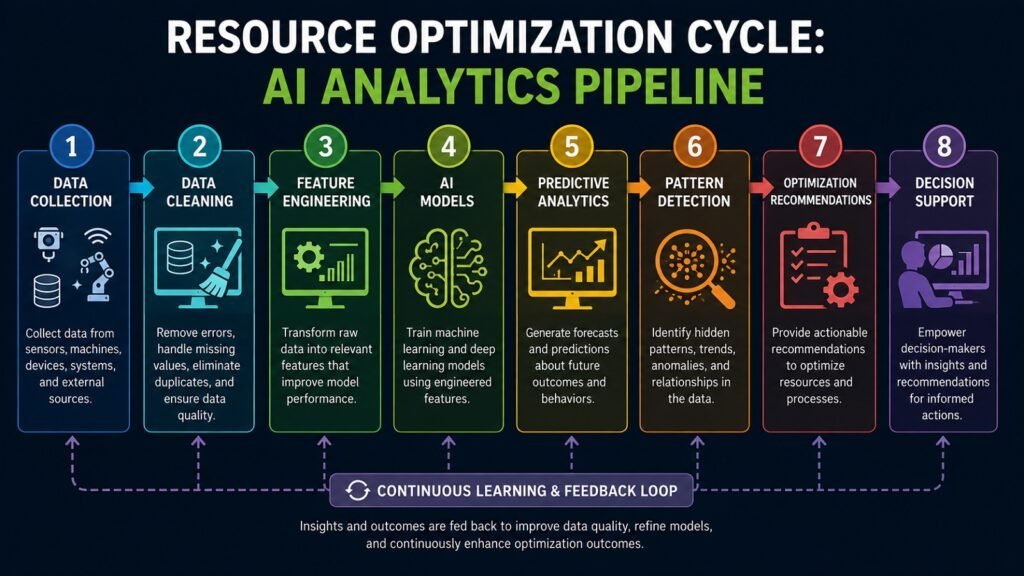
Integrated data becomes genuinely valuable within the Resource Optimization Cycle only when it is analyzed with sufficient depth to reveal what human operators cannot easily detect. This is where artificial intelligence, machine learning, predictive analytics, statistical modeling, simulation technologies, and digital twins transform operational datasets into specific, actionable optimization opportunities.
Machine learning algorithms excel at identifying patterns across large and complex datasets. In energy management, they can identify correlations between weather conditions, occupancy levels, and building energy consumption that would be invisible in conventional reporting. In manufacturing, anomaly detection models flag deviations from operational baselines hours or days before they result in equipment failures. Digital twins take analysis further by simulating physical system behavior under different operating conditions, allowing engineers to evaluate optimization scenarios without disrupting live operations.
Research published in Nature Energy found that machine learning applied to building energy systems achieved consumption reductions of up to 40 percent in certain HVAC optimization applications. DeepMind’s application of reinforcement learning to cooling systems in Google data centers reduced cooling energy consumption by approximately 40 percent compared with human-managed baselines.
These results should be understood in context. AI systems require high-quality, well-labeled training data to perform reliably. Model bias presents a risk when training data does not adequately represent the range of conditions a system may encounter. Computational requirements for training complex models can be substantial, and integrating AI analytics into existing operational environments requires careful system design. Organizations typically address these challenges through phased deployment, robust data governance frameworks, and ongoing model validation.
Intelligent analysis provides the evidentiary foundation that optimization decisions require, replacing intuition and historical averages with current, specific, and quantified operational knowledge.
Table: Resource Optimization Cycle — Analytical Technologies and Their Role in Resource Optimization
| Technology | Role in Intelligent Analysis |
| Machine Learning Algorithms | Identify operational patterns and anomalies across large and complex datasets |
| Predictive Analytics | Forecast future resource demand and system performance based on historical and real-time data |
| Digital Twins | Simulate physical system behavior to evaluate optimization scenarios before implementation |
| Statistical Modeling | Quantify relationships between operational variables to support evidence-based decisions |
| Reinforcement Learning | Optimize control strategies through continuous feedback from operational outcomes |
| Anomaly Detection Systems | Identify deviations from normal operational behavior that indicate inefficiency or risk |
| Neural Networks | Process high-dimensional operational data to support complex classification and prediction tasks |
| Simulation Software | Model system dynamics under different conditions to identify efficiency improvement opportunities |
4. Resource Optimization Cycle Through Optimization Decisions
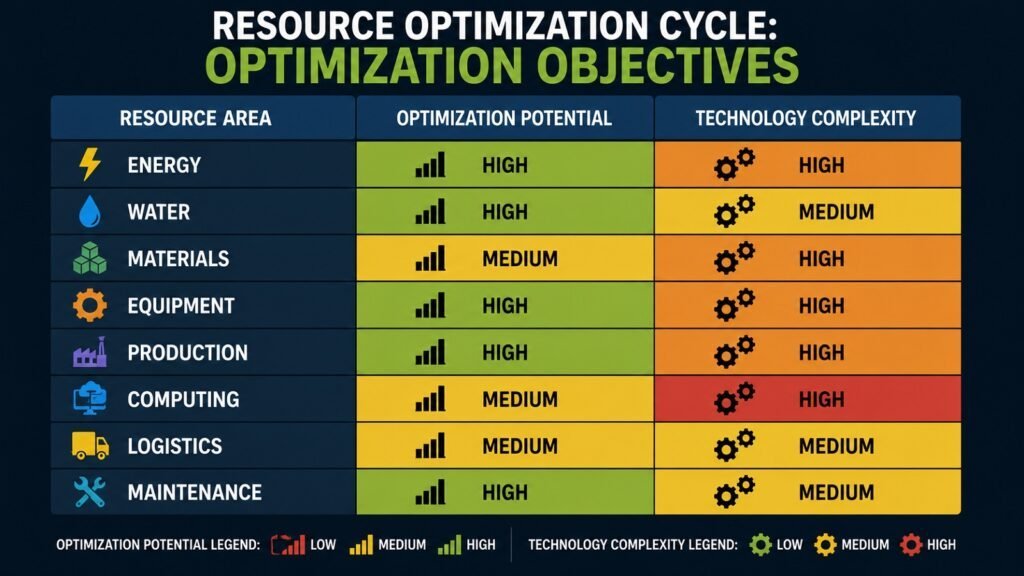
Analysis reveals what needs to change. Optimization decisions determine exactly how that change should happen. This stage of the Resource Optimization Cycle converts analytical insights into specific operational choices about how resources should be allocated, scheduled, rerouted, or reduced across technology systems.
Optimization decisions draw on mathematical programming techniques, AI-driven decision models, simulation platforms, and decision-support systems. Linear programming, mixed-integer optimization, and genetic algorithms address problems where multiple competing constraints must be balanced simultaneously, such as scheduling production across shared resources while minimizing energy costs and meeting delivery deadlines. More complex environments increasingly rely on reinforcement learning systems that adjust operational parameters in real time based on performance feedback.
An optimization model is only as useful as its ability to reflect real-world constraints accurately. Oversimplified models perform well in simulation but fail under unpredictable operational conditions. The most effective systems are designed with operational engineers who understand both the mathematics of optimization and the physical constraints that bound what is achievable.
UPS developed its ORION route optimization system to determine the most fuel-efficient delivery routes across its driver network. The company reported saving approximately 100 million miles annually, producing substantial fuel and emissions reductions. In energy systems, grid operators use optimal power flow algorithms and AI-driven dispatch systems to balance supply and demand in real time.
Higher levels of optimization often introduce greater system complexity, creating new failure modes that require more sophisticated monitoring. Organizations must balance efficiency gains against the reliability and management demands that sophisticated decision systems introduce.
Table: Resource Optimization Cycle — Optimization Techniques and Their Contribution to Decision-Making
| Technique | Contribution to Optimization Decisions |
| Linear Programming | Determines efficient resource allocation when constraints can be expressed linearly |
| Mixed-Integer Optimization | Solves complex scheduling problems involving both continuous and discrete variables |
| Genetic Algorithms | Explore large solution spaces to find near-optimal outcomes for multi-variable problems |
| Reinforcement Learning | Continuously adjusts operational parameters based on real-time performance feedback |
| Simulation-Based Optimization | Evaluates competing decision scenarios in a virtual environment before implementation |
| Multi-Objective Optimization | Balances trade-offs between efficiency, cost, reliability, and environmental performance |
| Constraint Programming | Models operational rules and physical limitations to guide feasible solutions |
| Decision Support Systems | Present optimization recommendations in formats that support fast and informed decisions |
5. Resource Optimization Cycle Through Automated Execution
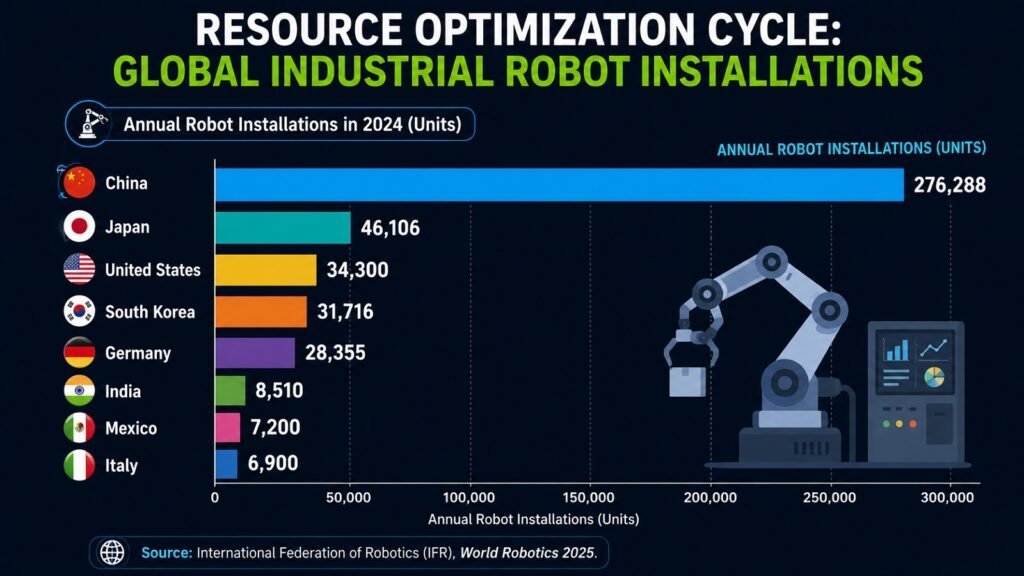
Optimization decisions are only as effective as the mechanisms that carry them out. Automated execution translates optimized plans into real-world operational adjustments through industrial automation, robotics, programmable logic controllers, intelligent control systems, and software automation platforms.
Automation removes the delay and variability that human intervention introduces between a decision and its implementation. A building energy management system can adjust HVAC settings and equipment schedules within seconds of receiving an optimized control signal. In manufacturing, programmable logic controllers execute production schedules and coordinate robotic systems at speeds that far exceed human operational capacity. Autonomous control systems in smart grids balance load distribution and respond to demand fluctuations without operator involvement.
McKinsey & Company research indicates that automation and intelligent control systems have the potential to reduce manufacturing energy intensity by 20 to 30 percent when optimization algorithms are combined with real-time execution capabilities. Amazon’s robotic fulfillment systems coordinate thousands of autonomous agents simultaneously to optimize inventory movement and order processing, reducing resource requirements while improving throughput consistency.
Automated execution introduces its own challenges. Cybersecurity vulnerabilities in industrial control systems present significant risks because unauthorized access can disrupt operations or create safety hazards. Workforce adaptation is an important consideration as automation redefines roles. Interoperability between platforms from different vendors complicates integration in environments with diverse or aging equipment.
The data generated during automated execution also creates the operational record that predictive maintenance systems depend on to monitor equipment health in the following stage.
Table: Resource Optimization Cycle — Automation Technologies and Their Role in Execution
| Technology | Role in Resource Optimization Cycle |
| Programmable Logic Controllers | Execute real-time process control instructions across industrial and manufacturing systems |
| Industrial Robots | Perform precise, repeatable physical tasks with greater speed and consistency than manual operations |
| Building Automation Systems | Automatically control HVAC, lighting, and energy systems to optimize building resource consumption |
| Autonomous Control Systems | Manage complex operational environments without continuous human intervention |
| Manufacturing Execution Systems | Coordinate production scheduling, resource allocation, and quality control on the shop floor |
| Smart Grid Controllers | Automatically balance electricity supply and demand across distributed generation and consumption |
| Software Automation Platforms | Execute digital workflows, reporting, and data processing tasks without manual input |
| Robotic Process Automation | Automate repetitive digital tasks to reduce processing time and resource requirements |
6. Resource Optimization Cycle Through Predictive Maintenance
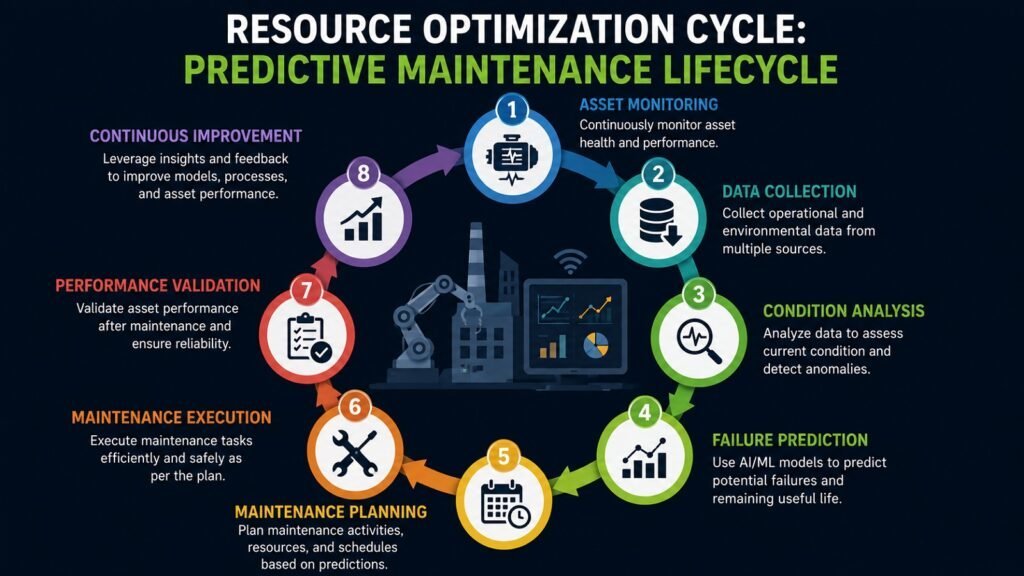
Even the most efficiently designed system loses resource optimization value when equipment fails unexpectedly. Predictive maintenance addresses this within the Resource Optimization Cycle by continuously monitoring asset health and intervening before breakdowns cause energy losses, production interruptions, or damage to connected systems.
Unlike preventive maintenance, which schedules service at fixed intervals regardless of equipment condition, predictive maintenance uses real-time operational data to determine when service is genuinely necessary. Vibration analysis detects bearing wear and mechanical imbalances in rotating equipment. Thermal imaging identifies heat signatures that indicate electrical faults or insulation degradation. Machine learning models trained on historical failure data identify sensor signal combinations that typically precede specific failure modes, allowing maintenance teams to act before breakdowns occur.
Deloitte research estimates that predictive maintenance reduces equipment maintenance costs by 25 to 30 percent, eliminates up to 70 percent of breakdowns, and extends machine life by 20 to 40 percent in industrial environments where it is effectively implemented. Digital twins amplify these benefits by providing virtual reference models of each asset’s expected behavior, making deviations that indicate deteriorating conditions easier to detect.
Implementation requires sustained investment. High-quality sensor coverage is essential because monitoring gaps create blind spots that undermine predictive capability. Data consistency is necessary for training reliable models, particularly for assets with long mean times between failures. Integration with maintenance planning systems ensures that predictions translate into scheduled actions rather than unaddressed alerts.
Predictive maintenance extends asset life and prevents resource losses associated with equipment-related failures, reinforcing the efficiency gains delivered by earlier stages of the cycle.
Table: Resource Optimization Cycle — Predictive Maintenance Technologies and Their Purposes
| Technology | Primary Purpose within the Resource Optimization Cycle |
| Vibration Analysis | Detects mechanical wear and imbalance in rotating equipment before failures develop |
| Thermal Imaging | Identifies abnormal heat patterns indicating electrical or mechanical deterioration |
| Ultrasonic Monitoring | Detects leaks, friction, and stress in pressurized and mechanical systems |
| Machine Learning Diagnostics | Identifies failure precursors by recognizing patterns in historical and real-time sensor data |
| Digital Twins for Maintenance | Provide virtual asset models that highlight deviations from expected operational behavior |
| Condition Monitoring Systems | Continuously track equipment health parameters to support maintenance decision-making |
| Asset Management Platforms | Schedule, track, and document maintenance activities based on predictive system outputs |
| Oil and Fluid Analysis | Detects contamination and degradation in lubrication and hydraulic systems before mechanical damage |
7. Resource Optimization Cycle Through Resource Recovery and Reuse
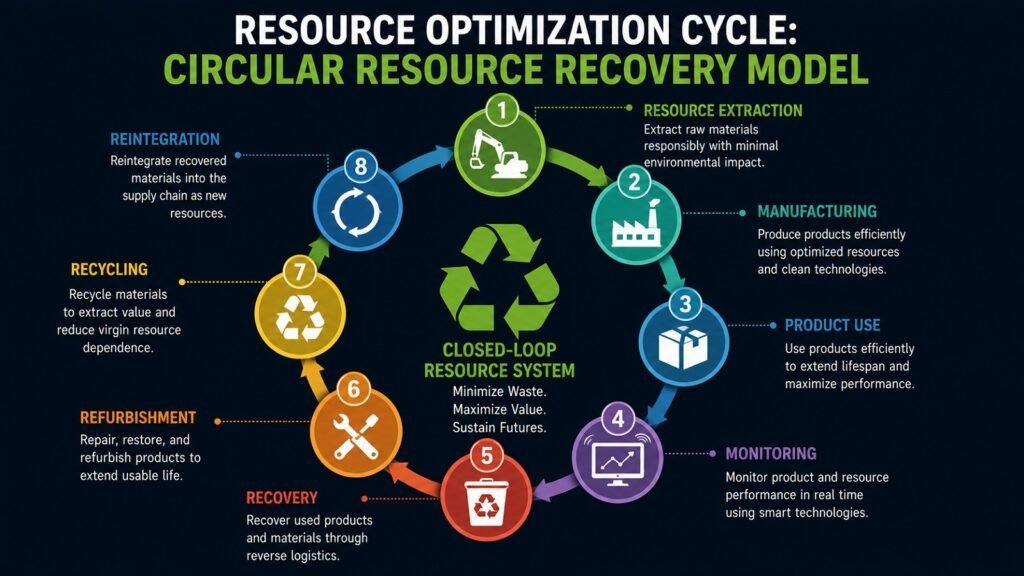
The Resource Optimization Cycle would be incomplete if it focused only on operational efficiency and ignored what happens to resources at the end of their productive life. Resource recovery and reuse extend the cycle by capturing value from materials, energy, and components before they become waste, reducing dependence on virgin resource inputs.
Battery recycling is one of the most technologically significant areas of resource recovery. Lithium-ion batteries from electric vehicles and energy storage systems contain lithium, cobalt, nickel, and manganese. Hydrometallurgical processes can recover 95 percent or more of these materials under controlled conditions, reducing the need for primary mining while addressing disposal risks. Companies such as Redwood Materials and Li-Cycle have developed industrial-scale processes to recover battery materials and reintroduce them into supply chains.
The Global E-waste Monitor estimated that global electronic waste reached 62 million metric tons in 2022, with only 22 percent formally recycled. Printed circuit boards and processors contain gold, silver, palladium, and copper, which can be recovered through automated disassembly and hydrometallurgical separation. Industrial water reclamation systems treat wastewater from manufacturing processes for reuse in cooling and other industrial applications. Heat recovery exchangers capture thermal energy from manufacturing exhaust and data center cooling, converting waste heat into useful energy for additional process requirements.
Economic viability remains a challenge. The cost of collecting, sorting, and processing recovered materials must be competitive with primary resource production for recovery programs to scale without policy support. Technology development continues to improve recovery economics, but long-term investment and supportive regulatory frameworks are typically required to build infrastructure at scale.
Table: Resource Optimization Cycle — Recovery Technologies and Their Contribution to Resource Optimization
| Technology | Contribution to Resource Recovery and Reuse |
| Hydrometallurgical Battery Recycling | Recovers lithium, cobalt, nickel, and manganese from spent batteries for reuse in new cells |
| Automated Electronic Waste Disassembly | Separates and processes components from end-of-life electronics to recover precious metals |
| Industrial Water Reclamation | Treats and recycles wastewater from manufacturing processes to reduce freshwater consumption |
| Heat Recovery Exchangers | Capture thermal energy from industrial exhaust and cooling systems for productive reuse |
| Component Refurbishment Systems | Restore used components to serviceable condition for redeployment in systems or as spare parts |
| Remanufacturing Platforms | Return end-of-life products to original performance specifications using recovered materials |
| Circular Manufacturing Systems | Design production processes to reintegrate recovered materials directly into new manufacturing cycles |
| Material Recovery Facilities | Sort and process mixed waste streams to extract reusable industrial materials at scale |
8. Resource Optimization Cycle Through Lifecycle Optimization
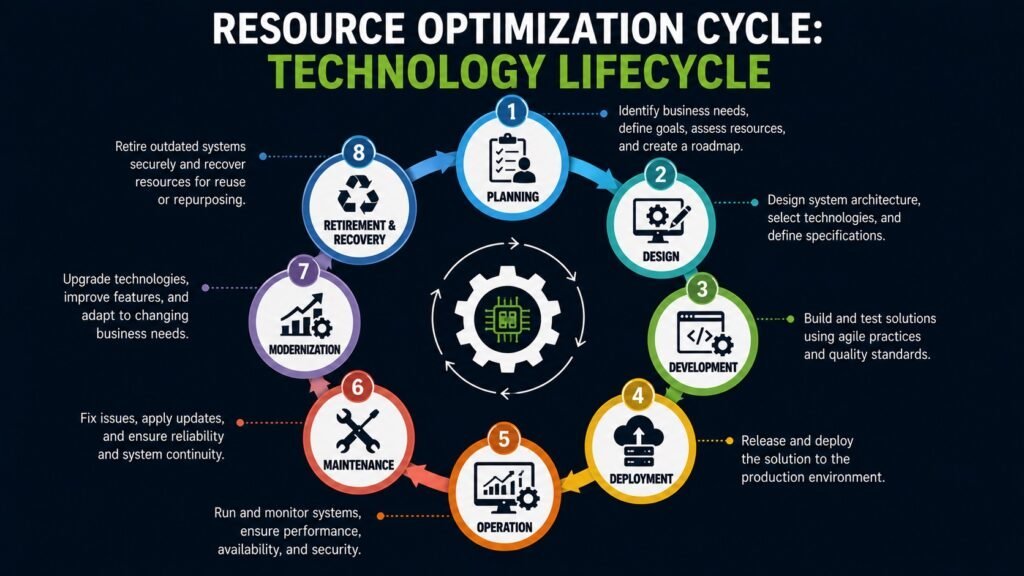
All the efficiency gains achieved across the previous stages of the Resource Optimization Cycle depend on technology systems that remain fit for purpose throughout their operational lives. Lifecycle optimization ensures that resource efficiency is not only achieved at deployment but continuously improved through design, operation, modernization, and eventual retirement.
Digital twins are central to lifecycle optimization because they create continuously updated virtual models of physical assets that accumulate operational knowledge over time. As a system ages, its digital twin reflects actual performance trends rather than original design assumptions, enabling engineers to identify optimization opportunities that only emerge after years of operational experience. Product lifecycle management platforms coordinate design, engineering, manufacturing, maintenance, and disposal activities across the entire system lifecycle, reducing inefficiencies that arise when these functions operate in isolation.
Modular engineering design makes it easier to upgrade individual components without replacing entire assemblies. Software updates allow optimization algorithms and control parameters to be improved throughout a system’s life without physical modifications. The IEC 62264 standard provides a recognized framework for integrating enterprise and control systems in ways that support continuous operational improvement.
Research from the Ellen MacArthur Foundation indicates that circular economy approaches to product design — incorporating modularity, repairability, and upgrade potential — can reduce total resource consumption by 30 to 50 percent compared with linear take-make-dispose models across the full product lifecycle.
Implementation challenges are real. Technology obsolescence can make older systems incompatible with newer optimization tools. Interoperability between lifecycle management platforms and operational technology varies widely across industries and equipment generations. Long-term lifecycle planning requires organizational commitment that extends well beyond typical project planning horizons.
Table: Resource Optimization Cycle — Lifecycle Optimization Technologies and Their Contributions
| Technology | Primary Contribution in Resource Optimization Cycle |
| Digital Twins | Accumulate operational knowledge over time to support continuous performance improvement |
| Product Lifecycle Management Platforms | Coordinate design, operations, maintenance, and disposal for end-to-end resource efficiency |
| Modular Engineering Design | Enable component-level upgrades without full system replacement, extending operational life |
| Software Update Systems | Improve optimization algorithms and control parameters without physical system modifications |
| Asset Management Systems | Track asset condition, performance history, and maintenance records across the full lifecycle |
| Long-Term Performance Monitoring | Identify gradual performance degradation trends that require lifecycle intervention |
| Lifecycle Assessment Tools | Quantify the environmental impact of technology systems across all lifecycle stages |
| System Modernization Platforms | Upgrade aging infrastructure with current optimization technologies while preserving continuity |
Conclusion: The Future of the Resource Optimization Cycle in Sustainable Technology
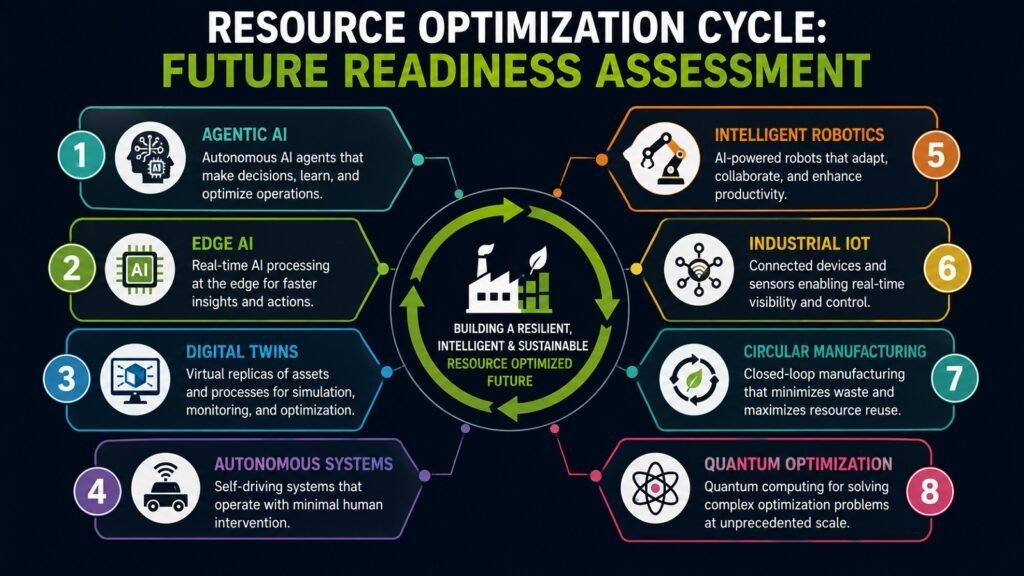
The eight stages of the Resource Optimization Cycle — visibility, integration, analysis, decisions, execution, maintenance, recovery, and lifecycle improvement — form an interconnected framework that enables technology systems to continuously improve their resource efficiency. Together they represent a fundamental shift in how organizations approach the relationship between performance and resource consumption, replacing static efficiency targets with a dynamic, self-improving operational capability.
Several emerging technology developments are likely to extend these capabilities significantly. Agentic AI systems, which can independently plan, evaluate, and execute multi-step optimization tasks without continuous human instruction, are beginning to appear in energy management, supply chain optimization, and industrial control applications. These systems operate at speeds and scales that far exceed conventional automation, allowing the cycle to respond to changing conditions in near real time.
Advanced digital twins, enhanced by high-resolution sensor networks and more powerful simulation engines, will create more accurate and predictive representations of physical systems. Edge intelligence, where AI processing moves closer to where operational data is generated, will reduce latency in optimization cycles and support more responsive automated execution across distributed infrastructure such as smart cities and renewable energy networks.
Self-optimizing infrastructure — systems that automatically adjust their own parameters based on performance feedback — represents the logical evolution of the Resource Optimization Cycle’s core principles. Early examples already exist in adaptive data center cooling and self-healing power grid architectures, and these capabilities are expected to expand broadly as AI and automation technologies mature.
The most important insight the Resource Optimization Cycle offers is that efficiency is not a destination but an ongoing engineering discipline. Organizations that embed systematic, technology-driven optimization into every operational stage will be better positioned to meet future performance, sustainability, and competitiveness demands as resource constraints intensify.
Table: Resource Optimization Cycle — Eight Stages and Their Long-Term Contributions to Sustainable Technology
| Stage | Long-Term Contribution to Sustainable Technology |
| Resource Visibility | Establishes the continuous data foundation that makes all subsequent optimization possible |
| Data Integration | Creates unified operational intelligence that improves the accuracy of optimization decisions |
| Intelligent Analysis | Identifies efficiency opportunities that would be undetectable through conventional monitoring alone |
| Optimization Decisions | Ensures resources are allocated in the most efficient manner given operational constraints |
| Automated Execution | Delivers optimization outcomes with precision and consistency that human management cannot sustain |
| Predictive Maintenance | Preserves asset performance and prevents resource losses from equipment degradation |
| Resource Recovery and Reuse | Extends the value of existing resources and reduces dependence on primary raw material consumption |
| Lifecycle Optimization | Ensures resource efficiency improvements are sustained and compounded across the full system lifespan |