Table of Contents
Introduction — Screen Time and the Digitalization of Life
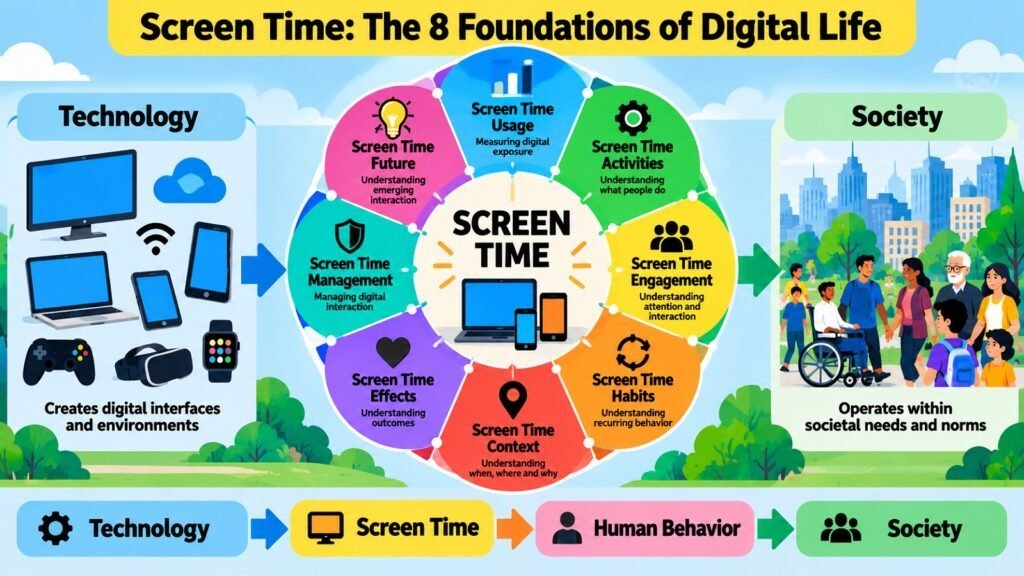
Screens were once specialized tools confined to particular settings — offices, living rooms, lecture halls. Now they are embedded in nearly every dimension of daily life: work, learning, communication, commerce, and entertainment all flow through digital interfaces that people carry in their pockets, wear on their wrists, and consult dozens of times each day. Screen Time, therefore, is not simply a count of hours spent looking at a display. It is a broader indicator of how people relate to digital technology, and understanding it requires considerably more than a single number.
Two forces shape that relationship: technology and society. Technology determines the devices, interfaces, platforms, algorithms, and digital environments that create and influence Screen Time. Society determines how those technologies are adopted, used, normalized, and integrated into everyday institutions. Screen Time is an important aspect for both Technology and Society because changes in one domain continuously reshape the other. A new platform feature can alter millions of behavioral routines overnight; a shift in social norms can make previously common technology use feel intrusive or unacceptable.
Duration alone cannot adequately explain Screen Time. Two people spending equal hours with screens may differ in every meaningful respect: the devices they use, the activities they pursue, how deeply they engage, the habits they have formed, the contexts surrounding their use, and the outcomes they experience. This article develops eight powerful foundations for understanding Screen Time — Usage, Activities, Engagement, Habits, Context, Effects, Management, and Future — a framework that readers can use to interpret digital exposure more intelligently, distinguishing established evidence from widespread assumptions and connecting theory with practical understanding.
Table 1: Screen Time Foundations Covered in This Article
| Screen Time Aspect | What It Explores |
| Screen Time Usage | How digital exposure is measured across devices, duration, and interaction patterns |
| Screen Time Activities | What people do during Screen Time — work, learning, entertainment, and more |
| Screen Time Engagement | How technology mechanisms influence the depth and persistence of user interaction |
| Screen Time Habits | How repeated technology use forms recognizable behavioral routines over time |
| Screen Time Context | How setting, timing, and purpose change the meaning of Screen Time |
| Screen Time Effects | What research indicates about physical, cognitive, behavioral, and social outcomes |
| Screen Time Management | How tools and practices help users monitor and improve their digital use |
| Screen Time Future | How emerging technologies are redefining screen-based interaction |
1. Screen Time Usage: Measuring Digital Exposure
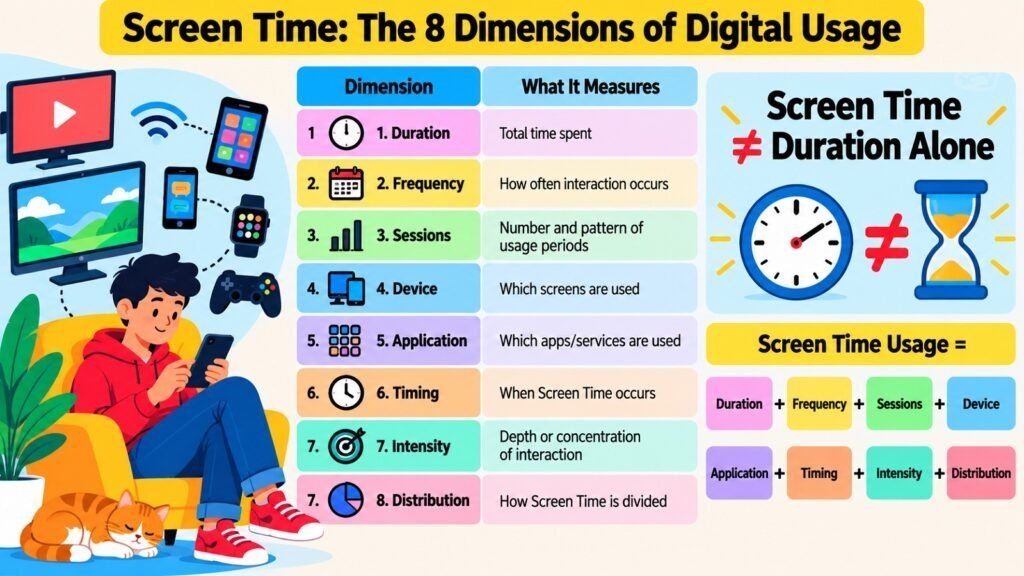
Any serious understanding of Screen Time starts with measurement. Screen Time Usage refers to the foundational layer of digital exposure: the data generated when people interact with devices, applications, and digital services. Modern operating systems have made this layer increasingly visible — smartphones report daily and weekly summaries, computers log active time per application, and wearables record interaction patterns across connected devices. This measurement infrastructure has changed how individuals, researchers, and institutions think about digital behavior.
Duration is the most discussed dimension, but it is only one of several that together produce a meaningful picture. How often a person reaches for their phone matters independently of how long each session lasts. A user checking a device forty times in brief intervals has a fundamentally different usage profile from one who engages in two extended, uninterrupted sessions — even when total time is identical. Session frequency and session length interact in ways that shape how Screen Time is experienced.
Distribution across the day adds another layer: whether usage concentrates in the morning, spreads through working hours, or clusters before sleep may matter as much as total duration. Device type introduces further complexity — a television, a work laptop, a smartphone during a commute, and a gaming console all generate Screen Time in meaningfully different ways.
What can be measured can be analyzed, compared, and managed. Screen Time Usage data creates an empirical foundation for everything else, enabling individuals to identify patterns, researchers to study population-level behavior, and organizations to design evidence-based policies. The challenge is that usage data is still only a behavioral trace: it records what happened, not why it happened or what it meant. Interpreting Screen Time Usage well means treating it as a multidimensional measurement rather than a single statistic, and recognizing that the same total can represent very different digital realities.
Table 2: Screen Time Usage Dimensions and What They Measure
| Usage Dimensions | What It Measures |
| Duration | Total screen interaction time over a defined period |
| Frequency | How often a device or app is accessed within a time window |
| Session length | Average duration of each individual screen session |
| Device use | Distribution of Screen Time across device types |
| Application use | Time spent within specific apps or software categories |
| Timing | When during the day screen interactions predominantly occur |
| Intensity | Degree of active versus passive engagement per session |
| Distribution | How Screen Time is spread across the day or week |
2. Screen Time Activities: Understanding Digital Use
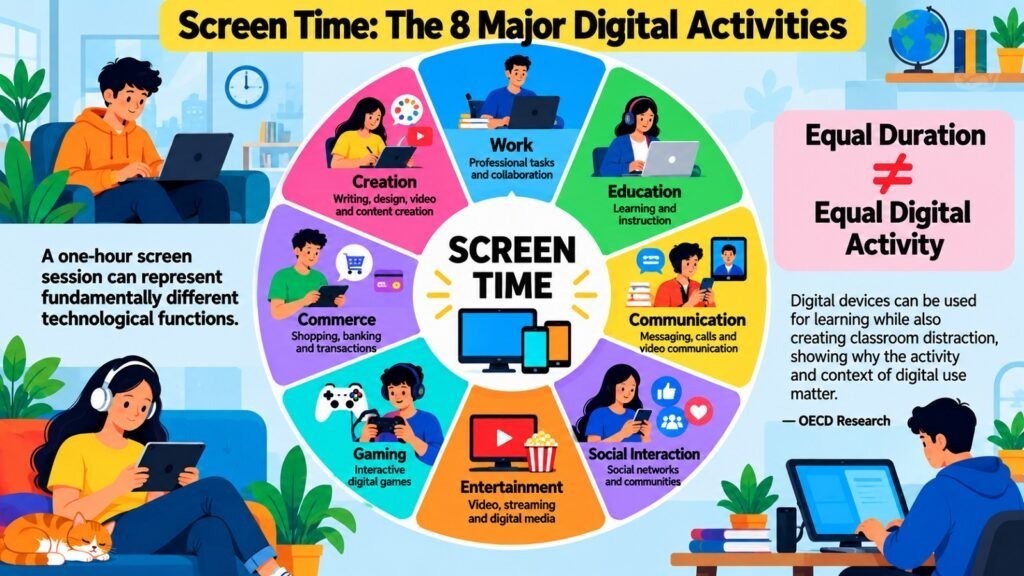
Duration tells you how long someone spent with a screen. Activity tells you what they actually did — and these are not the same question. The same device, in the same person’s hands, during the same hour, can support radically different purposes depending on which application is open. A laptop used for writing a report, attending a video call, editing footage, or placing an order represents the same hardware but four meaningfully distinct Screen Time Activities. Any analysis that treats them as equivalent because the device is the same will produce conclusions that do not survive scrutiny.
Modern technology has made this diversity possible. Operating systems, application ecosystems, cloud services, and high-bandwidth connectivity have turned consumer devices into platforms capable of supporting work, education, commerce, communication, entertainment, creativity, and healthcare simultaneously. Understanding activities also means moving beyond simple productive-versus-unproductive distinctions. Gaming can involve complex problem-solving and strategic thinking. Passive streaming can be genuinely restorative in certain contexts. The analytical discipline required is to examine the purpose, design, and actual outcomes of an activity rather than assigning fixed value to categories based on their labels.
Research consistently finds that the nature of what people do on screens matters when interpreting outcomes. Studies examining children have generally found that associations between Screen Time and well-being depend heavily on the activity type, who is present, and the conditions surrounding use — not simply total hours. For practical purposes, this means categorizing digital time by purpose: work, learning, communication, entertainment, creation, commerce. That classification is consistently more informative than treating total duration as the primary unit of analysis.
Table 3: Screen Time Activity Categories and Their Primary Digital Purpose
| Activities | Primary Digital Purpose |
| Professional work | Creating, analyzing, and managing tasks through digital tools |
| Online education | Accessing structured learning and educational resources via screens |
| Social communication | Messaging, video calls, and social network engagement |
| Entertainment | Consuming video, audio, and other digital content for enjoyment |
| Gaming | Interactive digital experiences involving challenge or social play |
| Information consumption | Reading news, research, and informational content digitally |
| Content creation | Producing written, visual, audio, or video content with digital tools |
| Digital commerce | Purchasing goods and managing financial transactions online |
3. Screen Time Engagement: How Technology Captures Attention
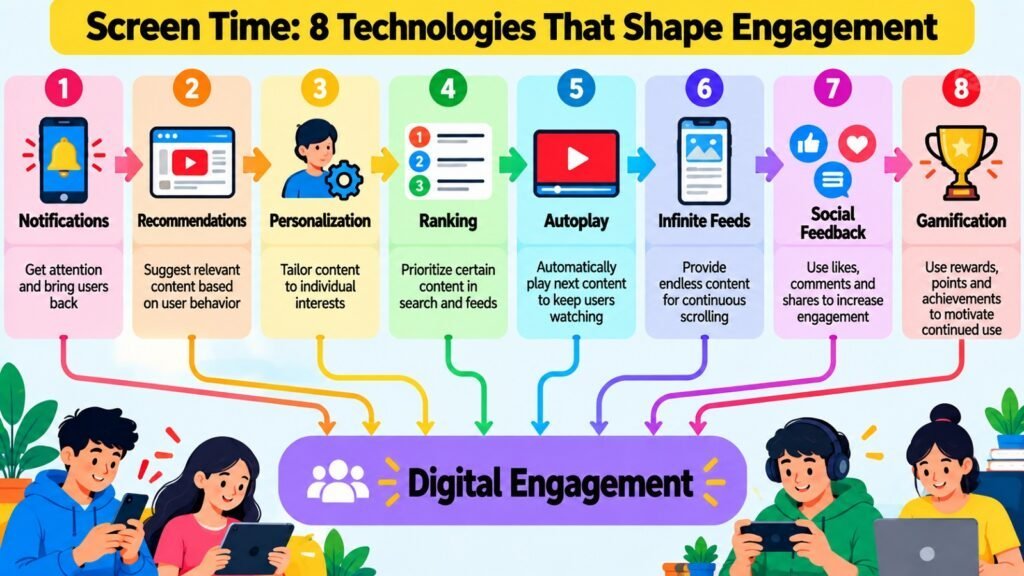
There is a meaningful difference between being near a screen and being engaged with one. Screen Time Engagement refers to the depth, intensity, and persistence of a user’s interaction with a digital system. Unlike duration, which measures how long the screen is on, engagement concerns how thoroughly the system occupies attention. Two people spending equal time on the same application can have very different engagement experiences depending on how the interface is designed, how content is delivered, and what mechanisms the platform uses to sustain interaction.
Digital platforms deploy well-documented mechanisms to maintain engagement. Push notifications interrupt ongoing activity to pull users back to an app. Recommendation algorithms analyze past behavior to surface content calibrated to hold interest, creating a feedback loop that makes continuing easier than stopping. Autoplay removes the pause between content items; infinite scroll removes natural stopping points entirely. The concept of persuasive technology, introduced by behavioral scientist B.J. Fogg, describes how systems can change human behavior through their structure rather than explicit instruction — and many platform features fit this description precisely. Gamification elements, social feedback signals such as likes and comments, and variable reward patterns extend the same logic across different types of applications.
None of this means technology fully determines user behavior. People retain agency, and context, purpose, and individual differences matter considerably. Recognizing that digital systems are often designed to maximize engagement helps users distinguish between interaction that reflects a genuine choice and interaction that reflects the path of least resistance built into the interface. A practical test: would you have continued this session if the platform had required a deliberate action to do so? That small friction reveals how much of the engagement was intentional versus technology-driven.
Table 4: Screen Time Engagement Mechanisms and Their Influence
| Engagement Mechanisms | How It Influences Screen Interaction |
| Push notifications | Interrupt activity to redirect attention back to an app |
| Recommendation algorithms | Surface calibrated content to sustain continued engagement |
| Autoplay | Advances to new content automatically, removing the need to choose |
| Infinite scroll | Eliminates pagination and natural stopping points in content feeds |
| Gamification | Uses points, streaks, and rewards to reinforce repeated use |
| Personalization | Adapts content and interface to individual preferences and return rate |
| Social feedback signals | Likes and comments reinforce sharing and habitual checking behaviors |
| Alerts and badges | Visible counts create urgency and motivate return visits |
4. Screen Time Habits: Technology and Everyday Behavior
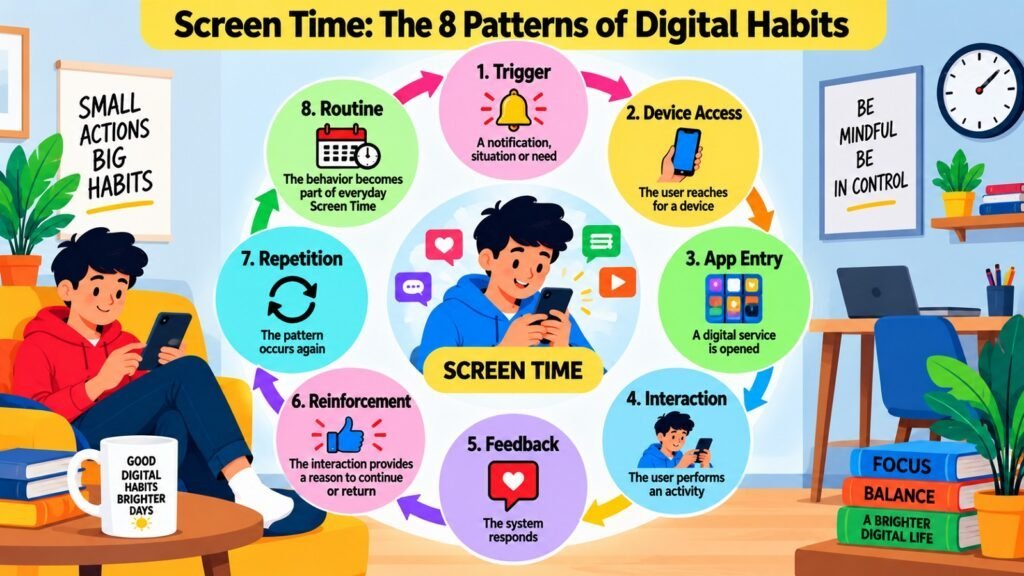
Engagement explains how technology sustains a session. Habits explain how technology use becomes a recurring feature of daily life. Screen Time Habits are the recognizable, repeated patterns of digital behavior that emerge over time through the interaction of individual choices, social norms, technological convenience, and environmental cues. Unlike deliberate decisions to use a device, habits operate more automatically, triggered by familiar contexts. The psychological structure is well established: a cue triggers a routine, and a reward reinforces repetition. In Screen Time terms, the cue might be a notification sound, a moment of boredom, or the transition between tasks; the routine is the screen interaction itself; the reward is social connection, new information, or simply an occupied mind.
Technological characteristics reinforce this loop at multiple points. Persistent connectivity means devices are always ready. Notification systems create reliable cues throughout the day. Content abundance ensures that opening an app almost always delivers something that feels rewarding. Common Screen Time Habits — habitual notification checking, morning device checking before engaging with the physical environment, evening scrolling as a wind-down routine, rapid device switching without clear intention — are recognizable across populations and appear consistently in digital behavior research. Their prevalence suggests they are shaped partly by shared technological characteristics rather than purely individual personality differences.
Recognizing Screen Time Habits is more useful than measuring total duration alone. A person spending ninety minutes on social platforms in fifteen planned sessions has a fundamentally different behavioral profile from someone accumulating the same time in forty reflexive checks triggered by notifications. The aggregate number looks identical; the behavioral reality is quite different. Identifying where cues come from, what routines they trigger, and whether the rewards align with genuine goals gives a more accurate and actionable picture of digital behavior than any usage dashboard summary.
Table 5: Common Screen Time Habits and Their Technological Drivers
| Habits | Common Technological Driver |
| Notification checking | Push systems delivering frequent, unpredictable alerts across apps |
| Morning device checking | Devices as alarms combined with always-on social and messaging apps |
| Habitual app opening | Low-friction shortcuts and icons for frequently used services |
| Device switching | Multi-device ecosystems with synchronized accounts and notifications |
| Bedtime scrolling | Portable devices and recommendation-driven feeds available at night |
| Multitasking across screens | Multiple connected devices with synced notifications running simultaneously |
| Reflexive social media use | Variable reward patterns via likes and content updates in social platforms |
| Continuous work connectivity | Always-on email and messaging platforms normalizing immediate response |
5. Screen Time Context: When, Where and Why We Use Screens
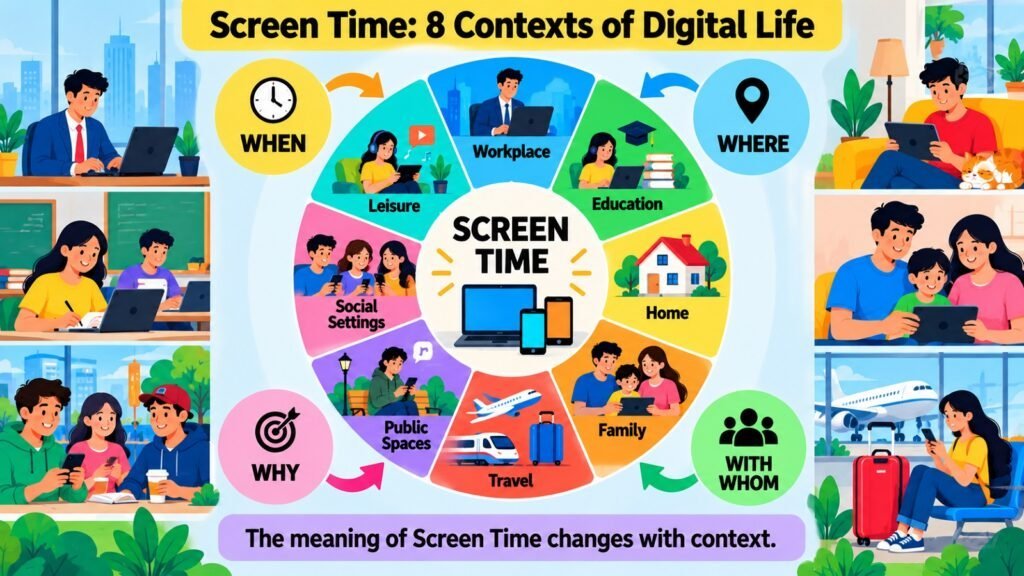
The same amount of Screen Time can represent profoundly different experiences depending on the circumstances surrounding it. When it happens, where it happens, why it is happening, who else is present, which device is involved, and what else is occurring in the surrounding environment all contribute to how that time is experienced and what it means. Ignoring context means treating fundamentally different situations as equivalent simply because they share a duration. A professional using a laptop during focused work and an adolescent scrolling a social feed at midnight may each log sixty minutes of Screen Time, but those sixty minutes carry entirely different implications.
Technological development has made context more complex. Before smartphones, Screen Time was largely confined to specific locations and time slots — a computer at a desk, a television in a common room. Mobile technology dissolved those boundaries. Work now follows employees home, onto trains, and into hours previously reserved for rest. Learning can happen at any time in any environment with a signal. Entertainment accompanies users through queues, commutes, and waiting rooms. This dissolution of the line between digital and non-digital life is a defining characteristic of contemporary Screen Time, and it creates contextual challenges that earlier generations simply did not encounter.
Thinking about Screen Time contextually means developing awareness of how purpose, location, timing, social setting, and surrounding activity interact. This is not about applying blanket rules — no universal statement about screen use before bed or during meals can capture the full range of actual situations. The goal is a more precise analytical lens: the same technology can function as a productivity tool, a learning platform, a social connector, or a source of distraction depending entirely on the context in which it appears. Understanding that context is essential to evaluating what any given episode of Screen Time actually represents.
Table 6: Screen Time Contexts and Key Considerations
| Context | Key Consideration |
| Workplace | Whether screens support defined tasks or create distraction from work |
| Home environment | How digital activity interacts with family presence and leisure routines |
| Educational settings | Whether technology enhances learning or competes with instructional attention |
| Public spaces | How mobile screen use affects social presence and situational awareness |
| Transportation and travel | Whether transit Screen Time is productive, recreational, or reflexive |
| Social settings | How screen presence influences the quality of in-person interactions |
| Leisure and recreation | Whether digital activity is intentional and restorative or passive and habitual |
| Family and caregiving | How caregiver screen use models digital behavior for children |
6. Screen Time Effects: Understanding Technology’s Outcomes
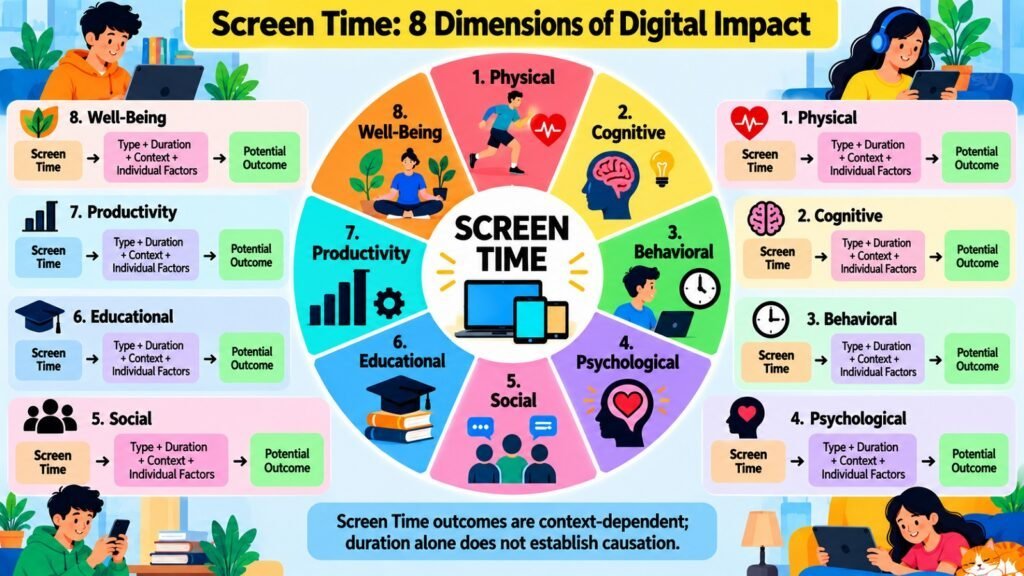
Few topics in technology research attract more public attention, and more oversimplification, than what Screen Time does to people. The research literature is large, growing, and considerably more nuanced than most popular accounts suggest. Screen Time Effects depend heavily on activity type, duration and intensity, individual characteristics, timing, context, and platform design. Presenting them as simple or uniform misrepresents the science. The single most important analytical distinction is between association and causation: many studies find correlations between Screen Time and outcomes such as sleep quality, attention, mood, or academic performance, but correlation does not establish cause.
The American Psychological Association, the American Academy of Pediatrics, and major international health organizations have all acknowledged that evidence in this area is often mixed, inconsistent across studies, or insufficient to support firm recommendations without contextual qualification. Physical considerations — eye strain from extended near-vision focus, sedentary posture, and the potential influence of screen light on circadian rhythms in the evening — represent areas of reasonable association, though mechanisms and magnitudes are still actively studied. Cognitive research examining whether heavy digital media use affects sustained attention or working memory remains an area of active debate rather than settled consensus.
A practical interpretation framework for Screen Time Effects should begin by asking what kind of Screen Time is involved. Research that averages together family video calls, educational software, passive social media, and interactive gaming will produce findings that may apply to none of those activities specifically. The next question is what Screen Time may be displacing — the effect of screen use replacing sleep is often more significant than the direct screen exposure itself. Approach claims about Screen Time Effects with genuine curiosity and appropriate skepticism, prioritizing high-quality studies and systematic reviews over alarming headlines built on weaker evidence.
Table 7: Screen Time Effect Areas and Research Considerations
| Outcome Areas | Research Consideration |
| Physical comfort | Extended use linked to eye strain and postural discomfort, especially without breaks |
| Sleep quality | Late-evening screen exposure associated with delayed sleep onset |
| Sustained attention | Effects of digital media use on attention capacity remain mixed and debated |
| Emotional well-being | Mood associations vary by activity type, platform design, and individual factors |
| Social development | Digital communication can supplement connection; substitution effects are less clear |
| Academic performance | Educational tech benefits structured use; passive entertainment during study is disruptive |
| Physical activity | Displacement of active time by sedentary Screen Time is a documented concern in children |
| Cognitive development | Interactive screen use shows different associations than passive consumption in young children |
7. Screen Time Management: Designing Better Digital Use
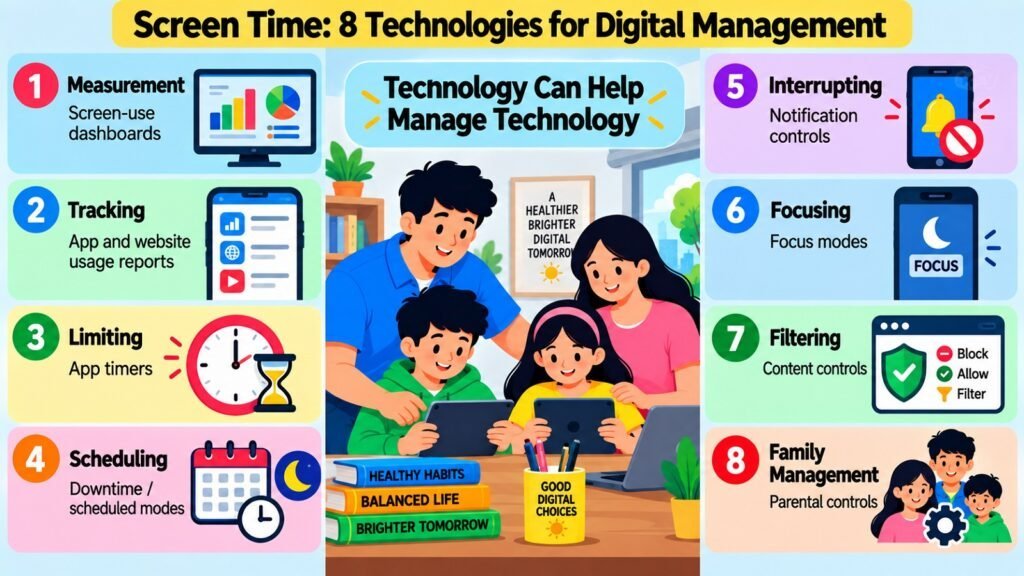
Screen Time Management is often framed as a strategy for reducing total hours, but that framing is too narrow. Effective management is about improving the quality, intentionality, timing, and context of digital use rather than simply cutting numbers. A person who reduces screen time by eliminating professional communication and meaningful social connection has not necessarily improved their digital life. A person who spends slightly more hours on screens but shifts toward purposeful activities, eliminates reflexive checking, and stops late-night scrolling may have made a more meaningful change. The goal is a better relationship with technology, not a lower score on a usage dashboard.
Modern operating systems have embedded a range of management tools directly into their products. Apple’s Screen Time feature, introduced in iOS 12 in 2018, provides usage reports, application-level time limits, scheduled downtime, and communication controls. Android’s Digital Wellbeing, launched the same year, offers comparable functionality including app timers, focus modes, and bedtime settings.
Beyond built-in tools, effective management involves behavioral and environmental strategies: removing non-essential notifications eliminates cues that trigger habitual checking; placing devices outside the bedroom removes the structural conditions for bedtime scrolling; scheduling specific times to check messages rather than responding immediately introduces intentional friction that reshapes ingrained routines.
In educational and workplace contexts, Screen Time Management takes on additional dimensions. Schools are developing device policies that weigh the benefits of educational technology against the potential for distraction. Organizations are addressing how always-on digital communication affects employee focus and well-being. Parents are navigating the challenge of modeling healthy digital behavior while helping children develop self-regulation. Across all these contexts, the most effective approaches work with the user’s goals rather than relying purely on external restriction — management through intention rather than prohibition.
Table 8: Screen Time Management Tools and Their Practical Purpose
| Management Tools | Practical Purpose |
| Usage tracking dashboards | Show where Screen Time is spent to enable informed decisions |
| App time limits | Set daily maximums per application to encourage deliberate use |
| Notification controls | Reduce alerts to eliminate interruptions and habitual checking triggers |
| Focus modes | Restrict distracting apps during designated work or study periods |
| Parental controls | Allow caregivers to set time, content, and communication limits for children |
| Content controls | Filter specific content categories based on user or family preferences |
| Scheduled downtime | Block device use during designated periods such as sleep or mealtimes |
| Digital well-being dashboards | Provide visual Screen Time summaries to support reflection and goal-setting |
8. Screen Time Future: From Screens to Digital Interaction
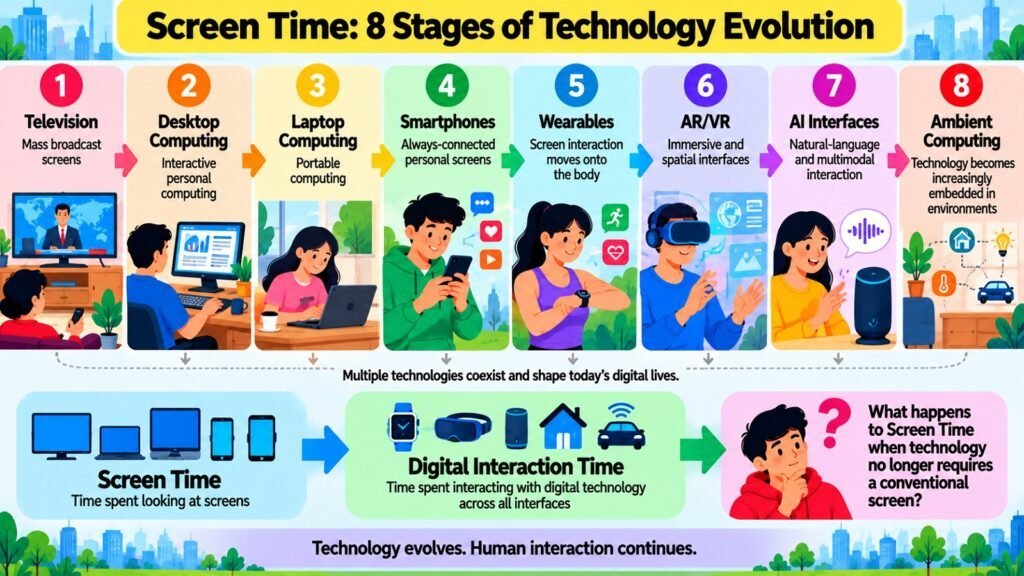
The concept of Screen Time rests on an assumption that is becoming less stable: that digital interaction is primarily visual, primarily screen-bound, and organized around a discrete rectangular display. Smart speakers and voice assistants introduced meaningful digital interaction that does not require looking at a screen at all. Augmented reality devices overlay digital information onto the physical world through optical systems that differ fundamentally from conventional displays. Wearables move digital interaction to the body itself. The trajectory of technology suggests that these shifts will continue and accelerate.
Artificial intelligence is changing the nature of digital interaction in ways that affect Screen Time both directly and indirectly. AI-powered assistants capable of natural language conversation make it possible to complete tasks through voice that previously required reading and visual navigation. Machine learning systems embedded in devices can anticipate user needs and surface information contextually, reducing the deliberate navigation that currently occupies much Screen Time.
Spatial computing, exemplified by devices such as Apple’s Vision Pro and the mixed reality headsets developed by Meta and Microsoft, represents a further transformation: rather than looking at a flat surface, users interact with virtual objects distributed through three-dimensional space. This does not reduce engagement with digital content, but it fundamentally changes the physical form of that engagement and challenges conventional definitions of what a screen actually is.
The broader direction of technology suggests that future digital interaction will be more continuous, more contextual, and in some cases less visually concentrated than present Screen Time. More integrated technology could reduce attention demands; it could also make digital interaction harder to observe and consciously regulate. The framework developed in this article — Usage, Activities, Engagement, Habits, Context, Effects, Management — will need to expand and adapt as interfaces evolve. Screen Time is not a fixed technological category but an evolving measure whose meaning changes as the technologies mature and evolve.
Table 9: Emerging Technologies and Their Potential Screen Time Changes
| Emerging Technology | Potential Screen Time Change |
| Generative AI assistants | Shift interaction to voice and conversation, reducing visual screen engagement |
| Augmented reality glasses | Blend digital content into the physical world, blurring the screen boundary |
| Virtual reality headsets | Replace conventional screens with immersive three-dimensional environments |
| Spatial computing platforms | Distribute digital content across 3D space rather than flat display surfaces |
| Voice and audio interfaces | Enable task completion through speech, reducing reliance on visual screens |
| Wearable computing devices | Move digital interaction to the body via smartwatches, rings, and sensors |
| Ambient computing | Embed digital capability into physical spaces without dedicated screen devices |
| Brain-computer interfaces | Explore direct neural interaction, potentially bypassing screens entirely |
Conclusion — Screen Time and the Future of Digital Life
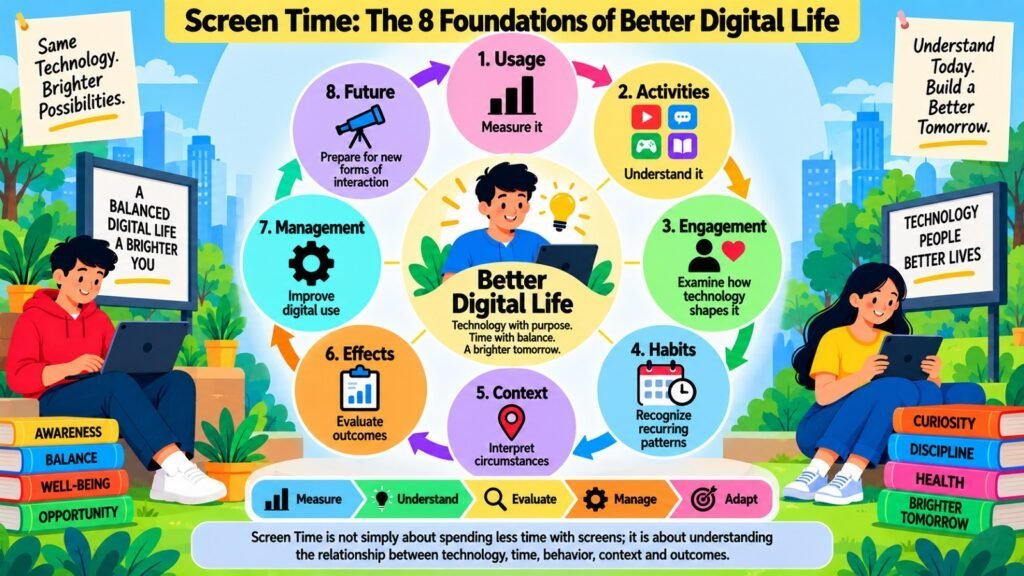
Eight foundations, examined together, reveal something no single metric could communicate: Screen Time is not a quantity to be minimized but a multidimensional relationship to be understood. Usage establishes how digital exposure is measured and why multiple dimensions are more informative than a single hour-count. Activities reveal that what people do behind screens matters as much as how long they stay there. Engagement shows how technology is designed to sustain and deepen attention, making the distinction between intentional and technology-driven interaction important for honest self-assessment. Habits demonstrate how repeated use becomes integrated into daily routines through cues, reinforcement, and the convenience that modern platforms are deliberately designed to maximize.
Context adds the insight that identical amounts of Screen Time carry different meanings depending on when, where, why, and with whom they occur. Effects require careful, evidence-grounded analysis that acknowledges both what research has established and where scientific consensus is still developing, resisting oversimplification in both directions. Management is not simply a strategy for reducing hours but a combination of technological tools and intentional practices that can improve how technology is used.
Future developments signal that the concept of Screen Time itself may need to evolve as AI, wearables, spatial computing, and ambient technologies change the fundamental character of digital interaction. Screen Time is an important aspect for both Technology and Society precisely because it sits at the intersection of how systems are built and how people choose to live.
The most important practical lesson is that duration is a starting point, not an answer. Meaningful engagement with Screen Time requires asking what activities it consists of, how intentional the engagement is, what habits have formed, what context surrounds it, and what the evidence actually says about outcomes.
The future challenge for individuals, families, educators, organizations, and policymakers will not simply be spending less time with technology. It will be developing better, more intentional, and more sustainable relationships with the digital systems already woven deeply into how people live, work, learn, and connect.
Table 10: Screen Time Foundations and Their Core Takeaways
| Foundation | Core Takeaway |
| Screen Time Usage | Measure multiple dimensions — duration, frequency, device, timing — not just total hours |
| Screen Time Activities | Purpose and function define the character of use; what people do matters as much as how long |
| Screen Time Engagement | Platforms use deliberate mechanisms to sustain attention; recognizing them enables intentional use |
| Screen Time Habits | Identify cues and routines driving digital behavior, not just the totals they produce |
| Screen Time Context | Setting, timing, and purpose change what Screen Time means; context is inseparable from evaluation |
| Screen Time Effects | Outcomes are nuanced and context-dependent; distinguish association from causation in claims |
| Screen Time Management | Improve quality, timing, and purpose of digital use, not only total hours spent |
| Screen Time Future | Emerging technologies are redefining digital interaction beyond conventional screen-based measurement |