Table of Contents
Introduction: Social Media and the Foundations of a Connected Digital Society
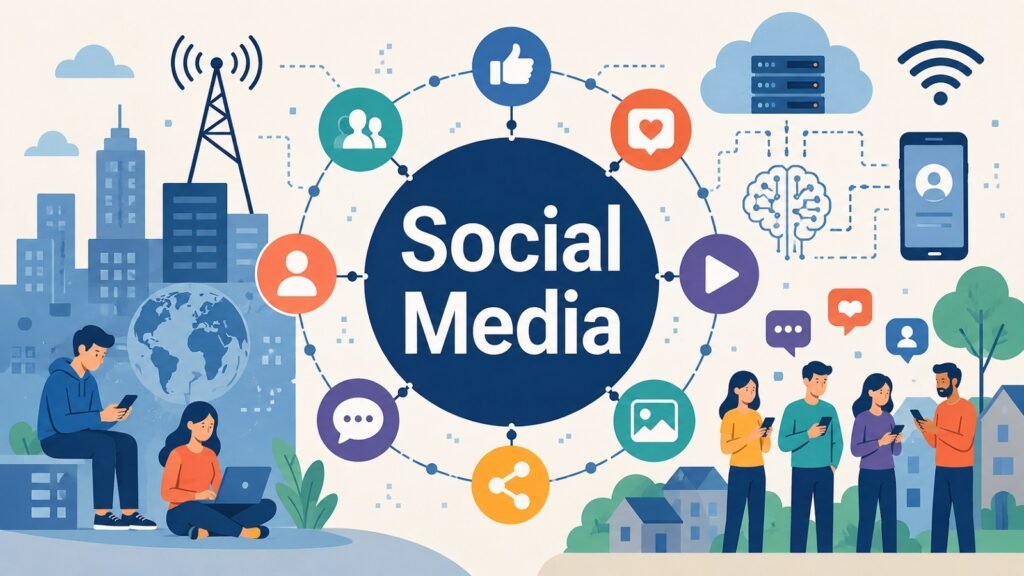
Social Media is a technology-driven digital ecosystem that enables individuals, organizations, governments, and communities to create, share, discover, and exchange information through interconnected digital platforms. It is far more than a collection of websites where people post updates or follow friends. At its core, Social Media represents a layered technological infrastructure shaped by decades of progress in internet engineering, cloud computing, mobile hardware, data systems, and artificial intelligence.
The technological aspects of Social Media are an integral part of the broader relationship between Technology and Society. They influence how people communicate, collaborate, access knowledge, participate in commerce, and engage with institutions. When engineers build a platform feature or a researcher studies algorithmic behavior, they are contributing to a field that touches nearly every dimension of modern life.
Understanding Social Media through a technology lens means tracing its evolution from early text-based forums and simple profile pages to the sophisticated platforms operating today. These platforms now support billions of simultaneous interactions across languages, time zones, and devices. That transformation did not happen by accident. It was driven by fundamental advances in distributed computing, mobile networks, multimedia compression, recommendation algorithms, and data infrastructure.
This article explores eight technological foundations that together explain how Social Media works, grows, and continues to change. Each section approaches Social Media from a different angle, ranging from platform architecture and core technologies to communication, content, the creator economy, commerce, digital communities, and emerging innovations. Together, these foundations offer a structured and research-oriented way to understand why Social Media has become so central to the digital world.
Table 1: Social Media — Eight Foundations and Their Technological Focus
| Foundation | Primary Technological Focus |
| Social Media Platforms | Platform architectures, cloud infrastructure, and network effects that enable digital interaction |
| Social Media Technology | Core technologies including AI, CDNs, APIs, and cloud systems that power platform operations |
| Social Media Communication | Real-time messaging, multimedia, live streaming, and multilingual communication technologies |
| Social Media Digital Content | Content creation, compression, storage, recommendation, and global distribution systems |
| Social Media Creator Economy | Publishing tools, analytics, monetization systems, and AI-assisted content creation |
| Social Media Commerce | Product discovery, digital storefronts, payment systems, and recommendation-driven shopping |
| Social Media Digital Communities | Collaboration platforms, moderation systems, and knowledge-sharing technologies |
| Future of Social Media | Emerging technologies including generative AI, spatial computing, AR, VR, and decentralized networks |
1. Social Media Platforms: Building the Digital Foundation
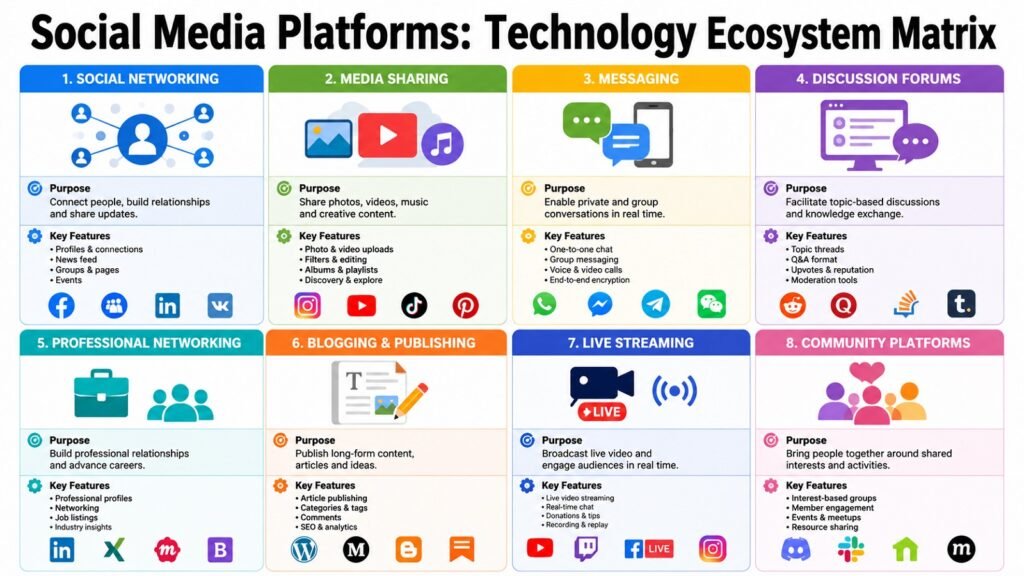
Social Media is built upon a diverse range of digital platform architectures, each designed to support different modes of communication, collaboration, and information exchange. These platforms did not emerge in a single wave. They evolved alongside shifts in networking technology, mobile computing, cloud infrastructure, and changing user expectations over several decades. Understanding why different platform types exist requires examining the technological purposes they were built to serve.
Social networking platforms were among the earliest to gain widespread adoption. They were designed to replicate and extend real-world social graphs through digital connections, using graph database structures and identity management systems. As mobile devices became more capable, media-sharing platforms emerged to take advantage of improved cameras, faster mobile networks, and better compression standards. Messaging platforms followed a different path, prioritizing low-latency communication protocols and end-to-end encryption as privacy concerns grew.
Discussion forums and community platforms serve a different technological function. They are built around threaded conversation models, upvoting mechanisms, and content aggregation logic that surfaces the most relevant posts for each user. Professional networking platforms combine social graph technology with structured data systems that support resume-style profiles, skills matching, and job recommendation engines. Blogging and long-form content platforms rely on content management systems, search indexing, and editorial workflow tools that prioritize depth over speed.
Platform ecosystem theory helps explain why these categories remain distinct despite consolidation efforts. Each platform type generates its own network effects, where the value of the platform increases as more users join and contribute. When a live streaming platform gains more viewers, it becomes more attractive to broadcasters, which in turn draws more viewers. This feedback loop is a direct result of platform architecture decisions made at the engineering level. The continued diversity of Social Media platforms reflects the reality that no single architecture can efficiently serve all forms of digital interaction.
Table 2: Social Media Platform Categories and Their Primary Technological Purpose
| Platform Category | Primary Technological Purpose |
| Social Networking | Manages digital social graphs and identity relationships across large user bases |
| Media Sharing | Supports high-volume image and video upload, compression, and distributed delivery |
| Messaging | Enables low-latency, encrypted real-time communication between individuals and groups |
| Discussion Forums | Organizes threaded conversations and applies content ranking and aggregation algorithms |
| Professional Networking | Combines structured profile data with skills matching and recommendation systems |
| Blogging | Powers long-form content publishing with CMS tools, search indexing, and editorial workflows |
| Live Streaming | Delivers real-time video through adaptive bitrate encoding and content delivery networks |
| Community Platforms | Supports interest-based group formation with moderation tools and collaborative features |
2. Social Media Technology: Powering the Connected World
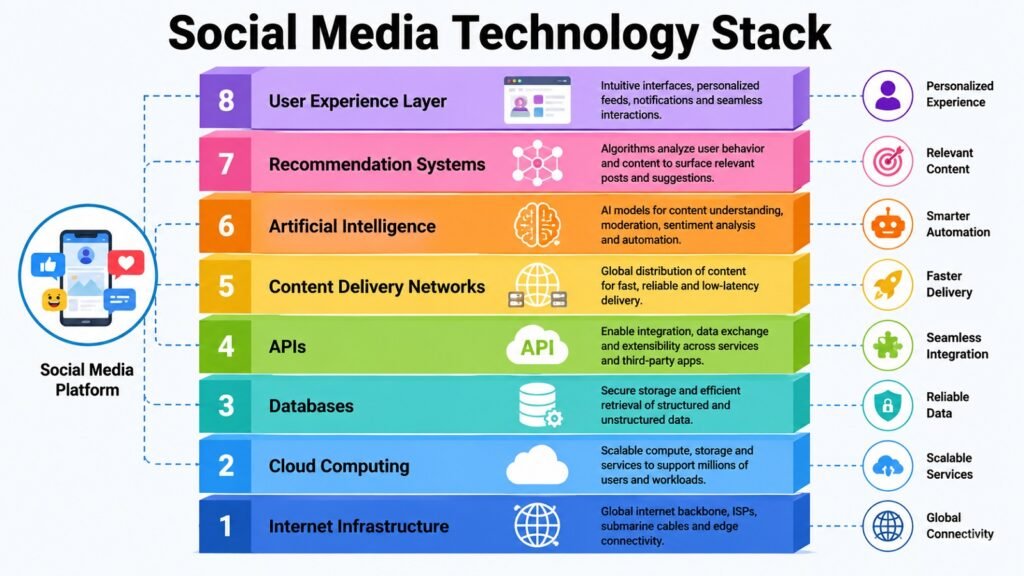
The infrastructure behind Social Media is a carefully coordinated stack of technologies that work together to deliver experiences that feel seamless, fast, and personalized. No single technology makes Social Media possible. The reliability and scale that users take for granted are the result of cloud computing, content delivery networks, databases, application programming interfaces, artificial intelligence, mobile systems, and cybersecurity operating in close coordination.
Cloud computing provides the elastic foundation that allows platforms to scale instantly in response to surges in activity. When a major event drives millions of simultaneous posts, platforms rely on distributed computing architectures to distribute that load across data centers without degrading performance. Content delivery networks sit closer to end users geographically, caching static assets and reducing the distance that data must travel, which directly reduces latency and improves loading speeds.
Databases form the backbone of every Social Media platform. Relational databases manage structured data such as user accounts and relationships, while NoSQL databases handle the high-volume, schema-flexible data generated by posts, interactions, and activity logs. Application programming interfaces allow different software systems to communicate and share data, making it possible for third-party developers to build on top of Social Media platforms and for platforms to integrate with external services.
Artificial intelligence and machine learning have become inseparable from Social Media operations. Recommendation systems analyze patterns in user behavior to surface content that each individual is most likely to find relevant or engaging. Natural language processing powers translation features, content moderation, and sentiment analysis tools. Cybersecurity systems use AI to detect fraud, spam, and coordinated inauthentic behavior at a speed and scale that human review alone could never achieve. Together, these technologies create the responsive, personalized, and secure experiences that define modern Social Media.
Table 3: Social Media Core Technologies and Their Primary Contribution
| Core Technology | Primary Contribution to Social Media |
| Cloud Computing | Provides elastic, scalable infrastructure to handle variable user loads globally |
| Content Delivery Networks | Reduces latency by caching assets closer to users across geographic regions |
| Relational Databases | Stores structured data including user accounts, profiles, and relationships |
| NoSQL Databases | Manages high-volume, flexible data from posts, interactions, and activity streams |
| APIs | Enables integration between platforms, third-party apps, and external services |
| Artificial Intelligence | Powers recommendation systems, content moderation, and personalization engines |
| Mobile Technologies | Delivers optimized platform experiences across smartphones and tablets |
| Cybersecurity Systems | Detects fraud, spam, and threats using automated monitoring and AI-based analysis |
3. Social Media Communication: Transforming Digital Interaction
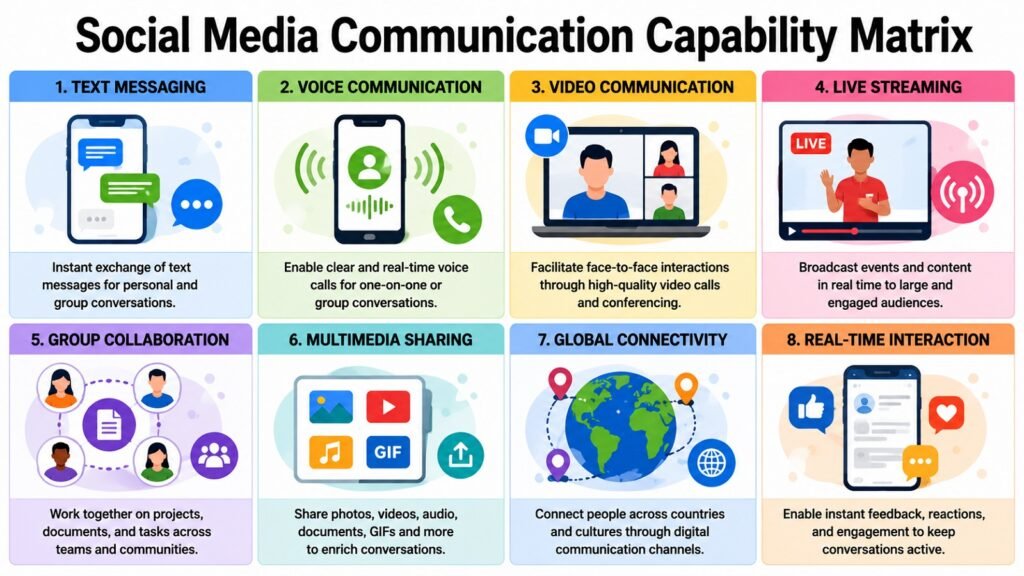
Communication is the defining function of Social Media, and technological innovation has transformed what communication can mean in a digital environment. Early internet communication was largely text-based, asynchronous, and limited in reach. Social Media changed all of that by introducing real-time messaging, multimedia communication, live broadcasting, collaborative interaction, and multilingual exchange at a global scale.
Real-time messaging on Social Media depends on technologies such as WebSockets, which keep persistent connections open between a user’s device and the platform’s servers. This allows messages to be delivered instantly without the user needing to manually refresh a page. The shift from polling-based systems to persistent connections was a significant engineering development that made truly live communication possible within browser-based environments.
Media Richness Theory, originally developed to explain organizational communication, offers useful insight into why Social Media communication feels more engaging than older digital formats. The theory suggests that richer communication channels are more effective for complex or emotionally nuanced exchanges. Social Media platforms now support video calls, animated responses, voice messages, and interactive live sessions, all of which increase the richness of digital communication and reduce the ambiguity that plain text often carries.
Machine translation and multilingual processing technologies have further extended the reach of Social Media communication. When a platform can automatically detect a user’s language and translate content in real time, it removes one of the most persistent barriers to global information exchange. Live streaming technologies have added another dimension by enabling synchronous communication between broadcasters and large audiences, complete with interactive features like real-time comments, polls, and live reactions. These advances have made Social Media communication more participatory and geographically borderless than at any earlier point in the internet’s history.
Table 4: Social Media Communication Capabilities and Their Technological Significance
| Communication Capability | Technological Significance in Social Media |
| Real-Time Messaging | WebSocket connections enable instant delivery without page refresh or polling delays |
| Multimedia Messaging | Compression and storage technologies support image, video, and audio exchange |
| Live Streaming | Adaptive bitrate encoding delivers synchronized broadcasts to large concurrent audiences |
| Multilingual Communication | Machine translation and NLP remove language barriers across global user bases |
| Interactive Broadcasting | Real-time polling, reactions, and comments create participatory live experiences |
| Group Collaboration | Shared channels and threaded conversations support team and community discussion |
| Voice and Video Calls | WebRTC protocols enable peer-to-peer audio and video communication in browsers |
| Asynchronous Messaging | Persistent message storage allows communication across different time zones |
4. Social Media Digital Content: Creating and Sharing Information
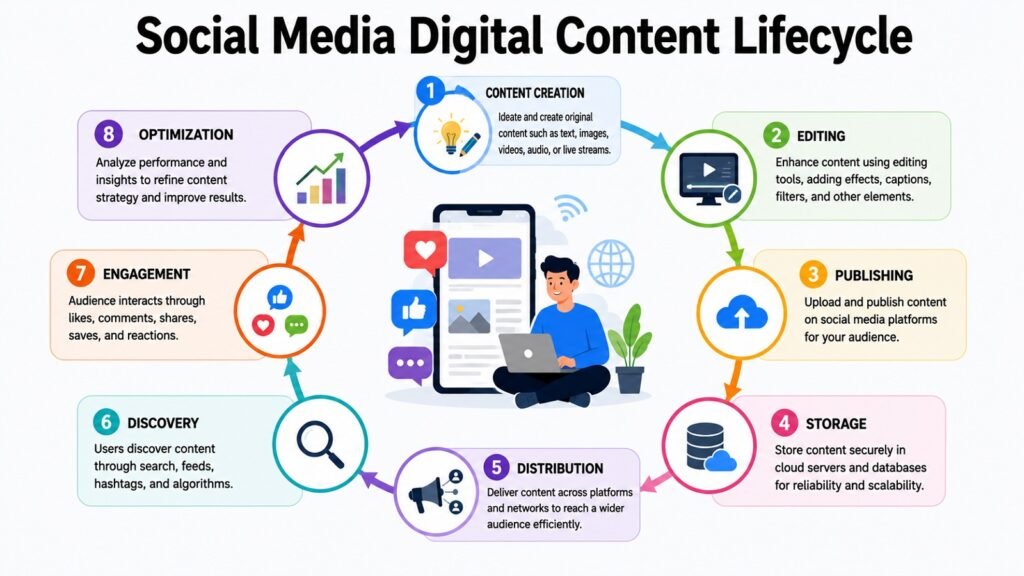
Digital content is the substance that gives Social Media its meaning and its reach. From the earliest days of status updates and shared links to today’s short-form videos, AI-generated visuals, and live streams, the evolution of content on Social Media mirrors advances in the underlying technologies that make creation and distribution possible. Understanding content through a technology lens means examining the full lifecycle from production to consumption.
Text content was the foundation of early Social Media. It required minimal bandwidth and could be stored and indexed efficiently. As network speeds improved and storage costs declined, image sharing became mainstream. Compression standards such as JPEG and WebP made it practical to share high-resolution images without overwhelming mobile data connections. Video followed a similar path. Advances in codec technology, particularly formats like H.264 and H.265, made it possible to stream high-definition video at reasonable file sizes, fundamentally changing what Social Media content could be.
The rise of short-form video content reflects a deliberate architectural choice made by platform engineers. Short videos are easier to encode, faster to load, and well suited to the behavioral patterns of mobile users who scroll quickly through feeds. Recommendation algorithms then amplify reach by surfacing content to users who are most likely to engage with it, creating a feedback loop between content performance and distribution. This is not a coincidence. It is the direct result of designing content systems around machine learning models trained on engagement data.
User-generated content and AI-assisted content creation now coexist within the same ecosystem. AI tools help creators produce captions, generate visual assets, suggest hashtags, and optimize posts for discoverability. Cloud infrastructure handles the storage demands of billions of pieces of content while intelligent content delivery networks ensure that material reaches users quickly regardless of their location. High-quality digital content, supported by strong technological infrastructure, remains the fundamental driver of meaningful engagement within Social Media.
Table 5: Social Media Digital Content Formats and Their Primary Technological Advantage
| Content Format | Primary Technological Advantage |
| Text Posts | Low bandwidth requirements support fast indexing, search, and global distribution |
| Images | Compression standards like WebP reduce file sizes while preserving visual quality |
| Short-Form Video | Efficient codecs and adaptive streaming enable fast load times on mobile networks |
| Long-Form Video | H.265 encoding and CDN delivery support high-definition streaming at scale |
| Live Streaming | Low-latency protocols enable real-time broadcasting to concurrent global audiences |
| Audio Content | Compressed audio formats support podcast hosting and voice-based social interaction |
| User-Generated Content | Cloud storage and moderation systems manage high-volume community submissions |
| AI-Assisted Content | Generative AI tools accelerate production of captions, visuals, and optimized posts |
5. Social Media Creator Economy: Empowering Digital Innovation
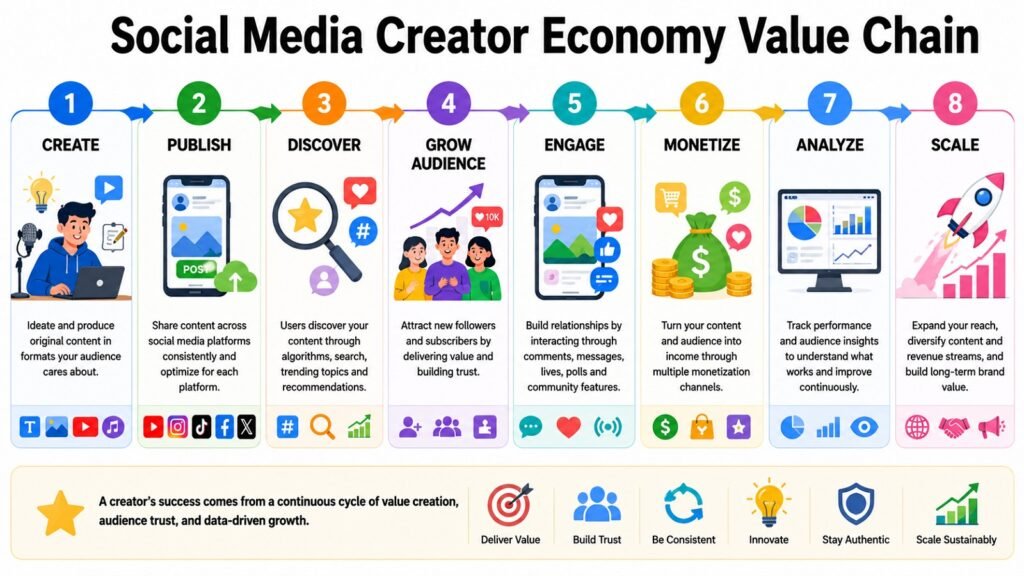
The creator economy is one of the more remarkable technological outcomes of the last decade of Social Media development. It emerged not from a single policy decision but from the convergence of publishing technologies, audience analytics, monetization infrastructure, and platform APIs that together made it possible for individuals to build sustainable creative practices without the backing of traditional media institutions.
Publishing tools were the first barrier to fall. Early blogging platforms gave writers a way to reach readers directly, bypassing editorial gatekeepers. As Social Media platforms matured, they introduced built-in creative suites that supported video editing, graphic design, music integration, and post scheduling. These tools lowered the technical skill required to produce polished content, opening the creator economy to a far wider range of participants than professional production workflows ever could.
Audience analytics systems gave creators something equally important: feedback. Platform dashboards now provide data on reach, engagement rates, audience demographics, viewing duration, and conversion behavior. This data allows creators to refine their content strategies using evidence rather than intuition. Digital economy research consistently finds that platforms offering robust analytics retain creators longer and see higher rates of content output, because creators can learn and adapt based on measurable results.
Monetization infrastructure has expanded considerably. Advertising revenue sharing, subscription tiers, tipping systems, digital merchandise, sponsored content tools, and paid online communities are all examples of monetization mechanisms that are built directly into platform architecture. AI-assisted creativity is adding another layer, helping creators generate ideas, draft scripts, produce background music, and translate content into multiple languages. Future technologies such as spatial computing and immersive experiences may soon allow creators to build digital environments that audiences can explore, extending the creator economy into entirely new technological territories.
Table 6: Creator Technologies and Their Primary Technological Function
| Creator Technology | Primary Technological Function |
| Publishing Tools | Enables content formatting, scheduling, and multi-platform distribution |
| Audience Analytics | Tracks reach, engagement, demographics, and content performance metrics |
| Monetization APIs | Supports ad revenue sharing, subscriptions, tips, and digital product sales |
| Content Recommendation | Distributes creator content to audiences based on behavioral and interest signals |
| AI Writing Assistants | Generates captions, scripts, and content ideas to accelerate production |
| Video Editing Tools | Provides in-platform editing for short-form and long-form video content |
| Translation Systems | Expands content reach through automated multilingual publishing |
| Community Management | Supports subscriber engagement through membership tools and direct messaging |
6. Social Media Commerce: Connecting Technology and Digital Shopping
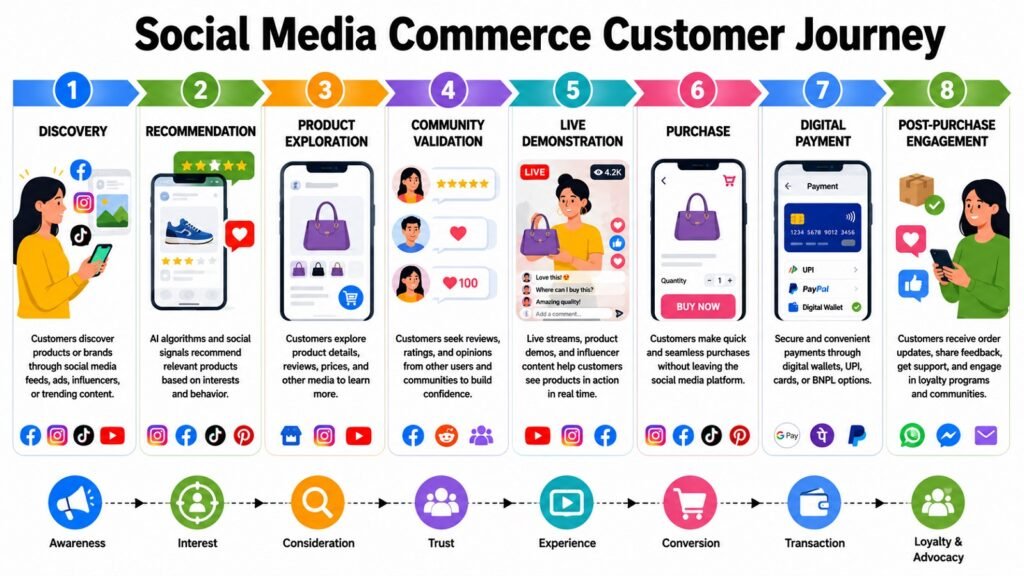
Commerce on Social Media has evolved well beyond simple product advertisements placed beside user-generated posts. Modern Social Media platforms have developed integrated commerce architectures that embed shopping into the natural flow of content discovery, communication, and community participation. This shift represents a fundamental change in how e-commerce technology functions and how consumers discover and purchase products.
Product discovery on Social Media now depends heavily on recommendation systems powered by machine learning. These systems analyze user behavior, purchase history, content preferences, and social connections to surface products that are likely to match each individual’s interests. The result is a form of passive discovery, where consumers encounter relevant products without actively searching for them. Research in e-commerce technology has shown that this approach consistently outperforms traditional keyword search in early-stage product discovery, particularly for new or unfamiliar product categories.
Digital storefronts embedded within Social Media platforms allow merchants to list products, manage inventory, and process transactions without directing customers to external websites. This reduces friction in the purchase journey and keeps commercial activity within the platform’s ecosystem. Live commerce, where hosts demonstrate products in real-time and viewers can purchase instantly through integrated payment systems, has grown rapidly in markets across Asia and is gaining momentum in other regions, supported by the same streaming infrastructure that powers live entertainment.
Conversational commerce is another technologically significant development. AI-powered chatbots integrated into messaging platforms can answer product questions, process orders, and handle post-purchase support in natural language. Digital payment systems have become faster and more secure, supporting one-tap checkout, biometric authentication, and digital wallets that reduce the number of steps between product discovery and completed purchase. Each of these capabilities reflects a deliberate integration of technology into the commercial layer of Social Media, and continued innovation in this space is likely to deepen the connection between content, community, and commerce.
Table 7: Social Media Commerce Technologies and Their Primary Function
| Commerce Technology | Primary Function |
| Product Recommendation Systems | Uses ML to surface relevant products based on user behavior and preferences |
| Embedded Digital Storefronts | Allows in-platform product listings, inventory management, and checkout |
| Live Commerce Streaming | Combines real-time video with instant purchase capabilities for interactive shopping |
| Conversational Commerce | AI chatbots handle product queries, orders, and support within messaging platforms |
| Digital Payment Systems | Enables fast, secure transactions using digital wallets and biometric authentication |
| Customer Review Systems | Aggregates user feedback to support purchase decisions and product trust |
| Shoppable Content | Embeds clickable product links directly into images, videos, and posts |
| Platform Integration APIs | Connects merchant inventory and payment systems with Social Media platforms |
7. Social Media Digital Communities: Enabling Global Collaboration
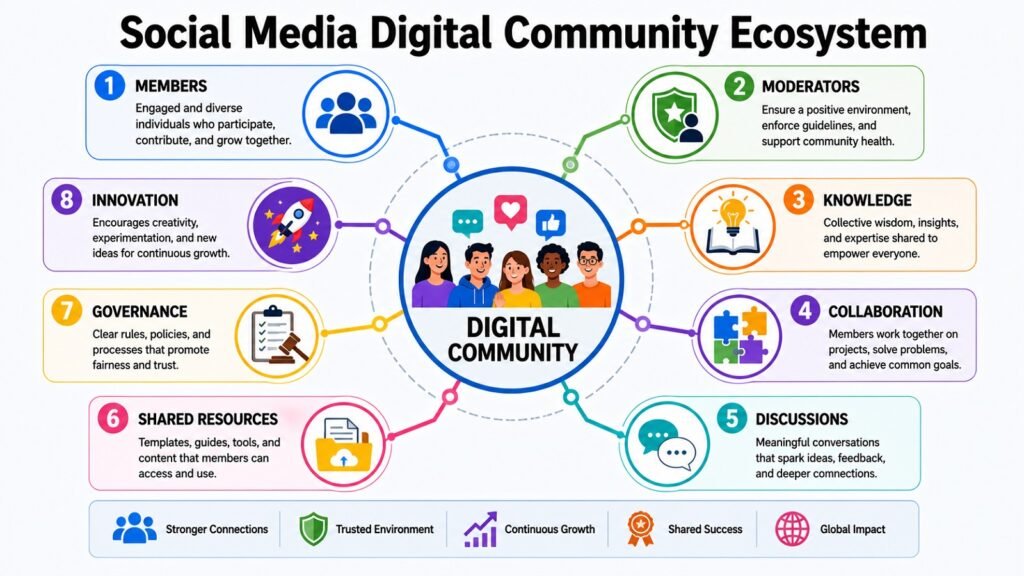
Digital communities represent one of the most enduring and consequential outcomes of Social Media technology. They bring together people who share interests, professional goals, or lived experiences across geographical boundaries that would have made such connections impossible in earlier eras. Understanding digital communities from a technology perspective means looking at the infrastructure, moderation systems, and collaboration tools that enable them to function at scale.
Community platforms are built on infrastructure that supports group formation, access control, content organization, and real-time interaction among large numbers of participants. Unlike general Social Media feeds, community environments require technologies that can manage roles and permissions, thread discussions by topic, surface relevant historical content, and support asynchronous participation for members in different time zones. These are non-trivial engineering challenges that require deliberate architectural decisions.
The concept of Communities of Practice, developed in organizational learning research, offers a useful framework for understanding how digital communities generate and share knowledge. When a community of software developers, educators, researchers, or designers gathers on a Social Media platform, they collectively produce knowledge resources through their interactions. Technology enables this process by preserving conversation history, making content searchable, and providing collaborative tools such as shared documents, wikis, and project boards. Open innovation research has similarly found that digital communities accelerate problem-solving by connecting contributors with complementary expertise who would rarely encounter each other in physical environments.
Moderation technology is as important as collaboration technology in sustaining healthy digital communities. AI-powered moderation tools help identify harmful content, enforce community guidelines, and reduce the burden on human moderators who cannot manually review every post in a large and active community. Content filtering systems, behavioral analysis, and reporting mechanisms work together to maintain environments where constructive participation remains possible. The technological infrastructure of digital communities, from collaboration tools to moderation systems, is what makes large-scale global collaboration a practical reality rather than an aspiration.
Table 8: Social Media Digital Community Types and Their Primary Technological Purpose
| Community Types | Primary Technological Purpose |
| Professional Communities | Structured profiles and networking algorithms connect practitioners by expertise |
| Learning Communities | Course platforms and discussion tools support structured peer education |
| Interest-Based Groups | Shared content feeds and discussion threads organize members around common topics |
| Open-Source Communities | Version control systems and collaborative coding tools support distributed development |
| Support Communities | Moderation tools and safe posting features protect vulnerable participants |
| Research Communities | Document sharing and collaborative annotation tools support academic exchange |
| Creator Communities | Analytics, feedback tools, and peer collaboration features support content producers |
| Civic Communities | Verified identity systems and discussion tools support organized civic participation |
8. Future of Social Media: Emerging Technologies and Innovation
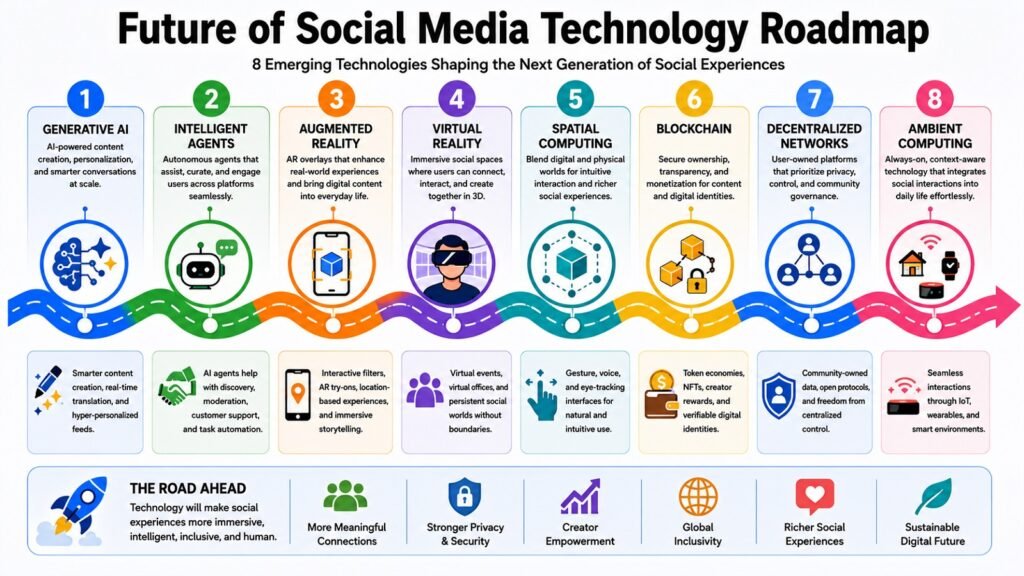
The future of Social Media will be shaped by a set of emerging technologies that are already in active development, even if their full effects are not yet visible in everyday platforms. These technologies include generative artificial intelligence, augmented reality, virtual reality, spatial computing, decentralized social networks, and blockchain-based identity and ownership systems. Each carries genuine implications for how Social Media platforms are built and how people participate in them.
Generative AI is the technology closest to transforming Social Media in the near term. It is already being used to produce content, automate moderation, generate personalized responses, and create synthetic media. As models become more capable and more integrated into platform workflows, the boundary between human-created and AI-generated content will continue to blur. This raises important technological questions about provenance, authenticity, and the systems needed to label and verify content origins at scale.
Augmented reality and spatial computing represent longer-horizon shifts that could fundamentally alter the interface between Social Media and physical environments. AR layers digital information over real-world views, creating opportunities for location-based social experiences, interactive product demonstrations, and immersive shared environments. Virtual reality platforms are already hosting social gatherings, concerts, and professional events, establishing early templates for what immersive Social Media could look like as headset technology becomes more accessible and comfortable.
Decentralized social networks, built on open protocols and blockchain infrastructure, are emerging as a technological response to concerns about data ownership, platform control, and digital identity. Unlike conventional Social Media platforms that store user data centrally, decentralized networks distribute data across many nodes, giving users more control over their own information. Trustworthy digital identity systems, scalable infrastructure, and privacy-preserving technologies will all be critical enablers of this transition. The future of Social Media will continue to be defined by these kinds of technological advances, and understanding their foundations now prepares both builders and users for the changes ahead.
Table 9: Social Media Emerging Technologies and Their Expected Contribution
| Emerging Technology | Expected Contribution to Future Social Media |
| Generative AI | Automates content creation, personalization, moderation, and synthetic media production |
| Augmented Reality | Overlays digital information on physical environments for immersive social experiences |
| Virtual Reality | Enables shared immersive spaces for social interaction, events, and collaboration |
| Spatial Computing | Integrates digital content with three-dimensional physical and virtual environments |
| Decentralized Networks | Distributes platform data and control across open protocols to improve user autonomy |
| Blockchain Identity | Provides verifiable digital identity and ownership records without central authorities |
| Intelligent Assistants | Supports navigation, discovery, and interaction through AI-powered platform agents |
| Immersive Commerce | Combines AR and VR with shopping to enable experiential product discovery and purchase |
Conclusion: Social Media as a Foundation of Future Digital Society
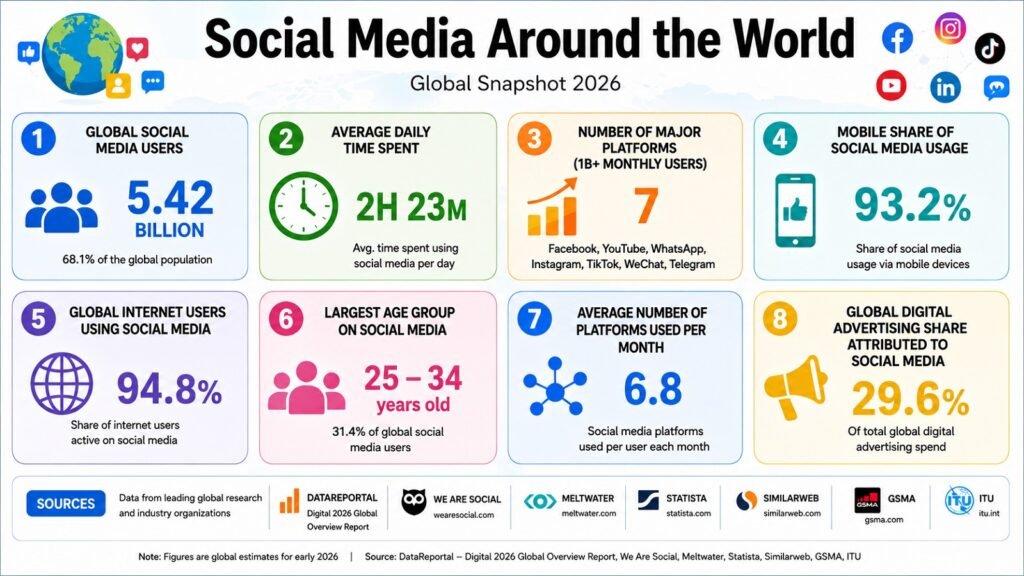
Social Media has moved far beyond its early identity as a set of websites for personal updates and online friendships. It is now a continuously evolving technological ecosystem built from platform architectures, communication technologies, content systems, commerce infrastructure, creator tools, community platforms, and emerging innovations that interact in complex and consequential ways.
Each of the eight foundations explored in this article reveals a different dimension of that complexity. Platforms define the structures through which interaction happens. Core technologies provide the reliability and scale that make global participation possible. Communication systems determine how people reach and understand each other. Content technologies shape what can be expressed and how widely it can travel. The creator economy democratizes digital publishing. Commerce technologies connect discovery with transaction. Digital communities turn individual participation into collective knowledge. And emerging technologies continue to extend the boundaries of what Social Media can be.
The technological aspects of Social Media will remain an integral part of the broader relationship between Technology and Society for the foreseeable future. Advances in artificial intelligence, cloud computing, immersive technologies, digital infrastructure, and intelligent networks will continue to reshape the ways people connect, collaborate, create, and engage with the world around them. That process has no clear endpoint, which is precisely what makes Social Media worth understanding deeply and revisiting often.
Table 10: Social Media — Eight Technological Foundations and Their Long-Term Significance
| Technological Foundation | Long-Term Significance |
| Social Media Platforms | Diverse architectures sustain global participation across communication, sharing, and collaboration |
| Social Media Technology | Integrated technology stacks enable the scalability, personalization, and security of modern platforms |
| Social Media Communication | Real-time and multimedia systems continue to close geographic and linguistic gaps worldwide |
| Social Media Digital Content | Evolving content formats drive engagement, knowledge sharing, and cultural participation |
| Social Media Creator Economy | Creator tools democratize publishing and expand digital entrepreneurship globally |
| Social Media Commerce | Integrated commerce technologies reshape how products are discovered, evaluated, and purchased |
| Social Media Digital Communities | Collaboration infrastructure enables large-scale knowledge creation and collective innovation |
| Future of Social Media | Emerging technologies will define the next generation of digital communication and connection |