Table of Contents
Introduction: Software Requirements as a Foundation for Success
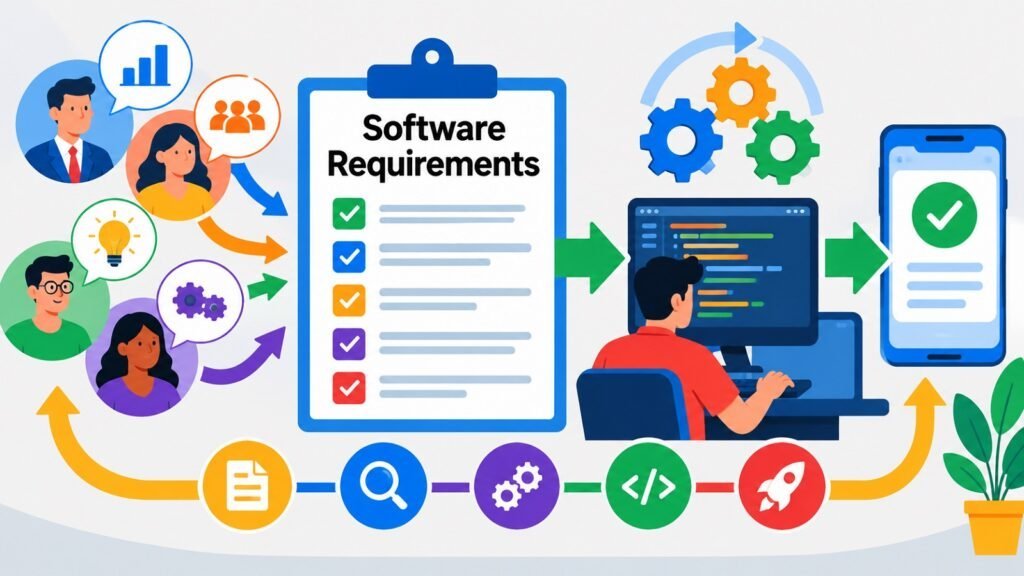
Every software project begins with a deceptively simple question: what exactly should this system do? Business leaders, users, operations teams, and technical staff often hold different expectations, and those expectations frequently conflict. Aligning them before development begins is the difference between software that serves its purpose and software that becomes a costly correction exercise.
Software Requirements represent an important aspect of software development and an important business function. They connect business objectives, stakeholder expectations, user needs, operational realities, and technology choices into a coherent foundation. A requirement establishes what a system is expected to accomplish, what conditions it must satisfy, and what qualities it must exhibit. Requirements are not the design of the software; they are the reason the software exists.
The requirements domain divides into two broad categories. Functional requirements describe specific behaviors and capabilities. Non-functional requirements describe the qualities governing how well the system performs those functions. Producing useful requirements also involves a lifecycle — discovery and classification, analysis, specification, validation, and management. Each stage adds clarity. Unclear, incomplete, or conflicting requirements create misunderstanding, rework, scope problems, and a widening gap between what software delivers and what the business needs.
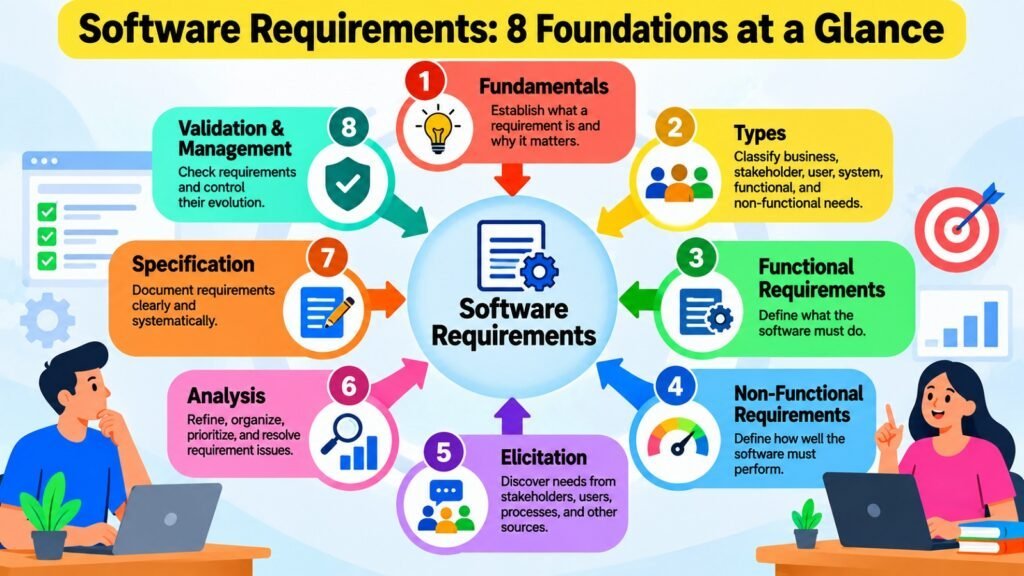
This article provides a foundational and comprehensive guide to Software Requirements across eight interconnected aspects, from fundamentals and types through functional and non-functional concerns, elicitation, analysis, specification, and validation and management.
Table 1: Software Requirements — Eight Aspects Covered in This Article
| Software Requirements Aspect | What It Covers |
| Software Requirements Fundamentals | Definition, purpose, and core characteristics of requirements |
| Software Requirements Types | Classification by source, purpose, and level of abstraction |
| Software Functional Requirements | Capabilities and behaviors the system is expected to provide |
| Software Non-Functional Requirements | Quality attributes and operational constraints on system performance |
| Software Requirements Elicitation | Techniques for discovering requirements from stakeholders and other sources |
| Software Requirements Analysis | Activities that refine and structure gathered requirement statements |
| Software Requirements Specification | Practices for documenting requirements in communicable, maintainable forms |
| Software Requirements Validation and Management | Examination of quality and ongoing control of changes over time |
1. Software Requirements Fundamentals
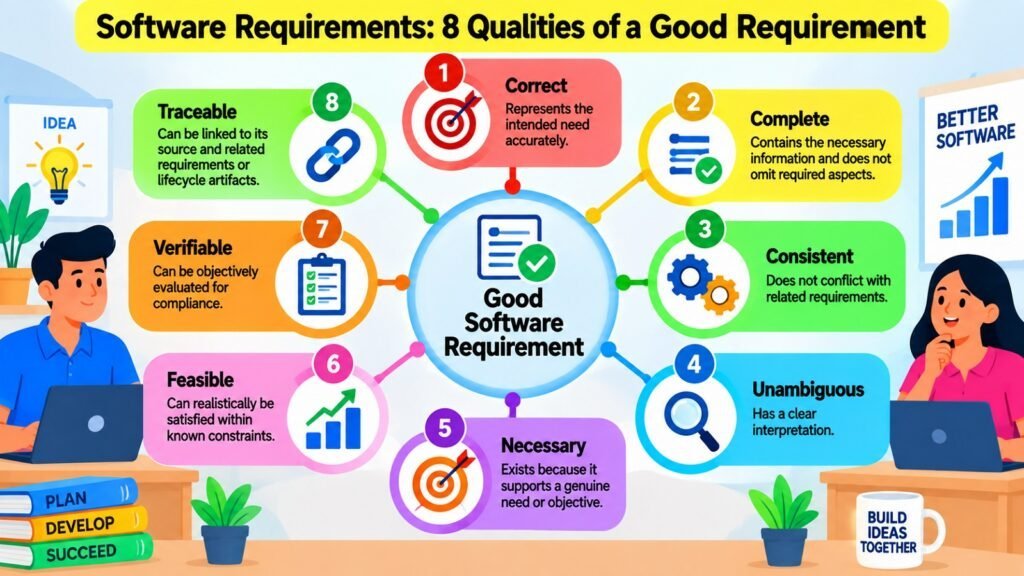
A requirement is a statement describing a capability, condition, or constraint that a system must satisfy to meet a business objective, a stakeholder expectation, or an operational need. The practical challenge is considerable. People tend to express needs as solutions rather than underlying objectives, and they often assume their own understanding is shared by everyone involved.
Requirements translate business needs, user expectations, and environmental constraints into statements that guide analysis, design, implementation, and verification. They sit between what the business wants to achieve and the technical decisions about how those outcomes will be produced. Requirements are not business goals, which remain at a strategic level, nor design specifications, which describe how software will be structured. They define expected system behavior and capability.
A practical mental model distinguishes a statement of need from a proposed solution. If a stakeholder says the system must send a weekly email summary to registered users, that describes an expected capability without prescribing implementation. If the same stakeholder specifies a batch job running every Sunday through a named mail server, the statement has crossed from requirement into an implementation decision. Requirements engineering research identifies this distinction as fundamental to producing requirements that remain useful across different design choices.
Effective requirements share characteristics that determine their usefulness: clarity ensures consistent understanding; consistency prevents conflict with related requirements; completeness captures the full scope of the intended condition; feasibility confirms the requirement can realistically be satisfied; necessity confirms it represents a genuine need; traceability links it to its origin and dependent work; and verifiability ensures it can be confirmed once the system is built. IEEE 830 emphasized several of these same properties, and they remain relevant to contemporary practice.
Table 2: Software Requirements — Eight Foundational Concepts
| Concept | Role in Software Requirements |
| Requirement statement | A precise description of what a system must do or satisfy to meet a defined need |
| Stakeholder | Any person or group with a legitimate interest in the system and its outcomes |
| Business need | The organizational objective or problem that motivates the system development effort |
| System boundary | The defined scope separating what the system contains from what it interacts with externally |
| Traceability | The ability to follow a requirement from its business origin through to implementation and verification |
| Verifiability | The property that allows a requirement to be confirmed as satisfied through testing or review |
| Constraint | A condition limiting the solution space, such as a regulation, technology restriction, or budget limit |
| Feasibility | The realistic possibility that a requirement can be satisfied within available resources and technology |
2. Software Requirements Types
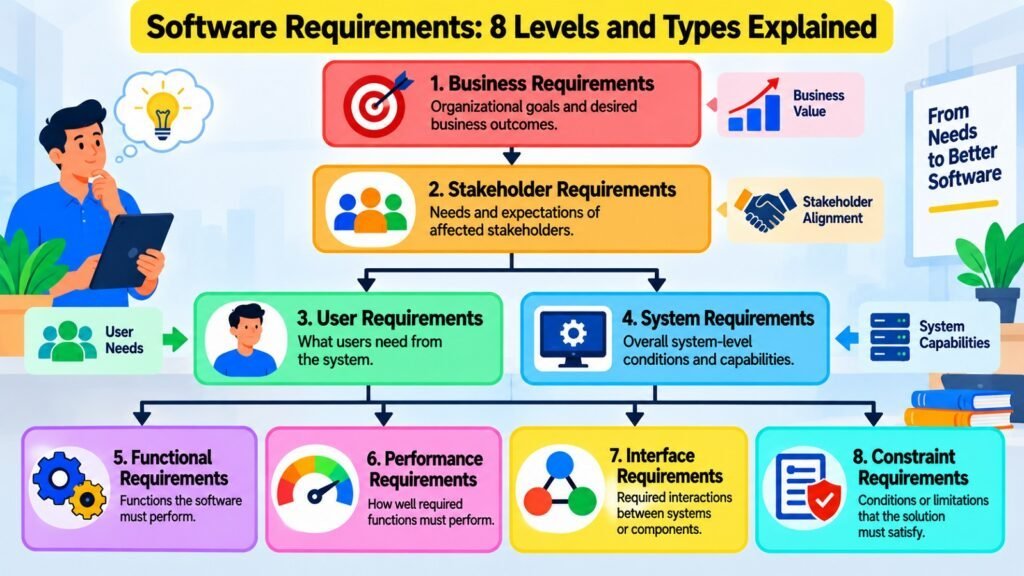
Not all requirements serve the same purpose or originate from the same source. Understanding how Software Requirements are classified helps analysts, developers, and stakeholders communicate clearly about what is being defined, at what level, and for whose benefit. Classification shapes how requirements are gathered, who is responsible for them, and how they influence downstream development decisions.
Business requirements describe the high-level outcomes the organization wants to achieve — strategic goals, regulatory compliance, revenue improvement, or cost reduction. They describe the reason the software is being built, not the software behavior itself. Stakeholder requirements translate business requirements into the specific needs and expectations of different groups involved in or affected by the system. One business requirement may generate different stakeholder requirements for users, administrators, compliance officers, and technical support teams.
User requirements focus on what users need to accomplish, expressed from the user perspective without specifying implementation. System requirements move closer to implementation by describing the capabilities and constraints the system must exhibit to satisfy user and stakeholder needs. System requirements often serve as the primary reference for development teams, translating human expectations into technically defined system behavior.
Functional requirements describe specific behaviors and actions. Non-functional requirements describe qualities and operational characteristics. Constraints represent a distinct category — they restrict the solution space without describing a capability, arising from regulatory rules, technology environments, or organizational policies. The ISO/IEC/IEEE 29148 standard provides a recognized framework for organizing these categories, though organizations frequently adapt terminology to their context. A financial services firm building a client portal illustrates how these levels connect: the business requirement to improve self-service generates stakeholder requirements for portfolio managers, clients, and compliance teams, which in turn generate user requirements and system requirements — each layer adding specificity without replacing the layers above it.
Table 3: Software Requirements — Classification by Type
| Requirement Type | Primary Focus |
| Business requirements | Strategic organizational goals and outcomes the software is intended to support |
| Stakeholder requirements | Needs and expectations of specific groups involved in or affected by the system |
| User requirements | Tasks, goals, and interactions that users must be able to perform with the system |
| System requirements | Defined capabilities and constraints the system must satisfy to meet user needs |
| Functional requirements | Specific behaviors, actions, and capabilities the system is expected to provide |
| Non-functional requirements | Quality attributes and operational expectations governing how the system performs |
| Constraints | Restrictions on the solution space from regulation, policy, technology, or environment |
| Interface requirements | Expected interactions with external systems, hardware, users, or services |
3. Software Functional Requirements
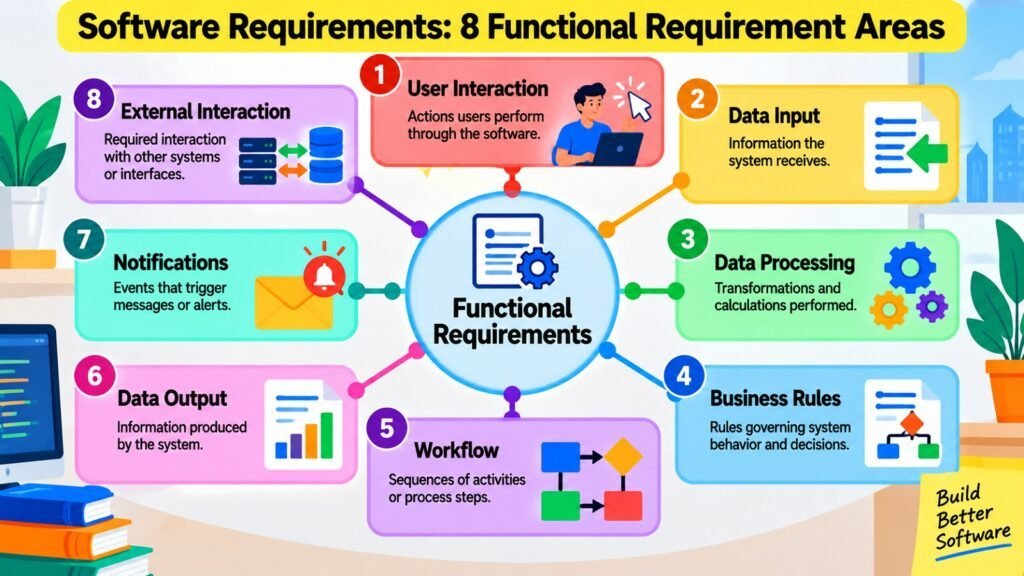
Software Functional Requirements define what a system is expected to do. They describe the capabilities, behaviors, actions, responses, and interactions the system must provide to users and to other systems it connects with. A functional requirement addresses a specific piece of observable behavior in terms independent of implementation. Deciding how the system accomplishes those things belongs to design and development.
The range of functional requirements in a typical system is broad. This category covers user authentication and authorization, data entry and validation, workflow processing, business rule application, calculations and transformations, search and retrieval, notifications and alerts, reporting and export, and integration with external systems. Each requirement must be precise enough to eliminate ambiguity while remaining free of unnecessary implementation constraints.
The distinction between a functional requirement and a design decision is important. A requirement stating that the system must allow administrators to deactivate user accounts describes a capability clearly. A statement specifying this must be achieved through a toggle control in a grid on the user management screen has moved into interface design. Holding that boundary produces requirements that can survive technology changes without becoming outdated.
Characteristics that make functional Software Requirements useful include precision, clarity, consistency, necessity, and verifiability. Verifiability is the practical test: a requirement that cannot be confirmed is of limited value. Transforming a vague request requires iteration. A stakeholder might ask for a system that makes it easy to find customer records — not verifiable. Through discussion, this becomes a requirement stating that authorized users must search for records by name, account number, or email address and receive results within a defined response time. The content is now testable and guides design without dictating it.
Table 4: Software Requirements — Eight Functional Requirement Areas
| Functional Area | Requirement Focus |
| User authentication | How the system verifies identity and manages login, logout, and session behavior |
| Data management | How the system creates, reads, updates, and deletes records while maintaining integrity |
| Business rule processing | How organizational rules are applied to validate inputs, calculate outputs, or control workflows |
| Search and retrieval | How users query the system and what results are returned based on defined criteria |
| Workflow and process | How the system routes tasks, manages approvals, tracks status, and supports multi-step processes |
| Reporting and analytics | What data the system must present, aggregate, or export for decision-making and audit purposes |
| External system integration | How the system exchanges data or invokes services with other applications or platforms |
| Notifications and alerts | What events trigger system messages, who receives them, and through what channel |
4. Software Non-Functional Requirements
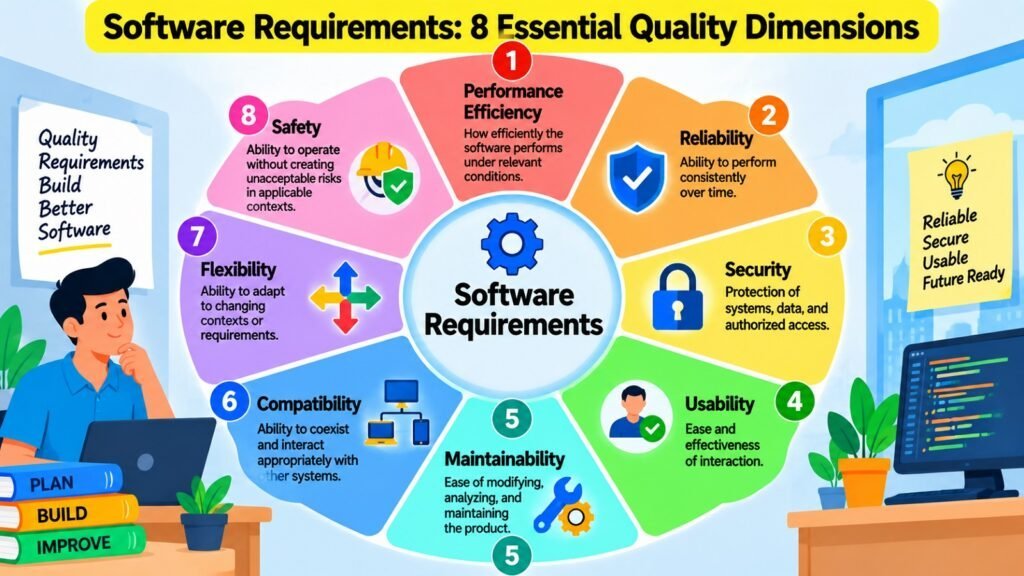
Software Non-Functional Requirements define the qualities and operational characteristics that determine how well a system performs its functions, not only whether it performs them. A system might satisfy every functional requirement and still fail in practice if it responds too slowly, becomes unavailable at critical times, or fails to protect sensitive data. Non-functional requirements address these concerns and can be decisive for long-term business value even when the system delivers all its intended capabilities.
Performance requirements describe how quickly and efficiently the system must respond under defined conditions. Availability requirements specify the proportion of time the system must be operational. Reliability addresses consistent operation without failure — focused on the frequency and severity of failures rather than total downtime. Scalability defines how the system must behave as user numbers, transaction volumes, or data sizes grow. Security covers protection of data and system resources against unauthorized access or modification.
Usability requirements address how effectively users can interact with the system. Accessibility requirements ensure the system can be used by people with different abilities, often informed by standards such as the Web Content Accessibility Guidelines. Compatibility requirements specify the environments and platforms the software must operate within. Maintainability requirements describe the expected ease of applying updates, resolving defects, or extending the system with new capabilities.
Non-functional requirements present a distinctive challenge because they are often expressed as vague preferences rather than testable conditions. Saying the system must be fast or must be secure does not produce a verifiable requirement. Useful formulations define quality attributes in measurable terms. Quality attributes also interact: improving security often introduces authentication steps affecting usability and performance; increasing availability through redundancy affects cost and complexity. These interactions are reasons to discuss non-functional requirements deliberately rather than treating each as an independent demand that can be maximized without consequence.
Table 5: Software Requirements — Eight Non-Functional Quality Attributes
| Quality Attribute | Requirement Focus |
| Performance | Response times, throughput rates, and resource consumption under defined load conditions |
| Availability | The proportion of time the system must be accessible and operational to its intended users |
| Reliability | The consistency of correct system operation over time and across conditions |
| Scalability | The system ability to maintain acceptable behavior as load, users, or data volume increases |
| Security | Protection of data and system resources against unauthorized access, disclosure, or modification |
| Usability | The ease and efficiency with which intended users can learn and interact with the system |
| Maintainability | The ease of applying corrections, updates, and extensions over the system operational life |
| Compatibility | The ability to operate correctly within specified environments, platforms, and integrations |
5. Software Requirements Elicitation
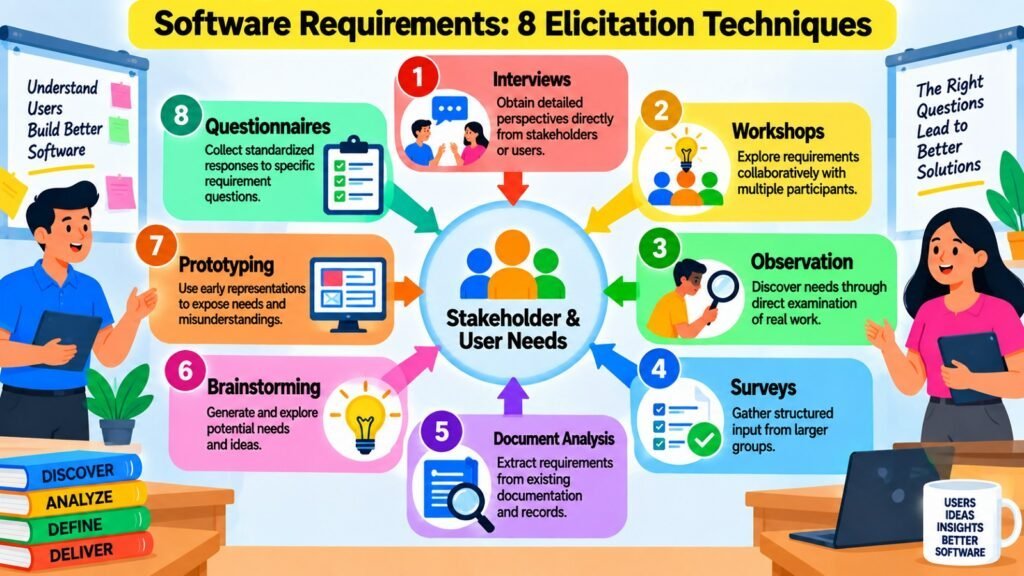
Software Requirements Elicitation is the process of discovering what a software system needs to do and be by drawing out information from stakeholders, users, business processes, existing systems, and relevant documentation. The word elicitation is deliberately chosen over collection or gathering because requirements are rarely available in complete form — they must be drawn out through structured inquiry, observation, and iterative dialogue.
One reason elicitation is challenging is that people cannot always articulate needs directly. Stakeholders may hold incorrect assumptions about how the current system works. Users may request features that do not address their underlying need. Domain experts may use specialist language that analysts do not fully understand. These gaps and assumptions are normal; recognizing them is the starting point for choosing appropriate techniques.
Interviews allow analysts to explore individual perspectives in depth. Workshops bring multiple stakeholders together to share and negotiate expectations, surfacing conflicts more efficiently than individual sessions. Observation involves watching users perform actual work rather than relying on what they describe in conversation, often revealing undocumented workflows and workarounds. Document analysis reviews policies, contracts, and reports to identify requirements that interviews may not surface. Surveys gather requirement information or priority data from large user populations. Prototypes help stakeholders visualize proposed behavior, revealing needs that abstract discussion cannot surface.
An organization replacing a legacy inventory system illustrates why multiple techniques complement one another. Stakeholder interviews reveal broad business goals and surface informal warehouse processes not documented anywhere. Observation in the warehouse uncovers those processes directly. A working prototype helps users identify missing capabilities during structured reviews. Document analysis of existing reports reveals output requirements that no stakeholder mentioned in interviews. Each technique contributes information the others did not capture — which is why requirements engineering practice recommends combining approaches rather than relying on any single method.
Table 6: Software Requirements — Eight Elicitation Techniques
| Elicitation Technique | Typical Use |
| Interviews | Exploring individual stakeholder perspectives and priorities through structured conversation |
| Workshops | Bringing multiple stakeholders together to surface conflicts and build shared understanding |
| Observation | Watching users perform actual work to discover undocumented processes and tacit knowledge |
| Document analysis | Reviewing documentation, reports, and policies to identify stated or implied requirements |
| Surveys and questionnaires | Gathering requirement information or priority data from large or distributed user populations |
| Prototyping | Using visual or interactive models to help stakeholders identify needs not easily expressed verbally |
| Brainstorming | Generating a broad range of potential requirements in an open, collaborative group setting |
| Use cases and user stories | Capturing requirements from a user goal perspective by describing user-system interactions |
6. Software Requirements Analysis
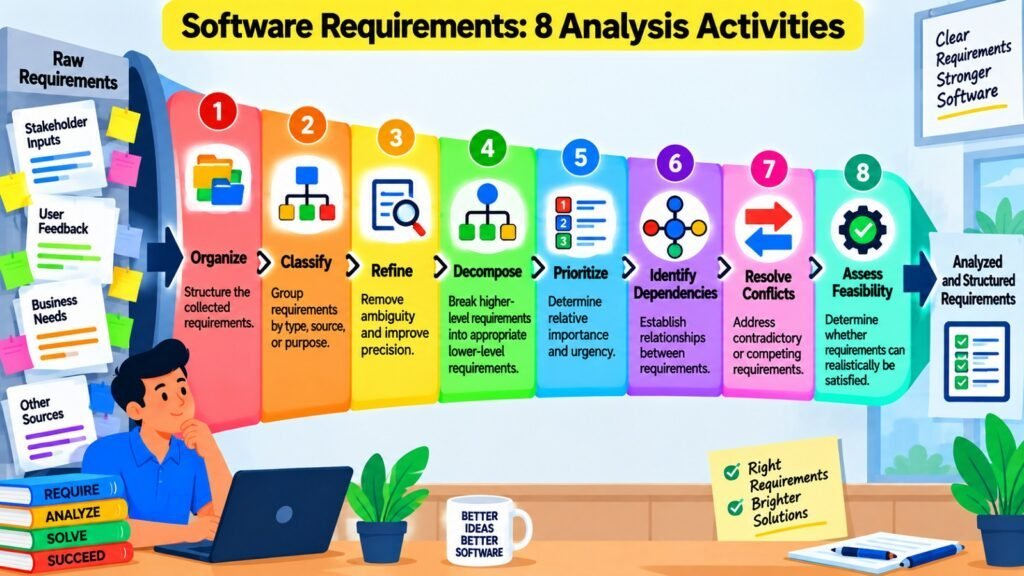
Software Requirements Analysis transforms gathered stakeholder statements into a clearer, more structured, and internally consistent understanding of what the software must accomplish. Elicitation produces raw material; analysis refines it. The two activities often overlap, because analysis frequently reveals gaps that require further elicitation, but they are conceptually distinct. Analysis is concerned not with discovering requirements but with making existing ones more precise, coherent, and usable.
Analysis begins with classification, placing each requirement in the appropriate category and ensuring different types are handled at the correct level of abstraction. Decomposition breaks complex or compound requirements into simpler, individually verifiable statements. A requirement describing multiple behaviors in one statement is difficult to trace, test, and manage. Separating it reduces ambiguity and makes each statement easier to handle in subsequent activities.
Conflict identification is demanding because conflicts are not always obvious. Two requirements may appear compatible in isolation but reveal incompatibility when considered together or when system constraints are applied. A security requirement demanding encryption of all stored data may conflict with a performance requirement demanding sub-second query response times across a large dataset. Neither requirement is wrong, but they cannot both be satisfied without design trade-offs, and analysis must make that conflict visible before implementation begins.
Ambiguity reduction examines language carefully, identifies vague terms, and seeks reformulations that reduce misinterpretation. Feasibility assessment evaluates whether each requirement can realistically be satisfied within available resources. Prioritization establishes relative importance based on business value, user need, risk, and dependency. Structured models such as data flow diagrams or entity relationship models can help analysts understand complex requirement dependencies without prescribing design solutions.
Table 7: Software Requirements — Eight Core Analysis Activities
| Analysis Activity | Purpose |
| Classification | Placing each requirement in the appropriate type and level category for consistent handling |
| Decomposition | Breaking complex or compound requirements into simpler, individually verifiable statements |
| Conflict identification | Detecting incompatible requirements that cannot both be satisfied without design trade-offs |
| Ambiguity reduction | Identifying and resolving vague language to ensure consistent understanding across stakeholders |
| Feasibility assessment | Evaluating whether each requirement can realistically be satisfied within available constraints |
| Prioritization | Establishing relative importance based on business value, user need, risk, and dependency |
| Dependency analysis | Identifying relationships between requirements that must be satisfied together or in sequence |
| Consistency checking | Verifying that the requirement set contains no internal contradictions or logical conflicts |
7. Software Requirements Specification
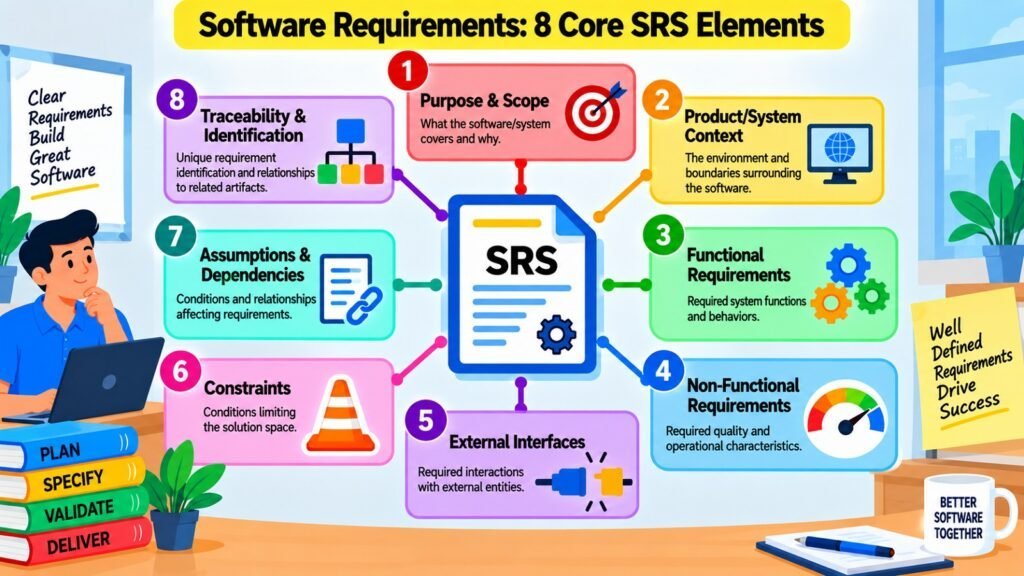
Software Requirements Specification converts understood and analyzed requirements into structured information that can be communicated, reviewed, referenced, and maintained. Analysis produces clearer requirements; specification produces documented ones. Documentation creates a shared reference that different participants, working at different times and in different roles, can consult to understand what the software is expected to accomplish.
The Software Requirements Specification — commonly abbreviated as SRS — is the most widely recognized artifact in this area. An SRS typically includes a description of system purpose and scope, definitions of key terms, a description of system context and its interactions with external entities, functional and non-functional requirements, interface descriptions, and documentation of assumptions, dependencies, and constraints. IEEE 830 offered detailed SRS guidance for many years, and while ISO/IEC/IEEE 29148 has since extended that guidance, the core purpose of a clear, complete, and agreed reference document remains unchanged.
Effective requirement statements within a specification share identifiable characteristics. Clarity means that the statement can be read without any ambiguity. Precision means it is specific enough to guide design and verification. Verifiability remains particularly important — a statement using terms like appropriate or user-friendly without definition cannot be confirmed as satisfied. A common improvement pattern replaces subjective language with defined conditions: instead of specifying that results must appear quickly, a more useful statement defines the maximum acceptable response time under stated conditions.
Not all contexts require a formal SRS. Agile approaches use lighter forms such as user stories, acceptance criteria, and product backlogs, emphasizing iterative refinement over comprehensive documentation. The important principle is that some documented form of requirement understanding must exist to coordinate development effort, support testing, and provide a basis for scope discussions. Whether that takes the form of a detailed SRS or a well-maintained product backlog depends on project context, risk profile, and stakeholder needs.
Table 8: Eight Elements of an SRS Document
| SRS Element | Purpose |
| Scope and purpose | Describes what the system is intended to accomplish and the boundaries of the effort |
| Definitions and terms | Establishes consistent meaning for key terms used throughout the specification |
| System context | Describes the environment in which the system operates and relationships with external entities |
| Functional requirements | Documents the specific capabilities and behaviors the system is expected to provide |
| Non-functional requirements | Specifies the quality attributes and operational constraints the system must satisfy |
| Interface requirements | Describes interactions with users, other systems, hardware, or external services |
| Assumptions and dependencies | Records conditions assumed true and external factors the system relies on |
| Constraints | Documents restrictions on the solution space, such as regulations or technology standards |
8. Software Requirements Validation and Management
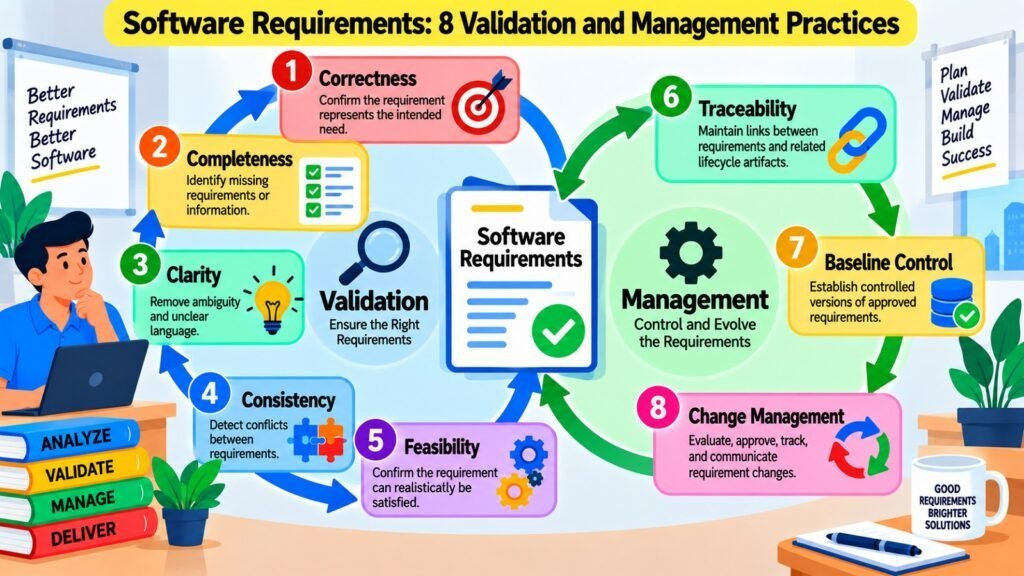
Software Requirements Validation and Management address two related but distinct concerns. Validation asks whether requirements, as specified, accurately and completely represent what the system needs to accomplish. Management addresses how requirements are controlled, tracked, and maintained as they evolve over the project lifecycle. Both are essential, and neglecting either creates problems that compound over time.
Requirements validation is a disciplined examination conducted before significant development investment is made. It checks whether requirements are correct, consistent, complete, feasible, clear, and verifiable. Validation activities include structured reviews and inspections, stakeholder walkthroughs, formal verification for safety-critical systems, and prototype-based evaluation where users confirm that proposed behavior matches their actual needs. Validation is distinct from software testing: testing confirms the implemented system satisfies its requirements; validation confirms the requirements themselves are the right expectations before implementation begins.
Requirements management begins once requirements are established and continues throughout the project. It involves maintaining a baseline of approved requirements, tracking changes against that baseline, controlling which changes are approved, and preserving relationships between requirements and dependent work. Changes require a formal process that considers the impact on schedule, cost, design, and testing. Traceability — typically maintained through a matrix — maps requirements to their business origins, related requirements, and dependent design and test artifacts, preserving reasoning and enabling impact assessment.
Requirements change for many legitimate reasons: evolving business objectives, updated regulations, new market information, or discoveries during development. Effective management does not prevent change; it makes change visible, understandable, and controlled. Impact analysis examines downstream consequences before a proposed change is approved, keeping apparently small changes from creating unexpected disruption. An apparently minor change to one requirement can affect dependent requirements, design decisions, and test coverage in ways only visible when relationships are mapped and examined carefully.
Table 9: Software Requirements — Eight Validation and Management Practices
| Practice | Primary Purpose |
| Requirements review and inspection | Systematically examining requirements for correctness, clarity, consistency, and completeness |
| Stakeholder walkthrough | Confirming that documented requirements accurately represent actual stakeholder needs |
| Prototype-based validation | Using working models to verify that proposed system behavior matches real user expectations |
| Baseline establishment | Defining an approved version of requirements as the reference point for development |
| Change control | Managing proposed changes through a formal review and approval process |
| Impact analysis | Assessing downstream consequences of a proposed change before it is approved |
| Traceability management | Maintaining documented relationships between requirements, their origins, and dependent artifacts |
| Version control | Tracking requirement change history so earlier versions and rationale remain accessible |
Conclusion: Software Requirements for Better Software Outcomes
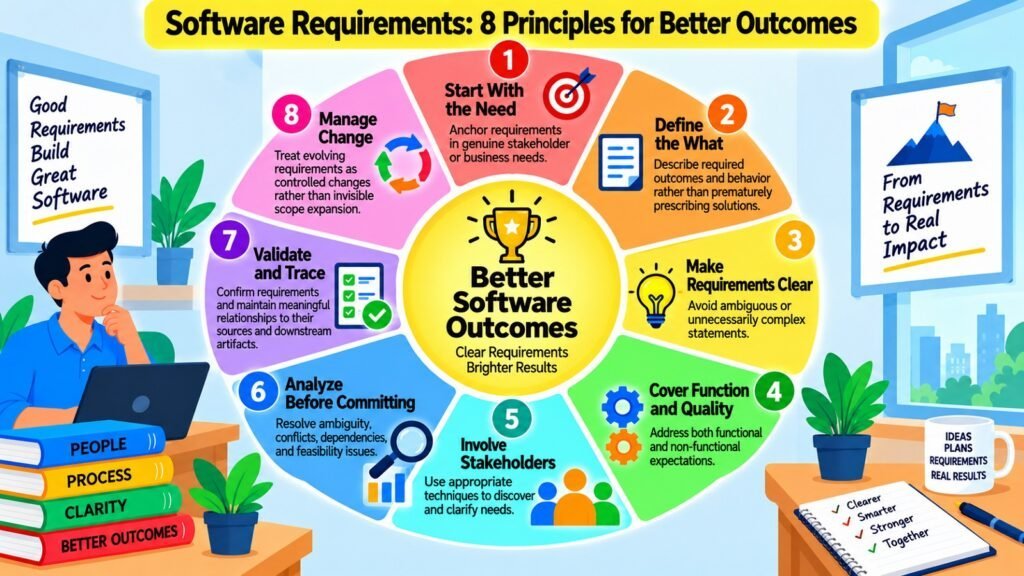
Software Requirements form the connective tissue between what an organization needs and what a software system will do. A consistent theme runs through all eight foundations: requirements work is fundamentally about achieving shared understanding. Fundamentals establish what a requirement is and why the discipline exists. Types clarify how requirements relate across levels of abstraction. Functional and non-functional requirements together define what the system must do and how well it must perform.
Elicitation recognizes that requirements must be discovered through structured inquiry. Analysis converts raw statements into coherent, consistent, and prioritized expectations. Specification creates documented forms that participants can consult across the development lifecycle. Validation confirms that specified requirements represent the right expectations before implementation begins. Management keeps requirements useful as business conditions evolve.
The boundary between Software Requirements and downstream disciplines of design, implementation, and testing is worth preserving. Requirements define what the software must accomplish; everything else addresses how. Keeping this boundary clear ensures requirements remain stable enough to guide development even as implementation decisions change. Treat requirements as an evolving source of clarity and alignment rather than a static document — managed well enough to keep the team, the stakeholders, and the software moving in the same direction.
Table 10: Software Requirements — Eight Practical Principles
| Principle | Practical Meaning |
| Define needs, not solutions | Requirements describe what the system must accomplish, not how it must be built |
| Confirm shared understanding | A requirement is only useful if all parties read it the same way |
| Keep requirements verifiable | If a requirement cannot be tested or confirmed, it cannot reliably guide development |
| Trace every requirement to its source | Understanding origin makes change impact far easier to assess and communicate |
| Distinguish types by purpose | Business, user, system, functional, and non-functional requirements serve different roles |
| Expect and manage change | Requirements evolve; controlled change is better than undocumented drift |
| Validate before you build | Confirming requirements accuracy early is far less costly than correcting a built system |
| Use documentation to coordinate | The purpose of a specification is to align understanding, not to restrict communication |