Table of Contents
Introduction: What Makes the Streaming Ecosystem the Foundation of Digital Entertainment?
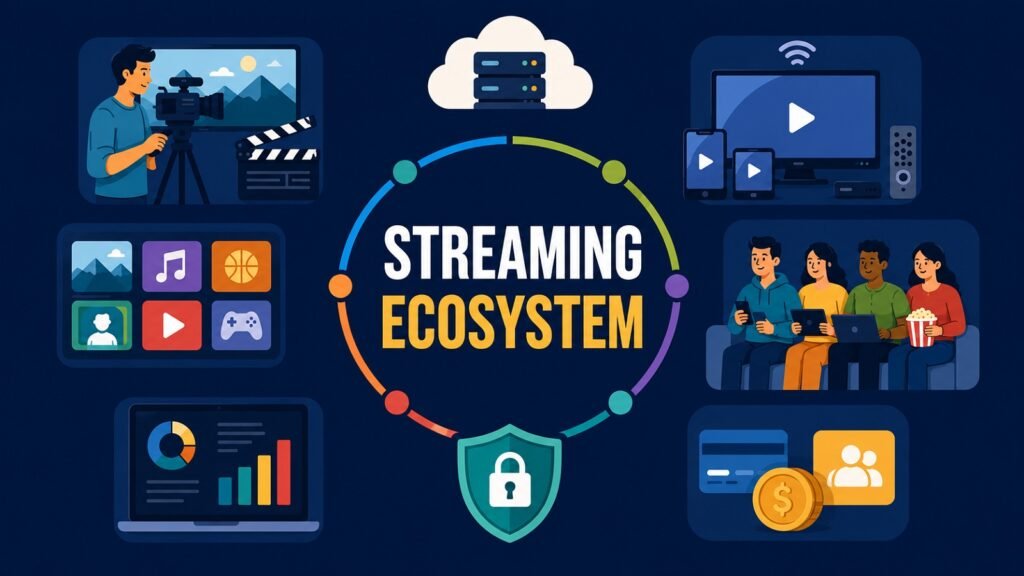
Something quiet happened over the last decade. The way people watch, listen, and find entertainment changed. Fixed schedules gave way to something personal and always within reach. This shift did not happen because of one company or one piece of technology. It happened because many moving parts learned to work together. We now call this network the Streaming Ecosystem. It has become an important component of modern digital entertainment. It connects creators, technology providers, distribution channels, businesses, and audiences into one system that keeps evolving.
The Streaming Ecosystem is not a single product. It works more like a living structure. Content gets made in one place. It gets delivered through complex infrastructure. It gets found through smart systems. It gets paid for through different business models. Finally, a viewer experiences it, often without thinking about any of the machinery behind it. Each part depends on the others. A brilliant show means little without infrastructure that can stream it well. A strong recommendation engine is useless without good content to recommend. This is what gives the Streaming Ecosystem its strength, and also its complexity.
Understanding this ecosystem matters to many kinds of people. Business leaders need it to make smart investment and licensing choices. Technology professionals need it to build systems that scale during busy moments. Content creators need it to see where their work fits in a larger chain. Researchers study it to track shifting consumer habits. Everyday viewers benefit too, simply by understanding why their favorite platform behaves the way it does, from buffering to eerily accurate suggestions.
This article walks through eight foundational parts of the Streaming Ecosystem. It starts with content creation, the origin point of everything else. Then it covers infrastructure, the technical backbone behind reliable streams. From there, it moves into distribution channels, discovery and personalization, business models, audience experience, rights and security, and finally streaming intelligence. Streaming intelligence ties data back into every other layer. None of these parts work alone. They form one connected chain. Understanding each link makes the whole picture much clearer.
Streaming Ecosystem: Eight Foundational Aspects Overview
| Aspect | Description |
| Content Creation | Produces the films, shows, music, and creator media worth streaming |
| Infrastructure | Delivers content reliably through cloud systems and networks |
| Distribution Channels | Carries content across apps, TVs, and connected devices |
| Discovery and Personalization | Helps audiences find content through search and suggestions |
| Business Models | Generates revenue through subscriptions and advertising |
| Audience Experience | Shapes how smooth and satisfying viewing feels |
| Rights, Security, and Compliance | Protects content, data, and legal standing |
| Streaming Intelligence | Turns data into insights that improve every layer |
1. Streaming Ecosystem Through Content Creation
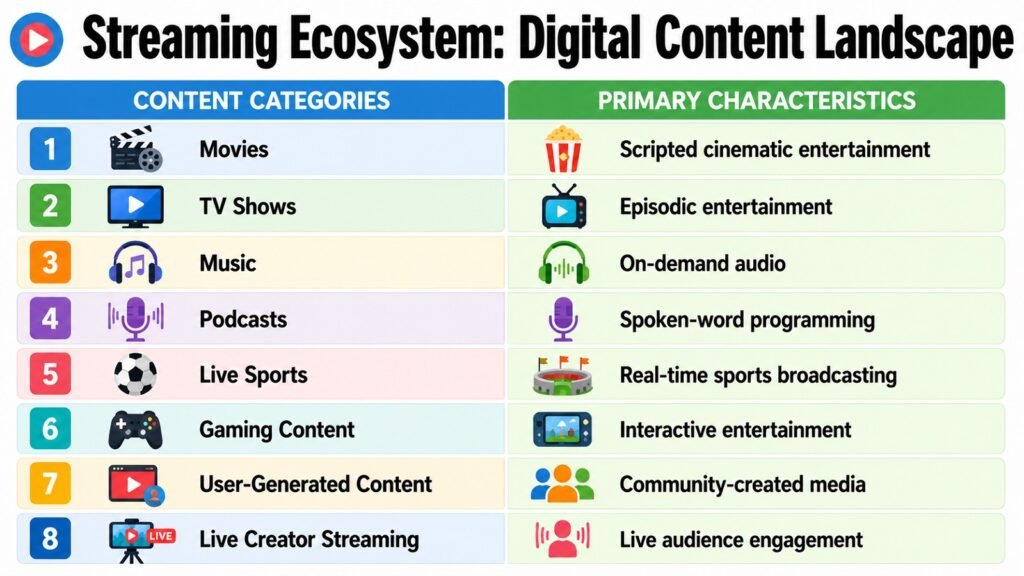
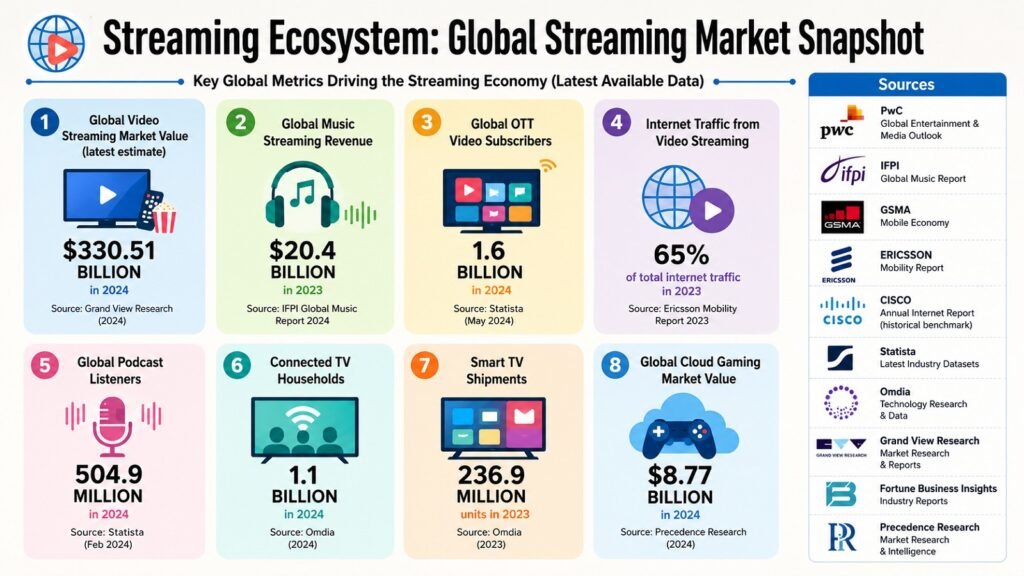
Every stream begins somewhere, long before a viewer presses play. Content creation is the starting point of the Streaming Ecosystem. It covers films, television shows, music, podcasts, live events, gaming content, and creator-driven media. What separates modern content creation from older broadcast models is intent. Productions today are often built with streaming in mind. Platforms shape formats, episode lengths, and release schedules around how streaming audiences actually behave, not around a television grid.
The media value chain is a well known idea in media economics. It explains how raw creative ideas move through production and packaging before they reach an audience. Within the Streaming Ecosystem, this chain has sped up. Studios and independent creators now think about intellectual property from the very start. A strong original show can grow into merchandise, spin-offs, and licensing deals long after the first season airs. This is part of why streaming companies invest heavily in owned content instead of relying only on licensed shows.
The creator economy adds another layer. Platforms built around individual creators, from video makers to independent musicians, now act like small production studios. Research on the creative economy shows that lower barriers to entry have opened up who gets to make content. This in turn gives audiences more variety to choose from. A teenager with a camera and a strong idea can now reach a global audience without ever working with a traditional studio.
None of this matters without quality. This is where content creation earns its place as the true foundation of the Streaming Ecosystem. Every other layer, from infrastructure to personalization, exists to serve the content itself. Without strong material, even the best delivery systems have nothing worth delivering. This is why leading platforms still treat original programming as their most valuable long-term investment.
Streaming Ecosystem: Content Types and Their Roles
| Aspect | Description |
| Film and Television | Drives subscriber growth through flagship titles |
| Music Streaming | Keeps engagement steady through catalogs and playlists |
| Podcasts | Builds loyal listening tied to personal interests |
| Live Events | Drives real-time engagement through sports and concerts |
| Gaming Content | Expands the ecosystem into interactive entertainment |
| Creator-Driven Media | Adds variety outside traditional studio content |
| Documentaries | Attracts smaller but highly engaged audiences |
| Animated Content | Serves family viewers and supports licensing revenue |
2. Streaming Ecosystem Infrastructure: The Technology Backbone
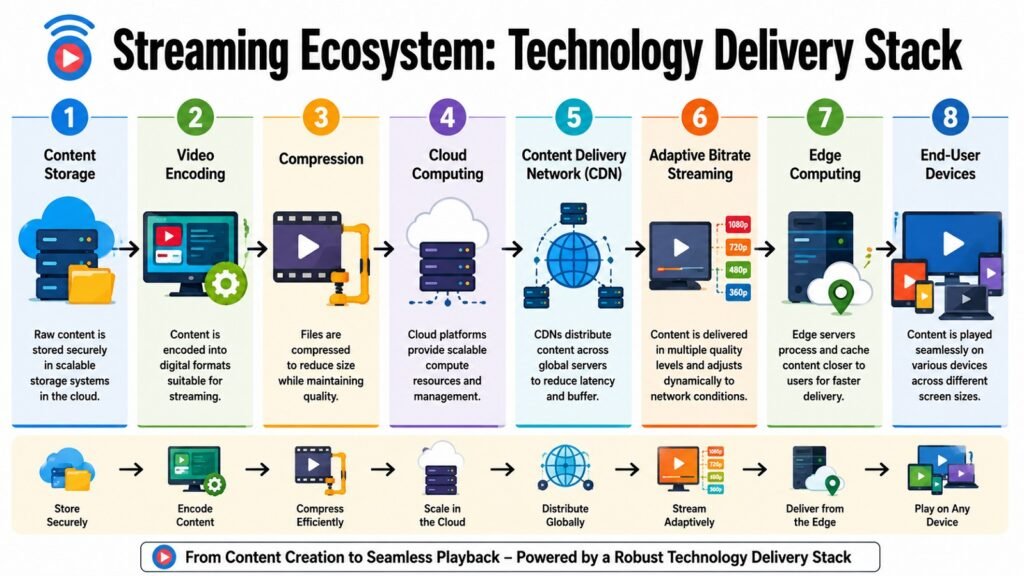
Behind every smooth video stream sits a mountain of technical work most viewers never see. Infrastructure is what makes the Streaming Ecosystem physically possible. It includes cloud computing, content delivery networks, encoding, compression, adaptive bitrate streaming, storage, and edge computing. These are not optional extras. They are the reason a show loads in seconds instead of minutes. They are also the reason quality adjusts automatically when a connection weakens.
Cloud computing gives streaming companies the flexibility to scale server capacity up or down based on demand. This matters a lot during big live events, when millions of viewers arrive at once. Content delivery networks, often called CDNs, place copies of content on servers closer to viewers. This shortens the distance data has to travel and cuts down on delay. Adaptive bitrate streaming works alongside this by adjusting video quality in real time. A viewer on a weak mobile connection still gets a watchable picture instead of constant buffering.
Encoding and compression solve a different problem. Raw video files are huge, so streaming providers shrink them using standards that reduce file size while keeping as much quality as possible. Engineering research on video codecs shows a steady tradeoff between compression and processing cost. This is why companies keep investing in newer codec standards that squeeze more quality out of less bandwidth. Edge computing pushes some of this work closer to the viewer, rather than back to a distant data center. This shaves off precious milliseconds of delay.
None of these technologies work well alone. A strong CDN cannot fix poorly encoded video. Efficient encoding cannot fix a network with no nearby servers. Within the Streaming Ecosystem, infrastructure choices ripple out into everything else, including audience experience and business costs. Better infrastructure directly cuts the churn caused by frustrating playback problems.
Streaming Ecosystem: Infrastructure Technologies and Their Contribution
| Aspect | Description |
| Cloud Computing | Provides flexible server capacity for changing demand |
| Content Delivery Networks | Reduces delay by serving content from nearby servers |
| Adaptive Bitrate Streaming | Adjusts video quality to match connection strength |
| Encoding and Compression | Shrinks file size while keeping visual quality |
| Edge Computing | Processes data closer to viewers to cut delay |
| Cloud Storage | Holds large content libraries ready on demand |
| Load Balancing | Spreads traffic evenly to avoid server overload |
| Network Monitoring | Detects and fixes performance issues quickly |
3. Streaming Ecosystem Content Distribution Across Digital Channels
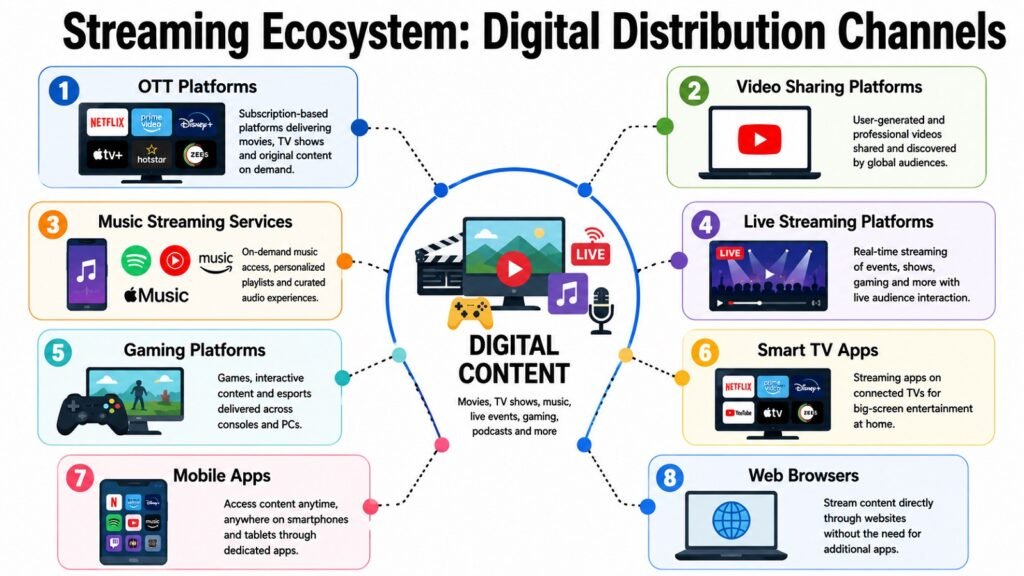
Content and infrastructure mean little if audiences cannot reach what has been made. Distribution is the layer of the Streaming Ecosystem responsible for getting content in front of people. It spans OTT platforms, music streaming services, live-streaming services, gaming platforms, smart TV apps, mobile apps, websites, and connected devices. Each channel serves a different habit. Someone might watch a film on a smart TV in the evening, then catch a podcast on a phone during a morning commute.
Over-the-top platforms, often shortened to OTT, deliver content directly over the internet. There is no need for cable or satellite boxes. This single shift removed big barriers to entry. It let streaming companies reach global audiences without negotiating with regional broadcasters one country at a time. Music streaming services followed a similar path. Listeners moved away from physical media and downloads toward instant, always-available libraries.
Smart TVs and connected devices deserve special attention. They changed where streaming happens inside the home. Many televisions now come with streaming apps built right into the operating system, so viewers no longer need a separate box or computer. Research on device habits shows that convenience drives adoption more than raw feature count. This explains why simple, well-built smart TV apps often beat more complex alternatives.
Effective distribution acts as the bridge between everything created earlier in the Streaming Ecosystem and the audiences waiting to enjoy it. Companies that spread across many channels, instead of relying on just one, tend to reach broader and more varied audiences. This supports steadier long-term growth and lowers the risk of depending on a single platform or region.
Gaming platforms add another layer to distribution. Cloud gaming now streams interactive experiences much like video and music get delivered. This shows how flexible distribution has become inside one ecosystem. A viewer today might move between a film, a playlist, and a game session without ever leaving the same digital environment, a shift few would have predicted a decade ago.
Streaming Ecosystem: Distribution Channels and Their Functions
| Aspect | Description |
| OTT Platforms | Delivers video content directly over the internet |
| Music Streaming Services | Provides on-demand access to audio libraries |
| Live-Streaming Services | Enables real-time broadcast of events and creators |
| Gaming Platforms | Distributes interactive and cloud-based gaming content |
| Smart TV Applications | Builds streaming directly into home televisions |
| Mobile Applications | Extends access to phones and tablets |
| Websites | Offers browser access without extra downloads |
| Connected Devices | Links streaming boxes and consoles to displays |
4. Streaming Ecosystem Content Discovery and Personalization
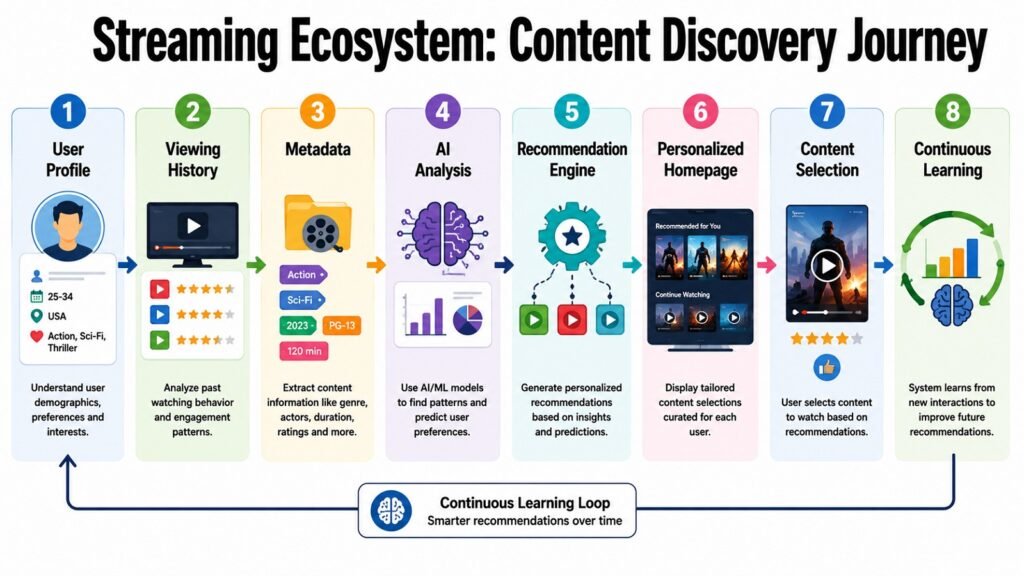
A huge content library only helps if people can actually find something worth watching. Discovery and personalization form the layer of the Streaming Ecosystem that guides audiences through this choice. It relies on recommendation systems, metadata, artificial intelligence, personalized homepages, search, and curated collections. Without this layer, even great content risks getting lost in a sea of options.
Recommendation systems usually rely on two known approaches. Collaborative filtering looks at patterns across many users. It suggests content based on what similar viewers enjoyed. Content-based filtering instead looks at what a single viewer already likes, such as genre, cast, or pacing, and finds similar titles. Most major platforms blend both approaches. Collaborative filtering is good at surprising discoveries, while content-based filtering stays close to known preferences.
Metadata plays a quiet but essential role here. Every piece of content carries tags describing genre, mood, themes, and production details. This information feeds directly into recommendation engines. Research on personalization shows that well-structured metadata often improves discovery more than raw algorithm complexity, simply because the system has better information to work with. Personalized homepages then arrange content for each viewer, prioritizing what someone is likely to enjoy next.
Within the Streaming Ecosystem, discovery has become a real competitive advantage, not just a background feature. Platforms that help viewers find good content quickly see higher engagement and less frustration, which leads directly to retention. As content libraries keep growing, the systems that guide people through them will only become more central to how the whole ecosystem works.
Search functionality deserves a special mention because it shows intent in its purest form. When a viewer types a specific title or actor name, the platform knows exactly what that person wants. This is unlike recommendations, which involve some guesswork. Strong search, paired with strong recommendations, gives audiences two paths toward the same goal: finding something worth their time, fast.
Streaming Ecosystem: Content Discovery Methods and Their Role
| Aspect | Description |
| Collaborative Filtering | Recommends content based on similar viewer patterns |
| Content-Based Filtering | Suggests titles similar to what a viewer already likes |
| Metadata Tagging | Supplies structured information that powers recommendations |
| Personalized Homepages | Arranges content for individual viewers |
| Search Functionality | Allows direct, intent-driven content discovery |
| Curated Collections | Highlights themed or editorially picked content |
| Artificial Intelligence | Improves recommendation accuracy over time |
| Trending Sections | Surfaces popular content based on real-time activity |
5. Streaming Ecosystem Business Models and Revenue Strategies
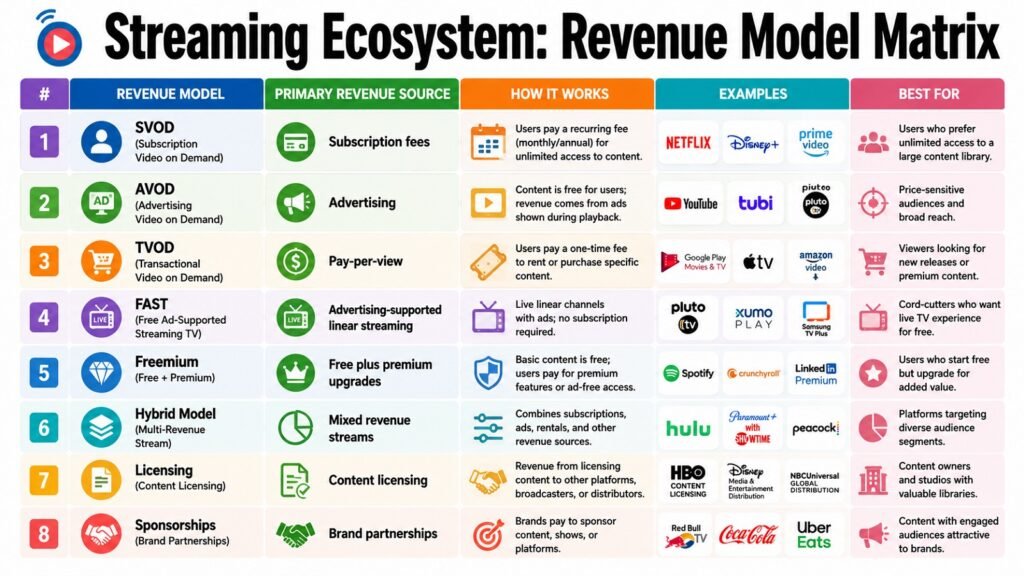
The creativity and technology discussed thus far cannot persist without a consistent revenue stream. Business models constitute the financial foundation of the Streaming Ecosystem. These models encompass subscription services, advertising-supported streaming, transactional frameworks, FAST channels, freemium offerings, hybrid monetization strategies, partnerships, and content licensing. Various markets and audiences react differently to these approaches, which is why most major platforms have moved away from relying solely on a single model.
Subscription economics, a well studied idea in business research, explains why steady recurring revenue is so attractive to streaming companies. It allows for more confident long-term investment in content and infrastructure, compared to relying on unpredictable one-time purchases. Network effects also play a role here. Platforms with bigger libraries and audiences become more valuable to both viewers and content partners, which strengthens their position over time.
Advertising-supported streaming has emerged as a viable alternative to subscription services, particularly through free ad-supported streaming television, commonly referred to as FAST channels. These channels resemble traditional broadcast television but are delivered entirely via the internet. They attract budget-conscious viewers while simultaneously generating advertising revenue for the platforms. Freemium models enhance this concept by providing a free tier alongside paid upgrades, thereby reducing the entry barrier for new users to experience a service.
Hybrid monetization, blending subscriptions with advertising tiers, has become common as companies search for the right balance between revenue and access. Licensing and partnership deals also matter, letting platforms share content and audiences without building everything alone. Within the Streaming Ecosystem, the right revenue strategy directly shapes how much a company can reinvest in content quality, technology, and customer experience.
Regional pricing shows how business models must adapt across markets. What works as a monthly fee in one country may need adjusting elsewhere to match local income and spending habits. This flexibility, though easy to overlook, plays a quiet but real role in how far the Streaming Ecosystem can truly extend across different economies around the world.
Streaming Ecosystem: Business Models and Their Characteristics
| Aspect | Description |
| Subscription Services | Generates steady recurring revenue from members |
| Advertising-Supported Streaming | Monetizes free access through ad placements |
| Transactional Models | Charges per individual purchase or rental |
| FAST Channels | Offers free, ad-supported linear-style streaming |
| Freemium Services | Combines free access with optional paid upgrades |
| Hybrid Monetization | Blends subscription and advertising revenue |
| Content Licensing | Generates revenue by leasing content to other platforms |
| Strategic Partnerships | Expands reach through shared content and bundling |
6. Streaming Ecosystem and the Modern Audience Experience
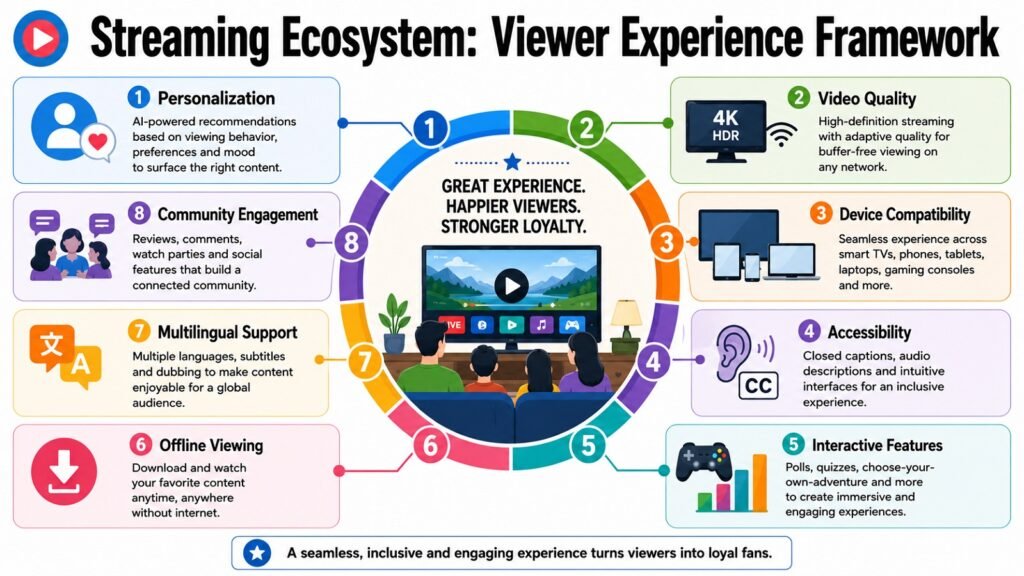
Even the best content and technology can fail if the experience around them feels clumsy. Audience experience is the layer of the Streaming Ecosystem that decides whether a viewer stays or leaves. It is shaped by interface design, streaming quality, cross-device compatibility, accessibility, multilingual support, offline viewing, and social engagement. This layer is where technology and human behavior meet most directly.
Research on human-computer interaction shows that simplicity often beats a long feature list when it comes to satisfaction. A cluttered interface with too many options can overwhelm viewers. A clean, simple layout helps people find what they want quickly and come back without hesitation. This is why leading platforms keep simplifying their navigation, even as their content libraries keep growing.
Cross-device compatibility has become a basic expectation, not a bonus feature. Viewers now expect to pause a show on a television and pick it up on a phone without any hassle. Platforms that fail to deliver this smooth handoff risk frustrating even loyal subscribers. Accessibility features, including subtitles, audio descriptions, and multilingual support, widen who can meaningfully use a platform. This matters both ethically and commercially, since streaming now reaches truly global audiences.
Offline viewing and social engagement features round out the modern experience. They give viewers flexibility during travel and easy ways to share what they enjoy with others. Within the Streaming Ecosystem, audience experience directly shapes churn, the rate at which subscribers cancel their service. Platforms that keep refining this experience tend to build stronger, longer-lasting bonds with their audiences, turning casual viewers into steady, loyal customers.
Small details often matter more than viewers realize. A poorly timed loading screen or a confusing menu can quietly wear down goodwill built up over months of good service. Companies that treat these small frictions as seriously as major outages tend to earn a level of trust that keeps people subscribed, even when rivals offer similar libraries at similar prices.
Streaming Ecosystem: Audience Experience Factors and Their Contribution
| Aspect | Description |
| Interface Design | Shapes how easily viewers navigate content |
| Streaming Quality | Determines visual and audio satisfaction during playback |
| Cross-Device Compatibility | Ensures smooth viewing across multiple screens |
| Accessibility Features | Expands usability for diverse audiences |
| Multilingual Support | Broadens reach across global markets |
| Offline Viewing | Provides flexibility without an active connection |
| Social Engagement | Encourages sharing and community interaction |
| Customer Support | Resolves issues that affect retention |
7. Streaming Ecosystem Rights, Security, and Compliance
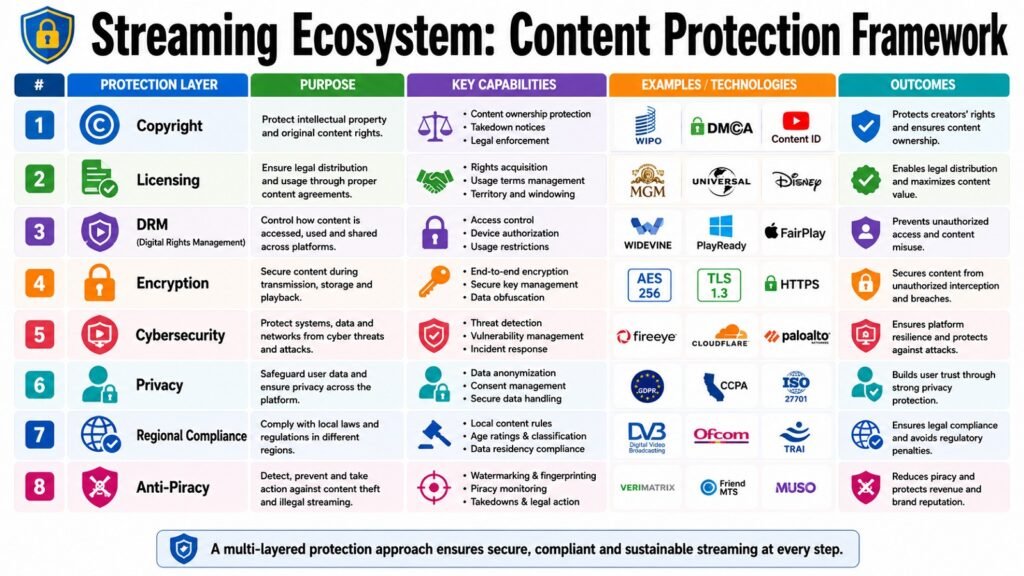
Trust holds the Streaming Ecosystem together just as much as technology does. Rights, security, and compliance protect creators, businesses, and audiences. This covers content licensing, copyright protection, Digital Rights Management, piracy prevention, cybersecurity, privacy protection, regional licensing, and regulatory compliance. Without these protections, the whole creative and financial structure behind streaming would be far less stable.
Copyright protection and licensing agreements decide who has the legal right to show specific content in specific regions. This is why the same title can appear on different platforms depending on where a viewer lives. Digital Rights Management, often shortened to DRM, technically enforces these agreements by controlling how content can be copied, shared, or accessed. It helps prevent unauthorized redistribution.
Piracy prevention remains an ongoing challenge across the industry. Research on digital content protection shows that layered security tends to work better than relying on any single method. Cybersecurity goes beyond content protection into safeguarding user accounts, payment details, and personal data. This has grown more important as streaming platforms collect increasingly detailed viewing histories. Privacy rules in many regions now require platforms to handle this data with clear consent and transparency.
Regional licensing and regulatory compliance add another layer of complexity, since laws around content, data, and advertising vary a great deal across countries. Platforms operating globally must navigate this patchwork with care. Within the Streaming Ecosystem, strong governance in this area protects long-term stability. It keeps trust between creators who supply content, businesses that distribute it, and audiences who rely on their data being handled responsibly.
This governance layer rarely gets public attention until something goes wrong. Yet it quietly supports nearly every transaction happening across the ecosystem. A single major data breach or licensing dispute can damage a platform’s reputation for years. This is why serious companies treat compliance as a core investment, not a reluctant cost of doing business.
Streaming Ecosystem: Security, Rights, and Compliance Practices
| Aspect | Description |
| Content Licensing | Establishes legal rights to distribute specific titles |
| Copyright Protection | Safeguards creative ownership across regions |
| Digital Rights Management | Controls access and prevents unauthorized copying |
| Piracy Prevention | Reduces unauthorized distribution through layered security |
| Cybersecurity | Protects user accounts and payment information |
| Privacy Protection | Governs responsible handling of viewer data |
| Regional Licensing | Adapts content availability to local legal rules |
| Regulatory Compliance | Ensures adherence to regional laws and standards |
8. Streaming Ecosystem Through Streaming Intelligence
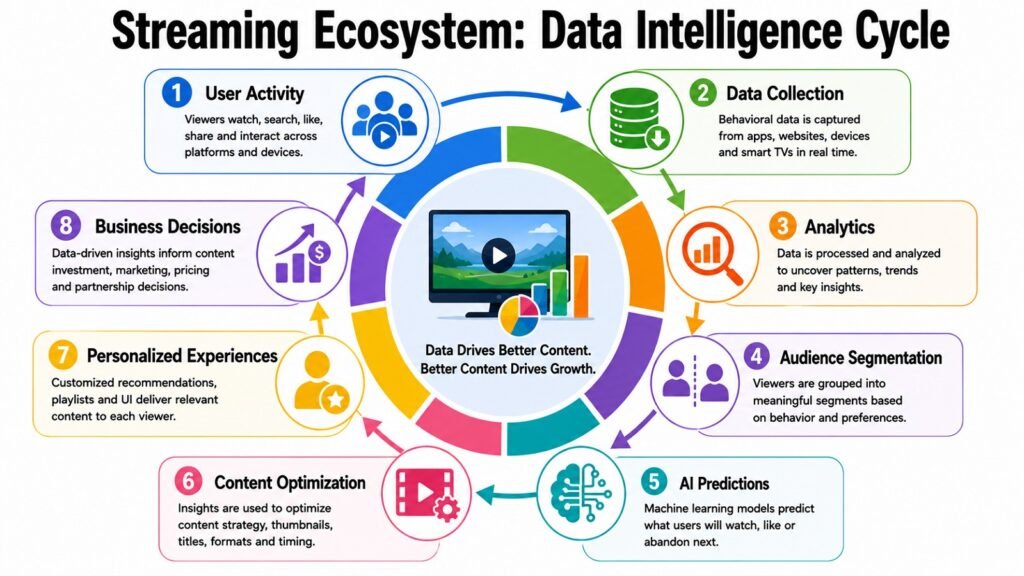
Every layer discussed so far creates information. Streaming Intelligence is what turns that raw information into something useful. This capability sits within the Streaming Ecosystem as a connective layer, not an isolated discipline. It covers audience analytics, recommendation optimization, predictive analytics, content performance measurement, viewer segmentation, churn prediction, and advertising optimization.
The principles of business intelligence, which are well-established across various industries, are directly applicable in this context. Data alone holds little significance until it is organized and interpreted in ways that facilitate decision-making. Audience analytics monitor actual viewer behavior, including what they watch and when they cease viewing. This provides platforms with concrete evidence, rather than mere assumptions, regarding which content resonates with audiences. Content performance measurement enhances this by evaluating how different titles perform relative to investment and expectations.
Predictive analytics advances this concept by forecasting future behavior based on historical patterns. Churn prediction, a commonly utilized tool, identifies viewers who exhibit early signs of disinterest, enabling platforms to intervene before a cancellation occurs. Viewer segmentation categorizes audiences based on shared characteristics or behaviors. This enables more precise content recommendations and advertising, thereby enhancing relevance for viewers while increasing efficiency for businesses.
Streaming Intelligence has become a genuine strategic capability, not a background function. Companies that invest seriously in analytics tend to make sharper choices about content, personalization, and advertising. These insights feed back into nearly every other layer of the Streaming Ecosystem covered in this article. In many ways, this layer acts as the nervous system connecting everything else together.
The value of this layer grows alongside the ecosystem itself. As more content, devices, and viewers join the picture, the volume of data grows too. Companies that turn this growing volume into clear, useful insight tend to pull ahead of competitors still relying on guesswork. This is exactly why data-driven decisions have shifted from a nice advantage to something closer to a baseline requirement.
Streaming Ecosystem: Streaming Intelligence Capabilities and Contribution
| Aspect | Description |
| Audience Analytics | Tracks real viewer behavior across content |
| Recommendation Optimization | Refines personalization accuracy over time |
| Predictive Analytics | Forecasts future viewing trends and behavior |
| Content Performance Measurement | Evaluates return on content investment |
| Viewer Segmentation | Groups audiences for targeted strategies |
| Churn Prediction | Identifies subscribers at risk of cancelling |
| Advertising Optimization | Improves ad targeting and relevance |
| Strategic Decision Support | Guides business choices with data-driven evidence |
Conclusion: The Future of the Streaming Ecosystem in Digital Entertainment
Looking back across all eight foundations, a clear pattern shows up. The Streaming Ecosystem works because none of its parts stand alone. Content creation supplies the raw material. Infrastructure carries it reliably. Distribution places it within reach. Discovery helps people find it. Business models fund the whole operation. Audience experience decides whether people stay. Rights and security protect everyone involved. Streaming intelligence quietly connects insights back into every other layer.
This is what makes the Streaming Ecosystem such an important component of modern digital entertainment. It is not one single innovation, but a coordinated system built from many disciplines working in step with each other. Creative teams, engineers, business strategists, legal experts, and data analysts all contribute to something that feels effortless to the average viewer, even though real complexity sits quietly underneath.
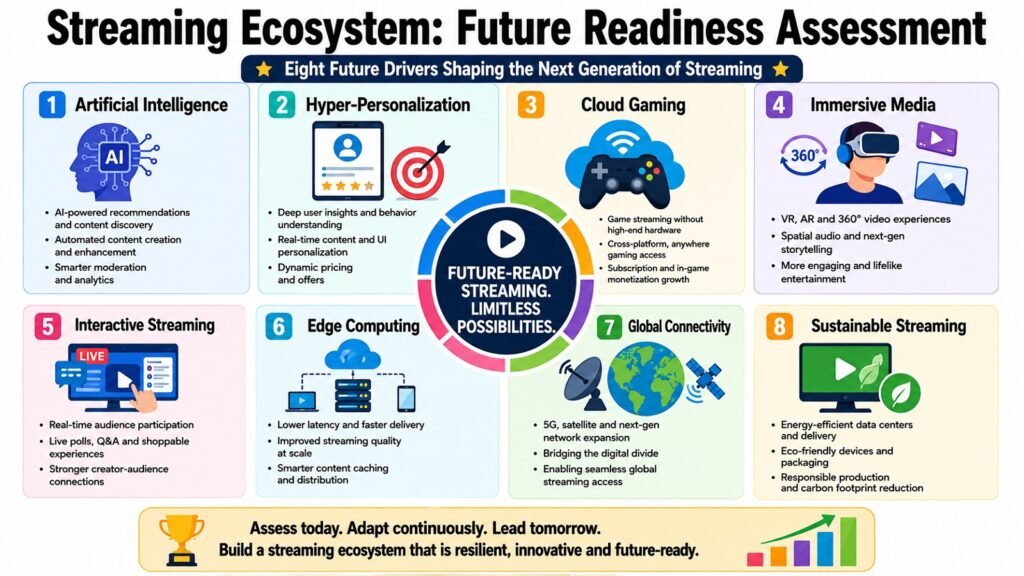
Looking ahead, the Streaming Ecosystem shows no sign of settling into a fixed shape. Artificial intelligence will likely deepen personalization further. Immersive formats and interactive media will push the boundaries of what streamed content can even mean. Cloud gaming keeps blurring the line between watching and playing. Next-generation connectivity promises to bring high-quality streaming to places where it still struggles today. Each of these changes will likely reshape one or more of the eight foundations covered here, without breaking the basic structure that connects them.
For business leaders, technology professionals, creators, and curious viewers alike, understanding this ecosystem offers a clearer view of where digital entertainment is heading next. The eight foundations explored in this article are not separate stories. They are chapters of the same ongoing narrative, and each one rewards a closer look for anyone wanting to understand how modern entertainment truly works.
Streaming Ecosystem: Foundations and Key Takeaways
| Aspect | Description |
| Content Creation | Quality content remains the irreplaceable starting point |
| Infrastructure | Reliable technology shapes the viewing experience |
| Distribution Channels | Reach depends on presence across many platforms |
| Discovery and Personalization | Smart recommendations turn choice into satisfaction |
| Business Models | Diverse revenue strategies support long-term growth |
| Audience Experience | Smooth design keeps viewers engaged and loyal |
| Rights, Security, and Compliance | Trust protects the entire ecosystem long term |
| Streaming Intelligence | Data turns every layer into a smarter system |