Table of Contents
Introduction — Types of Computer Networks: Understanding Connectivity Models
Computer Networks do not differ only in size. Two networks spanning the same physical distance can serve entirely different purposes, operate under different ownership models, and impose different security requirements. Understanding types of computer networks means recognizing these multiple dimensions rather than treating geographic scale as the only meaningful classification.
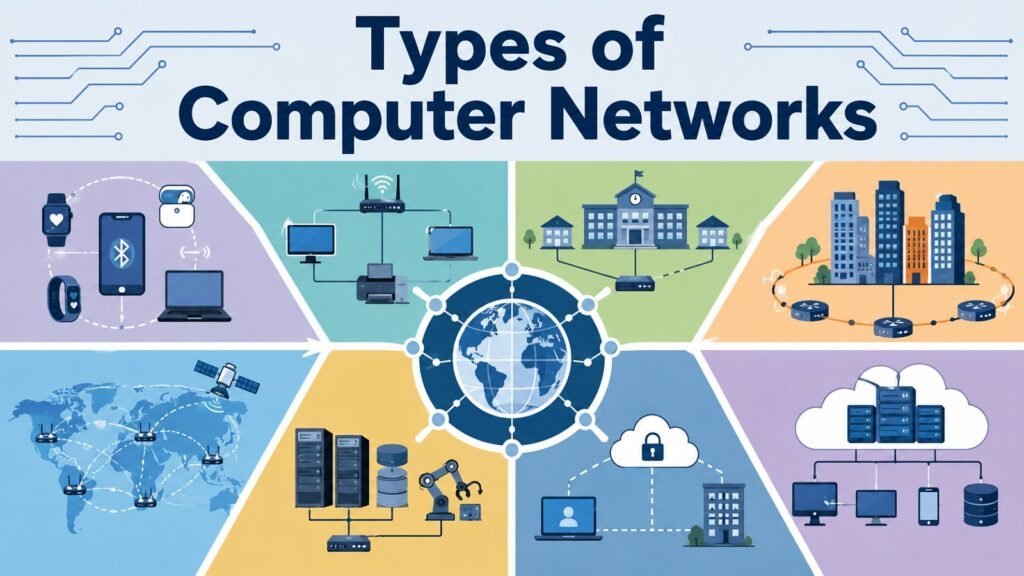
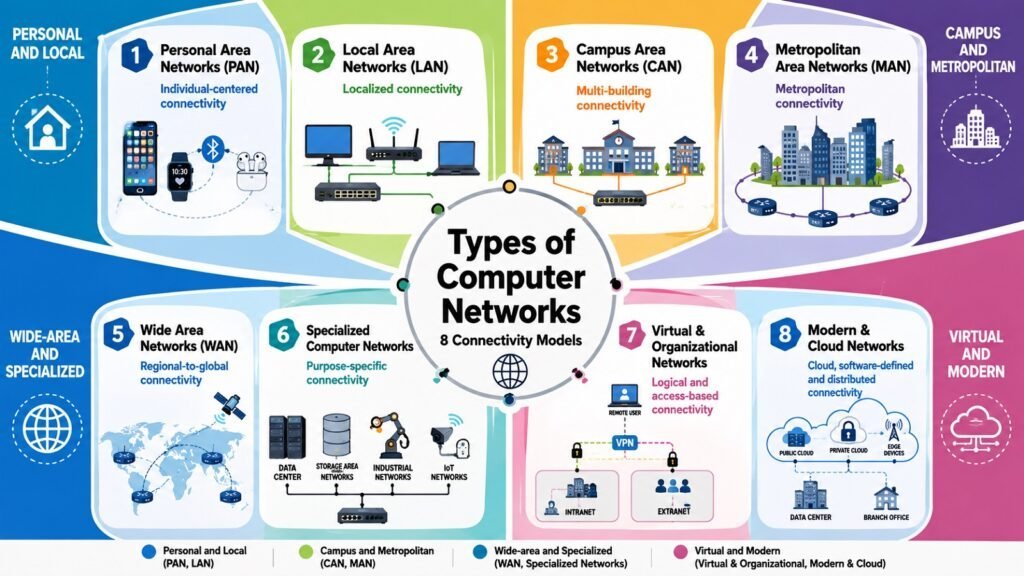
The most familiar framework arranges computer networks by geographic scope: Personal Area Networks serve one individual, Local Area Networks cover a building, Campus Area Networks span an institutional site, Metropolitan Area Networks reach across a city, and Wide Area Networks extend to countries and continents. This progression is useful, but it captures only part of the landscape.
Other categories emerge from purpose rather than geography. Storage Area Networks and industrial networks exist because certain workloads need connectivity characteristics a conventional LAN cannot efficiently provide. Virtual Private Networks and organizational models such as intranets define connectivity through access boundaries. Cloud and software-defined architectures challenge the assumption that network infrastructure must be fixed and centrally located.
This article examines eight connectivity models covering the full range of types of computer networks, explaining why each exists, where it fits, what trade-offs it introduces, and how it connects to other models. The table below provides a high-level roadmap.
Types of Computer Networks: Eight Connectivity Models at a Glance
| Network Model | Defining Role |
| Personal Area Network (PAN) | Connects personal devices around an individual within a few meters |
| Local Area Network (LAN) | Links devices within a home, office, or building for resource sharing |
| Campus Area Network (CAN) | Interconnects multiple LANs across a university or corporate campus |
| Metropolitan Area Network (MAN) | Extends connectivity across a city through service-provider infrastructure |
| Wide Area Network (WAN) | Spans cities, countries, or continents for geographically distributed sites |
| Specialized Computer Networks | Designed for specific workloads: storage, industrial control, or data centers |
| Virtual & Organizational Networks | Define connectivity by logical boundaries and organizational relationships |
| Modern & Cloud Networks | Support distributed, software-defined, and cloud-based environments |
1. Types of Computer Networks: Personal Area Networks (PAN)
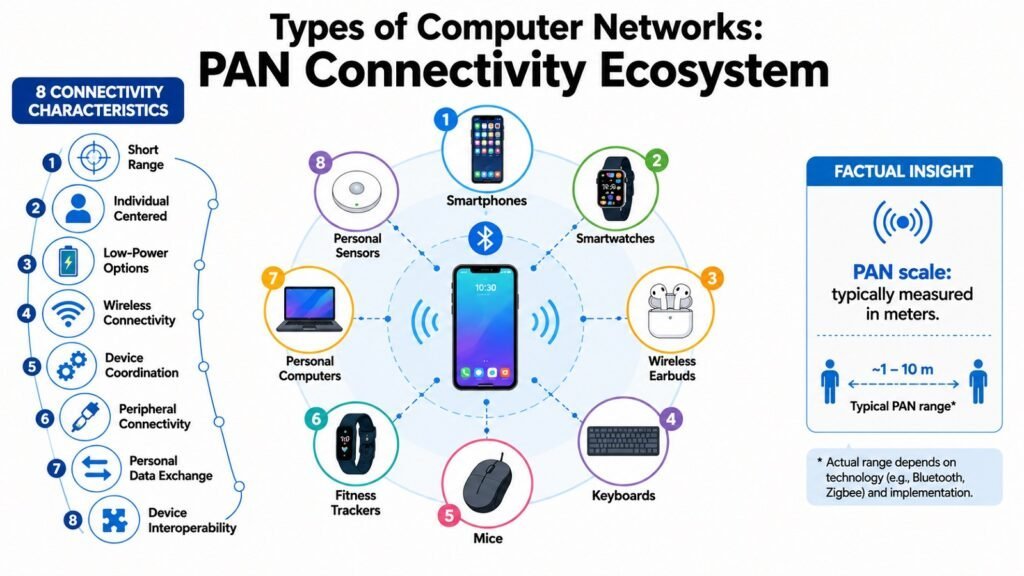
A Personal Area Network represents the smallest geographic scale in the framework of types of computer networks. It exists because personal computing is no longer a single-device experience. Smartphones, smartwatches, wireless earbuds, fitness trackers, keyboards, and mice all function better when they can communicate with one another and with a central device without cables or manual data transfers.
PANs emerged as Bluetooth technology matured and became embedded in consumer electronics. Bluetooth, governed by the IEEE 802.15 family of specifications, operates across short ranges measured in meters. This intentional range limitation reflects the personal-scale purpose: PAN devices are associated with one individual and extend that person’s computing environment rather than covering a shared space.
The distinction between a PAN and a LAN goes beyond scale. A LAN connects devices in a shared environment and typically supports multiple simultaneous users. A PAN is personal in scope. A smartwatch receiving notifications from a phone, or wireless earbuds receiving audio from a laptop, represents the defining PAN characteristic: one person, multiple associated devices, short-range communication.
Practical advantages include convenience and broad interoperability among devices from different manufacturers. Limitations are equally real. Bluetooth shares the 2.4 GHz band with Wi-Fi and other equipment, creating potential for interference. Range is inherently short, so a device in an adjacent room may lose its connection. Managing multiple paired devices can cause confusion when a peripheral connects to the wrong host, requiring manual intervention to correct.
Within the types of computer networks hierarchy, PAN is the entry point. It establishes the personal-scale baseline that makes every larger connectivity model easier to understand by contrast.
Types of Computer Networks: PAN Characteristics at a Glance
| Characteristic | Detail |
| Primary standard | IEEE 802.15 (Bluetooth and related short-range wireless protocols) |
| Typical range | Bluetooth Class 2: up to 10 m; Bluetooth 5.0: up to 40 m in open conditions |
| Common devices | Smartphones, smartwatches, earbuds, fitness trackers, keyboards, mice |
| Primary use case | Personal device interoperability for a single user within a personal space |
| Key advantage | Cable-free convenience and seamless pairing among consumer electronics |
| Key limitation | Short range, 2.4 GHz interference, and limited simultaneous connection management |
| Scope comparison | PAN serves one person; LAN serves a shared multi-user environment |
| Security note | Bluetooth pairing requires authentication; active discovery mode can expose devices to unauthorized access |
2. Types of Computer Networks: Local Area Networks (LAN)
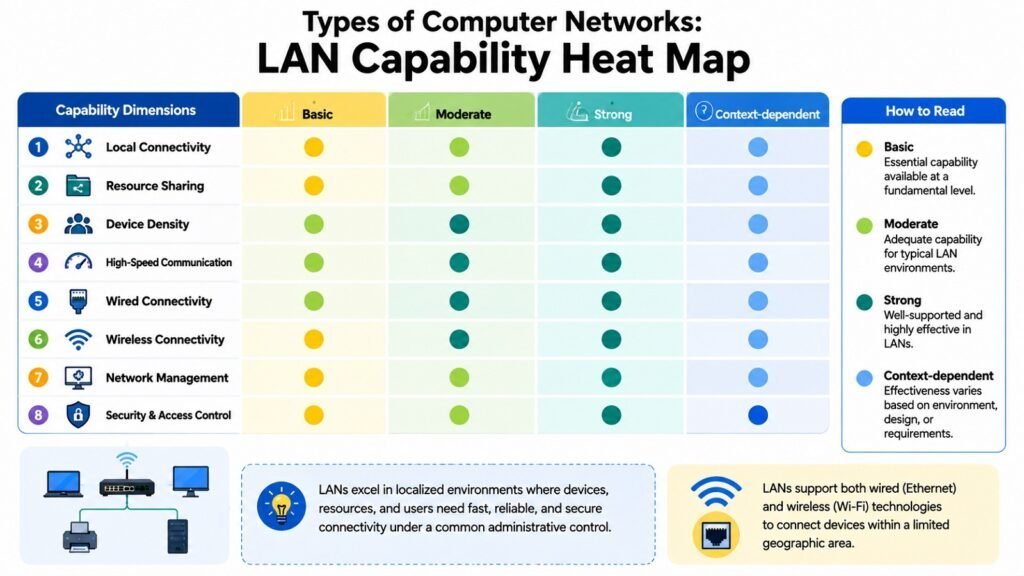
Local Area Networks occupy a central place in any discussion of types of computer networks because they represent the connectivity model most people encounter daily. A LAN connects devices within a defined physical environment such as a home, office floor, school, or laboratory, allowing those devices to share resources and access centralized services without external network infrastructure.
Ethernet, which is standardized by IEEE 802.3, has been the leading wired LAN technology for many years. Wi-Fi, standardized by IEEE 802.11, provides wireless LAN connectivity and is often referred to as a Wireless LAN or WLAN. A WLAN does not represent a distinct geographic category; rather, it is a LAN that utilizes wireless transmission, maintaining the same scope, ownership model, and purpose of resource sharing. The majority of contemporary LANs integrate wired backbone segments with wireless access points, functioning as a single administratively cohesive network.
LANs are typically owned and administered by the organization or individual occupying the space they serve. This ownership simplifies security policy, performance tuning, and capacity planning. The trade-off is full responsibility for maintenance, upgrades, and security. Performance within a LAN is high relative to wider-area connections. Modern Ethernet supports one gigabit per second as a standard enterprise baseline, with ten-gigabit options common in server-adjacent environments, and latency is measured in microseconds.
In the types of computer networks hierarchy, LAN sits above PAN and below CAN. When an organization’s physical footprint grows beyond a single building and multiple LANs require coordination, the next relevant classification is the Campus Area Network.
Types of Computer Networks: LAN Characteristics at a Glance
| Characteristic | Detail |
| Primary wired standard | IEEE 802.3 (Ethernet); 1 Gbps common in enterprise, 10 Gbps in server environments |
| Primary wireless standard | IEEE 802.11 (Wi-Fi); WLAN is a LAN variant, not a separate geographic classification |
| Typical environment | Homes, offices, schools, laboratories, single buildings |
| Ownership model | Owned and managed by the occupying organization or individual |
| Key advantage | High throughput, low latency, full administrative control, and straightforward resource sharing |
| Key limitation | Limited to building scope; broader coverage requires a higher-tier network architecture |
| Security approach | Owner-controlled; firewalls, VLAN segmentation, and access control are standard tools |
| Relationship to CAN | Multiple LANs interconnected across a concentrated site form a Campus Area Network |
3. Types of Computer Networks: Campus Area Networks (CAN)
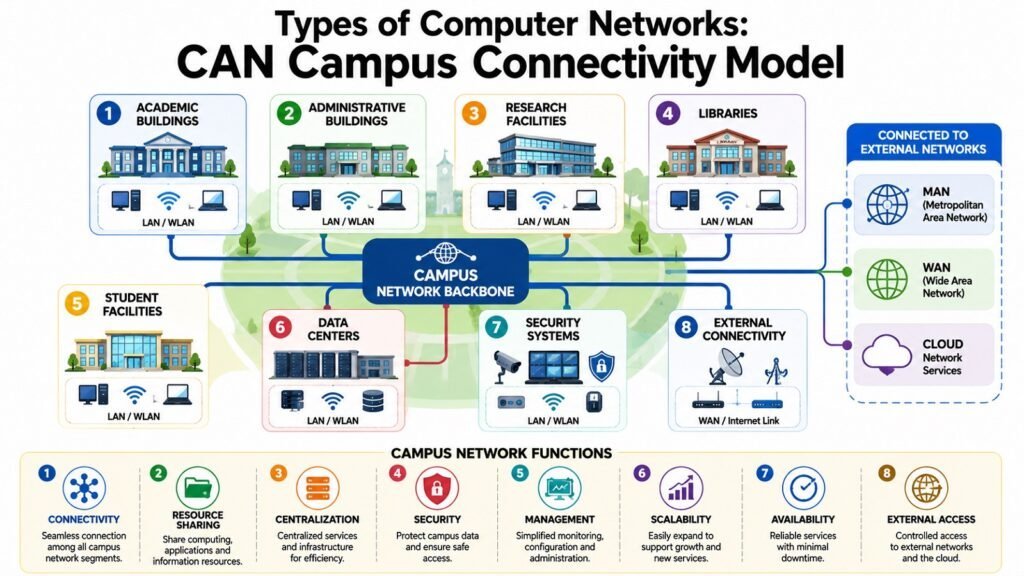
Campus Area Networks emerge when a single LAN can no longer serve an organization’s physical footprint. Universities, corporate headquarters, research facilities, hospital complexes, and industrial sites often occupy groups of buildings across a concentrated area. Each building may have its own LAN, but the organization needs these networks to function as a coordinated whole. CAN is the connectivity model that addresses this requirement within types of computer networks.
A CAN interconnects multiple LANs across buildings using high-capacity backbone links, most commonly fiber optic cabling. Routing and switching at the campus core directs inter-building traffic, connects centralized services such as authentication servers and storage systems, and enforces security policies across the combined environment. Unlike a single-building LAN, a CAN must handle inter-building routing, physical redundancy across multiple segments, and coordination among administrators overseeing different parts of the campus.
A university illustrates this model clearly. Each faculty building has its own LAN, and the campus CAN connects all buildings to a central data center, enables shared access to library and research databases, and routes internet traffic through a centralized gateway. Unlike a MAN served by an external provider, the CAN is typically owned, designed, and operated entirely by the institution itself.
Terminology and boundary definitions for CAN vary across technical sources, so no universal distance applies. The value of this category lies in recognizing that interconnecting multiple LANs across an institutional site creates distinct architectural requirements deserving their own tier in the types of computer networks framework.
Types of Computer Networks: CAN Characteristics at a Glance
| Characteristic | Detail |
| Scope | Multiple buildings across a concentrated institutional or corporate campus |
| Typical environments | Universities, corporate campuses, hospitals, research facilities, military bases |
| Backbone technology | Fiber optic cabling for inter-building backbone links |
| Ownership model | Fully owned, managed, and operated by the institution it serves |
| Key advantage | Centralized services and coordinated connectivity across a multi-building site |
| Key limitation | Higher infrastructure cost and planning complexity than a single-building LAN |
| Relationship to LAN | A CAN aggregates and interconnects multiple individual LANs within the campus |
| Relationship to MAN | CAN is within one site; MAN extends across a broader metropolitan region |
4. Types of Computer Networks: Metropolitan Area Networks (MAN)
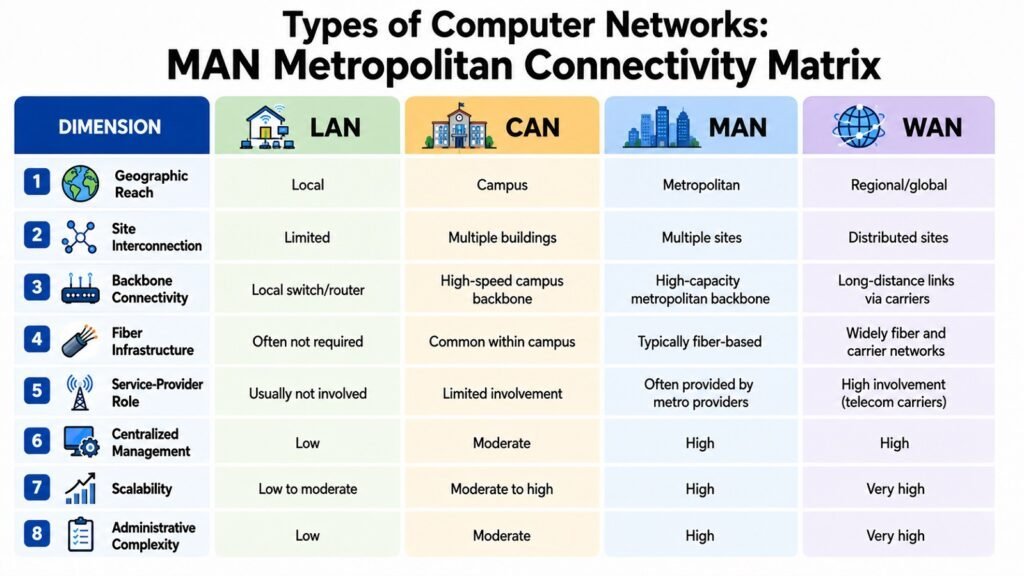
Metropolitan Area Networks address a connectivity challenge that campus and local networks cannot solve: linking multiple sites across an urban region. A city government connecting its offices, courts, fire stations, and public libraries through a shared high-capacity network is using MAN infrastructure. A university linking a downtown campus with a suburban research facility faces the same requirement.
Unlike LANs and CANs, which organizations typically own entirely, MANs often rely on service-provider infrastructure. Telecommunications companies and metro Ethernet providers operate the physical layer, and organizations lease high-capacity circuits to connect their sites. Fiber optic technology dominates MAN deployments because metropolitan distances require high bandwidth and low signal degradation. Metro Ethernet services extend familiar Ethernet standards across these distances, allowing geographically separated offices to connect using the same protocols used within their own buildings.
Trade-offs reflect the challenges of broader geographic scope. Latency is typically low by wide-area standards, often single-digit milliseconds across metropolitan distances. Reliability depends partly on the service provider’s infrastructure, requiring organizations to negotiate service-level agreements and plan for provider-side failures. Security demands careful attention because traffic may traverse networks outside the organization’s direct control.
MAN represents the point in types of computer networks where organizational control begins to share space with external infrastructure dependency. This shift carries architectural, contractual, and security implications that must be addressed before connectivity requirements expand further to WAN distances.
Types of Computer Networks: MAN Characteristics at a Glance
| Characteristic | Detail |
| Scope | Urban or metropolitan region connecting multiple sites or institutions |
| Typical provider | Telecommunications companies and metro Ethernet service providers |
| Common technology | Fiber optic links; Metro Ethernet services extending IEEE 802.3 across a city |
| Ownership model | Hybrid: provider owns physical infrastructure; organizations manage endpoints |
| Latency profile | Typically single-digit milliseconds across metropolitan distances |
| Key advantage | High-capacity city-wide connectivity without owning physical infrastructure |
| Key limitation | Dependency on provider reliability, SLA negotiations, and shared-infrastructure security |
| Relationship to WAN | MAN covers a city; WAN extends to national or global distances with greater complexity |
5. Types of Computer Networks: Wide Area Networks (WAN)
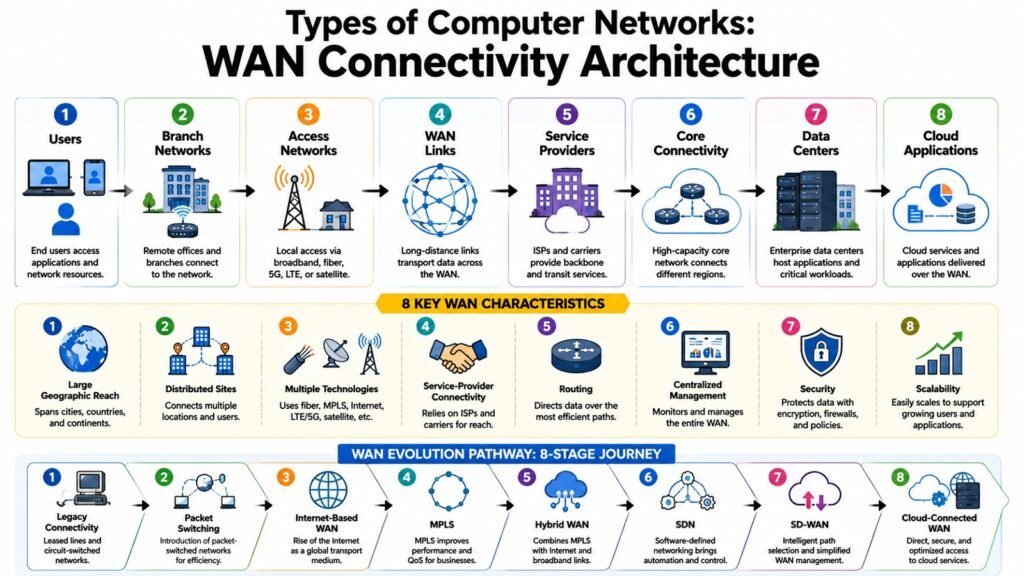
Wide Area Networks represent a turning point in the types of computer networks hierarchy, connecting locations separated by regional, national, or global distances. An enterprise with offices in New York, London, Singapore, and São Paulo cannot rely on a metropolitan provider. It needs WAN infrastructure spanning continents and routing traffic through multiple intermediate networks, often operated by different telecommunications carriers.
Geographic distribution at WAN scale introduces challenges absent from smaller network environments. Latency increases with physical distance, and an intercontinental round-trip can exceed 100 milliseconds under favorable conditions. Applications optimized for LAN-level microsecond latency may perform poorly over a WAN unless specifically engineered for delay. Reliability requires explicit architectural planning because a single link failure can isolate an entire regional office.
Security demands more attention at WAN scale because traffic frequently traverses public infrastructure or provider-managed networks outside the organization’s direct control. Encryption, VPN tunneling, and policy-based routing are standard tools for protecting data in transit. MPLS has historically been a common enterprise WAN technology offering predictable routing and quality-of-service controls, though at significant cost. More recent approaches leverage internet-based connections managed through SD-WAN solutions, enabling dynamic traffic steering across multiple link types.
WAN represents the apex of geographic connectivity within types of computer networks. Greater reach does not simply extend smaller network models; it requires rethinking latency, reliability, security, cost, and management at every layer. The evolution toward SD-WAN and cloud-connected architectures is examined in the final section.
Types of Computer Networks: WAN Characteristics at a Glance
| Characteristic | Detail |
| Scope | Regional, national, or global; connects locations across cities, countries, or continents |
| Typical technology | MPLS, leased lines, internet-based VPNs, and SD-WAN over broadband connections |
| Latency profile | Higher than LAN or MAN; intercontinental round-trips can exceed 100 milliseconds |
| Reliability approach | Redundant links, diverse routing paths, and automatic failover across multiple carriers |
| Security approach | Encryption, VPN tunneling, and policy-based routing across externally managed infrastructure |
| Ownership model | Organizations own endpoints; telecommunications providers operate physical infrastructure |
| Key operational challenge | Balancing performance, redundancy, security, and cost across distributed locations |
| Relationship to Internet | The Internet is not a WAN but provides the infrastructure many WAN solutions rely on |
6. Types of Computer Networks: Specialized Computer Networks
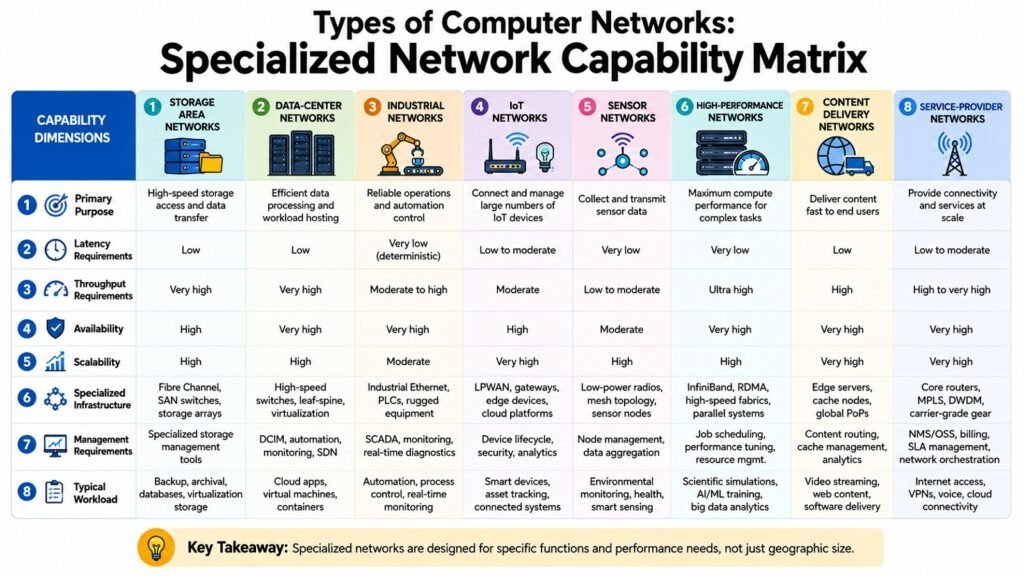
Not every network is best understood through geographic classification. Some networks exist because a particular workload or operational environment demands connectivity characteristics that a conventional LAN cannot efficiently provide. These environments constitute a category that expands the types of computer networks framework beyond geographic scope: specialized computer networks.
Storage Area Networks are the clearest example. A SAN gives multiple servers consistent, high-speed access to shared storage systems. Its traffic consists predominantly of storage I/O rather than general communication, so SAN technology prioritizes reliable block-level delivery and consistent throughput. Fibre Channel, a leading SAN protocol, operates over dedicated infrastructure separate from the general LAN precisely because mixing storage and general traffic degrades performance for both workloads.
Industrial networks represent a fundamentally different form of specialization. Manufacturing plants, utilities, and process industries use networks connecting sensors, actuators, programmable logic controllers, and supervisory systems. These environments require deterministic behavior: the network must deliver messages within guaranteed time boundaries because a delayed control signal can affect a physical process directly. Protocols such as PROFINET and EtherNet/IP address these requirements with timing standards unnecessary in standard office settings.
Data-center networks form a third category. Inside a modern data center, thousands of servers must exchange large volumes of traffic with low, consistent latency. The spine-and-leaf topology, which provides equal-length paths between any two endpoints, has become the standard architectural choice because it avoids the variable latency of traditional hierarchical designs. The key insight is that specialized networks are classified by function, not geography, and they coexist with LANs, WANs, and cloud environments as complementary alternatives.
Types of Computer Networks: Specialized Network Types at a Glance
| Specialized Network Type | Primary Purpose and Defining Characteristic |
| Storage Area Network (SAN) | High-speed, dedicated server access to shared storage; prioritizes block-level I/O over general communication |
| Data-Center Network | Low-latency server and storage interconnection using spine-and-leaf topology within a data center |
| Industrial Network (OT Network) | Connects sensors, actuators, and controllers; requires deterministic, time-bounded message delivery |
| HPC Network | Links scientific compute nodes using ultra-low-latency interconnects such as InfiniBand |
| Automotive Network (In-Vehicle) | Connects electronic control units; CAN bus and Automotive Ethernet prioritize real-time response |
| Avionics Network | Links flight control and navigation systems using standards such as ARINC 664 (AFDX) |
| Building Automation Network | Controls HVAC, lighting, and access systems using dedicated control protocols |
| Broadcast Network | Supports IP-based video production and distribution, often using SMPTE ST 2110 standards |
7. Types of Computer Networks: Virtual & Organizational Networks
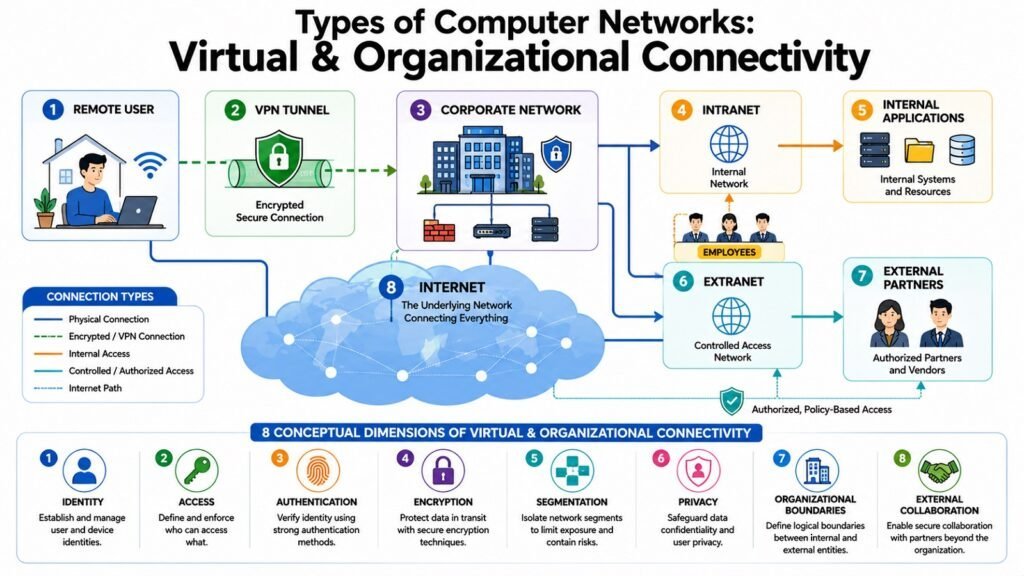
One of the most important conceptual expansions in types of computer networks is the recognition that networks can be defined by logical boundaries rather than physical location. A virtual or organizational network does not change how cables are routed or where routers are placed. It determines which users can reach which resources, how that communication is secured, and who controls access.
Virtual Private Networks illustrate this principle directly. A VPN creates an encrypted, authenticated tunnel between a user’s device and a remote network across public internet infrastructure. From the user’s perspective, the connection resembles being inside the organization’s private network, even when the user is in another country. The VPN does not alter the underlying physical infrastructure; it creates a logical layer of connectivity and security on top of it. This distinction between physical and logical networking is fundamental to modern organizational connectivity.
Intranets apply a different form of organizational boundary-setting. An intranet is a private network accessible only to members of a specific organization, using internet protocols without public access. Organizations use intranets to host internal portals, document systems, and communication tools that should not be exposed externally. Extranets extend controlled access to selected third parties: a manufacturer might grant a supplier access to its inventory system without exposing broader internal systems, using authentication, authorization, and encryption to keep the arrangement controlled.
Virtual and organizational networks operate over existing physical infrastructure rather than replacing it. Understanding how VPNs, intranets, and extranets layer on top of LANs, WANs, and cloud environments is essential for evaluating real-world architectures within the types of computer networks framework.
Types of Computer Networks: Virtual and Organizational Network Concepts at a Glance
| Network Concept | Defining Purpose and Characteristic |
| Virtual Private Network (VPN) | Encrypted, authenticated tunnel across public infrastructure to extend private network access remotely |
| Intranet | Private organizational network using internet protocols; accessible only to internal members |
| Extranet | Controlled extension of an intranet granting authenticated external parties access to specific resources |
| VLAN (Virtual LAN) | Logically segments a physical LAN into isolated broadcast domains without extra hardware |
| Zero Trust Network Access (ZTNA) | Enforces identity-based access at each request rather than granting broad access after login |
| Software-Defined Perimeter (SDP) | Creates one-to-one encrypted connections between users and specific resources, hiding infrastructure |
| Overlay Network | A logical network built on top of a physical or virtual network enabling tunneling or segmentation |
| Network Access Control (NAC) | Enforces device compliance and identity policies before granting access to organizational resources |
8. Types of Computer Networks: Modern & Cloud Networks
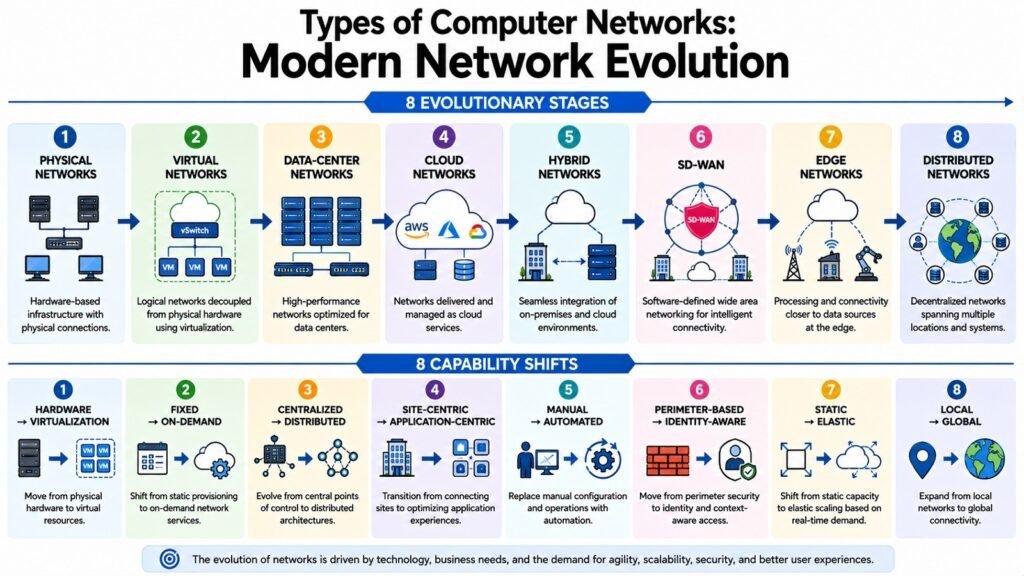
The final category in this examination of types of computer networks reflects how connectivity has evolved as computing itself has changed. Cloud computing, virtualization, software-defined infrastructure, and edge processing have collectively challenged assumptions that shaped network design for decades. Modern and cloud networks are not a single technology but a collection of approaches responding to the shift from centralized, on-premises computing toward distributed, cloud-connected environments.
Cloud networking connects users, branches, and data centers to computing resources hosted in public cloud platforms. Unlike a traditional WAN linking fixed organizational sites, cloud networking must accommodate dynamic resource allocation and traffic patterns that shift as workloads move between cloud regions. This dynamism makes static, hardware-configured routing increasingly difficult to manage at scale. SD-WAN responds by separating the control plane from the data plane, using centralized software to define routing policies across all WAN edge devices simultaneously, steering traffic across MPLS, broadband, and LTE connections based on application requirements and real-time link conditions.
Edge networking extends compute and connectivity closer to where data is generated. Manufacturing plants, retail outlets, and telecommunications networks increasingly process data at local edge sites rather than routing everything to a distant cloud, reducing latency and limiting bandwidth pressure on core networks. SASE, or Secure Access Service Edge, takes a different integration approach by combining WAN networking and security functions into a single cloud-delivered service.
Modern networks do not eliminate earlier geographic classifications. LANs still connect devices within buildings, and WANs still span geographic distances. The difference is that modern approaches integrate, virtualize, and software-define what was once rigid hardware-based infrastructure, making this evolution a defining characteristic of how types of computer networks are currently built and operated.
Types of Computer Networks: Modern and Cloud Network Characteristics at a Glance
| Characteristic or Technology | Role in Modern and Cloud Networking |
| Cloud Networking | Connects users and sites to cloud-hosted compute; requires dynamic routing and flexible access policies |
| SD-WAN | Centralizes WAN policy management; steers traffic across MPLS, broadband, and LTE based on application needs |
| Edge Computing Connectivity | Extends processing to local sites near data sources, reducing latency and core-network bandwidth pressure |
| Network Function Virtualization (NFV) | Replaces hardware appliances such as firewalls and load balancers with software on commodity servers |
| Cloud-Native Networking | Manages connectivity within and between cloud environments using virtual networks and software-defined policies |
| SASE (Secure Access Service Edge) | Combines WAN and security functions in a cloud-delivered service for distributed users and branches |
| Hybrid Connectivity | Integrates on-premises, private cloud, and public cloud through WAN, SD-WAN, and cloud networking |
| Observability and Telemetry | Uses flow data, distributed tracing, and real-time analytics to manage multi-cloud performance and security |
Conclusion — Types of Computer Networks: Building Connected Systems
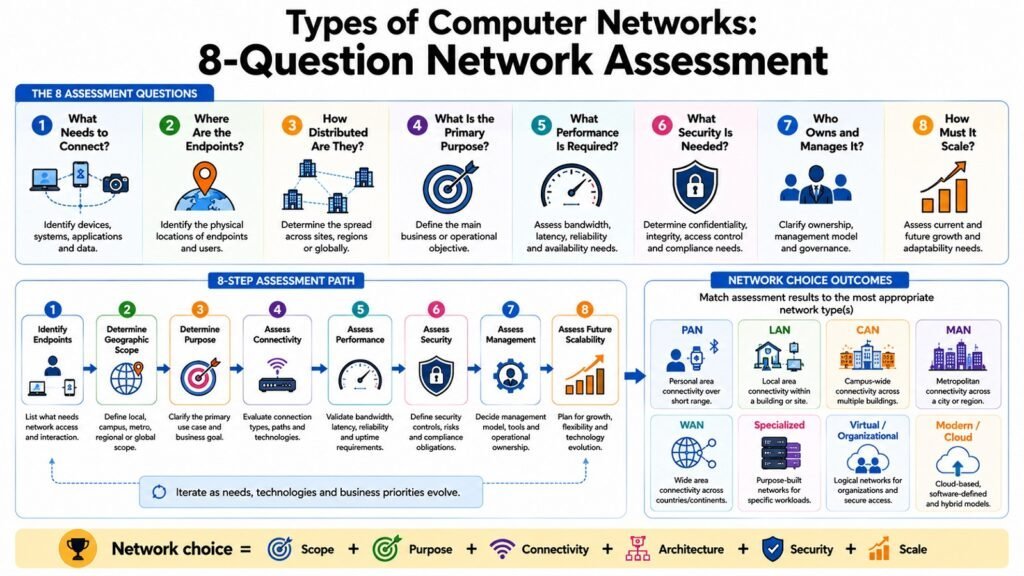
Understanding types of computer networks requires more than memorizing acronyms arranged by geographic size. It means recognizing how multiple classification dimensions- geographic scope, functional purpose, logical boundaries, organizational access, and computing architecture- each reveal something distinct about how networks are designed and why they exist.
The geographic progression from PAN through WAN reflects a real and important organizing principle, where each level introduces different requirements for ownership, latency, reliability, and cost. Specialized, virtual, organizational, and modern networks operate on entirely different dimensions. A SAN has no geographic position in the PAN-to-WAN hierarchy, and a VPN is a logical relationship rather than a physical place. Real environments combine multiple models simultaneously.
A practical mental model for evaluating any network starts with a few questions: What needs to be connected, and how far apart? What is the purpose of the connectivity? What performance, security, and reliability requirements apply? Who owns and manages the infrastructure, and how must it evolve? Working through these questions points toward the right combination of types of computer networks for any given situation.
Effective networking today depends on integrating different connectivity models rather than selecting one in isolation. A branch office connects through a LAN internally, uses a WAN link to reach headquarters, accesses a SAN for storage, connects remote workers through VPN, and routes cloud traffic through SD-WAN. Types of computer networks is a framework for thinking about how all these elements work together.
Types of Computer Networks: Key Takeaways for Building Connected Systems
| Key Takeaway | Practical Implication |
| Geographic scope is one classification dimension, not the only one | Evaluate networks by purpose, ownership, logical boundaries, and computing environment alongside size |
| PAN through WAN form a geographic hierarchy | Each level introduces distinct requirements for latency, reliability, ownership, and cost |
| CAN fills the gap between single-building LAN and metropolitan MAN | Multi-building institutional sites need a distinct architectural tier LANs and MANs do not address well |
| Specialized networks are classified by function, not geography | SAN, industrial, and data-center networks coexist with LANs and WANs based on workload requirements |
| Virtual and organizational networks define logical boundaries | VPNs, intranets, and extranets operate over existing infrastructure to control access and secure communication |
| Modern networks integrate geographic and non-geographic models | SD-WAN, cloud networking, and SASE build on LANs, WANs, and virtual networks rather than replacing them |
| Hybrid connectivity is the norm in complex organizations | Real environments combine LAN, WAN, SAN, VPN, and cloud networking in a single cohesive architecture |
| Network design should match requirements, not just taxonomy | Begin with what needs to be connected and why, then integrate the appropriate types of computer networks |