
Table of Contents
Introduction: Why Innovation Vision Is the Foundation of Business Growth
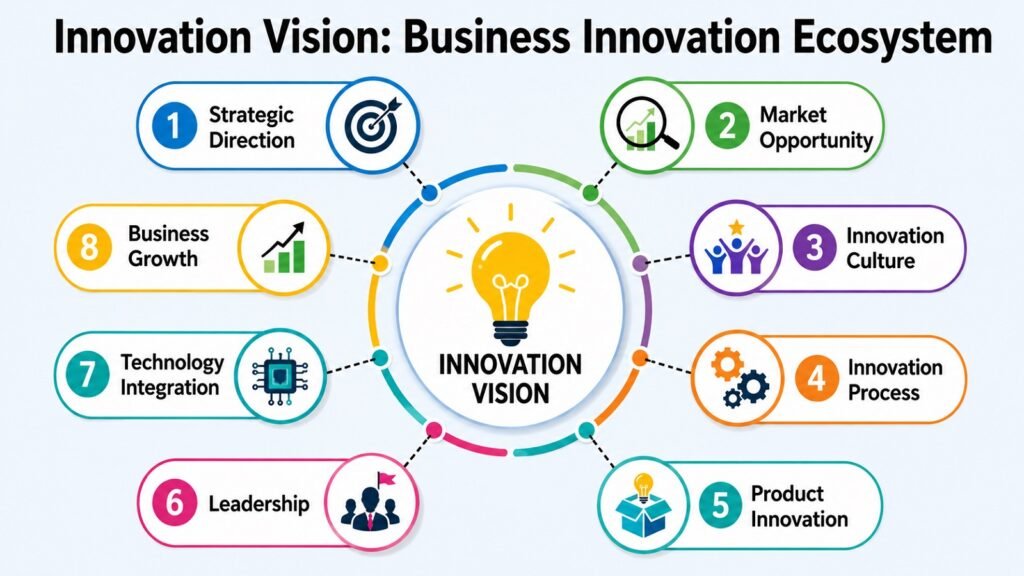
Every successful business that has established something enduring began with a distinct understanding of its destination. This sense of direction, particularly in the context of innovation, is referred to as Innovation Vision. It serves as one of the most essential foundations of a business’s Innovation Strategy, as it addresses a question that neither a roadmap nor a budget can resolve alone: what type of innovator does this organization genuinely aspire to be?
Innovation transcends merely generating new ideas or investing in technology. It involves pursuing the appropriate innovations — those that are in harmony with a clearly articulated purpose — and steering them towards a specific long-term objective. In the absence of this direction, innovation expenditures become dispersed, teams may diverge in their efforts, and resources may be utilized without yielding sustainable outcomes.
Innovation Vision sits apart from corporate vision, business strategy, and innovation strategy, though it works alongside all three. Corporate vision defines what a company wants to be in the broadest sense. Business strategy outlines how it will compete. Innovation strategy sets the approach to creating new value. Innovation Vision is the specific forward-looking commitment that tells the organization which innovations to pursue, why they matter, and how they will reshape the business over time. It gives strategy its north star.
Organizations with a well-defined Innovation Vision align leadership decisions, concentrate resources on high-impact efforts, attract innovation talent, and build a competitive advantage that endures. This article is a research-based guide combining academic theory, management frameworks, and real business experience. It covers what Innovation Vision is, why it matters, how leading companies develop it, what causes it to fail, and how it is evolving in a world reshaped by artificial intelligence and digital disruption. Eight principles — each explored in depth — carry the argument forward.
Table 1: Innovation Vision — Eight Principles at a Glance
| Principle | Contribution |
| Strategic Foundation | Defines what innovation means for the specific business and why it matters |
| Long-Term Business Value | Connects innovation efforts to sustainable competitive advantage |
| Core Elements | Identifies the building blocks that make Innovation Vision coherent and durable |
| Strategic Alignment | Ensures innovation efforts support the broader business direction |
| Leadership and Culture | Embeds Innovation Vision into daily behavior and organizational mindset |
| Creating and Communicating | Translates Innovation Vision from concept into organizational commitment |
| Common Challenges | Reveals why Innovation Vision fails and how businesses can respond effectively |
| Future Trends | Shows how Innovation Vision must adapt in the era of AI and digital transformation |
1. What Is Innovation Vision? Understanding the Strategic Foundation
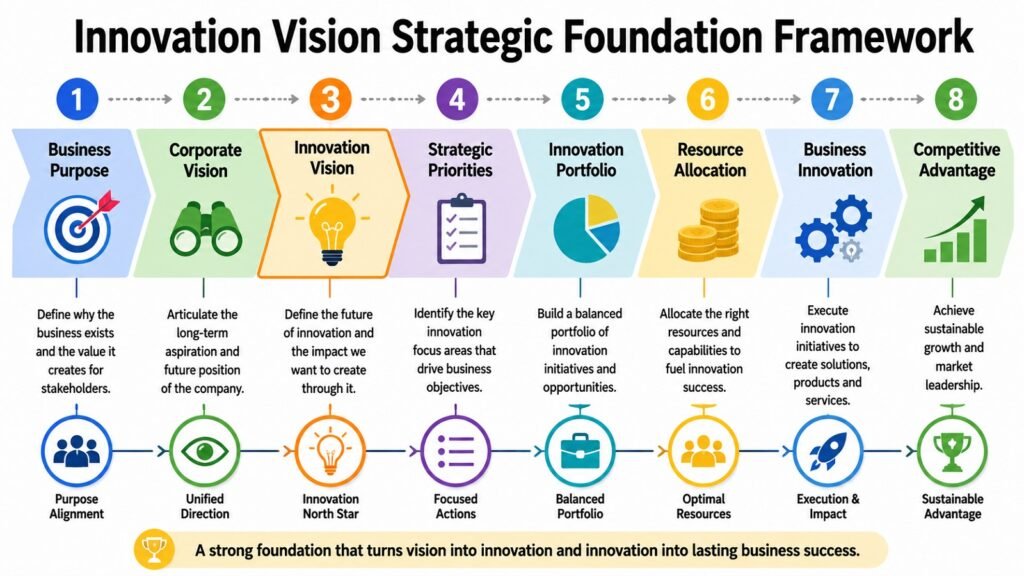
Innovation Vision is the long-term statement of intent that defines what kind of innovations a business will pursue, what purpose those innovations will serve, and where the organization expects to arrive as a result of sustained innovation over time. It operates at the intersection of ambition and strategy, giving innovation decisions a stable reference point even as markets shift and leadership teams change.
Academic literature in innovation management has treated vision as a central driver of innovation behavior since the early 1990s. Gary Hamel and C.K. Prahalad argued that organizations need a compelling future-oriented aspiration that stretches capabilities well beyond their current state. Innovation Vision applies that thinking to the innovation domain specifically — it tells people not just where the company is going, but where it is going through innovation.
It is important not to mistake Innovation Vision with similar concepts. Innovation pertains to the creation and implementation of new ideas and processes. Corporate vision outlines the overall identity of the organization. Innovation strategy constitutes the operational framework for allocating innovation resources. Innovation Vision acts as the guiding anchor that ensures the strategy is coherent — it addresses the questions of what and why prior to the strategy determining how.
Apple under Steve Jobs offers a well-documented example of Innovation Vision at work. Jobs described Apple’s ambition not as building better computers but as standing at the intersection of technology and the liberal arts — a statement that shaped every product decision across hardware, software, and retail for decades. IKEA offers an equally consistent example: its Innovation Vision of making well-designed furniture accessible to ordinary families has guided manufacturing, supply chain, and packaging innovation in remarkably disciplined ways over more than seventy years.
The practical lesson is clear: organizations that define their Innovation Vision give innovation efforts real coherence. Those that omit it tend to innovate reactively, chasing trends rather than building toward something with lasting strategic meaning.
Table 2: Eight Defining Characteristics of Innovation Vision
| Characteristic | Practical Implications |
| Future-Oriented | Describes a desired innovation state beyond the current business position |
| Strategic in Scope | Covers the entire innovation portfolio rather than individual projects |
| Purpose-Driven | Connects innovation goals to customer value and business meaning |
| Directional | Guides decisions about what to pursue and what to avoid in innovation |
| Durable | Remains stable enough to guide multi-year decisions and investments |
| Communicable | Can be clearly expressed to leadership, teams, partners, and stakeholders |
| Ambitious but Achievable | Stretches organizational capability without losing touch with reality |
| Aligned | Consistent with corporate mission, strategy, and competitive positioning |
2. Why Innovation Vision Drives Long-Term Business Success
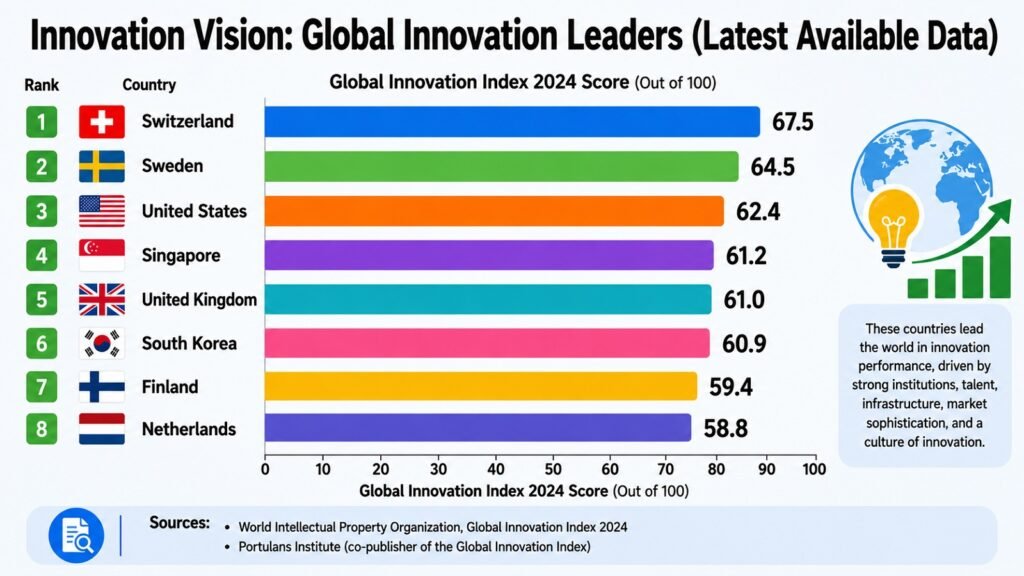
A business with a clear Innovation Vision knows not only what it wants to build but why it matters and how it connects to long-term competitive strength. That clarity ripples through every organizational layer — from how executives allocate capital to how engineers prioritize their work.
Strategic focus is the most direct benefit. When leadership agrees on an innovation direction, the organization concentrates resources rather than spreading them across unrelated bets. McKinsey research has found that companies with clear strategic innovation priorities earn returns on innovation investment that significantly outpace those treating it as an open-ended experiment. The mechanism is simple: when everyone understands the target, fewer resources get wasted on efforts that will never serve it.
Resource allocation sharpens because Innovation Vision creates a prioritization framework. Without it, investment decisions tend to follow the most persuasive argument in any given budget cycle. With it, proposals are measured against a shared question: does this support what we are building through innovation? That shift — from political to strategic allocation — frequently changes organizations in lasting ways.
Customer value deepens when the innovation direction is clear. Amazon’s innovation vision of making purchasing and delivery effortless has guided decades of investment in logistics, cloud infrastructure, and recommendation technology in ways that reinforce the customer relationship rather than diluting it. Employee engagement also rises. A 2023 Gallup analysis found that employees who see a clear connection between their work and organizational strategy are significantly more engaged and far less likely to leave.
Samsung’s persistent Innovation Vision of combining manufacturing scale with consumer electronics ambition has allowed it to compete across categories — from semiconductors to smartphones — that few rivals can span. The vision did not guarantee every product success, but it provided a durable competitive platform through multiple industry disruptions.
The business lesson is that Innovation Vision functions like a strategic filter. Organizations that have it move faster, waste less, and build more coherently toward a future that makes genuine competitive sense.
Table 3: Business Benefits of Innovation Vision and Their Organizational Impact
| Business Benefit | Organizational Impact |
| Strategic Focus | Reduces innovation waste by concentrating effort on aligned opportunities |
| Better Resource Allocation | Shifts investment decisions from political to evidence-based criteria |
| Customer Value Creation | Produces more coherent product and service portfolios over time |
| Employee Engagement | Connects individual work to a meaningful innovation purpose |
| Competitive Differentiation | Builds a strategic identity that rivals find difficult to copy quickly |
| Resilience | Helps organizations maintain direction through market disruption and change |
| Innovation Investment Quality | Raises the average impact of innovation spending over multiple cycles |
| Leadership Alignment | Gives executive teams a shared framework for strategic decisions |
3. Core Elements of an Effective Innovation Vision
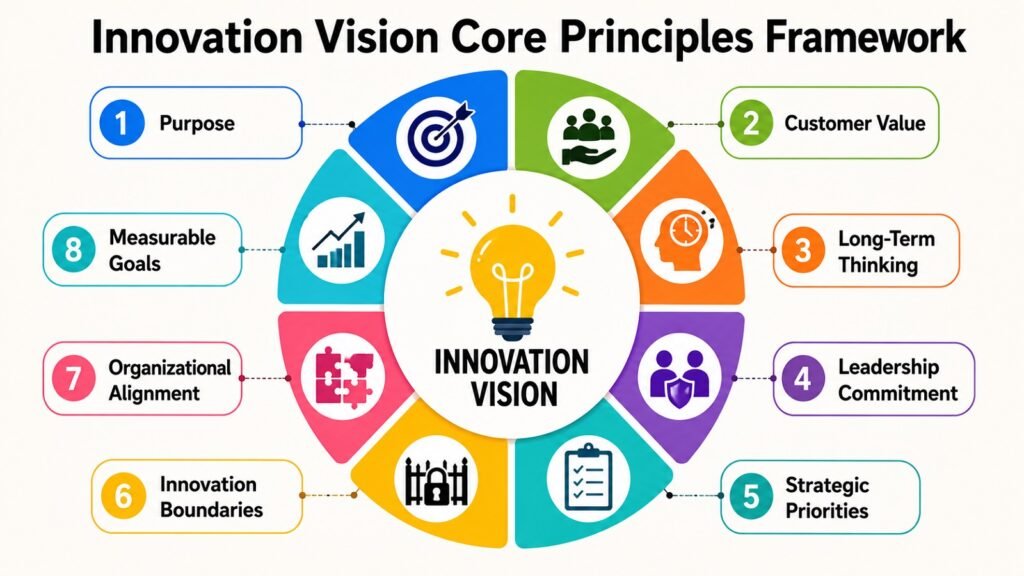
Not every statement about innovation qualifies as an effective Innovation Vision. Many organizations produce aspirational language that sounds compelling in a presentation but provides little guidance when difficult decisions arrive. What separates a functional Innovation Vision from an empty declaration is the presence of specific, interlocking elements that give it both meaning and operational usefulness.
Purpose sits at the center. It answers why the organization innovates — not for growth alone, which is too generic to guide decisions, but for a specific kind of value the business is uniquely positioned to create. Patagonia’s innovation purpose is anchored in environmental stewardship. Every product decision is filtered through that purpose rather than market trends alone, which gives its innovation program unusual consistency over time.
Long-term ambition gives the vision its reach. Research from Deloitte on high-performing innovators consistently finds that top companies define innovation ambitions extending five to ten years forward — horizons that are meaningful enough to guide serious capability-building rather than short-cycle feature additions.
Strategic priorities and innovation boundaries work together. Priorities tell the organization where to concentrate effort within the broader ambition. Boundaries clarify what the business will not pursue — an underappreciated discipline that paradoxically creates the focus necessary for real depth and excellence. Leadership commitment transforms vision from aspiration into organizational expectation. Boston Consulting Group research has shown that CEO-level engagement in innovation is one of the most reliable predictors of innovation program success, because it signals to the entire organization that the direction is a genuine strategic priority rather than a management exercise.
Measurable objectives give the vision accountability by creating milestones against which progress can be honestly assessed. Together, all these elements — aligned with the organization’s broader strategy — produce an Innovation Vision that guides decisions rather than decorating conference rooms.
Table 4: Core Elements of Innovation Vision and Their Contributions
| Core Element | Contribution |
| Purpose | Explains why the organization innovates and what value it seeks to create |
| Long-Term Ambition | Establishes a meaningful future state that stretches current capabilities |
| Strategic Priorities | Defines where innovation effort and investment should concentrate |
| Innovation Boundaries | Clarifies what the organization will not pursue, reducing strategic drift |
| Leadership Commitment | Converts the vision from aspiration to organizational expectation |
| Measurable Objectives | Provides milestones that allow honest tracking of innovation progress |
| Customer Focus | Anchors innovation ambition in the creation of real and lasting customer value |
| Organizational Alignment | Connects Innovation Vision to strategy, culture, and operational decisions |
4. Aligning Innovation Vision with Business Strategy
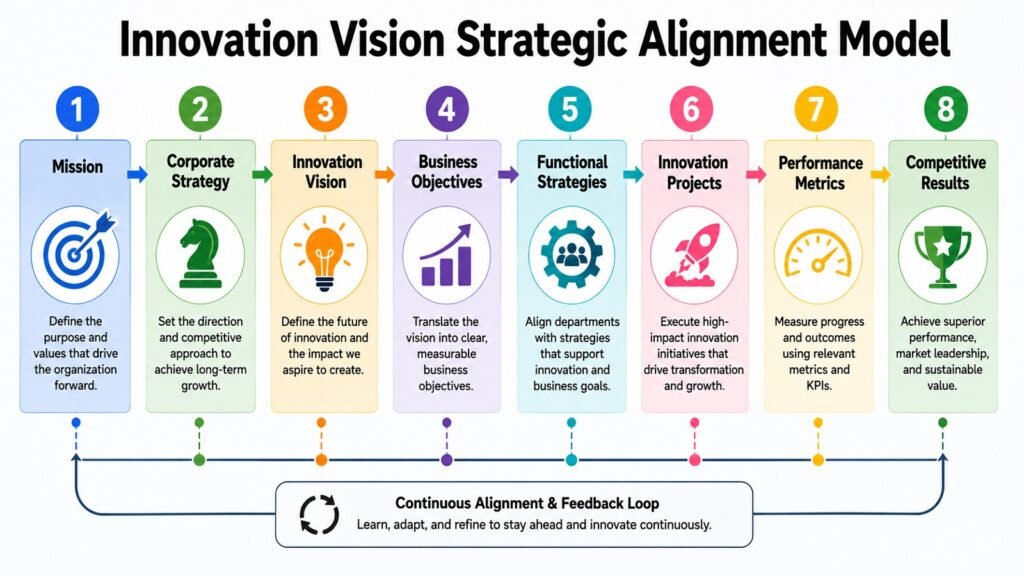
Innovation Vision does not exist in isolation. Its value depends on how tightly it connects with the business’s overall strategic architecture — mission, competitive positioning, customer strategy, financial priorities, and operational capability. When Innovation Vision and business strategy reinforce one another, innovation efforts compound over time. When they drift apart, even well-funded innovation programs produce results that the rest of the organization cannot build upon.
The relationship between Innovation Vision and mission is foundational. Mission describes the enduring purpose of the business. Innovation Vision should draw directly from that mission and translate it into a specific innovation direction rather than treating it as background. When the connection is visible, employees understand how innovation relates to everything the business does and why it matters.
Competitive strategy also shapes Innovation Vision in concrete ways. A business competing on cost leadership needs a different Innovation Vision than one competing on differentiation or customer intimacy. A discount retailer pursuing luxury product innovation is misaligning its innovation ambition with its strategic identity — an error that rarely ends well.
Portfolio decisions express alignment in the most direct way. Research from the Doblin Group found that companies balancing incremental improvements, adjacent expansions, and transformational bets consistently outperform those focused on any single horizon. Innovation Vision provides the basis for that balance by making explicit what the organization is building toward and over what time frame.
Cross-functional coordination improves dramatically when a shared Innovation Vision exists. Product development, marketing, operations, and finance pursue conflicting priorities when no unifying innovation direction is present. The measure of genuine alignment is whether teams cite Innovation Vision in resource decisions rather than only in board presentations. Strategy lives in meetings and budgets, not in documents.
Table 5: Strategic Alignment Factors and Their Contribution to Innovation Vision
| Alignment Factor | Contribution |
| Mission Connection | Grounds Innovation Vision in the enduring purpose of the business |
| Competitive Strategy | Ensures innovation ambition reflects the chosen competitive approach |
| Customer Strategy | Aligns innovation direction with the specific value promised to customers |
| Portfolio Balance | Distributes innovation investment across incremental and transformational horizons |
| Resource Allocation | Directs financial and human capital toward the highest-priority innovation areas |
| Cross-Functional Coordination | Reduces internal friction by providing a shared innovation reference point |
| Performance Metrics | Measures innovation outcomes in ways consistent with strategic priorities |
| Governance Structures | Embeds Innovation Vision into decision-making processes rather than documents |
5. Innovation Vision Through Leadership and Organizational Culture
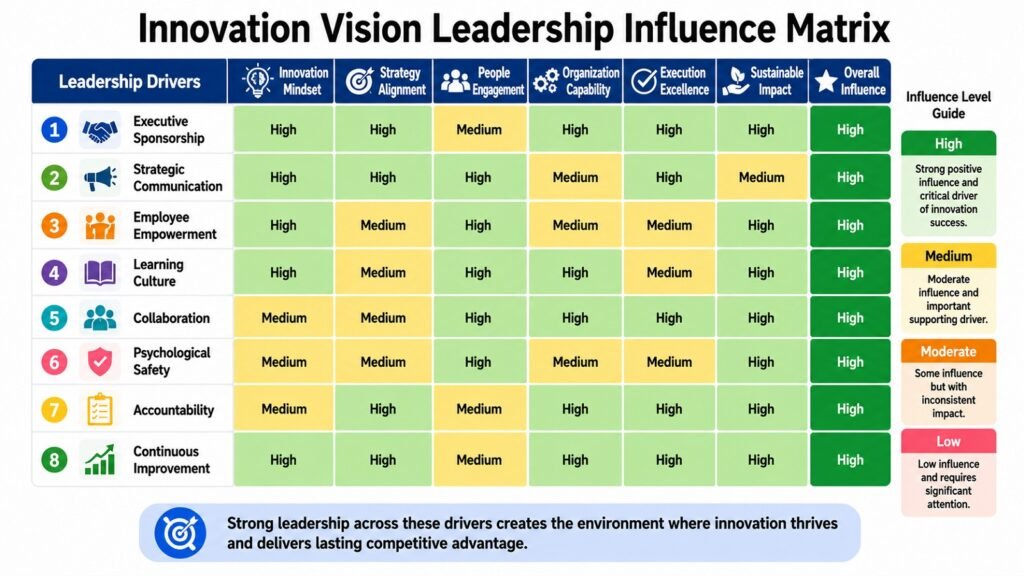
Innovation Vision is created in strategy sessions, but it lives or dies in the daily behavior of people across the organization. Leadership and culture are the transmission mechanisms that carry Innovation Vision from the executive level through every team and department. Without them, even the most carefully crafted vision remains a document rather than a force.
Executive commitment is where it begins. Leaders who discuss Innovation Vision consistently — in budget cycles, hiring decisions, and public communications — signal that the vision is a genuine priority rather than a seasonal theme. Google’s leadership has articulated for decades a vision of organizing the world’s information to make it universally accessible and useful, reinforcing it through research investments, product launches, and acquisitions over a remarkably long arc.
Communication is equally important. Research from the Center for Creative Leadership has found that employees engage most deeply with organizational vision when it is conveyed through specific stories and concrete examples rather than abstract strategic language. Leaders who can make Innovation Vision feel directly relevant to someone in product design, supply chain, or customer service embed it far more effectively than those who confine it to executive forums.
Psychological safety is a cultural prerequisite that deserves specific attention. Amy Edmondson’s research at Harvard Business School has demonstrated consistently that teams in psychologically safe environments are significantly more likely to surface new ideas, challenge existing assumptions, and experiment — all behaviors that Innovation Vision depends upon. Organizations where failure is penalized tend toward incremental improvements regardless of how ambitious their stated vision may be.
Collaboration structures matter more than most organizations acknowledge. Innovation Vision that spans multiple departments requires deliberate coordination — cross-functional innovation councils, shared development platforms, and joint accountability for innovation outcomes. Culture follows systems, and systems are built by leadership choices.
Table 6: Leadership and Cultural Practices That Strengthen Innovation Vision
| Practice | Influence |
| Executive Visibility | Signals that Innovation Vision is a genuine leadership priority |
| Clear Communication | Makes the vision relevant and tangible at all organizational levels |
| Psychological Safety | Creates the conditions for experimentation and honest idea-sharing |
| Learning Culture | Converts innovation experience into compounding organizational capability |
| Cross-Functional Collaboration | Prevents siloing that fragments innovation effort across the business |
| Innovation Governance | Embeds vision into decision-making and resource allocation processes |
| Recognition Systems | Rewards behaviors that advance Innovation Vision rather than safe choices only |
| Talent Development | Builds the innovation skills the organization needs to pursue its vision |
6. Creating and Communicating an Innovation Vision
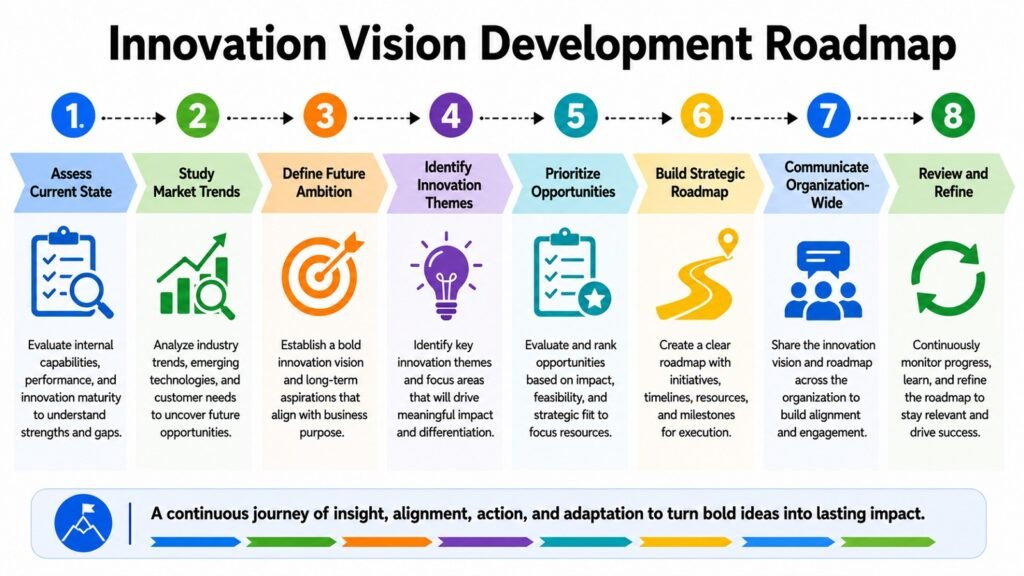
Creating an Innovation Vision is a deliberate strategic process, not a creative exercise completed in an offsite brainstorm. Organizations that produce enduring Innovation Vision move through a structured sequence of thinking — combining honest assessment of current capabilities, clear evaluation of future opportunity, and disciplined choices about where to concentrate innovation energy.
The process begins with strategic assessment. Before defining a direction, leadership needs an honest picture of where the organization currently stands — what innovation capabilities exist, how the competitive landscape is shifting, how customer needs are changing, and what distinctive strengths the business actually possesses. This assessment phase is frequently underinvested, with teams rushing to define aspirations before honestly appraising their starting position.
Opportunity mapping follows. This stage identifies the spaces where innovation could generate the greatest strategic value — not merely where ideas are easiest to generate. Scenario planning, market intelligence, customer research, and technology foresight all contribute. The 3M innovation vision — applying its materials science expertise to solve real problems across diverse industries — illustrates a well-mapped innovation direction: specific enough to filter decisions but open enough to allow genuine exploration across many domains.
Establishing strategic priorities within the vision gives it operational weight. The vision must communicate not only direction but also sequence — which capabilities to build first, which markets or customer segments to address early, and which investments unlock subsequent options. Communication is the step that most organizations underestimate. Research from Prosci’s change management studies has found that organizations typically under-communicate major strategic changes by a factor of ten or more. Effective Innovation Vision communication requires multiple channels, consistent reinforcement, and genuine leadership engagement rather than a single all-hands announcement.
Continuous refinement closes the loop. Innovation Vision should be a living strategic document reviewed on a regular cycle — typically annually — to remain relevant without losing the directional consistency that makes it valuable in the first place.
Table 7: Stages of Developing Innovation Vision and Their Objectives
| Development Stage | Key Objective |
| Strategic Assessment | Establish an honest baseline of current innovation capabilities and competitive position |
| Opportunity Mapping | Identify innovation domains with the greatest potential strategic value |
| Ambition Definition | Translate opportunity analysis into a clear directional innovation statement |
| Priority Setting | Determine which innovation areas deserve the earliest and deepest investment |
| Stakeholder Input | Incorporate cross-functional and customer perspectives into the vision design |
| Communication Planning | Define how Innovation Vision will be conveyed across leadership levels and teams |
| Launch and Embedding | Integrate the vision into governance, incentives, and decision-making processes |
| Continuous Refinement | Review and update Innovation Vision as market and competitive conditions evolve |
7. Common Challenges and Mistakes in Innovation Vision
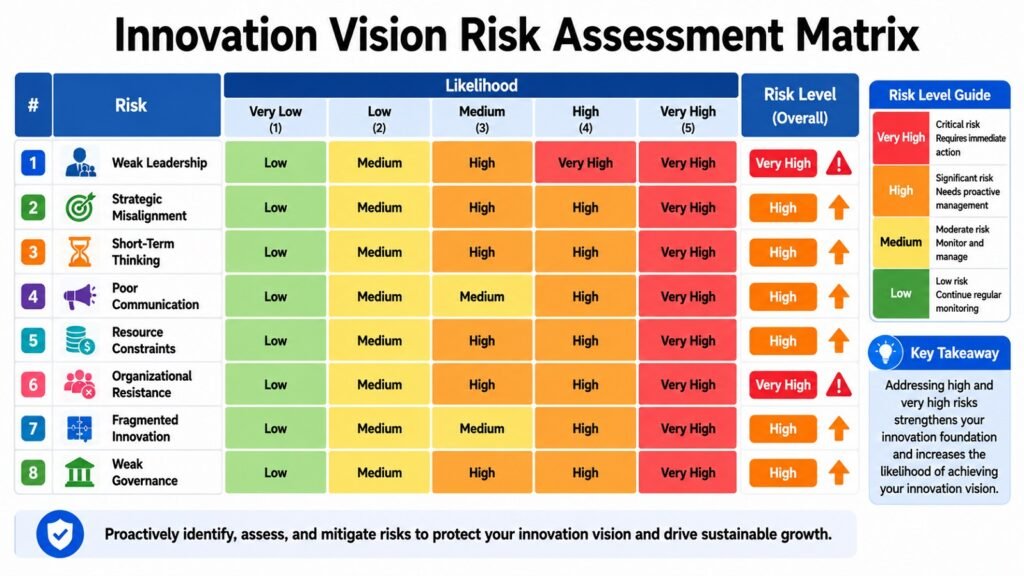
Despite good intentions and significant investment, Innovation Vision frequently fails to produce the results it was designed to achieve. The reasons are rarely mysterious, though they are often uncomfortable to acknowledge. Understanding why Innovation Vision breaks down is as important as understanding how to develop it well.
Weak leadership commitment is the most common underlying cause. When senior leaders endorse an Innovation Vision publicly but allow contradictory decisions in private — funding projects that contradict stated priorities, rewarding short-term results at the expense of long-term innovation goals, or cutting innovation budgets under pressure — the vision loses credibility quickly. Employees watch what leaders do far more carefully than what they say.
Poor communication is a closely related failure. Research from Kotter International has found that organizations typically under-communicate major strategic changes by a factor of ten or more, meaning the vision never truly reaches the people who need to act on it. A single announcement and an intranet page do not constitute a communication strategy for something as directional as Innovation Vision.
Fragmented innovation initiatives represent another common pattern. Organizations that run too many separate innovation projects — each justified by its own logic rather than connected to a shared vision — dilute the resources and attention that any one effort needs to succeed at meaningful scale. This fragmentation grows gradually, as individual teams pursue their own innovation agendas in the absence of a coordinated organizational direction.
General Electric’s struggles with innovation consistency over the last two decades illustrate how short-term financial pressure can erode long-term innovation direction even in organizations with historically strong capabilities. Innovation Vision is inherently long-term, but quarterly earnings pressure and internal incentive systems regularly create tension that resolves in favor of the short term — and the vision quietly retreats. The practical response is to treat these challenges as design problems. Organizations that build deliberate systems for sustaining leadership commitment, maintaining communication, and protecting long-term investment are far more likely to see Innovation Vision produce lasting results.
Table 8: Common Innovation Vision Challenges and Practical Business Responses
| Challenge | Practical Response |
| Weak Leadership Commitment | Embed Innovation Vision into leadership KPIs and decision-making criteria |
| Poor Communication | Use multiple channels, repeated messaging, and concrete storytelling |
| Fragmented Initiatives | Consolidate innovation portfolios around shared vision priorities |
| Short-Term Financial Pressure | Ring-fence core innovation budgets and protect them from quarterly cuts |
| Organizational Resistance | Engage resistors early, listen for valid concerns, and address root causes |
| Unclear Strategic Priorities | Define specific innovation domains and communicate what is out of scope |
| Misaligned Incentives | Align reward systems with long-term innovation behaviors and outcomes |
| Inconsistent Execution | Create governance structures that review innovation progress against vision regularly |
8. The Future of Innovation Vision in the AI and Digital Era
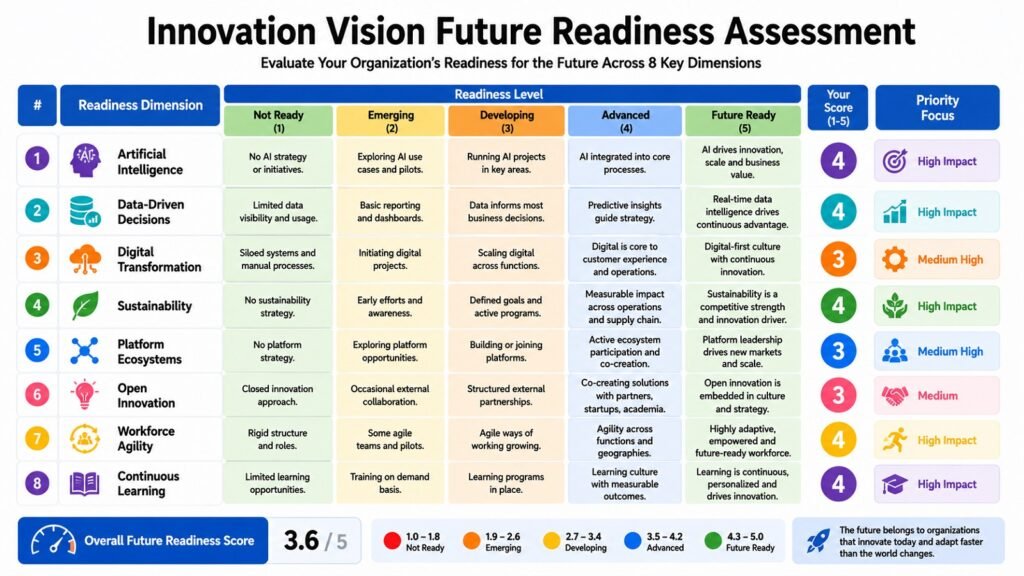
The environment in which Innovation Vision operates is changing faster than at any previous point in business history. Artificial intelligence, digital platform ecosystems, sustainability pressures, data-driven decision-making, and shifting customer expectations are not simply new topics for innovation teams to address. They are reshaping what Innovation Vision needs to contain, how it is developed, and how frequently it must be updated to stay strategically relevant.
Artificial intelligence is the most disruptive force. AI changes the economics of ideation, experimentation, and product development in ways that compress innovation cycles and reduce barriers to entry across many industries. A 2024 report from the McKinsey Global Institute estimated that generative AI could add between two and four trillion dollars in annual value across industries, with product innovation among the highest-impact domains. For Innovation Vision, this means organizations must now explicitly address how AI capabilities fit their stated innovation direction — not as an add-on but as a structural consideration.
Digital platform ecosystems are redefining innovation boundaries. Companies increasingly innovate within interconnected networks of partners, developers, and customers who co-create value on shared platforms. Salesforce, Apple, and Amazon Web Services each exemplify this model. Innovation Vision that is defined purely internally — without accounting for ecosystem relationships — risks missing the most significant opportunities available.
Sustainability is becoming a non-negotiable dimension of Innovation Vision rather than an optional consideration. The Ellen MacArthur Foundation’s research on circular economy innovation suggests that organizations embedding sustainability into their Innovation Vision — rather than treating it as a compliance requirement — tend to identify more durable business models and more resilient supply chains. Data-driven adaptation is also changing how Innovation Vision evolves. Organizations with strong data capabilities can now track innovation performance with far greater precision and update their strategic direction based on evidence rather than intuition alone.
The implication for business leaders is that Innovation Vision in the AI and digital era must function as an adaptive capability rather than a fixed declaration. Organizations that can update their innovation direction in response to emerging opportunities — while maintaining the underlying purpose that gives innovation its meaning — will be best positioned to build enduring competitive advantage in conditions that continue to accelerate.
Table 9: Future Trends and Their Expected Influence on Innovation Vision
| Future Trend | Expected Influence |
| Generative AI | Compresses innovation cycles and requires vision to address AI integration explicitly |
| Platform Ecosystems | Expands innovation boundaries beyond the firm to include partner and developer networks |
| Sustainability Imperative | Makes environmental and social goals a core dimension of innovation direction |
| Data-Driven Adaptation | Enables more frequent and evidence-based updates to Innovation Vision |
| Open Innovation | Requires vision to account for external knowledge sources and co-creation models |
| Customer Expectation Shifts | Demands that innovation direction track evolving customer value priorities closely |
| Global Competition | Raises the strategic stakes of innovation direction in emerging and developed markets |
| Digital Talent Scarcity | Forces organizations to build Innovation Vision around talent attraction and retention |
Conclusion: Turning Innovation Vision into Lasting Business Advantage
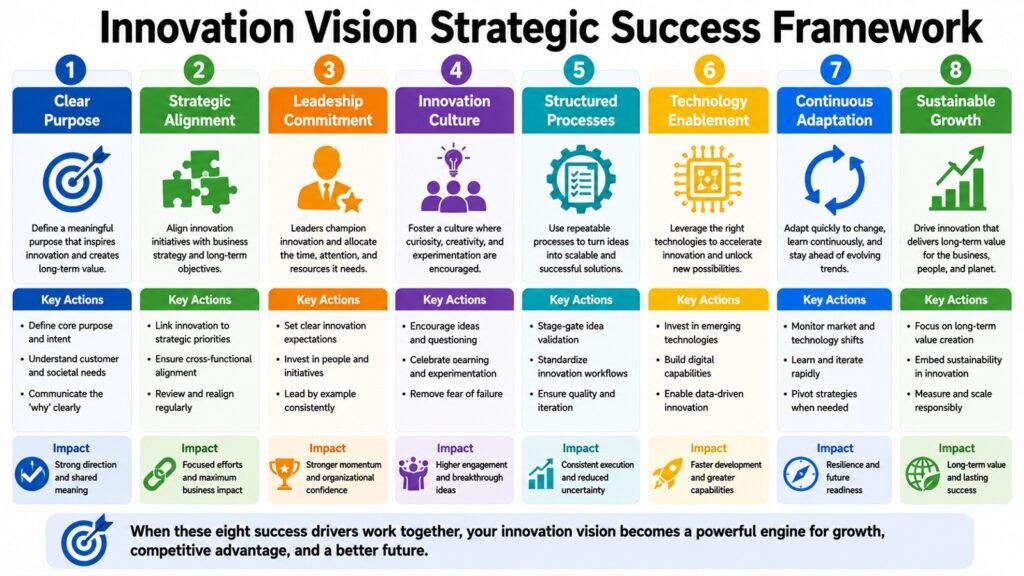
The eight principles explored in this article trace a single consistent argument: Innovation Vision is not a luxury or peripheral concern. It is a fundamental component of how organizations build and renew competitive advantage through innovation over time. Without a clear innovation direction, even well-resourced businesses tend to produce activity that consumes capital without creating lasting strategic value.
Each principle adds a layer to that argument. Innovation Vision begins with a clear strategic definition that distinguishes it from adjacent concepts and anchors it in business purpose. It drives long-term success by improving focus and resource quality. It depends on specific core elements — purpose, ambition, priorities, and accountability — that give it substance rather than rhetorical appeal. It must align with business strategy to produce coherent organizational behavior, require leadership and cultural reinforcement to move from concept into practice, and demand structured development paired with genuine communication investment. It fails predictably when common challenges go unaddressed. And it must evolve as AI, platforms, and sustainability reshape every industry.
The most important insight across all eight principles is this: Innovation Vision is not something a business defines once and revisits only when performance disappoints. It is a living strategic capability that requires regular review and deliberate refinement as the world changes. Organizations that treat it that way — as an enduring guide rather than a periodic exercise — consistently make better innovation decisions, waste fewer resources, and build competitive identity that rivals find genuinely difficult to replicate.
Table 10: Eight Principles of Innovation Vision — Key Takeaways
| Principle | Primary Takeaway |
| Strategic Foundation | Innovation Vision defines what kind of innovator a business is committed to becoming |
| Long-Term Business Success | Clear innovation direction improves focus, resource quality, and competitive resilience |
| Core Elements | Effective vision requires purpose, ambition, priorities, and measurable accountability |
| Strategic Alignment | Innovation Vision must connect with mission, strategy, and operational decision-making |
| Leadership and Culture | Vision lives in daily behavior and requires systems that reinforce it continuously |
| Creating and Communicating | Structured development and consistent communication are both essential to vision impact |
| Common Challenges | Most vision failures stem from predictable problems that deliberate design can prevent |
| Future Trends | Innovation Vision must evolve as AI, platforms, and sustainability reshape every industry |