
Table of Contents
Introduction — Network Security: The Foundation of Cyber Defense
Networks once operated within relatively contained boundaries. Organizations controlled a defined perimeter — data centers, campus networks, managed devices — and security meant monitoring what crossed that edge. That model is no longer adequate. Today, organizational networks extend into public cloud infrastructure, remote work environments, third-party integrations, connected devices, and distributed services that no single team fully controls. The network is now a relationship between entities communicating across environments spanning multiple administrative domains.
This transformation explains why Network Security, an important aspect of overall Cybersecurity, cannot rely solely on perimeter defenses. It must address how networks are designed, how connectivity is controlled, how internal movement is constrained, how communications are protected in transit, and how organizations detect threats, respond to incidents, and recover from disruption. IBM’s Cost of a Data Breach research consistently finds that faster detection and containment directly reduce the operational and financial damage of security incidents. Those capabilities arise from a mature, integrated Network Security program rather than from any individual tool.
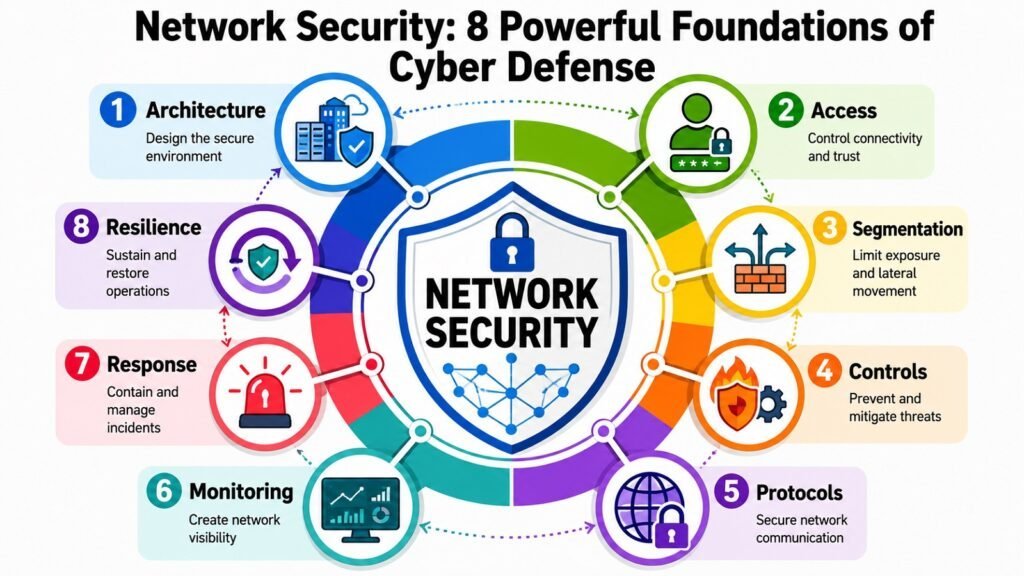
Effective Network Security is not a collection of separate technologies but a coordinated system of principles, architectures, controls, practices, and capabilities that work together as a unified whole. This article examines eight foundations that together constitute that system: Architecture, Access, Segmentation, Controls, Protocols, Monitoring, Response, and Resilience. Each foundation addresses a distinct security function, and each depends on and reinforces the others. An organization that excels in one area while neglecting another creates exploitable gaps — and sophisticated attackers are adept at finding them. Understanding how the eight foundations interact is therefore as important as understanding what each one does in isolation.
Network Security: Eight Foundations and Their Role in Cyber Defense
| Network Security Foundations | Role in Network Security |
| Architecture | Structures security zones and trust boundaries |
| Access | Controls who connects and under what conditions |
| Segmentation | Limits lateral movement after a breach occurs |
| Controls | Filters and blocks malicious network activity |
| Protocols | Protects communications through encryption and authentication |
| Monitoring | Creates visibility to detect threats and anomalies |
| Response | Enables containment, investigation, and remediation |
| Resilience | Sustains operations when preventive controls fail |
1. Network Security Architecture: Designing a Secure Network
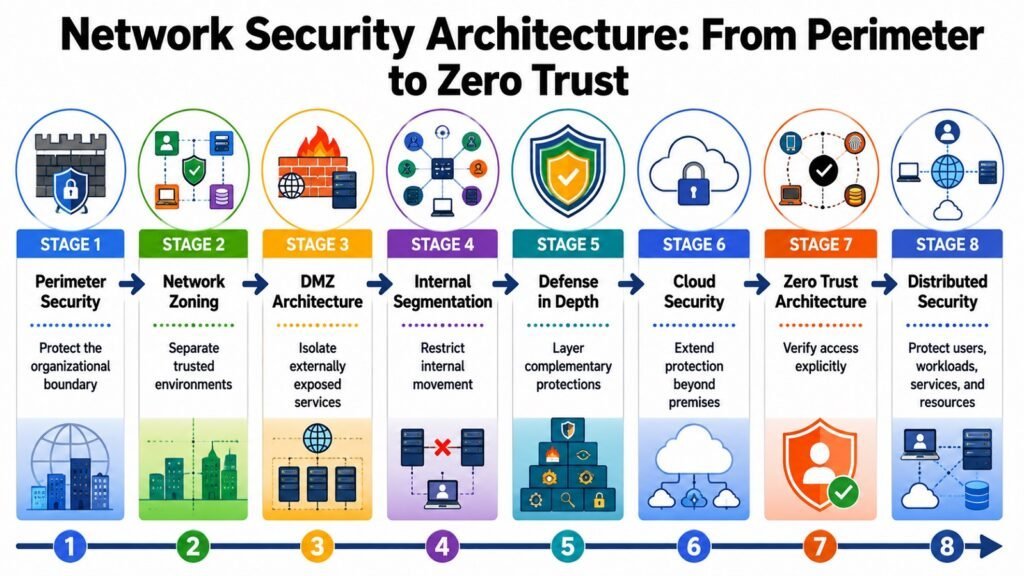
Network Security Architecture is the structural foundation on which every other security measure depends. Before a firewall is configured or an access policy written, the underlying architecture has already determined where trust boundaries sit, what systems can reach what, and how far a compromise can travel. Architectural decisions shape attack surfaces, influence traffic flows, determine containment possibilities, and define what visibility is available to security teams. Getting those decisions right at the design stage is consistently more effective than attempting to retrofit security onto a network not built to support it.
A well-designed architecture divides the environment into meaningful security zones. A demilitarized zone isolates public-facing services from internal systems. Internal segmentation separates sensitive workloads, administrative environments, and critical infrastructure from general user traffic. Hybrid and multi-cloud environments require equal architectural discipline because workloads distributed across different administrative domains need explicitly defined traffic paths, access controls, and inspection points. NIST Special Publication 800-207 on Zero Trust Architecture formalizes a principle that modern network design must respect: network location alone is not a sufficient basis for trust. Every access decision must be grounded in verified identity and context rather than assumed safe because of where a device resides.
The 2013 Target breach illustrates the real cost of architectural weakness. Attackers entered through compromised credentials belonging to a third-party HVAC vendor and moved laterally through an insufficiently segmented environment to reach payment card systems. Stronger architectural isolation between vendor access paths and payment infrastructure would have broken that lateral path entirely. Architecture is not always the most visible layer of Network Security, but it determines what every other control can accomplish.
Network Security Architecture: Principles and Security Implications
| Architectural Principle | Network Security Implication |
| Security zones and DMZs | Prevents threats in one zone reaching others automatically |
| Trust boundary definition | Applies controls precisely where trust levels change |
| Internal segmentation | Stops compromise propagating freely across the network |
| Zero Trust design | Requires verified identity for all resource access |
| Hybrid and cloud integration | Extends security discipline consistently to cloud paths |
| Attack surface minimization | Reduces entry points by removing unnecessary connectivity |
| Defense-in-depth layering | Forces attackers to bypass multiple independent controls |
| Third-party access isolation | Limits vendor credential compromise to dedicated segments |
2. Network Security Access: Controlling Network Connectivity
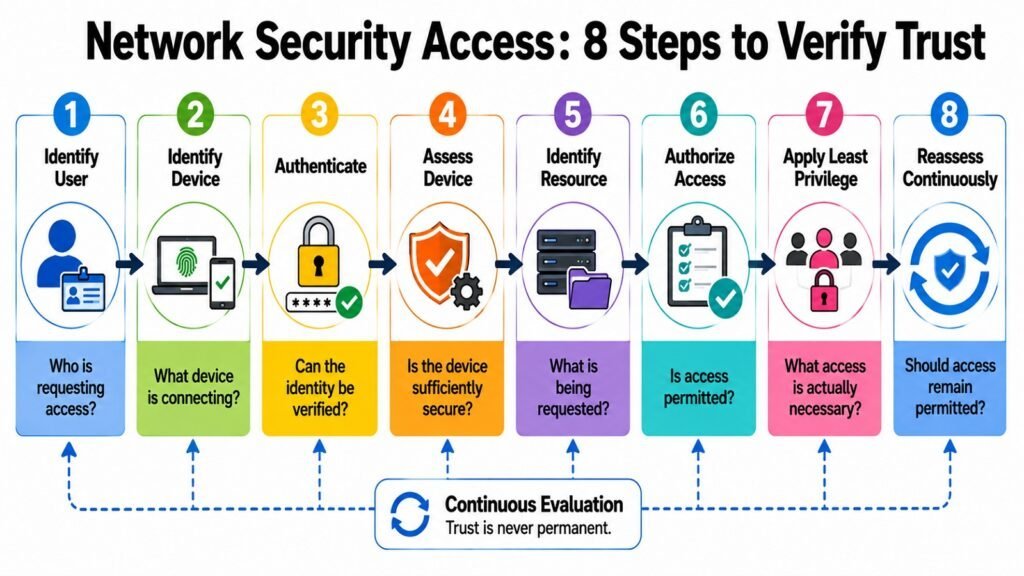
Network connectivity is itself a security decision. Every time a user, device, application, or workload is permitted to reach a resource, a trust judgment has been made — either explicitly through a defined policy or implicitly through the absence of one. Network Security Access is the discipline that makes those judgments deliberate, consistently enforced, and appropriately restrictive. It determines not only who may connect but under what conditions, from which devices, and to which specific resources, ensuring that every granted connection reflects a verified need rather than a default assumption of trust.
Authentication confirms identity. Authorization determines what an authenticated entity may access. But neither function alone is sufficient. Network Access Control systems extend evaluation to device posture — verifying patch levels, encryption status, and required security software before granting connectivity. A legitimate user on an unmanaged or compromised device represents a materially different risk profile from the same user on a managed endpoint.
The Verizon Data Breach Investigations Report consistently identifies credential compromise as a leading cause of confirmed incidents, reinforcing a critical principle: authenticated access should not mean unrestricted access. A stolen credential should open only the specific resources the legitimate account holder was permitted to reach. Zero Trust network access addresses this directly by granting per-session, resource-specific access based on verified identity and device context rather than broad network entry following a single authentication event.
Privileged accounts — those controlling infrastructure, configurations, and sensitive data environments — require additional verification steps, tighter access scope, and more rigorous session monitoring than standard user accounts. Remote access paths, contractor connections, and unmanaged device scenarios each introduce specific risks that must be addressed through deliberate access policy rather than inherited from legacy network defaults that predate current threat realities.
Network Security Access: Principles and Their Security Value
| Access Principle | Network Security Value |
| Least privilege | Limits damage from compromised or misused accounts |
| Multi-factor authentication | Prevents stolen passwords from enabling access alone |
| Network Access Control | Blocks non-compliant or unmanaged devices at connection |
| Zero Trust network access | Grants specific resource access, not broad network entry |
| Privileged access management | Protects high-risk accounts with stronger controls |
| Remote access security | Applies equal access policies to off-premises connections |
| Device identity verification | Confirms device is known and managed, not just credential |
| Session monitoring | Detects anomalous behavior within authenticated sessions |
3. Network Security Segmentation: Limiting Exposure and Lateral Movement
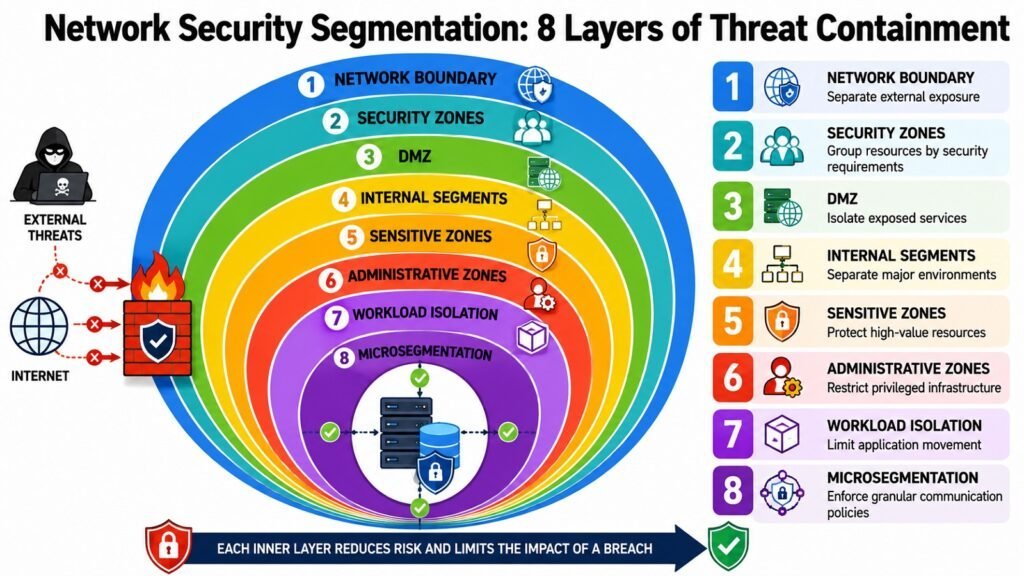
Preventing unauthorized entry is necessary but not sufficient as a Network Security strategy. Attackers who gain a foothold through phishing, credential compromise, exploited vulnerabilities, or supply chain intrusions will almost always attempt to move laterally — from their initial point of access toward higher-value targets such as domain controllers, databases, payment systems, or sensitive administrative environments. Network Security Segmentation limits how far that movement can reach and how much operational damage can result before detection and containment occur.
In a flat, unsegmented network, a compromised device can typically communicate with most internal systems without encountering additional controls. Lateral movement becomes a matter of traversal rather than privilege escalation. VLANs offer one layer of logical separation, but they are insufficient alone because they can be misconfigured and because inter-VLAN traffic is not always subject to meaningful inspection. Microsegmentation, implemented through software-defined networking or host-based policy enforcement, addresses this by restricting east-west communication at the workload level regardless of network topology.
The 2017 NotPetya attack demonstrated what unrestricted lateral movement costs at scale. Malware propagated through internal Windows networking protocols, reaching every reachable system within hours. Organizations with stronger internal segmentation suffered significantly more contained damage because propagation encountered boundaries rather than open pathways. This outcome reflects a core principle consistent with NIST guidance: segmentation is a containment strategy that assumes some threats will breach perimeter defenses and focuses on limiting the consequences of that breach.
Effective segmentation must reflect genuine security distinctions — differences in trust, function, or data sensitivity — rather than arbitrary divisions. Poorly designed boundaries can create false confidence while leaving critical lateral paths between high-value systems unaddressed. The operational overhead of managing segmentation policies increases with granularity, but the goal is meaningful blast-radius reduction: limiting how many systems a single compromise can affect.
Network Security Segmentation: Approaches and Security Value
| Segmentation Approach | Network Security Value |
| VLANs | Creates logical separation with enforcement at boundaries |
| Microsegmentation | Controls east-west traffic at workload level |
| Security zones | Groups systems by trust for inter-zone inspection |
| East-west traffic control | Detects lateral movement bypassing perimeter defenses |
| Blast-radius reduction | Limits systems reachable from a single compromise |
| Critical system isolation | Restricts access to high-value assets with strict policies |
| Administrative network separation | Protects privileged pathways from lateral attackers |
| Third-party and IoT isolation | Prevents partner or device compromise spreading internally |
4. Network Security Controls: Protecting Networks From Threats
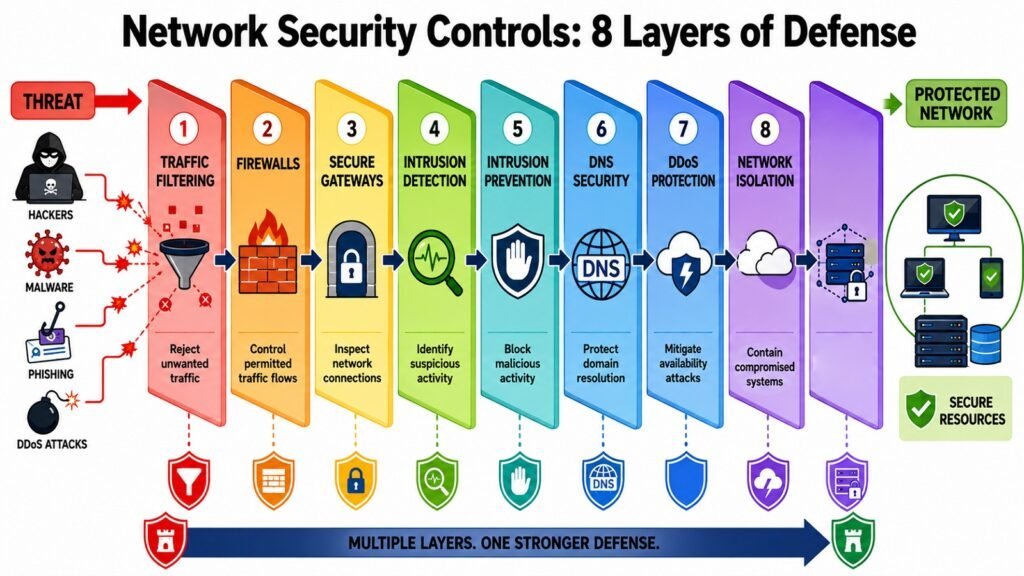
Network Security Controls are the technologies and mechanisms that actively filter, inspect, block, and mitigate malicious network activity. Architecture establishes the environment and segmentation limits lateral movement within it, but controls are the layer that applies active defense against threats as they traverse the network. No single control addresses every threat category, and understanding what each mechanism can realistically accomplish — and where its limitations lie — is essential to building a defense posture that holds up under real adversarial conditions.
Next-generation firewalls enforce application-aware access policies, controlling traffic by application type and user identity rather than only by port and protocol. This additional context makes them more effective against threats that exploit standard ports to carry malicious payloads. Intrusion prevention systems identify and block malicious traffic patterns automatically, reducing the time between detection and containment, though aggressive prevention can occasionally affect legitimate sessions.
DNS security controls address one of the most exploited channels in the modern threat landscape: attackers routinely use DNS to resolve command-and-control infrastructure, exfiltrate data through DNS tunneling, and redirect users to malicious destinations. Filtering DNS resolution disrupts these techniques without requiring deep packet inspection of every session. The 2016 Dyn DNS attack illustrated that availability is a core Network Security concern, not just a performance issue. By overwhelming a DNS provider’s infrastructure with volumetric traffic, attackers disrupted major internet services across the United States — demonstrating why DDoS protection belongs in any comprehensive Network Security control strategy.
Defense in depth is the organizing principle that gives controls their collective effectiveness. Layered and complementary defenses ensure that an attacker who bypasses one mechanism still encounters others. Mature Network Security planning distinguishes between prevention — stopping attacks before impact — and mitigation — reducing damage when prevention proves insufficient — and maintains both capabilities in parallel rather than treating prevention as the only objective.
Network Security Controls: Types and Specific Security Purpose
| Control Type | Specific Security Purpose |
| Next-generation firewalls | Enforces application-aware policies beyond port filtering |
| Intrusion prevention systems | Auto-blocks malicious traffic patterns in real time |
| DNS security filtering | Blocks malicious domain resolution to disrupt C2 traffic |
| Web application firewalls | Stops injection and scripting attacks on web services |
| DDoS protection | Absorbs volumetric attacks to preserve service availability |
| Secure web gateways | Filters outbound traffic and inspects encrypted sessions |
| Network proxies | Intermediates connections for inspection and logging |
| Email security gateways | Blocks phishing, malicious attachments, and spam at entry |
5. Network Security Protocols: Securing Network Communication
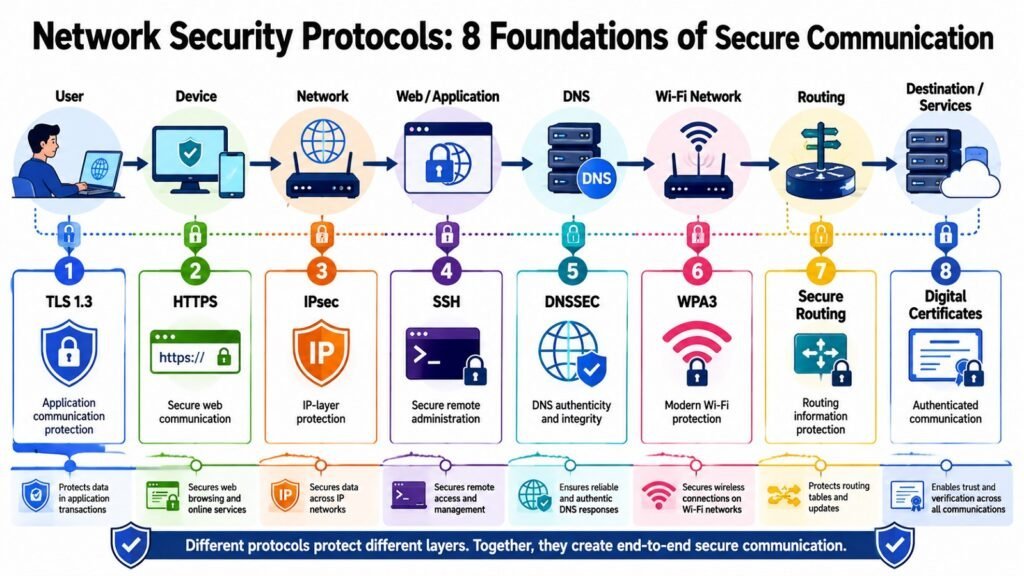
Network traffic travels across infrastructure that no single organization fully controls. Packets cross internet exchange points, third-party transit networks, and cloud provider backbones — environments where they could be intercepted, read, or modified by parties with access to the underlying infrastructure. Network Security Protocols are the standards that protect communication in transit, ensuring data reaches its destination without being read by unauthorized observers, altered by intermediaries, or attributed to impersonated sources.
Transport Layer Security is the foundational standard for protecting application-layer communications across the internet. TLS provides encryption, server authentication through digital certificates, and integrity verification. HTTPS — HTTP carried over TLS — secures the majority of web traffic worldwide. TLS 1.3, standardized by the IETF in 2018, eliminated weaker cipher suites exploitable in earlier versions and streamlined the handshake process, improving both security and connection performance.
IPsec provides security at the network layer and underpins most site-to-site VPN connections, protecting traffic between organizational locations or between on-premises infrastructure and cloud environments. Secure Shell replaced the plaintext Telnet protocol for remote administrative access to servers and network devices; configured with key-based authentication, SSH significantly reduces the risk associated with remote infrastructure management. Protocol selection and configuration require ongoing attention. The POODLE and Logjam vulnerabilities demonstrated how weaknesses in specific protocol versions and cipher suites could be exploited to downgrade encrypted connections and expose sensitive communications even when more secure options were technically available.
An important distinction separates encrypting communications from establishing genuine trust in communicating parties. TLS encrypts the channel between endpoints, but the security of that channel depends on the validity and proper verification of the certificate presented. Certificate authority compromise or improper validation can allow a malicious party to intercept encrypted traffic while appearing fully legitimate. Protocol security is a system — encompassing key management, certificate validation, and timely deprecation of weak standards — not a single feature that can be toggled on and forgotten.
Network Security Protocols: Eight Protocols and Security Functions
| Protocol | Network Security Function |
| TLS 1.3 | Encrypts and authenticates application-layer communications |
| HTTPS | Secures web traffic against eavesdropping and tampering |
| IPsec | Encrypts and authenticates network-layer VPN traffic |
| SSH | Secures remote administrative access via encryption and keys |
| DNSSEC | Signs DNS responses to prevent record injection attacks |
| WPA3 | Protects wireless communications with stronger encryption |
| SRTP | Encrypts real-time voice and video network streams |
| MACsec (IEEE 802.1AE) | Encrypts Layer 2 frames on LAN segments and in data centers |
6. Network Security Monitoring: Creating Network Visibility
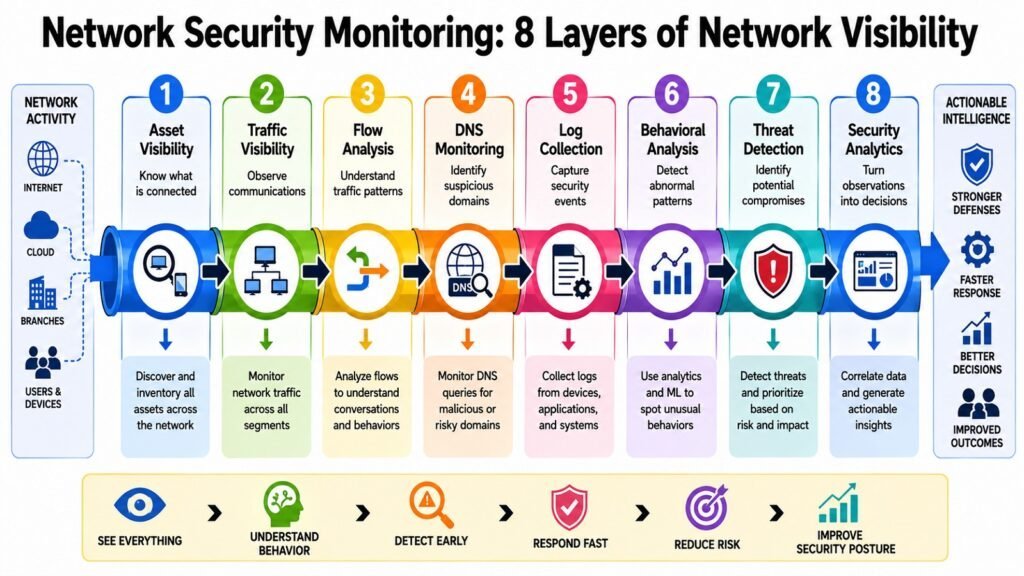
No control set eliminates every threat. Attackers who gain access through compromised credentials, zero-day exploits, or supply chain intrusions may traverse a network for extended periods before conventional controls reveal their presence. Network Security Monitoring is the visibility discipline that makes detection possible in those conditions. IBM’s Cost of a Data Breach research consistently finds that faster detection and containment directly and significantly reduce the financial and operational impact of security incidents, making monitoring one of the highest-return investments in a mature Network Security program.
Network traffic analysis examines communication patterns to identify anomalies indicating malicious activity. Full packet capture provides maximum forensic detail but generates data volumes that are difficult and costly to store at enterprise scale. NetFlow and IPFIX flow data captures session metadata — source, destination, protocol, and volume — without retaining full packet content, enabling anomaly detection at considerably lower storage overhead. DNS monitoring deserves dedicated attention because DNS is used by nearly every network-connected system and is one of the most consistently exploited channels in attacker tradecraft, enabling command-and-control communication, data exfiltration through tunneling, and early-stage malware activity that often appears before other indicators.
The 2020 SolarWinds supply chain attack illustrated the detection challenge that sophisticated threats present. Malicious code embedded in legitimate software updates made attacker traffic appear normal and expected. Signature-based detection missed the compromise because the activity did not match known indicators. Detection required behavioral analysis — identifying anomalies in what authenticated software was communicating with, not whether the software itself appeared valid. SIEM platforms aggregate and correlate events from network devices, security controls, and endpoints to provide centralized visibility across the environment.
Network Detection and Response tools apply behavioral analytics specifically to network traffic to catch threats that evade signatures. Alert fatigue — the operational inability to investigate every generated alert — remains a genuine constraint. Effective monitoring is about producing accurate, actionable, contextually enriched alerts rather than maximizing alert volume.
Network Security Monitoring: Visibility Sources and Specific Insights
| Visibility Source | Network Security Insight Provided |
| Full packet capture | Complete session content for forensic investigation |
| NetFlow / IPFIX flow data | Session metadata for pattern and anomaly detection |
| DNS query monitoring | Early-stage malware activity and C2 connections |
| SIEM log aggregation | Correlated event patterns indicating security incidents |
| Network Detection and Response | Behavioral threat detection beyond known signatures |
| Endpoint network telemetry | Process-level connection data revealing application behavior |
| Threat intelligence feeds | Known indicators enriching detection and investigation |
| Out-of-band monitoring | Traffic observation without affecting production performance |
7. Network Security Response: Containing and Recovering From Attacks
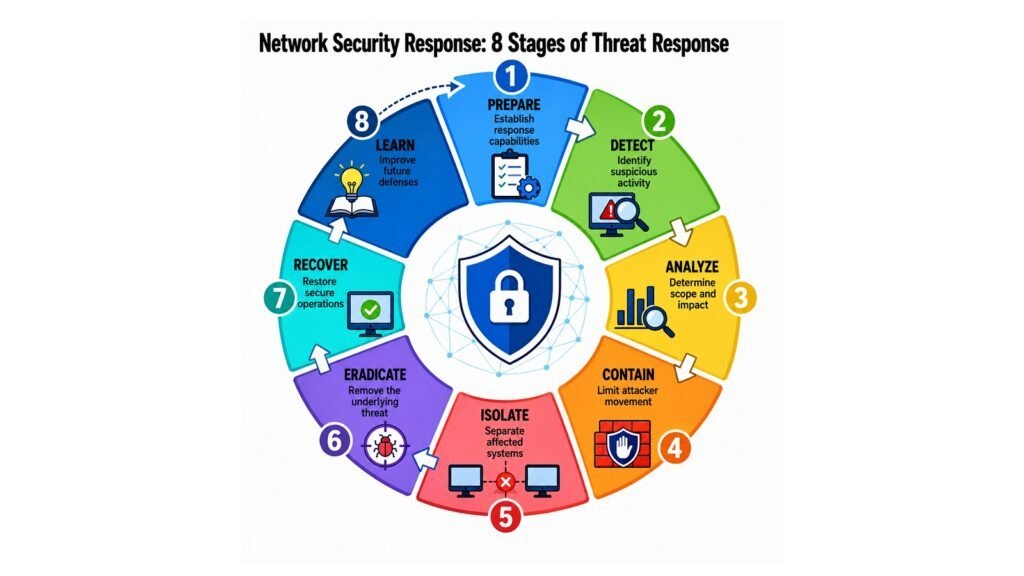
Monitoring creates visibility; response determines what the organization does with it. When suspicious or confirmed malicious activity is identified, speed, precision, and cross-functional coordination of response directly affects whether an incident remains bounded or escalates into a broader operational crisis. Network Security Response is the set of capabilities and decision frameworks that convert detection into containment, investigation into understanding, and disruption into recovery.
Network isolation — removing a compromised host, segment, or connection from the broader environment — is one of the most immediately effective response actions available. Isolation stops malware propagation, severs attacker access to command-and-control infrastructure, and halts ongoing data exfiltration. The decision is not always straightforward. In healthcare systems, operational technology environments, or production infrastructure, isolating a compromised component may interrupt services with significant safety or continuity consequences.
The 2021 Colonial Pipeline ransomware incident illustrated both the value of rapid containment and the significant operational impact that network-level response decisions can carry when applied to critical infrastructure. Traffic blocking and DNS sinkholing — which redirects queries for malicious domains to a controlled server — are faster and often less disruptive alternatives that can neutralize attacker command-and-control communication while simultaneously identifying which internal hosts are affected.
Network forensics, built from preserved packet captures, flow records, DNS logs, and firewall events, provides the investigative foundation for understanding the full scope of a compromise. Remediation must address every affected component, not just the most visible entry point. Automated response playbooks reduce the gap between detection and containment by executing predefined actions — firewall rule changes, host quarantine, credential revocation — in seconds for high-confidence scenarios. More complex incidents require human judgment and coordinated decision-making across security, network, and business continuity teams.
Network Security Response: Actions and Incident Value
| Response Action | Network Security Value During Incidents |
| Network isolation | Halts malware spread and severs attacker C2 access |
| Traffic blocking | Disrupts C2 without requiring full system isolation |
| Host quarantine | Restricts suspect endpoint while investigation proceeds |
| DNS sinkholing | Neutralizes malicious domains and identifies infected hosts |
| Credential revocation | Stops attackers using authenticated access mid-incident |
| Automated response playbooks | Executes containment actions in seconds for known threats |
| Network forensics | Reconstructs incident timeline and traces attacker path |
| Emergency segmentation | Isolates affected areas while rest of network continues |
8. Network Security Resilience: Building Networks That Withstand Disruption
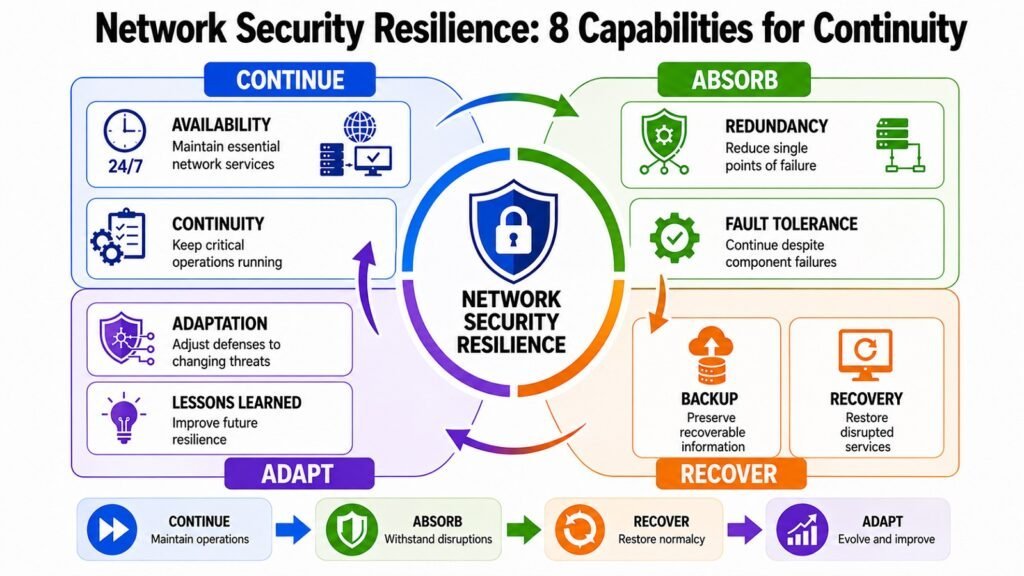
Network Security Resilience addresses the question that every other foundation leaves open: what happens when prevention fails? No architecture is impenetrable, no control set handles every threat, and no monitoring system catches every compromise immediately. Resilience determines whether a successful attack or infrastructure failure produces a temporary, recoverable disruption or an extended operational crisis. It is not a product or a feature but an emergent property of how the network is designed, operated, tested, and improved over time.
Redundancy is the most fundamental resilience mechanism. Network paths, critical infrastructure components, and key security controls should have genuinely independent alternatives that activate when primary systems fail or are disrupted. That independence matters more than many organizations recognize: a backup circuit from the same provider traversing the same physical infrastructure offers limited protection against a provider-level disruption or a physical attack. True resilience requires architectural diversity — separate providers, diverse routing paths, and backup controls that are not vulnerable to the same failure modes as the systems they replace.
The 2016 Dyn DNS attack tested resilience directly. By overwhelming DNS infrastructure with volumetric traffic rather than breaching access controls, attackers disrupted major internet services without crossing a single security perimeter. Defending against this class of threat requires upstream traffic scrubbing, anycast network architecture, and pre-established mitigation provider relationships — capabilities that must be in place before an attack begins, not assembled during one. The 2021 Log4Shell vulnerability illustrated a different resilience challenge: rapidly identifying exposure in third-party software dependencies, isolating affected components, and reconfiguring access when a trusted dependency unexpectedly introduces a critical vulnerability at scale.
Business continuity planning and disaster recovery testing translate resilience principles into operational reality by validating that backup systems, failover configurations, and degraded-mode operations function as expected before an incident makes them necessary. Resilience is ultimately the integrated outcome of all eight Network Security foundations working together and being regularly tested and refined.
Network Security Resilience: Principles and Security Value
| Resilience Principle | Network Security Value |
| Network redundancy | Eliminates single points of failure in connectivity |
| DDoS resilience architecture | Absorbs volumetric attacks without losing availability |
| Business continuity planning | Maintains essential services under degraded conditions |
| Disaster recovery testing | Validates failover and backup systems before crisis |
| Supply chain risk management | Monitors third-party dependencies for introduced risk |
| Adaptive security posture | Enables rapid reconfiguration when new threats emerge |
| Recovery time objective planning | Designs infrastructure to meet defined recovery targets |
| Cyber resilience frameworks | Applies NIST SP 800-160 and ENISA guidance systematically |
Conclusion — Network Security: Building a Stronger Cyber Defense
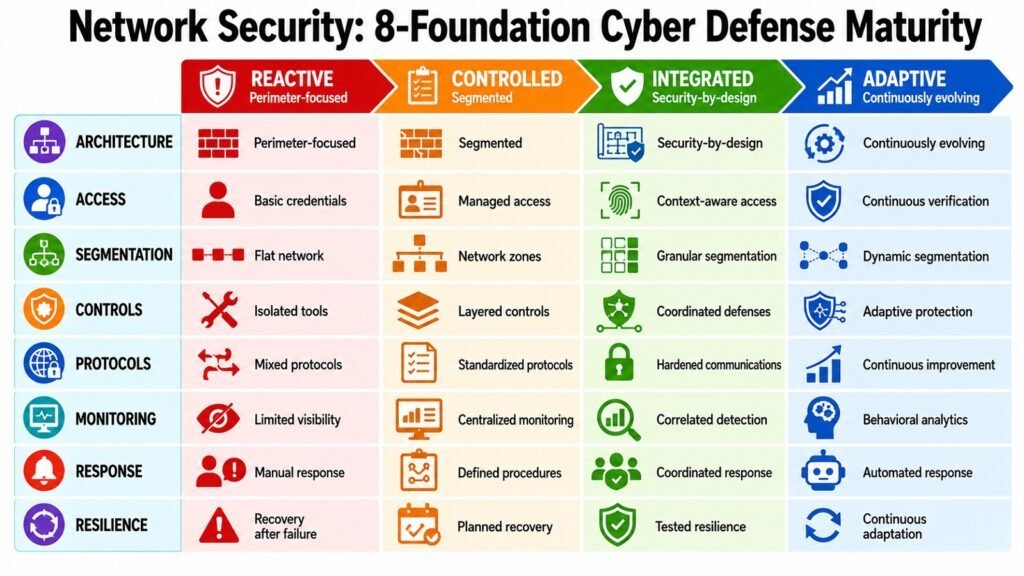
Network Security is an important aspect of overall Cybersecurity, not simply because it protects network infrastructure but because networks are the medium through which users, devices, applications, workloads, services, and data interact. When network security fails, consequences extend beyond connectivity. Data is exposed, services are disrupted, and the trust relationships that digital operations depend on are undermined in ways that take significant time and resources to restore. Treating Network Security as a continuous discipline of design, protection, visibility, response, and resilience — rather than a collection of independently deployed perimeter tools — is what distinguishes a mature security posture from a reactive one.
Eight foundations examined in this article form an integrated system. Architecture establishes the secure environment and determines what every other layer can accomplish. Access enforces verified and appropriately restricted connectivity. Segmentation limits how far threats travel after gaining entry. Controls apply active defense against malicious traffic across multiple layers. Protocols protect communications in transit from interception and manipulation. Monitoring creates the visibility that detection requires. Response converts detection into containment and recovery. Resilience ensures that essential operations continue even when preventive controls are insufficient. Weaknesses in any one foundation affect the performance of the others, and no area should be treated as an isolated investment or a completed project.
The eight-foundation framework provides a practical lens for evaluating maturity, identifying gaps, and prioritizing investment. Rather than asking whether a specific technology is deployed, it poses the more useful question of whether the underlying security function is actually being fulfilled. Cloud computing, Zero Trust adoption, AI-assisted detection, and distributed infrastructure will continue reshaping how each foundation is implemented. The underlying principles will not change. Network Security is a continuous process of designing, protecting, observing, responding, and adapting — and organizations that sustain that discipline are consistently better positioned to protect what matters most.
Network Security: Eight Foundations and Core Security Questions
| Foundations | Core Network Security Question |
| Architecture | Is the network designed to contain threats across all environments? |
| Access | Are only verified, authorized entities connecting to resources? |
| Segmentation | Do internal boundaries limit how far a compromise can travel? |
| Controls | Are complementary defenses filtering threats across all layers? |
| Protocols | Are communications encrypted and authenticated in transit? |
| Monitoring | Is visibility sufficient to detect and investigate threats? |
| Response | Can the organization contain threats and recover effectively? |
| Resilience | Do operations continue and recover when controls fail? |