
Table of Contents
Introduction — Value Proposition: Understanding Its Role in Value Delivery
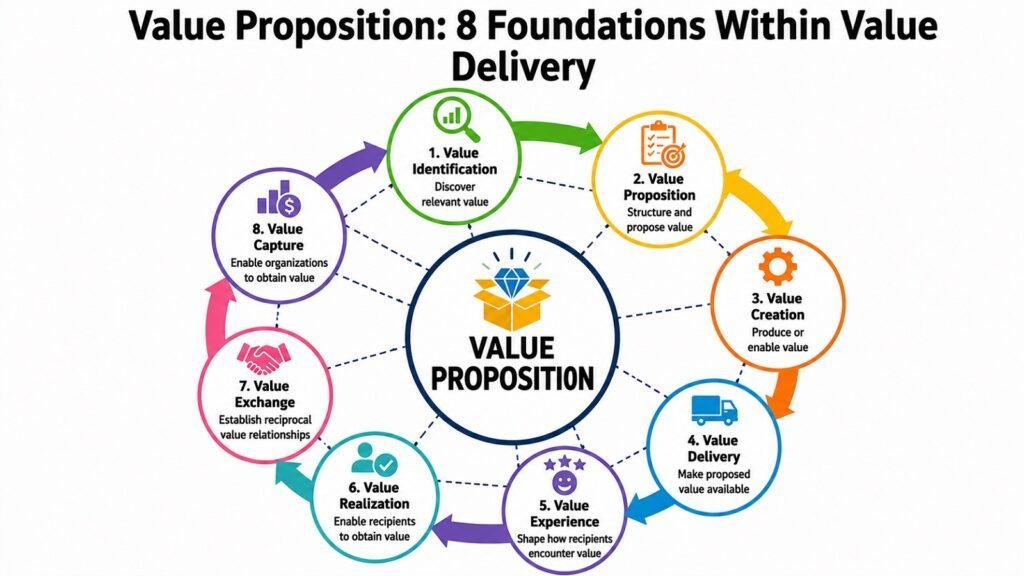
A value proposition is among the most consequential concepts in business strategy, yet it is also among the most routinely misunderstood. Organizations reduce it to a slogan, a sales message, or a feature list. Each reduction misses the point. A value proposition is a structured logic that connects an offering with a recipient, articulates the value being proposed, establishes why that offering is preferable to alternatives, and defines the terms on which value is exchanged and captured.
To understand value propositions clearly, it helps to distinguish them from two related concepts. Value identification focuses on discovering, understanding, prioritizing, and validating what matters to customers and stakeholders. Value delivery focuses on making promised value available through products, services, and experiences. Value proposition sits between these activities. It structures, expresses, differentiates, communicates, substantiates, exchanges, and captures proposed value — distinct analytical work, not interchangeable labels for the same process.
Several research traditions inform this article. Customer-value theory, developed by scholars including Zeithaml, Woodruff, and Holbrook, examines how recipients judge value through perceived benefits relative to perceived costs. Service-dominant logic, advanced by Vargo and Lusch, emphasizes value-in-use and co-creation through interaction. Exchange theory addresses reciprocal value relationships, signaling theory explains how organizations communicate quality credibly, and business-model scholarship addresses how organizations capture value from exchanges they enable.
This article argues that a strong value proposition is a structured system rather than a single statement. Eight foundations explain that system: architecture, value promise, perceived value, differentiation, communication, credibility, exchange, and capture. Together, they describe how proposed value is organized, expressed, interpreted, and connected to organizational sustainability.
Value Proposition: Eight Foundations at a Glance
| Value Proposition Foundations | Central Role or Question |
| Architecture | How do the components of a proposition form a coherent logic? |
| Value Promise | What specific value does the offering propose to provide? |
| Perceived Value | How does the recipient interpret and judge the proposed value? |
| Value Differentiation | Why should a recipient prefer this offering over alternatives? |
| Value Communication | How clearly and effectively is the proposition expressed? |
| Value Credibility | What gives the recipient sufficient reason to believe the promise? |
| Value Exchange | What does the recipient provide in return for the proposed value? |
| Value Capture | How does the organization obtain value from the exchange it creates? |
1. Value Proposition Architecture: Structuring the Logic of Value
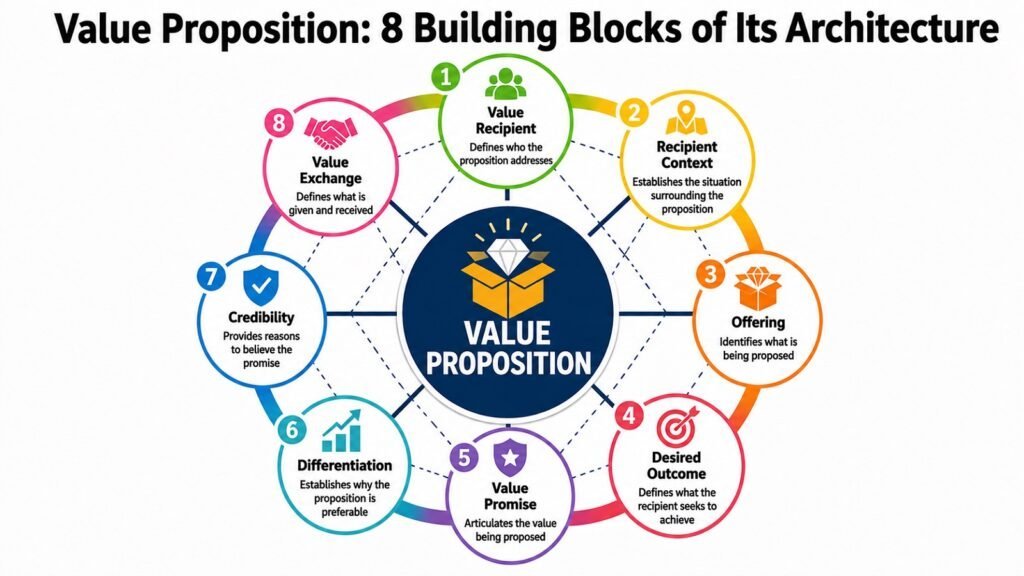
Architecture describes how components are organized and how they relate to one another. A value proposition architecture is the underlying logic that holds a proposition together — not a checklist to complete, but the relational structure that determines whether those elements form a coherent whole or remain a collection of disconnected claims.
Research in strategic marketing consistently shows that value propositions are multidimensional constructs. Payne and Frow, writing in the Journal of Marketing, identified value propositions as spanning customer value, organizational value, and the exchange relationship linking them. Anderson, Narus, and Van Rossum distinguished between all-benefits statements, favorable points of difference, and resonating focus propositions, arguing that only the last type is genuinely customer-centric. The same facts can produce a weak or strong proposition depending entirely on how components are structured and connected.
Consider how Salesforce constructs its core value proposition. Rather than listing software features, it connects a clearly defined recipient — businesses managing complex customer relationships — with a specific outcome: unified customer data that improves decision-making and revenue performance. Differentiation rests on cloud delivery and integration breadth. Credibility draws on certifications and measurable performance data. Exchange terms are subscription-based, and value capture occurs through recurring revenue. Each component reinforces the others; a weakness in any one reduces the coherence of the whole.
This is the diagnostic value of architectural thinking. When a proposition feels vague or unconvincing, the problem is usually structural: the recipient is underspecified, the promise is disconnected from a meaningful outcome, the differentiation does not genuinely matter to that recipient, or credibility mechanisms are absent. Understanding architecture allows practitioners to locate the weakness at the structural level rather than rewriting a tagline. Value proposition architecture is also distinct from value proposition design methodology, which concerns the research and iteration process used to build a proposition. Architecture addresses the logical structure of what exists — whether the components are properly connected and whether they form a coherent case for value.
Value Proposition Architecture: Key Components
| Component | Role in a Coherent Value Proposition |
| Recipient definition | Specifies who the proposition is intended for and their relevant context |
| Offering description | Identifies what is being proposed in terms the recipient recognizes |
| Desired outcome | Connects the offering to a result the recipient values |
| Value promise | States what specific value the offering proposes to deliver |
| Differentiation logic | Establishes why this proposition is preferable to alternatives |
| Communication frame | Aligns expression of value with the recipient’s language and perspective |
| Credibility basis | Provides the recipient with reasons to believe the proposition |
| Exchange and capture | Defines the reciprocal value relationship and organizational sustainability |
2. Value Promise: Defining the Value Proposition
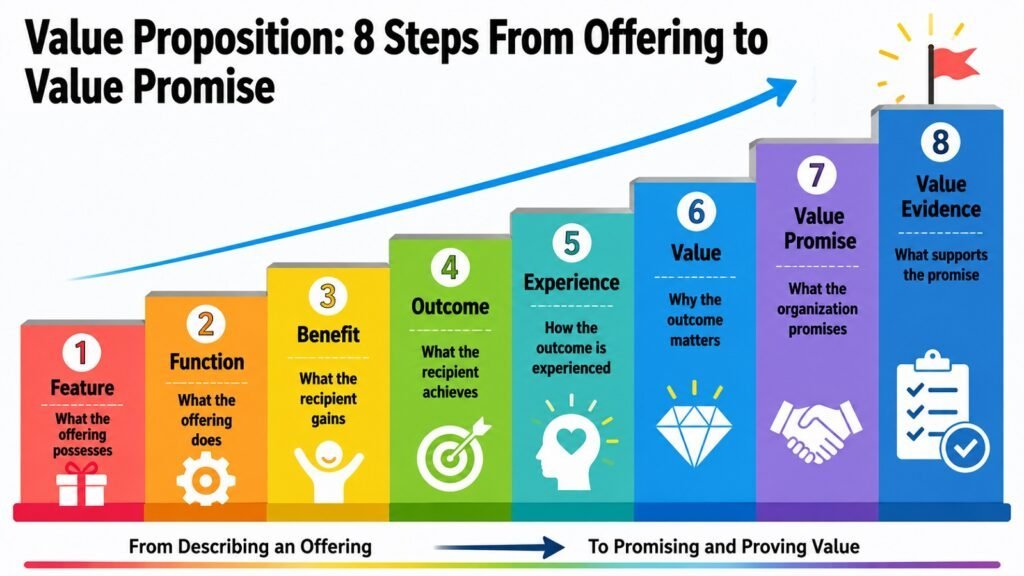
At the heart of every value proposition is a commitment — a statement, implicit or explicit, about what the offering can do for its recipient. This commitment is the value promise. It is not a feature description, a benefit list, or a specification. It is the link between what an offering provides and a meaningful outcome or form of value that the recipient cares about.
The distinction between a feature, a benefit, and a value promise is important and frequently overlooked. A feature is a characteristic of the offering. A benefit is a positive consequence of that feature. A value promise is the meaningful result the recipient can expect to achieve. A cloud storage service offering five gigabytes of space describes a feature. Explaining that the space allows access from any device states a benefit. Promising that work is always available and securely shareable without technical effort is a value promise, because it connects the offering to what the recipient ultimately wants to experience.
Customer-value research by Woodruff and Gardial established that customers organize their judgments hierarchically: from attributes through consequences to desired states. Promises that reach the level of desired states are consistently more compelling than those that stop at product attributes. This aligns with the jobs-to-be-done framework developed by Christensen and colleagues, which argues that customers engage offerings to accomplish specific tasks and that effective propositions address the underlying job rather than the product’s features.
Vague promises to be “better” or “innovative” are weak because they do not connect to any particular recipient outcome. Amazon’s proposition around speed, selection, and convenience is effective because each element connects to a tangible outcome: reduced search time, reliable delivery, and lower friction. Apple’s iPhone promise combined ease of use with ecosystem integration, addressing functional and experiential outcomes for a clearly defined user. Specificity and outcome-connection are what distinguish a compelling promise from a generic claim, and they are what make a value proposition actionable rather than merely aspirational.
Value Promise: Characteristics of Effective Propositions
| Characteristic | Why It Strengthens Value Promise |
| Outcome-focused | Connects the offering to results the recipient actually wants |
| Specific | Reduces ambiguity and allows the recipient to evaluate the claim |
| Recipient-relevant | Addresses a meaningful need, goal, or circumstance of the intended audience |
| Achievable | Is supported by the genuine capabilities of the offering |
| Understandable | Uses language familiar to the recipient rather than internal terminology |
| Differentiated | Proposes value not equally available from obvious alternatives |
| Proportionate | Matches the scale and significance of the recipient’s real need |
| Verifiable | Can be substantiated through evidence, demonstration, or experience |
3. Perceived Value: How Recipients Interpret the Value Proposition
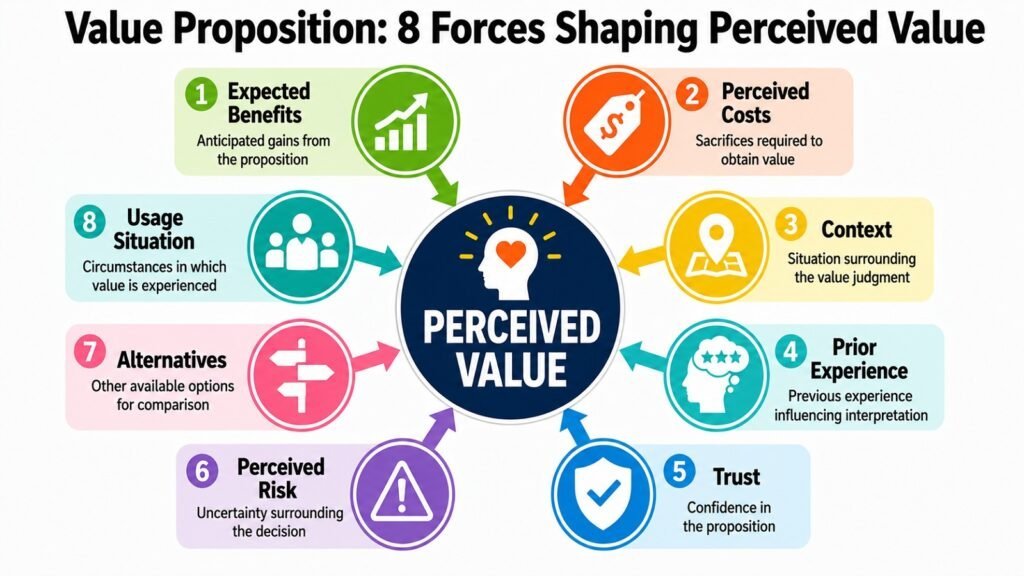
A value proposition is a claim that must pass through the recipient’s interpretive lens. Perceived value is the judgment a recipient forms about the worth of an offering, and it does not necessarily correspond to the value the organization believes it is proposing. This gap between proposed value and perceived value is one of the most practically important concepts in value proposition analysis.
Zeithaml’s foundational research defined perceived value as the consumer’s overall assessment of a product’s utility based on perceptions of what is received and what is given up. Benefits received can be functional, emotional, social, or epistemic. Costs extend well beyond monetary price to include time, effort, psychological discomfort, risk, and opportunity costs. A proposition that appears strong by an organization’s internal standards may produce a weak perception because it underestimates the total cost the recipient must bear.
Context shapes perception in ways organizations consistently underestimate. A hospital patient evaluating a treatment plan brings different expectations and emotional state than a business executive evaluating software. A consumer in a market with well-established alternatives applies more comparative scrutiny than one in an underserved context. Prior experience creates reference points that facilitate or hinder reception of a new proposition. Trust in the provider shapes willingness to accept promised value before it has been directly experienced.
Google Search illustrates strong perceived value: speed, relevance, and simplicity are confirmed with every interaction. Many enterprise software systems face the opposite situation — genuine functional value paired with weak perceived value, because implementation is demanding and promised outcomes materialize slowly. Costs are immediate and visible while benefits are deferred. The practical implication is that organizations must manage perceived costs alongside articulated benefits — by reducing complexity, accelerating early value delivery, and building trust through credibility — if propositions are to be received as genuinely valuable.
Perceived Value: Factors That Shape Recipient Interpretation
| Factor | Relevance to Perceived Value |
| Perceived benefits | What the recipient believes they will receive, functional or otherwise |
| Perceived costs | All sacrifices the recipient associates with obtaining the offering |
| Prior experience | Previous interactions that create reference points and expectations |
| Contextual circumstances | Situational factors such as urgency, available resources, and environment |
| Alternatives available | Comparative judgments made against other known options |
| Uncertainty and risk | The degree of doubt the recipient holds about the promised outcome |
| Trust in the provider | Confidence in the organization’s willingness and ability to deliver |
| Framing and positioning | How the proposition is expressed relative to the recipient’s reference points |
4. Value Differentiation: Making the Value Proposition Preferable
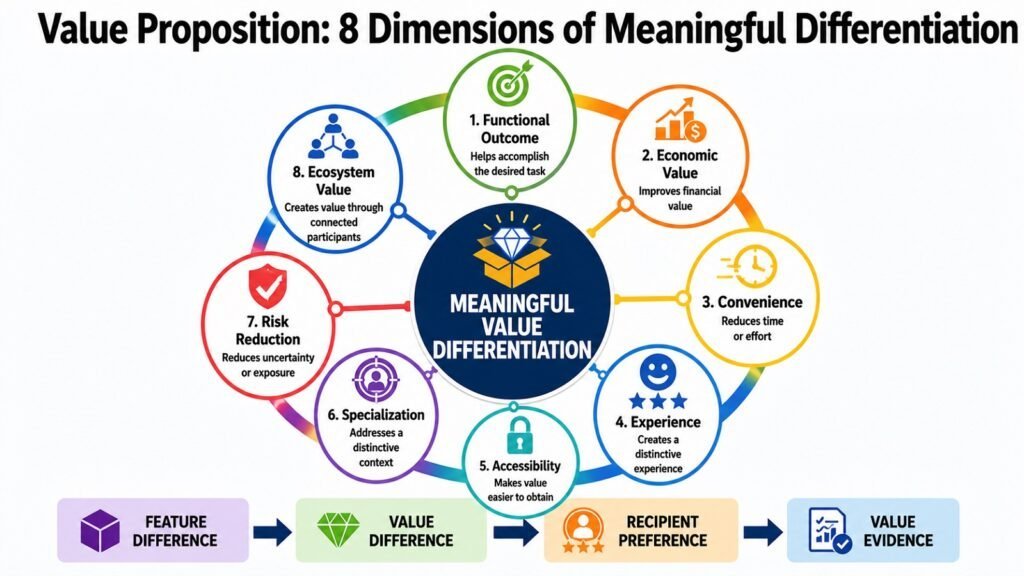
A value proposition does not exist in isolation. Recipients typically have choices — direct competitors, substitutes, workarounds, or simply the option to do nothing. Value differentiation is the component of a proposition that addresses this comparative reality by establishing why the proposed value is preferable to the alternatives a recipient can realistically access.
Porter’s framework established that sustainable positioning requires either delivering greater value at comparable cost or comparable value at lower cost. Value differentiation in a proposition operates on a related principle but focuses on the recipient’s experience of preference. The distinction between genuine and superficial differentiation matters considerably. A longer feature list does not constitute meaningful differentiation unless the additional features produce a meaningfully better outcome. The relevant test is whether the proposed difference actually changes the recipient’s preference — not whether it looks impressive from the organization’s own perspective.
Netflix illustrates outcome and convenience differentiation clearly. Its initial proposition against video rental chains was not simply wider selection. It removed late fees, physical travel, and limited stock, eliminating multiple friction points simultaneously. The recipient outcome — entertainment viewing — was the same, but the total cost structure was dramatically lower. The differentiation rested not on any single feature but on a reconfigured experience that addressed the most frustrating aspects of the existing alternative. Organizations that focus only on functional features frequently miss differentiation opportunities grounded in experience, access, or total cost of obtaining value.
Differentiation can be grounded in outcome superiority, greater convenience, economic advantage, experience quality, specialization, accessibility, risk reduction, or ecosystem compatibility. Equally important is recognizing the role of substitutes. A direct competitor may not exist, but recipients almost always have an alternative — including inaction — against which any proposition is implicitly evaluated. A compelling value proposition makes a clear case for preference that holds up under that comparison.
Value Differentiation: Eight Bases for Preference
| Basis of Differentiation | Value-Based Reason It Strengthens a Proposition |
| Outcome superiority | Recipient achieves meaningfully better results than with alternatives |
| Convenience and ease | Reduced effort, friction, or complexity relative to alternatives |
| Economic advantage | Superior value-to-cost ratio or total cost of ownership |
| Experience quality | Distinctive interaction quality — reliability, speed, or emotional resonance |
| Specialization | Precise fit for a recipient’s specific needs that general alternatives cannot match |
| Accessibility | Brings value to recipients previously unable to obtain it |
| Risk reduction | Reduces the likelihood or severity of negative outcomes for the recipient |
| Ecosystem or integration | Creates greater value through compatibility with the recipient’s existing systems |
5. Value Communication: Making the Value Proposition Clear
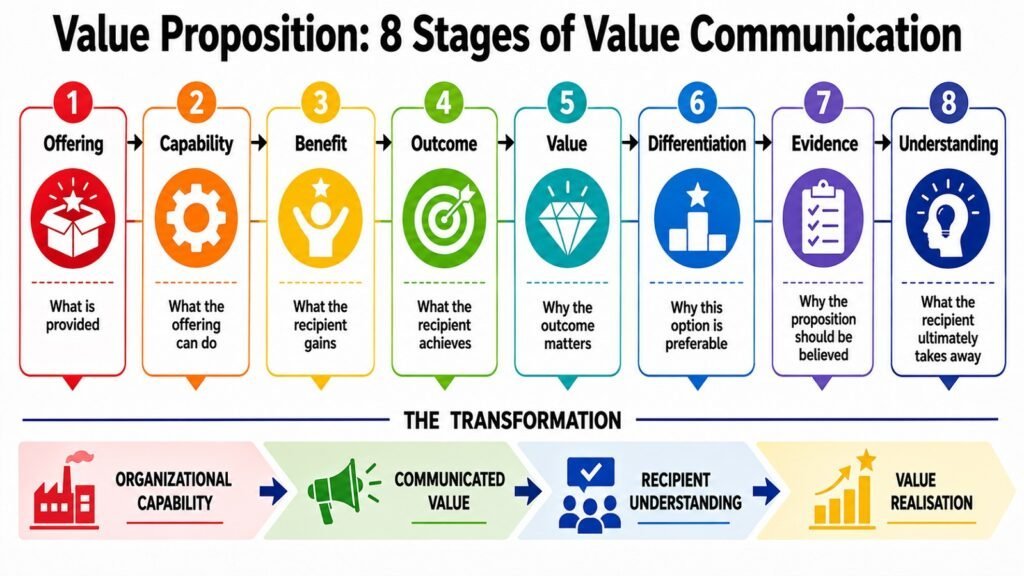
A well-structured value proposition grounded in a genuine and differentiated promise can still fail if it is not communicated effectively. Value communication is the process through which a proposition is expressed, framed, and conveyed so that the intended recipient can understand and evaluate it. It is distinct from the value promise itself: the promise concerns what value is proposed; communication concerns how effectively that proposition reaches and resonates with its intended audience.
Ries and Trout’s foundational work on positioning established that simple, consistent, and recipient-relevant messages consistently outperform technically detailed but cognitively demanding ones. More recent research on processing fluency confirms that propositions perceived as easier to understand are also judged as more credible and more valuable, independent of their actual content. Clarity is not secondary to substance — it is part of what makes a proposition persuasive.
A common communication failure is feature-centrism: expressing value through what the offering has or does rather than what the recipient gains. Technical specifications and internal terminology are meaningful to those who design an offering but opaque to those evaluating it. IBM’s well-known repositioning from hardware and software to business solutions was partly a communication shift — the same products reframed around business outcomes rather than technical capabilities. The underlying offering changed little; the communication architecture did, and the proposition became more compelling as a result.
Consistency across touchpoints matters equally. A proposition expressed differently in sales, on a website, in a product interface, and in customer support creates cognitive friction and weakens confidence. Consistency does not require identical wording; it requires that the central logic — recipient, outcome, differentiation — remains coherent wherever the recipient encounters the organization. Storytelling reinforces this by anchoring the proposition in evidence and consequence. A case study showing how a specific organization achieved a specific outcome communicates more memorably than an abstract performance claim.
Value Communication: Eight Principles for Clarity
| Principle | Role in Making a Value Proposition Understandable |
| Recipient language | Uses terminology and framing familiar to the intended audience |
| Outcome focus | Expresses value in terms of what the recipient gains, not what the offering does |
| Clarity and simplicity | Eliminates jargon, complexity, and unnecessary qualification |
| Consistency | Maintains coherent messaging across all recipient touchpoints |
| Relevance | Addresses the specific concerns, needs, and context of the recipient |
| Conciseness | Communicates the essential proposition without diluting it with excess detail |
| Storytelling | Uses concrete examples or narratives to make the proposition tangible |
| Framing | Positions the proposition relative to the recipient’s existing reference points |
6. Value Credibility: Making the Value Proposition Believable
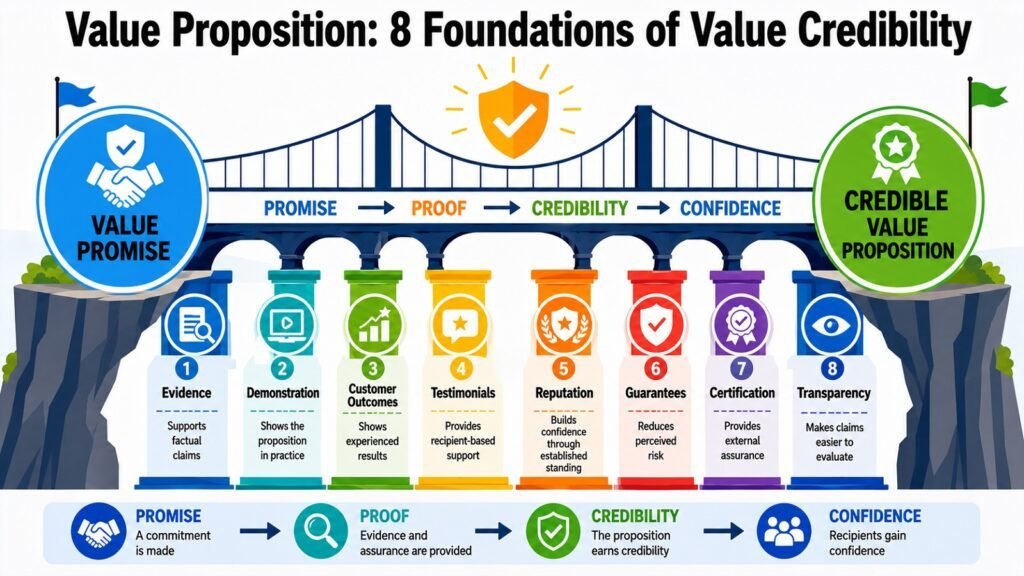
An attractive value promise is necessary but not sufficient for a compelling proposition. Recipients must also have sufficient reason to believe the promise. Value credibility is the foundation that converts a claim into something recipients are willing to act upon. Without it, even precisely articulated and clearly communicated propositions produce hesitation rather than engagement.
Akerlof’s analysis of information asymmetry showed that without credibility mechanisms, buyers cannot reliably distinguish genuine value from false claims, and markets can fail entirely as a result. Signaling theory, developed by Spence, explains how organizations communicate quality through signals that would be too costly or difficult for inferior providers to replicate. In most value proposition contexts, recipients cannot evaluate promised value before committing to an exchange. Credibility mechanisms close that information gap and allow the proposition to function as intended.
The appropriate mechanism depends on the proposition type and the uncertainty involved. Demonstrations and free trials address functional performance uncertainty by letting recipients experience value before fully committing. Quantified case studies address outcome skepticism with measurable evidence. Third-party testimonials are effective when recipients trust peer perspectives more than the provider — common in professional and B2B settings. Certifications and independent audits address compliance or quality claims where formal verification carries weight. Guarantees and warranties transfer risk from recipient to provider, reducing the barrier to engagement.
The concept of Promise-Proof Alignment — introduced here as an analytical framework — captures a diagnostic question practitioners should ask: does the evidence supporting a proposition match the nature of the claim? Economic superiority claims need economic evidence; experiential claims need experiential evidence. Microsoft Azure’s enterprise proposition illustrates layered credibility effectively, combining compliance certifications, independent security audits, uptime guarantees, and a diverse reference customer portfolio. No single mechanism carries the full burden; each addresses a different dimension of uncertainty that enterprise decision-makers face.
Value Credibility: Mechanisms for Believable Propositions
| Credibility Mechanism | Type of Claim or Uncertainty It Addresses |
| Free trials and demonstrations | Functional performance uncertainty — lets recipients experience value directly |
| Quantified case studies | Outcome skepticism — provides measurable evidence of results achieved |
| Third-party testimonials | Provider bias — offers perspective from recipients the audience trusts |
| Certifications and accreditations | Compliance and standard-conformance claims |
| Guarantees and warranties | Risk transfer — reduces the recipient’s cost of engaging with an unproven promise |
| Reputation and track record | Long-term reliability claims supported by organizational history |
| Independent audits | Security, financial, or quality claims requiring impartial verification |
| Transparent data and methodology | Performance claims where recipients want to understand the basis of the evidence |
7. Value Exchange: Understanding What the Value Proposition Offers and Requires
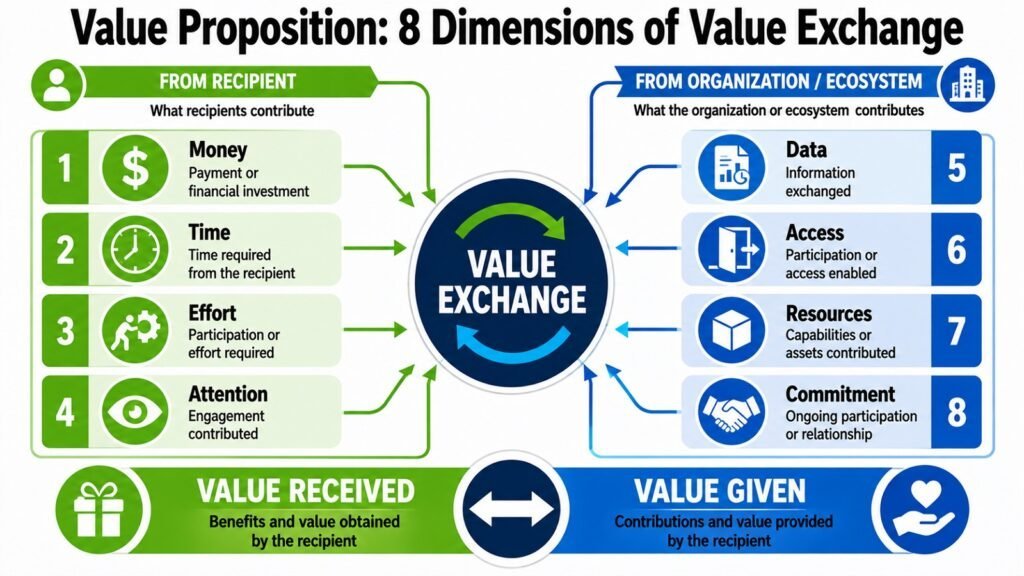
A value proposition does not describe a gift. It describes a proposed exchange in which a recipient receives or expects value and, in return, provides something: money, time, data, attention, commitment, or other resources. Understanding this exchange relationship is essential to evaluating whether a proposition is genuinely compelling or only superficially attractive.
Exchange theory, developed by Bagozzi and others, establishes that value is transacted through reciprocal relationships rather than transferred unilaterally. Service-dominant logic, advanced by Vargo and Lusch, reinforces this by framing value as always co-created through the integration of resources by multiple parties. These frameworks reposition the recipient from a passive receiver to an active contributor. A proposition must be evaluated not only by what it offers but by what it requires the recipient to provide.
Non-monetary exchange components are frequently underestimated. Time is significant: a free service requiring twenty hours of setup has already extracted substantial value before delivering any in return. Attention is a resource recipients budget consciously or not, and propositions demanding sustained attention without quickly delivering perceived value often fail to achieve adoption. Data has become a major exchange currency in digital contexts. Commitment — to a platform, subscription, or contract — reduces future flexibility and is a non-trivial element in any complete assessment of a value proposition.
Google’s core services illustrate an exchange model where monetary payment is absent. Recipients provide attention, enabling advertising revenue, and data, improving targeting and product quality, in exchange for search and communication services. The exchange is perceived as favorable because received value is immediate and high-utility. Switching costs add another dimension: technical lock-in, migration complexity, and retraining requirements can sustain a relationship even when the underlying proposition weakens. A genuinely strong proposition earns retention through ongoing value rather than exit barriers.
Value Exchange: Components in a Value Proposition
| Exchange Component | What It Represents in a Value Proposition |
| Monetary price | The financial amount a recipient pays for access to the proposed value |
| Time investment | Hours spent on adoption, learning, configuration, or ongoing use |
| Effort and attention | Cognitive and physical resources required to obtain and use the offering |
| Data and information | Personal, behavioral, or organizational data provided in exchange for access |
| Commitment and lock-in | Reduced future flexibility from platform, contract, or integration dependencies |
| Risk bearing | Uncertainty or potential negative outcomes the recipient accepts by engaging |
| Switching costs | Resources required to exit the relationship and move to an alternative |
| Participation and co-creation | Active contributions the recipient makes to produce the eventual value |
8. Value Capture: Turning the Value Proposition Into Business Value
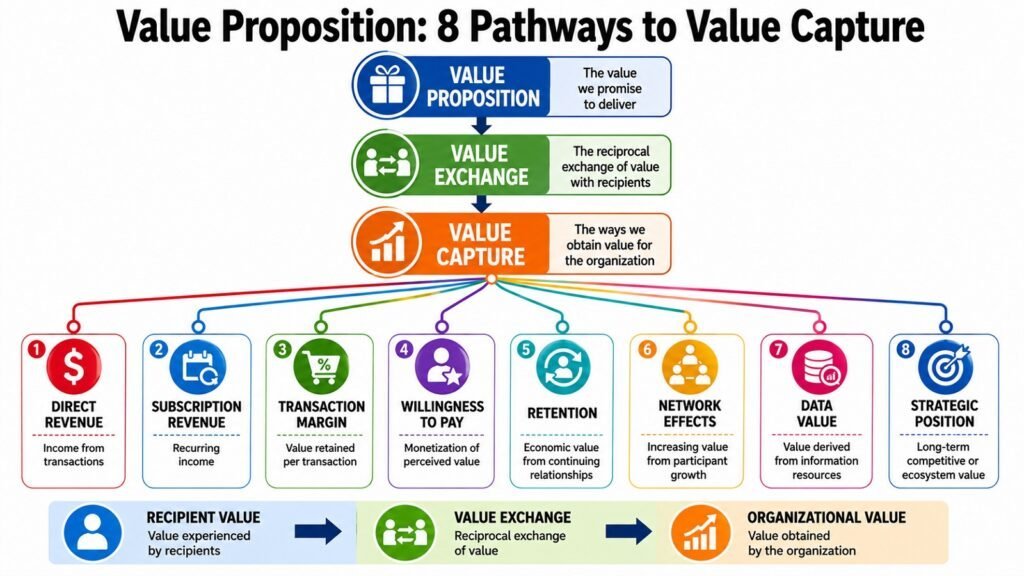
Creating value for recipients is necessary but not sufficient for organizational sustainability. An organization must also capture sufficient value from the exchanges it enables — value that flows back in economic, strategic, or relational form. Value capture is the organizational side of the proposition equation, connecting proposed value with long-term viability.
Teece’s analysis of appropriability established that innovators do not automatically benefit from the value they create; capturing it requires specific mechanisms and conditions. Brandenburger and Stuart extended this by showing that capture depends on bargaining power as well as value creation. A proposition that generates substantial recipient value but fails to translate it into sustainable organizational returns is structurally incomplete, regardless of how well its other components are constructed.
Revenue models are the most visible capture mechanisms. Subscription pricing converts ongoing access to proposed value into predictable organizational revenue, aligning income with continued recipient engagement. Transactional pricing captures value at the moment of exchange. Premium pricing appropriates a portion of the surplus value a recipient perceives relative to alternatives. Usage-based pricing scales capture with the intensity of recipient engagement. Beyond revenue, market position represents the ability to sustain a favorable competitive stance over time. Network effects create compounding organizational value as each additional participant increases the offering’s worth for existing participants. Data accumulation enables ongoing improvement and new proposition development. Ecosystem participation allows an organization to generate returns through its position within a broader value network.
Apple’s App Store illustrates multi-mechanism capture. The proposition offers developers access to a large, high-spending audience and a distribution infrastructure. Apple captures value through a transaction percentage, sustains its position through platform exclusivity, and compounds advantage through network effects. The proposition to developers is substantial, and so is the organizational capture mechanism — illustrating that a sustainable value proposition creates a genuinely reciprocal exchange in which both parties obtain meaningful value.
Value Capture: Mechanisms and Their Relevance
| Capture Mechanism | Relevance to Organizational Value |
| Subscription pricing | Converts recurring access value into predictable organizational revenue |
| Premium pricing | Captures a share of the surplus value the recipient perceives over alternatives |
| Usage-based revenue | Aligns capture with the intensity of recipient engagement and value realization |
| Market position | Sustains competitive advantage that protects future value creation and capture |
| Network effects | Creates compounding value as each additional participant strengthens the offering |
| Data accumulation | Enables ongoing improvement, cost reduction, or new proposition development |
| Retention and loyalty | Extends the period over which organizational value is captured from each relationship |
| Ecosystem participation | Generates organizational value through position within a broader value network |
Conclusion — Value Proposition: Connecting Promised Value With Sustainable Value
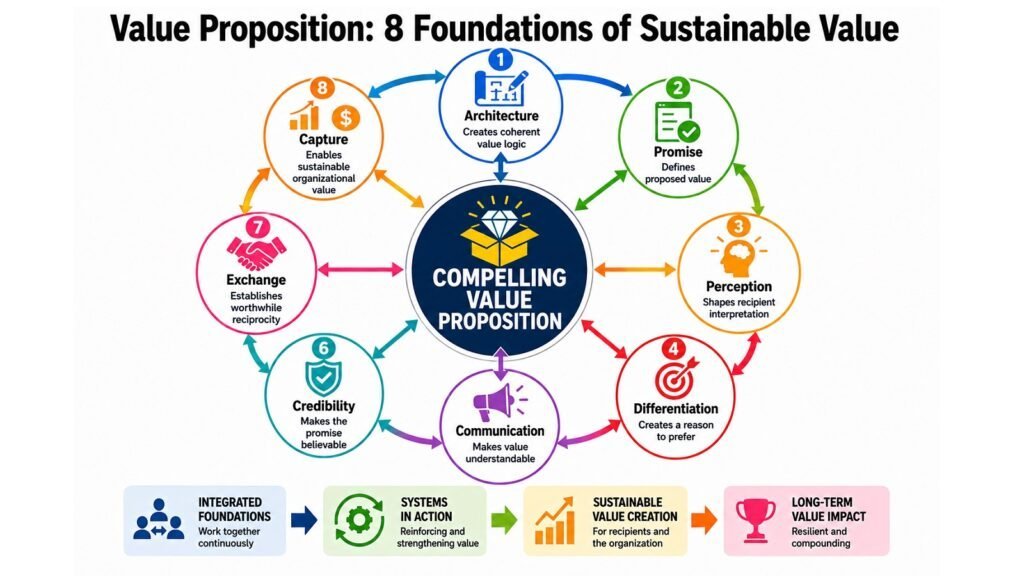
The eight foundations examined in this article form a single structured logic, not independent dimensions to optimize separately. Their strength depends on how they reinforce one another. A well-articulated promise without credibility produces skepticism. Credibility without differentiation provides no reason for preference. Differentiation without effective communication remains invisible. Communication without an equitable exchange relationship may attract attention but not commitment. Exchange without organizational value capture is not sustainable. This interdependence is why a value proposition should be understood as a system, not as a statement.
The distinctions between value identification, value proposition, and value delivery remain important to preserve. Value identification establishes what recipients consider meaningful. Value proposition structures and expresses what an organization proposes to provide — why, and on what terms. Value delivery makes that promise real through the actual experience of the offering. Conflating these functions produces poorly built propositions that either describe value without connecting it to recipient needs, or describe operational capabilities without explaining why they matter.
The theoretical traditions drawn on here — customer-value theory, perceived-value research, service-dominant logic, signaling theory, exchange theory, competitive positioning, and business-model scholarship — each illuminate a different aspect of the value proposition challenge. The questions they raise are practical: Who is the recipient? What outcome are they seeking? Why is this offering preferable? What must they give up? What reason do they have to believe the promise? How does the organization benefit sustainably? Organizations that answer these questions honestly build propositions that hold together under scrutiny and remain meaningful as market conditions evolve.
The principle worth retaining is straightforward: a value proposition earns its effectiveness not from the language used to express it but from the integrity of the system it represents.
Value Proposition: Eight Foundations and Their Essential Lessons
| Value Proposition Foundations | Essential Lesson for Practitioners |
| Architecture | A proposition is only as coherent as the connections between its components |
| Value Promise | Specificity and outcome-connection separate compelling promises from vague claims |
| Perceived Value | Proposed value and perceived value differ — understanding that gap is essential |
| Value Differentiation | Differentiation is only meaningful when it changes the recipient’s actual preference |
| Value Communication | Clarity and recipient-relevance determine whether a proposition is understood |
| Value Credibility | Evidence must match the nature of the claim to close the recipient’s doubt |
| Value Exchange | Recipients evaluate all costs, not just price — the full exchange must be fair |
| Value Capture | A proposition that creates value without capturing it is not organizationally sustainable |